- The paper demonstrates that independently learned fMRI embeddings converge to an approximately isometric latent space, enabling unsupervised cross-subject translation.
- The methodology employs a subject-specific encoding pipeline with pairwise orthogonal transformations and global synchronization to align neural representations.
- These findings validate the Strong Platonic Representation Hypothesis and have significant implications for cross-subject modeling and transfer learning in neuroscience.
Unsupervised Recovery of Universal Neural Geometry: Platonic Representations in the Human Brain
Theoretical Framework: Strong Platonic Representation Hypothesis
This paper extends the Strong Platonic Representation Hypothesis from its origins in artificial neural networks to biological neural systems. The hypothesis posits that independently trained models—or, analogously, independently sampled brains—converge toward a geometrically similar latent space through their intrinsic representational structure. The claim is that representations are not only similar but approximately isometric, such that embeddings can be translated across instances via orthogonal transformations without paired data or external anchors.
Crucially, the study targets human visual cortex, using high-quality, repeated fMRI responses from the Natural Scenes Dataset (NSD), and asks whether universal geometry can be recovered directly from brain activity with no shared stimuli for training. The result is a constructive approach to cross-subject neural translation that does not require paired measurements, model-derived features, or anatomical reference spaces.
Methodology: Self-Supervised Neural Embedding and Translation
The methodological pipeline consists of three stages:
- Subject-Specific Encoder: Each subject's repeated fMRI presentations are used to learn an embedding space, leveraging voxel reliability weighting, PCA, multi-view CCA, and a nonlinear residual MLP refinement to optimize invariant representations across repetitions.
- Pairwise Brain-to-Brain Translation: Unsupervised orthogonal transforms are estimated between subjects, mapping independently learned spaces into one another using pseudo-correspondence matching based on K-means centroids and iterative refinement. Transformations are restricted to the orthogonal group O(d), enforcing isometry.
- Global Synchronization: Pairwise maps are synchronized via spectral orthogonal synchronization, recovering one rotation per subject and yielding a shared latent space where all embeddings are placed into a common coordinate system.
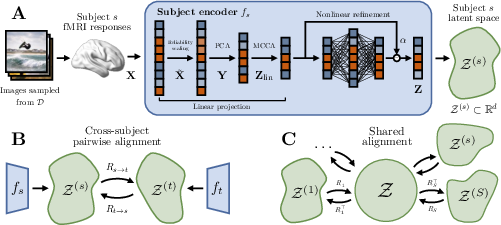
Figure 1: Method overview—subject-specific encoding, pairwise unsupervised translation via orthogonal rotations, and synchronization to a universal latent space.
Empirical Results: Strong Isometric Convergence Across Brains
Encoder Stability
Within-subject retrieval using self-supervised encoders achieves a mean rank of 5.28 (chance = 258) and R@1 of 0.82, demonstrating highly stable representations across repetitions. Ablation experiments show substantial gains over direct neural and model-guided baselines, confirming the efficacy of repetition-driven self-supervision.
Pairwise brain-to-brain translation achieves mean rank 2.56, R@1 0.78, and RSA 0.63 across subject pairs in the held-out shared image evaluation. Notably, these results are obtained without any paired cross-subject training data or model-derived anchor spaces. Model-guided and optimal transport baselines yield lower recall, and no-translation controls perform poorly, emphasizing the necessity and sufficiency of orthogonal translation.
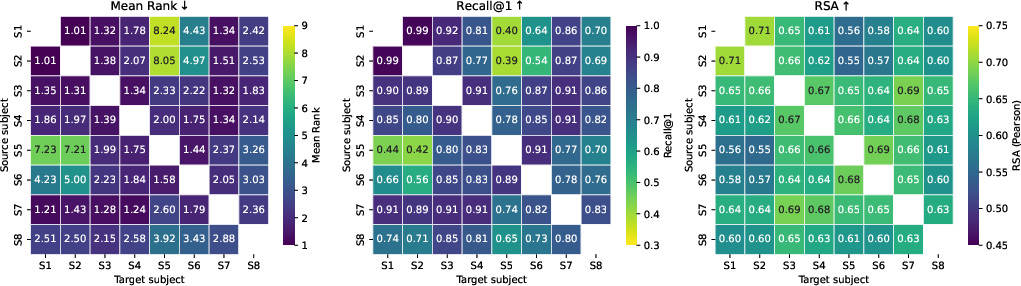
Figure 2: Pairwise alignment results—low mean rank and high recall after unsupervised orthogonal translation among ordered subject pairs.
Shared Latent Space and Synchronization
Global synchronization further denoises and enhances performance, improving mean rank to 2.00 and R@1 to 0.83. The synchronized space allows all subjects—each mapped through a single orthogonal transform—to retrieve corresponding images across the cohort, substantiating the claim of an approximately isometric latent structure in neural representation.
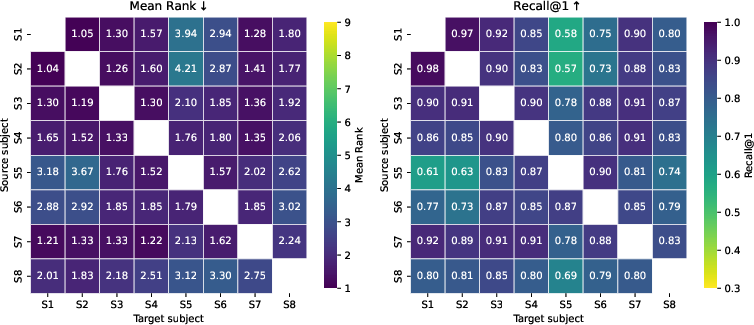
Figure 3: Retrieval performance after synchronization—shared latent space supports coherent cross-subject retrieval, outperforming pairwise methods.
Control for Acquisition Artifacts
Residualization of acquisition confounds is shown to mitigate blocklike session/run structure in trial-by-trial correlation matrices, further refining the intrinsic neural geometry for downstream translation.
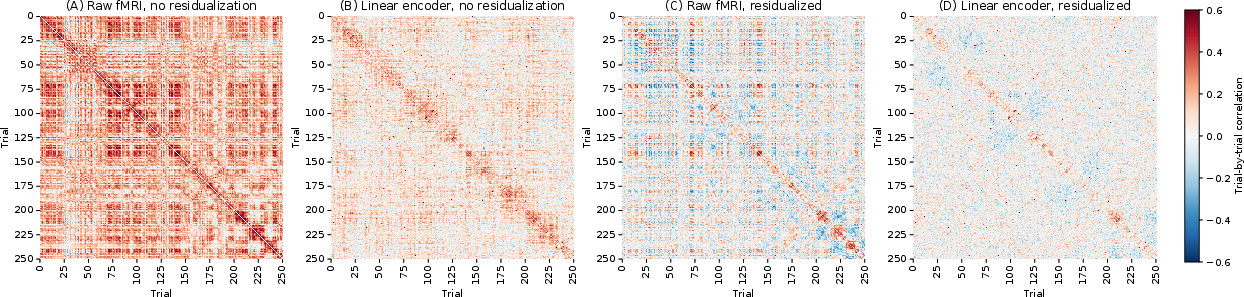
Figure 4: Residualization reduces session/run confounds, enhancing reliability of extracted neural embeddings.
Encoder Hyperparameter Effects and Translation Stability
Dimensionality sensitivity and rotation stability analyses indicate optimal encoder performance with embedding sizes in the 100–150 range, and demonstrate that seed selection remains critical due to initialization sensitivity in unsupervised translation.

Figure 5: Encoder dimensionality search—retrieval performance optimized at moderate latent dimensionality.
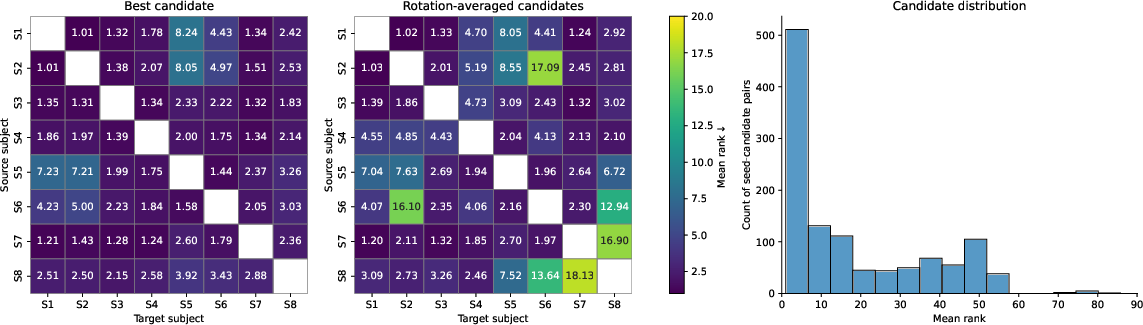
Figure 6: Rotation stability across seeds—performance varies, with best seed selection outperforming mean rotation.
Supervised mappings from neural embeddings to last-layer representations of vision and LLMs (e.g., CLIP, DINOv2, ViT) recover moderate instance-level correspondence (mean rank 5.86, R@1 0.51). However, these mappings do not achieve the near-isometric transformability observed across brains, indicating that current models, while decodable, differ in the geometry of their representational axes relative to biological neural spaces.
Implications and Future Directions
Practical and Theoretical Significance
The strong isometric correspondence among subject-specific neural embeddings, recoverable without external anchors, has direct implications for cross-subject modeling, data transfer, and neural decoding. It enables transferability of decoding models, image-to-fMRI encoders, and synthetic data generation across individuals, reducing the reliance on costly per-subject paired calibration. The universal neural geometry could facilitate learning from heterogeneous datasets—where stimulus sets are disjoint across subjects—and might inform neural privacy frameworks in clinical contexts.
Theoretically, this result reifies the Platonic Representation Hypothesis in biological systems, arguing for universal axes of neural representation that transcend individual anatomical or experiential differences. The separation of decodability and geometric equivalence between brains and artificial models suggests that future AI systems aiming to emulate neural computation may need to incorporate geometric constraints mirroring those observed in biological cortex.
Conclusion
This study demonstrates that subject-specific fMRI representations in human visual cortex are approximately isometric and translatable across individuals via purely geometric orthogonal transformations, learned without any shared cross-subject data or external anchors. The strong numerical results and mutual compatibility of embeddings in a synchronized common space provide empirical support for a universal latent structure in neural representation. The findings open avenues for cross-subject neural modeling, geometric analysis of biological and artificial representations, and principled translation across neural systems, with significant ramifications for both computational neuroscience and machine intelligence.