- The paper finds that random recurrent networks quantitatively reproduce the low dimensionality observed in neural recordings.
- It employs Dynamical Mean-Field Theory with finite measurement time and context variability to model neural dynamics.
- The study shows that activity geometry, rather than dimensionality alone, is key to distinguishing random from structured network hypotheses.
Random Neural Networks and the Dimensionality of Neural Population Activity
Introduction
This paper ("Random neural networks match observed dimensionality of neural population recordings and motivate stronger experimental tests" (2605.26551)) interrogates the prevailing assumption that the low-dimensional geometry observed in large-scale neural recordings is indicative of highly structured brain circuitry. The authors analyze whether minimal random network models—specifically random recurrent neural networks endowed with unstructured Gaussian connectivity and external inputs—can quantitatively account for the low dimensionality observed in neural population activity, or whether dimensionality alone is sufficient for inferring structure beyond randomness. Incorporating recent developments in Dynamical Mean-Field Theory (DMFT) with experimental realism (finite measurement time and behavioral context variability), the paper rigorously examines how activity geometry arises and elucidates which experimental observables offer meaningful discrimination between random and structured network hypotheses.
Modeling Framework and Analytical Methods
The model adopts a classical random recurrent neural network architecture, as formulated by Sompolinsky et al., with the net input current to neuron i evolving according to:
hi(t)+∂thi(t)=j∑Jijrj(t)+fi,
where Jij is sampled from an i.i.d. zero-mean Gaussian distribution with variance g2/N (gain parameter g), and external inputs fi are independent Gaussian variables representing behavioral context strength I. The nonlinearity ϕ between h and r is chosen odd (hi(t)+∂thi(t)=j∑Jijrj(t)+fi,0) for analytical tractability under DMFT.
The DMFT framework is used to derive self-consistent equations for both the ordered response (mean rate, hi(t)+∂thi(t)=j∑Jijrj(t)+fi,1) and temporal chaos (fluctuations around the mean, hi(t)+∂thi(t)=j∑Jijrj(t)+fi,2), as well as their variances and autocovariances. The participation ratio (PR) quantifies the linear dimensionality of the activity, capturing the effective number of principal directions with substantial variance in the neural state space.
Crucially, the analysis integrates finite measurement time (hi(t)+∂thi(t)=j∑Jijrj(t)+fi,3), yielding corrections to the asymptotic hi(t)+∂thi(t)=j∑Jijrj(t)+fi,4 predictions, and extends to multiple behavioral contexts (distinct external inputs), enabling exploration of cross-context activity geometry.
Dimensionality, Measurement Time, and Comparison to Data
The core finding is that, once finite recording time and context variability are realistically modeled, the measured linear dimensionality (PR) of population activity in random networks matches the values observed in primate motor cortex recordings.
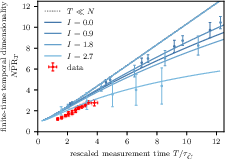
Figure 1: Temporal chaos and ordered responses under a behavioral context; variance of chaos decreases with input strength, ordered-response variance increases, and long-time dimensionality is non-monotonic in input strength.
The theoretical predictions demonstrate that the dimensionality grows sublinearly with measurement time hi(t)+∂thi(t)=j∑Jijrj(t)+fi,5 due to neural correlations, saturating at the network size for long windows. In experimentally relevant regimes (movement durations hi(t)+∂thi(t)=j∑Jijrj(t)+fi,6 s, autocorrelation time hi(t)+∂thi(t)=j∑Jijrj(t)+fi,7 ms, neuron number hi(t)+∂thi(t)=j∑Jijrj(t)+fi,8), dimensionality is largely insensitive to network parameters and varies only weakly over hi(t)+∂thi(t)=j∑Jijrj(t)+fi,9, thus failing to discriminate connection structure.
Figure 2: Finite-time PR as a function of measurement duration; theoretical predictions align with low experimental dimensionality from monkey PMd and M1 data.
Numerically, the agreement between random network predictions and data is robust for long measurement windows, with discrepancies at short times reflecting single-neuron biophysical detail rather than network organization.
Activity Geometry Across Behavioral Contexts
The paper rigorously investigates activity similarity across contexts by analyzing cross-context cosine similarity (CS) of ordered responses and the orientation similarity (OS) of temporal chaos fluctuation ellipsoids. Ordered responses mirror input similarity and saturate quickly with increasing input strength, providing limited discrimination.
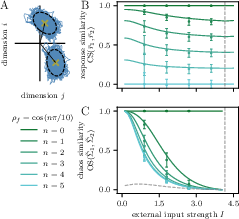
Figure 3: Ordered-response similarity (CS) retains input similarity, plateauing at strong input; orientation similarity (OS) of temporal chaos declines rapidly, decorrelating across contexts well before the ordered response changes.
Notably, the orientation similarity OS, reflecting the overlap of fluctuation directions between contexts, is highly sensitive to input strength and network correlations. As input grows, OS decays much more rapidly, reaching random-overlap baselines, indicating that activity geometry can change substantially even if mean responses remain similar. Unlike CS, OS is informative about network structure beyond mere input effects.
Dimensionality Over Multiple Behavioral Contexts
Extending to multi-context scenarios, the authors analyze the dimensionality of the cloud of ordered responses across many behavioral contexts. The predicted multi-context dimensionality rises monotonically with external input strength and grows sublinearly with the number of sampled contexts. This forms a structured baseline against which deviations (from experiment) can signal extra organization.
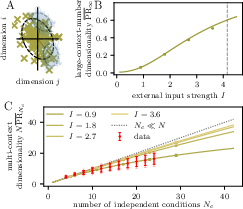
Figure 4: Multi-context dimensionality PR increases with input, matches experimental values for context-rich tasks; sublinear growth with context number is predicted and confirmed in data.
Experimental comparisons (Bartolo et al.) show that PR as a function of behavioral context number agrees with minimally structured network baselines, suggesting that current data cannot distinguish random from elaborate circuitry.
Numerical Robustness and Analytical Generality
Analytical results are validated by simulations, and appendix analyses establish that key qualitative behaviors—such as non-monotonicity in chaos dimensionality as input increases and the rapid cross-context decorrelation of fluctuation geometry—are robust across gain parameters and network sizes.
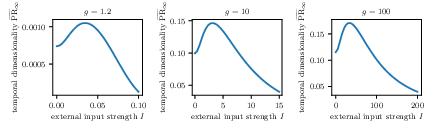
Figure 5: Appendix—dimensionality PR remains non-monotonic in input strength across diverse gain values.
Experimental Implications and Future Directions
The study delivers strong claims: activity dimensionality alone does not distinguish random connectivity from structured wiring, and current experimental protocols (recording time, context variety) are insufficient to infer underlying organization. The authors motivate stronger tests: geometry of activity fluctuations as a function of input strength, rapid OS decay across behavioral contexts, and multi-context dimensionality scaling. These observables enable rigorous discrimination and motivate experimental designs that target regimes where random network predictions vary appreciably.
Practically, this implies that future large-scale neural recordings—especially those expanding measurement time, neuron number, or context richness—must carefully interpret dimensionality in light of random connectivity baselines. Theoretically, the work reinforces the necessity of geometric and correlational analyses, rather than relying on dimensionality alone, when inferring structure in biological networks.
Conclusion
The paper provides a comprehensive, quantitative account of how random neural networks can replicate the low-dimensional structure seen in neural population recordings when finite sampling and contextual variability are properly included. Dimensionality measurements alone are insufficient to infer network structure; instead, richer geometric observables and experimental perturbations are required for distinguishing randomness from organization. The analytical framework, grounded in DMFT, paves the way for both more rigorous inference of network connectivity and principled experimental design in systems neuroscience and network modeling.