- The paper introduces Conditional Copula Entropy (CCE) as a novel metric to rigorously quantify and analyze directional representational alignment in neural networks.
- Empirical and theoretical analysis in both linear and nonlinear settings reveals that alignment varies non-monotonically with sample size, peaking away from the interpolation threshold, while increasing monotonically with SNR.
- Results on real-world datasets demonstrate a decoupling between task performance and internal representation quality, suggesting that traditional metrics may overlook structural insights.
Signal-to-Noise Ratio and Sample Size Govern Representational Alignment in Neural Networks
Introduction
This paper presents a theoretical and empirical analysis of representational alignment in neural networks, systematically investigating how signal-to-noise ratio (SNR) and training sample size modulate the structure of learned internal representations. The authors introduce Conditional Copula Entropy (CCE) as a novel, rigorous metric of geometrical alignment, providing analytic tractability in linear regimes and demonstrating technical generality across regression/classification tasks and both synthetic and real-world datasets. Crucially, the study exposes the decoupling between task performance and representational alignment and offers quantitative, directional insight into the mechanisms underlying representational convergence.
The authors depart from conventional, predominantly symmetric metrics (e.g., CKA, SVCCA) and leverage CCE—a directional, rank-based entropy quantifying how local neighborhood structures in one space predict neighborhoods in another. The CCE is formally defined via the conditional entropy of copula variables associated with pairwise distances, capturing information-theoretic local similarity:
CCE(A→B)=−η→0limH(cB∣cA=η)
where cA, cB are rank-based copula variables. Under Gaussian assumptions, the authors provide analytical expressions for CCE between one-dimensional projections of high-dimensional random vectors, with closed-form dependence on inter-representation correlation ρ:
CCE(A→B)=−21log(1−ρ2)−21ρ2
This opens the possibility of theoretical predictions in well-controlled teacher-student setups.
Theoretical Results in Linear Networks
The study begins with a teacher-student setting, analyzing two-layer linear networks trained on independently drawn data perturbed by Gaussian noise. Leveraging singular value decomposition and high-dimensional asymptotics (Marchenko-Pastur law), the closed-form for representational correlation—and thus alignment—emerges as a function of SNR and the ratio α=n/d (samples to input dimension):
ρ∗={SNR+α−11SNRα>1 SNR+1−α1α⋅SNRα<1
Empirical measurements validate the analytic predictions, exhibiting non-monotonic alignment variation with sample size and monotonic dependence on SNR.
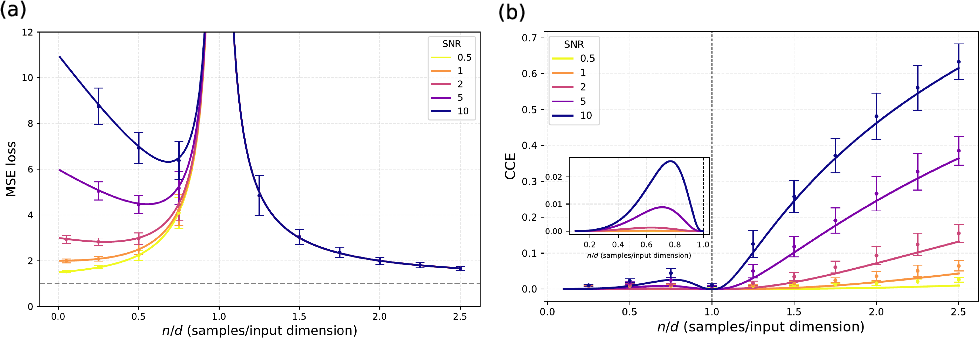
Figure 1: Generalization error and CCE in deep linear networks, as a function of training sample size divided by model parameters, across SNR levels. Panel (b) reveals non-monotonic CCE with training size.
Notably, CCE peaks away from the interpolation threshold (n=d), vanishes at this threshold, and rises with data quantity and SNR. Intriguingly, generalization error and representational alignment respond differently to SNR, signifying a decoupling between task performance and internal geometry.
Empirical Results in Nonlinear Networks
The paper then generalizes to two-layer ReLU networks trained under identical protocols, with numerical estimation of CCE. Despite the increased complexity and loss of analytic tractability, the core phenomena persist: alignment varies non-monotonically with sample size, minimized near the interpolation threshold, and monotonically increases with SNR.
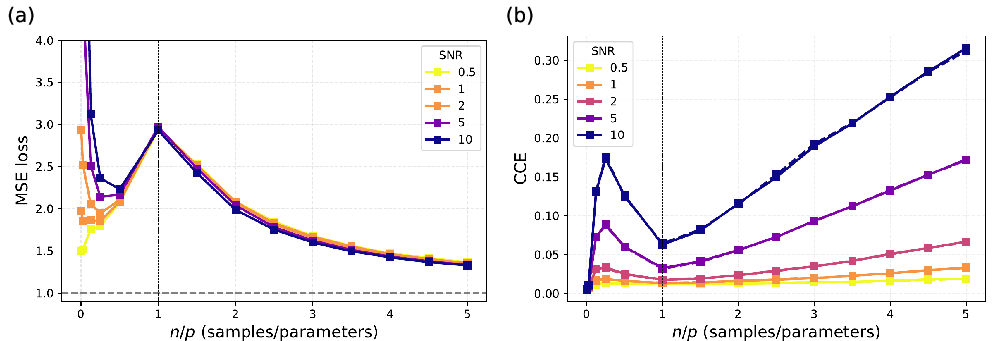
Figure 2: Generalization error and CCE in nonlinear (ReLU) networks, as functions of normalized sample size and SNR. Non-monotonic CCE persists, but remains nonzero at threshold.
Double descent in both error and CCE is observed, but unlike the linear model, CCE does not vanish at the threshold. This indicates nonlinear models retain some structured representation even when generalization performance degrades.
A salient experiment compares the informativeness of representations across architectures. Despite the teacher being linear, nonlinear students (ReLU networks) learn more informative internal representations (higher CCE) than optimal linear students, except at the latter's interpolation threshold.
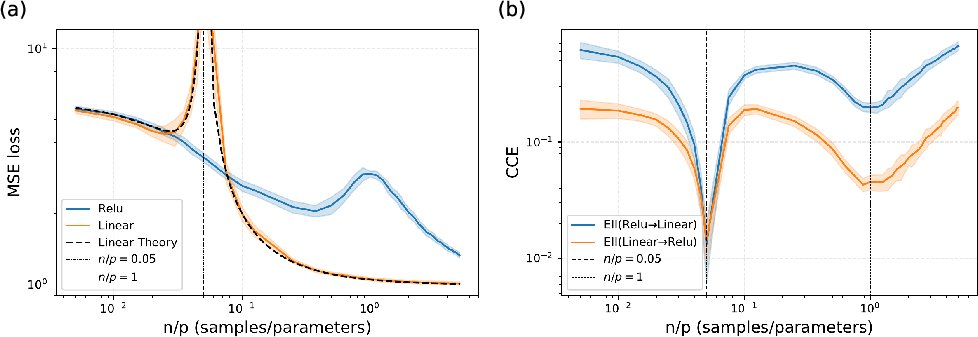
Figure 3: Generalization error and CCE between linear and nonlinear networks for SNR=5. CCE demonstrates ReLU networks have more informative representations, decoupled from generalization error.
This provides robust evidence that standard generalization error does not reliably track representational quality, and mere task-optimality does not guarantee rich internal structure.
Classification on Real-World Data
Synthesizing the prior theoretical insights into practical settings, the authors analyze CIFAR-10 classification using convolutional networks, varying sample size and artificially controlling label noise (inverse-SNR). Double descent and non-monotonic alignment reappear, confirming universality across tasks, architectures, and data modalities.
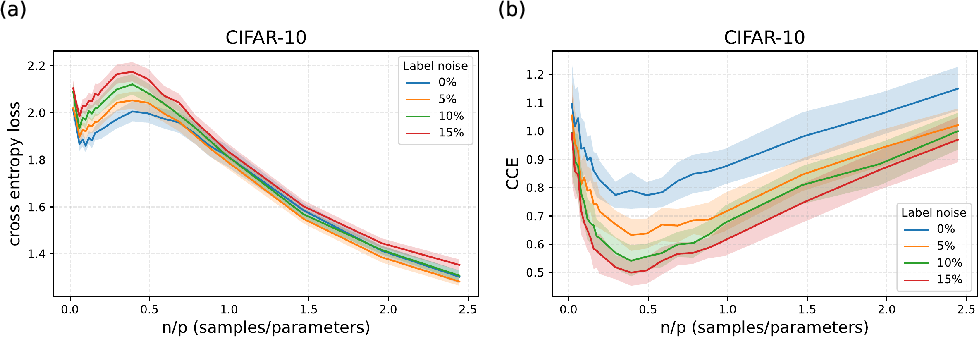
Figure 4: Generalization error and CCE for CIFAR-10 classification CNNs, as a function of sample size and label noise. Minimum alignment at interpolation threshold.
Increasing label noise depresses representational alignment in both underparameterized and overparameterized regimes. Similar results are obtained for MNIST with fully connected networks, indicating broad generality.
Implications and Future Directions
The study demonstrates that both SNR and training sample size jointly govern representational alignment in neural networks, but their influence is decoupled from generalization performance. This has practical and theoretical ramifications:
- Metric limitations: Alignment metrics (especially directional, asymmetric measures like CCE) are essential for correctly characterizing representation quality. Conventional symmetric metrics fail to capture informativeness disparities revealed here.
- Design criteria: Architects of neural systems should not conflate task performance with internal representation quality. Nonlinear models may yield richer internal structure even if suboptimal in classical error terms.
- Representation universality: The non-monotonic dependence observed suggests underlying universal phenomena in dynamics of representation learning, pointing toward deeper cross-disciplinary theory.
- Open questions: Extending analytic theory to nonlinear/multimodal settings, studying training dynamics, and quantifying effects of depth and width are immediate routes for advancing foundational understanding.
Conclusion
This rigorous work offers substantial theoretical and empirical support for the claim that signal-to-noise ratio and sample size are dominant, decoupled determinants of representational alignment in neural networks. The introduction and deployment of Conditional Copula Entropy as a metric establishes a strong analytic and practical foundation for future inquiries into the nature of learned representations. The demonstrated dissociation between representational informativeness and task performance underscores the need for careful metric selection and advocates for richer theories of deep representation learning.