- The paper introduces classical adiabatic annealing on Ising machines, detailing its dynamical evolution through continuation methods and bifurcation analysis.
- It proposes a hybrid CAA method that integrates a slow CAA phase with a rapid RA phase to systematically avoid saddle-node bifurcations.
- Numerical benchmarks reveal marginal time-to-target improvements over RA, emphasizing parameter sensitivity and underlying hardware challenges.
Introduction
This work presents a thorough performance analysis of classical adiabatic annealing (CAA) in analog Ising machines (IMs), situating the method amidst established heuristic strategies for tackling combinatorial optimization problems. The primary focus is on both the theoretical characterization of CAA using continuation methods and its empirical benchmarking against regular annealing (RA) and variants such as the hybrid CAA method. Simulations target MaxCut instances (up to 800 spins) and Beasley QUBO instances (with external fields), and the hybrid CAA protocol is introduced based on insights from bifurcation analysis. The study emphasizes that, while classical analogues of quantum annealing are conceptually appealing, real performance gains over simpler, practically established protocols such as RA are marginal or parameter-dependent.
Classical Adiabatic Annealing: Foundations and Continuation Analysis
Classical adiabatic annealing operationalizes the gradual interpolation of the IM Hamiltonian from a trivial, easily solvable initial configuration (typically an all-to-all ferromagnetic system) to the target problem Hamiltonian. The dynamic variables are continuous spin amplitudes, updated according to a nonlinear stochastic differential equation with linear gain, interaction strength, and noise (Eq.~(2), tanh nonlinearity). The energy landscape transformation is controlled by an interpolation parameter F(t) governing the convex combination of the initial and problem-specific coupling matrices.
Continuation analysis, leveraging tools such as AUTO-07p, is employed to track the IM's fixed points as F evolves from $0$ to $1$. A typical evolution trajectory reveals that, even for adiabatic and noiseless cases, the fixed point corresponding to the initialized ground state often encounters saddle-node (SN) bifurcations. These SNs can terminate the desired solution branch, potentially diverting the system away from the global minimum of the target Hamiltonian.
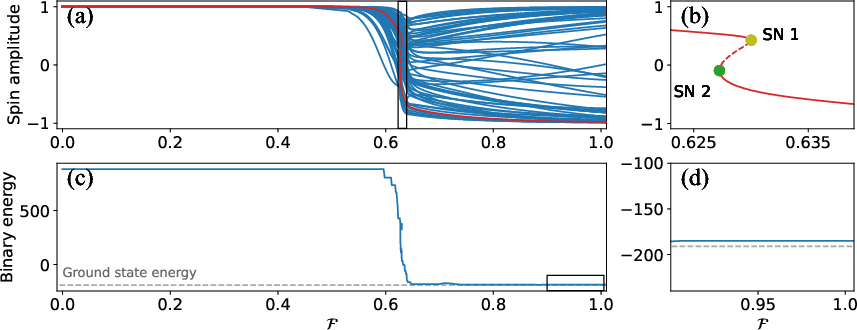
Figure 1: Typical evolution under classical adiabatic annealing shows spin amplitudes exhibiting bifurcations as the interpolation parameter F is varied for a MaxCut instance.
A key finding is that the location of these SNs is sensitive to the coupling strength β. As β decreases, SNs approach and annihilate at a cusp, suggesting that CAA could avoid SNs if performed at sufficiently low β.
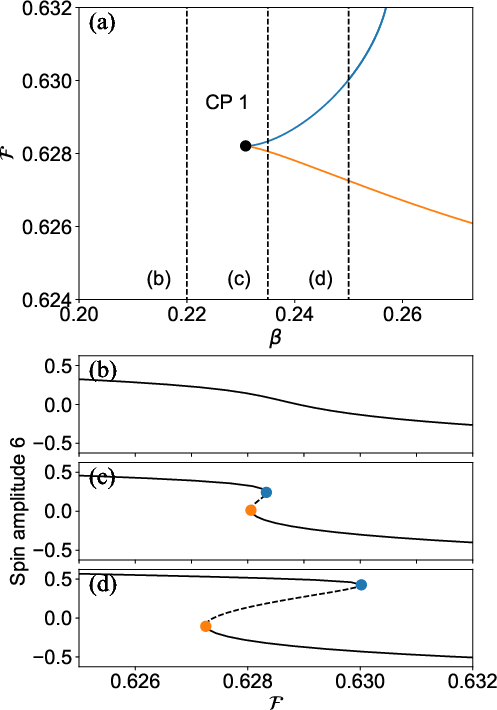
Figure 2: Positions of SN bifurcations as a function of β demonstrate the cusp structure.
However, a separate pitchfork bifurcation at small β imposes a lower bound due to the potential collapse of all spin amplitudes. This constraint is quantified by a critical F0, related to the leading eigenvalue of the coupling matrix.
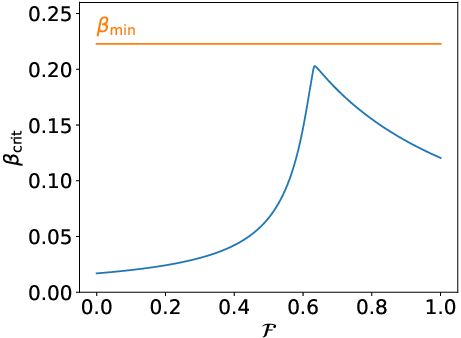
Figure 3: The critical F1 threshold—F2 versus F3—dictates the minimum F4 for sustaining nonzero spin amplitudes.
Hybrid CAA: Bifurcation-Aware Annealing Protocol
To mitigate the intrinsic limitations of CAA, the hybrid CAA method is proposed. It consists of two stages:
- CAA Phase: Slow interpolation (F5) at the minimal feasible F6 (F7), ensuring the branch is free from SNs.
- RA Phase: Once F8, F9 is increased (RA) such that the system evolves towards a fixed point corresponding to a binary minimum of the Ising Hamiltonian.
This protocol is shown via continuation analysis to systematically overcome the SN issue, at the expense of introducing another hyperparameter (the speed $0$0).
Numerical Experiments and Benchmarking
Extensive simulations are performed with both MaxCut (BiqMac, GSET) and Beasley QUBO instances. The main metrics are the success rate (SR; fraction of ground state solutions) and time-to-target (TTT; time to achieve $0$199% SR).
Parameter scans over $0$2 and $0$3 reveal:
- For adiabatic easy instances, hybrid CAA matches the ground state at slow rates, with RA-alone performing similarly at the rapid limit.
- For adiabatic hard instances, slow CAA cannot avoid low SR due to persistent SNs; only faster, noise-aided runs occasionally succeed via energy landscape hopping.
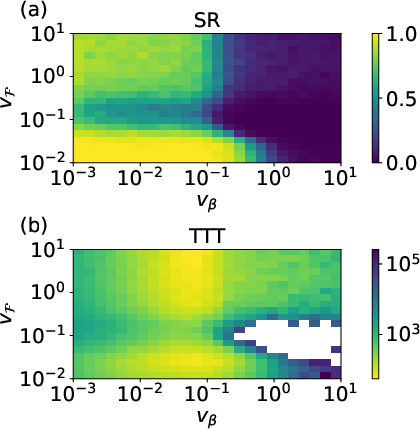
Figure 4: Hybrid CAA parameter scan for an adiabatic easy MaxCut instance shows regions of high SR and minimal TTT at low annealing speeds.
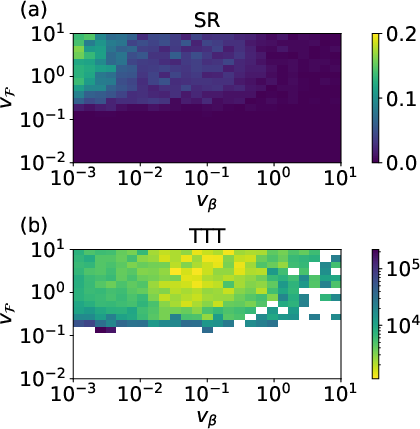
Figure 5: For adiabatic hard problems, SR drops to zero at low $0$4, highlighting the inescapable SN bifurcations.
Performance comparisons between hybrid CAA and RA across MaxCut and Beasley instances yield the following:
- MaxCut (no external fields): Hybrid CAA offers a modest TTT reduction (factor $0$51.6 at $0$6), with the gap narrowing as noise increases. Both methods fail on harder GSET problems.
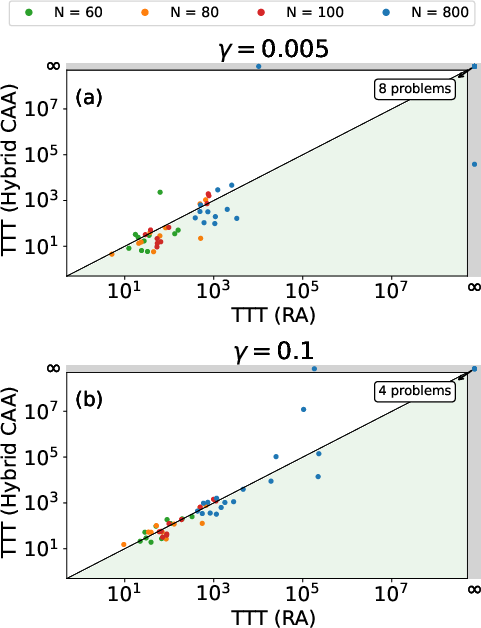
Figure 6: TTT scatter for BiqMac/GSET MaxCut instances; green-shaded region denotes hybrid CAA outperforming RA.
- Beasley (external fields): Hybrid CAA can outperform RA by an order of magnitude for select instances, but the advantage disappears when both use the "spin sign" method—a corrective for amplitude/external field imbalance.
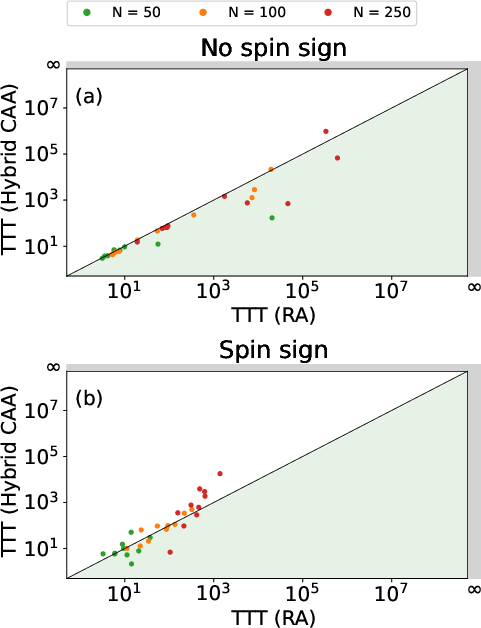
Figure 7: Beasley instance TTT comparison shows near-parity between hybrid CAA and RA when both employ the spin sign method.
Implications for Ising Machine Algorithmics and Hardware
The analysis establishes that hybrid CAA offers robust bifurcation avoidance and can yield incremental performance improvements in noise-regularized analog Ising networks. However, the benefits are context-dependent: numerical results indicate that, with appropriate implementation tweaks (e.g., spin sign correction), simpler protocols such as RA perform on par with more elaborate, parametrically involved schemes like hybrid CAA. In hardware terms, the demanding requirements (all-to-all connectivity for initialization, frequent Hamiltonian updates) may preclude efficient realization in many analog IM platforms. The hybrid method's value is thus mainly in its theoretical clarity and its ability to delineate regimes of algorithmic tractability versus intrinsic dynamical limitation.
Conclusion
This study systematically characterizes classical adiabatic annealing on Ising machines from the perspective of dynamical systems and stochastic optimization, providing both continuation-theory-based insights and rigorous empirical benchmarks. Hybrid CAA, as a bifurcation-aware strategy, slightly improves upon RA under specific conditions, especially in low-noise regimes and for select classes of combinatorial problems. However, the marginal gains, combined with additional hyperparameter complexity and stringent hardware implementation requirements, constrain its practical relevance. Future work may investigate algorithm-hardware co-design that enables initialization strategies with partial connectivity, as well as richer learning-based schedule parameterization for scalable analog optimization.