WT-UMI: Tactile-based Whole-Body Manipulation via Force-Supervised Contact-Aware Planning
Abstract: Whole-body humanoid manipulation of bulky, deformable, and shared-load objects requires distributed contact sensing and explicit force regulation, yet most imitation policies treat contact force only implicitly. On the other hand, different demonstration sources provide complementary modalities with inherent trade-offs: human demonstrations capture natural contact forces but not robot-executable actions, while teleoperation directly records robot actions but with less natural force regulation. This paper presents \textbf{WT-UMI}, a wearable whole-body tactile interface worn by human operators or mounted on humanoids, providing accurate observations of tactile images, contact forces, and end-effector poses across both human demonstration and humanoid teleoperation modes. We introduce a force-conditioned target-pose correction module that converts measured human poses into contact-aware robot targets by learning corrections from teleoperation data. To leverage the natural force interaction in human data, we propose a force-supervised planner that predicts end-effector pose chunks and contact-force trajectories. The predicted contact force serves as the reference for a tactile-based admittance controller. Across five contact-rich tasks spanning deformable objects, bulky rigid objects, and human--humanoid collaboration, WT-UMI improves success rate and reduces contact-position tracking error over four policy baselines. Our project page is available at https://wt-umi.github.io/WTUMI/.

Paper Prompts
Sign up for free to create and run prompts on this paper using GPT-5.
Top Community Prompts
Explain it Like I'm 14
Easy Summary of the Paper
This paper is about teaching a humanoid robot to use its whole body—not just its fingers—to safely and smoothly handle big, soft, or heavy objects, and even work with a human partner. The key idea is to give the robot “skin” that feels touch and pressure across its chest, forearms, and hands, then use that touch information to plan where to move and how hard to push.
What Is the Main Goal?
The goal is to help robots do contact-heavy jobs that hands alone can’t handle, like hugging a big yoga ball to move it, reorienting a pillow, carrying a bucket, or transporting a long beam or table with a human. To do this well, the robot needs to know:
- Where it is touching the object (the contact spot)
- How hard it is pressing (the contact force)
- How to move next so the touch stays stable and safe
What Questions Did They Ask?
- How can we capture realistic, whole-body touch and force data from humans and robots doing the same tasks?
- How can we turn human demonstrations (which feel natural) into robot-friendly actions (which the robot can actually execute)?
- Can a robot learn to plan both where to move and how hard to push at the same time?
- Will using predicted forces during control make the robot more stable and smoother when it’s in contact with objects?
How Did They Do It?
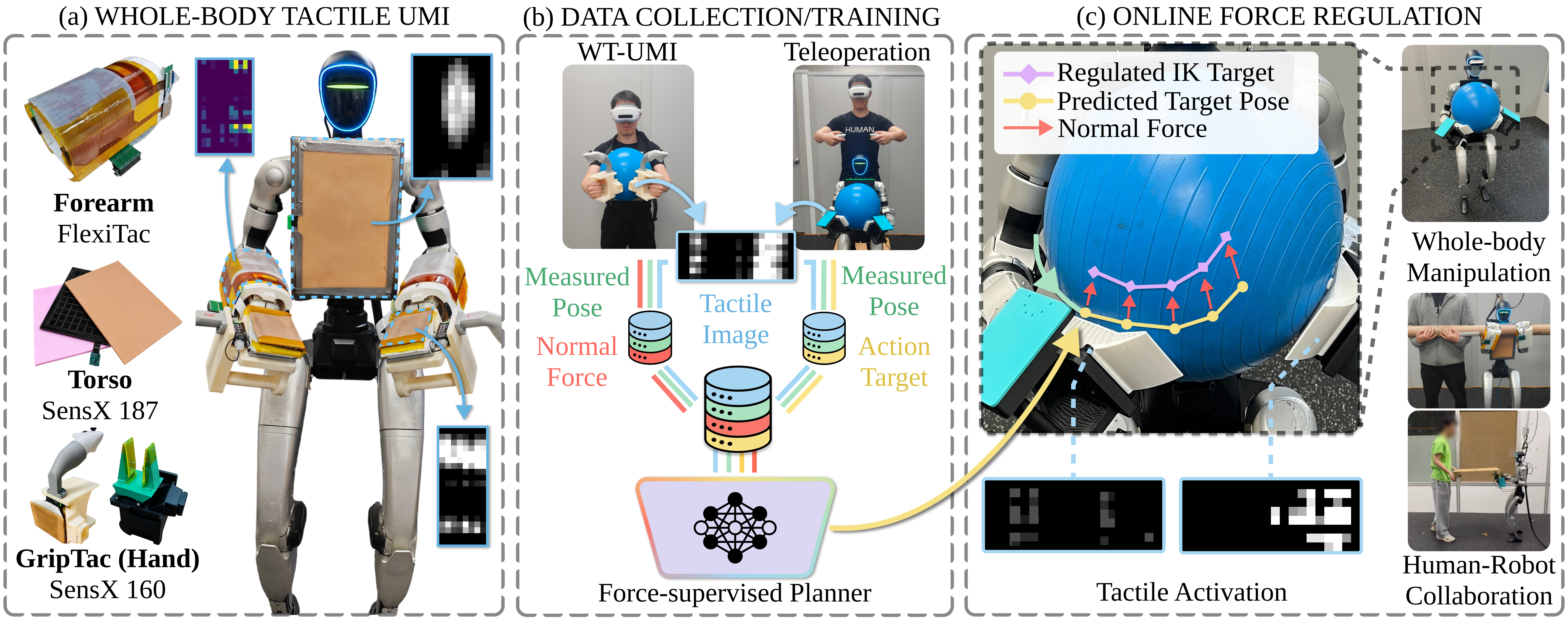
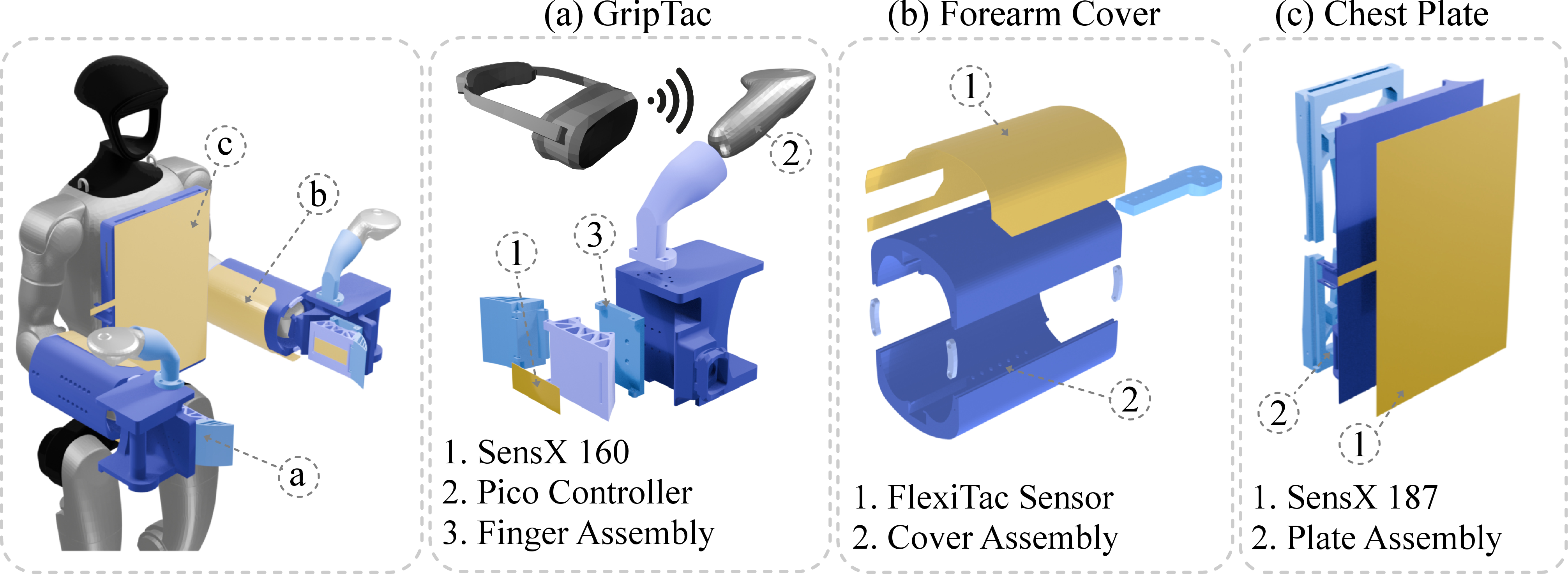
They built a system called WT-UMI (Whole-Body Tactile Universal Manipulation Interface). Think of it as a shared “tactile suit” for humans and robots.
- Tactile “skin”: Thin pressure sensors on the chest plate, forearms, and special handheld grips (called GripTacs). These create “tactile images” — like a pressure heatmap that shows where and how hard the robot (or human) is touching.
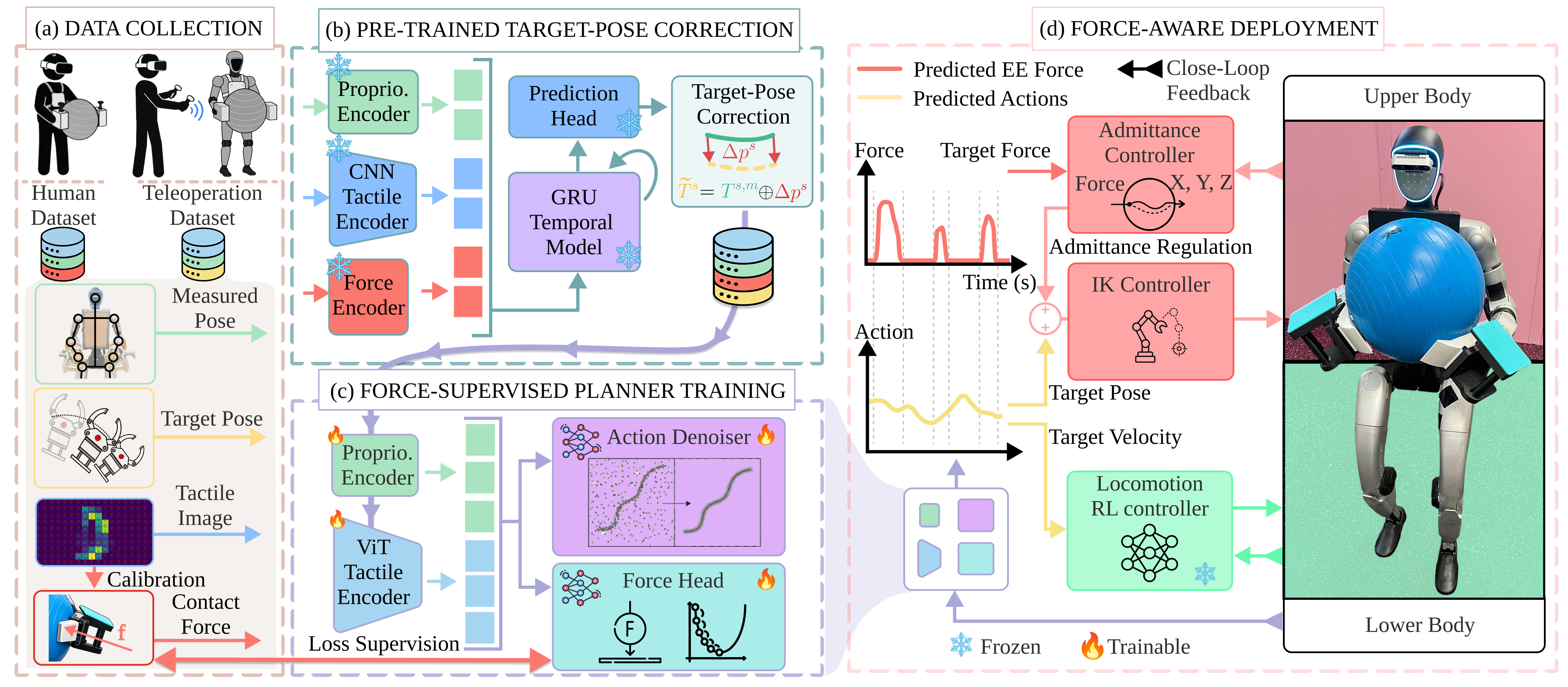
- Two ways to collect training data: 1) Human mode: A person wears the sensors and performs the task naturally. This gives great force and touch data. 2) Teleoperation mode: The same sensors are mounted on a humanoid robot. A person uses VR controllers to move the robot’s arms. This gives exact robot commands that the robot understands.
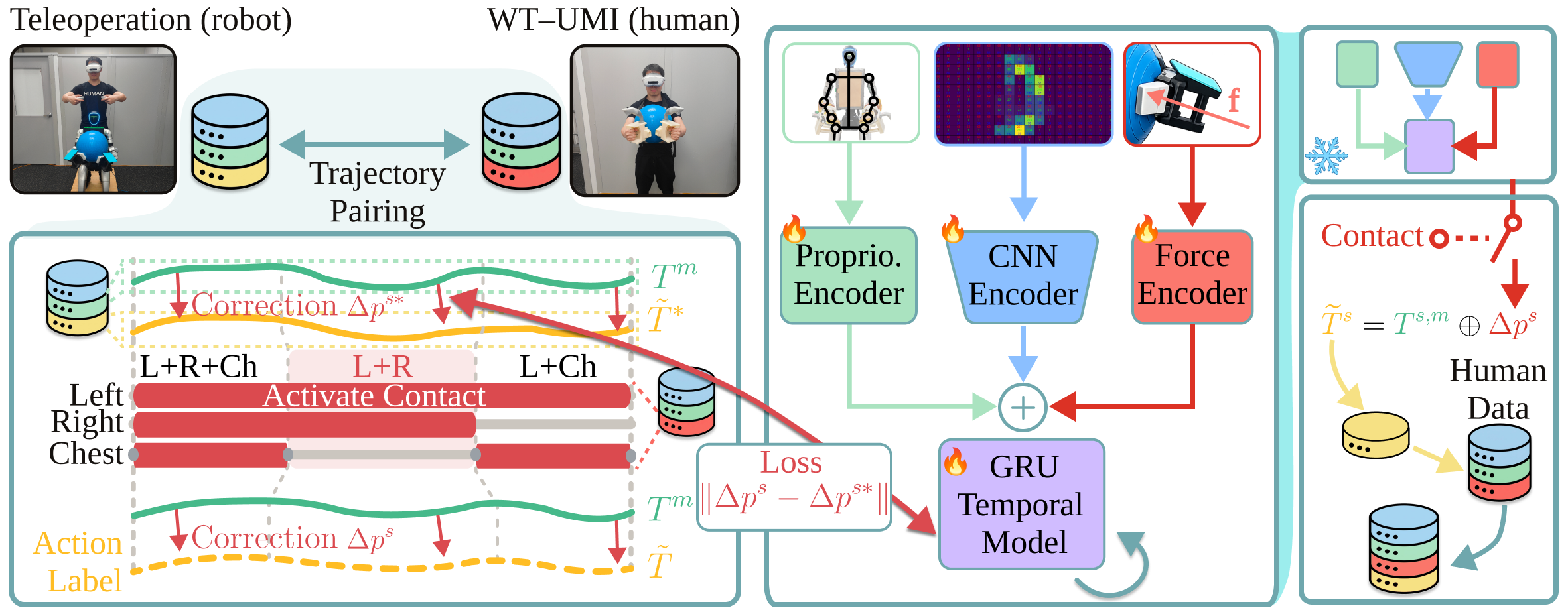
- Pose correction (making human moves robot-ready): Human motions don’t match robot bodies perfectly. So the team trained a “pose correction” module that learns small adjustments from the teleoperated robot data. It turns human hand poses into robot-friendly target poses, while keeping the good contact/force behavior from human demos.
- A planner that thinks about touch and force together: A learning model looks at recent tactile images (pressure maps) and hand poses, then predicts:
- Where the robot’s hands should go next (a short “chunk” of future poses)
- How much force it should apply over time
- You can think of it as a smart coach that says, “Move your hands here and press this much.”
- Admittance control (gentle, force-aware adjustments): During execution, the robot compares the predicted “how hard to press” with what it actually feels. If it’s pressing too hard or too soft, the controller makes small, smooth corrections to keep touch stable—like a springy cushion that adjusts until the pressure is just right.
They tested all of this on five real tasks:
- Handling soft things: yoga ball stabilization and pillow reorientation
- Handling bulky rigid things: moving a cone-shaped bucket
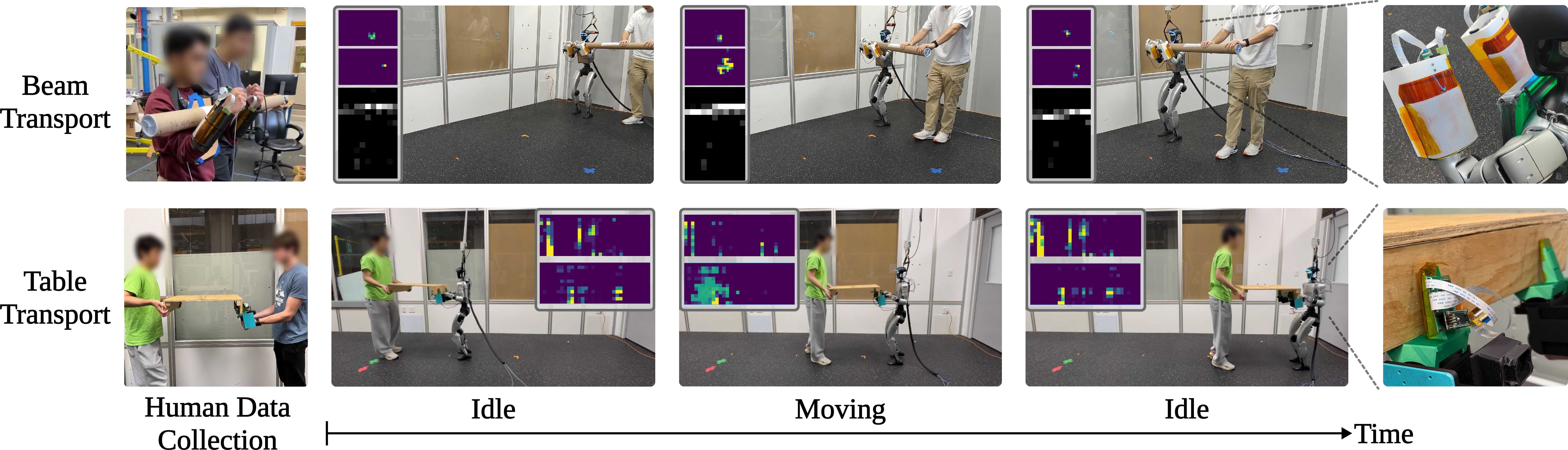
- Working with a human partner: carrying a beam and a table together
What Did They Find?
- Combining human and robot data is best:
- Human demonstrations provide natural, smooth force control (they feel how hard to push).
- Teleoperation provides robot-usable action labels.
- The pose correction module bridges them: it translates human motions into robot-ready targets while keeping the good contact behavior. This combo improved success and smoothness compared to using teleoperation alone.
- Better contact quality:
- The robot kept the touch point more centered (less “contact drift”).
- It applied steadier, more appropriate force, helping prevent slips or losing the object.
- Smoother motion and more stability:
- The admittance controller (the “gentle adjuster”) made movements less jerky and helped maintain stable contact, especially during tricky surface changes or when objects moved unexpectedly.
- Accurate force predictions:
- The planner learned to predict future contact forces well, especially when trained on human data (which had smoother, better-timed force patterns).
- Stronger performance across tasks:
- On the cone-shaped bucket task (which is one of the hardest), success went up noticeably (for example, from about 60% to 80% in their tests) when using the combined human+robot approach with pose correction and force-aware control.
- Overall movements became smoother and more reliable across tasks.
Why Is This Important?
- Many real-world jobs require whole-body contact, not just fingertips. Hugging, pushing, bracing, and carrying together with a human are everyday tasks.
- Seeing isn’t enough: vision can be blocked by the object during contact, and it doesn’t tell you how hard you’re pressing. Touch fills that gap.
- This work provides a practical way to gather good training data and turn it into safe, force-aware robot skills that work on a real humanoid.
What Could This Change in the Future?
- Safer, more helpful household robots that can carry furniture, hold large items steady, or assist people in moving things.
- Better collaboration between humans and robots, because the robot can “feel” and respond to a partner’s push or pull.
- More robust handling of soft or oddly shaped objects, like pillows, bags, or balls, which are common in homes and warehouses.
Limitations and Next Steps
- The “skin” doesn’t cover the robot’s entire body yet—just the chest, forearms, and hands. Adding sensors to more areas would help.
- The system currently doesn’t use camera images together with touch. Combining vision and touch could help the robot anticipate contact and recover faster if it loses contact.
- The model predicts force mostly along one main direction (how hard you press). In the future, predicting full 3D forces and torques could enable even finer control.
In short, this paper shows a practical path for teaching robots to use touch across their bodies, plan both motion and force, and work more smoothly and safely with the world—and with us.
Knowledge Gaps
Knowledge gaps, limitations, and open questions
Below is a concise list of unresolved issues, missing pieces, and unexplored directions that emerge from the paper.
- Limited tactile coverage: only palms, forearms, and chest are instrumented; sensing on dexterous fingers, legs, back, and shoulders is absent, limiting whole-body contact diversity and task coverage.
- Bimanual-only action space: the planner outputs pose targets for the two hands only; despite forearm/chest tactile sensing, there is no explicit action planning or control for torso/forearm contacts.
- Target-pose correction restricts to translations: the correction module predicts only a 3D translation offset per hand; rotational corrections (and full 6-DoF retargeting) for human-to-robot pose transfer are not learned or evaluated.
- Force modeling is scalar and normal-only: the force head predicts a single non-negative normal force per hand; shear forces, torsional components, and full 6D contact wrenches (or distributed pressure maps) are not modeled.
- No explicit slip/friction reasoning: the system does not estimate or regulate tangential forces, friction cones, or slip events; slip detection and recovery strategies are not addressed.
- Force regulation limited to proportional admittance: the admittance controller uses proportional adjustments without damping/integral terms or environment stiffness identification; passivity/stability guarantees and gain tuning guidelines are not provided.
- Short-horizon prediction: both action and force trajectories are predicted over ~400 ms; longer-horizon contact sequencing, anticipation of upcoming contacts, and multi-stage planning are unaddressed.
- Vision not integrated: the policy excludes RGB/depth, leaving object pose/shape estimation, contact anticipation, and re-acquisition after contact loss underexplored (authors note this as future work).
- Human–robot collaboration evaluation is qualitative: tasks T4–T5 lack quantitative metrics for intent inference accuracy, shared load distribution, partner comfort, or safety; generalization to diverse human partners and speeds is not studied.
- Generalization scope is narrow: experiments are on five tasks (quantitative analysis primarily on T1–T3) with one robot (Unitree G1); transfer to unseen objects, different geometries/compliances, and other humanoids is not demonstrated.
- Data alignment assumptions: the DTW-based human–teleop trajectory pairing and contact-mode inference are potentially brittle; sensitivity to segmentation errors, misalignments, and force-threshold choices is not quantified.
- Teleop data efficiency vs. quality: while small teleop datasets supervise correction, how performance scales with teleop data volume/quality and correction-network capacity is not analyzed.
- Label noise in corrected human demos: error introduced by the correction module (e.g., mispredicted offsets, missed contact gating) and its downstream impact on planner learning is not measured.
- Latency and asynchronous inference robustness: the impact of 100 ms chunk latency (and 200 Hz low-level control) on closed-loop stability, contact oscillations, and task performance under timing jitter is not characterized.
- Sensor calibration robustness: long-term drift, temperature/humidity sensitivity, hysteresis, and curvature effects on thin-film piezoresistive arrays—especially across human vs. robot mounts—are not systematically evaluated.
- Fault tolerance: robustness to partial tactile sensor failure, dead pixels, wiring noise, or loss of one modality (e.g., forearm or chest array) is not studied.
- Comparative baselines: there is no comparison with strong model-based hybrid force/position whole-body controllers or tactile MPC; differences in stability, force accuracy, and contact robustness remain unknown.
- Ablation of force head utility: the specific contribution of predicted force references vs. (i) no force head, (ii) constant force setpoints, or (iii) purely measured-force feedback is not isolated.
- Chest/forearm feedback usage: although chest and forearm tactile images are encoded, it is unclear how much they affect decisions when only hand poses are commanded; an ablation isolating each tactile site’s contribution is missing.
- Contact-centroid heuristic: regulating contact using a centroid ignores multi-peak contact patches and edge effects; robustness when contacts straddle sensor boundaries is not examined.
- OOD event handling: the system can “freeze” on out-of-distribution inputs; there is no mechanism for uncertainty estimation, anomaly detection, or automatic recovery/re-exploration after contact loss.
- Safety in HRI: maximum permissible forces, transient spikes, and interaction safety thresholds during human–robot collaboration are not monitored or reported.
- Task scalability: the data and training pipeline’s scalability to dozens/hundreds of tasks, and the role of multi-task or compositional learning, are untested.
- Sensor/robot portability: while shared modules reduce domain gap, how to transfer policies to different tactile skins/placements or robots without identical hardware remains open.
- Integration with semantics: the approach does not leverage language or task descriptions; how to specify new goals/variants via language or multimodal prompts is unaddressed.
- Coupling with locomotion: lower-body locomotion is controlled by a separate RL policy; joint optimization or coordinated planning of whole-body kinematics and contact forces is unexplored.
- Hyperparameter sensitivity: effects of horizon lengths, tokenization, ViT architecture, and force-loss weighting (λ_F) on stability and performance are not reported.
- Dataset transparency: it is unclear whether sensor calibration data, raw tactile/force datasets, and trained models will be released for reproducibility and benchmarking.
Practical Applications
Immediate Applications
Below are practical uses that can be implemented with today’s hardware and software stack described in the paper (WT-UMI sensors, VR teleoperation, force-conditioned pose correction, force-supervised planner, tactile-based admittance control, and a stable lower-body locomotion policy).
- Whole-body “bear-hug” manipulation for bulky and deformable items (logistics, manufacturing, facilities)
- What: Stabilize, reposition, and transport large boxes, foam parts, cushions, pillows, yoga balls, buckets, or cone-like containers when grasping is unreliable.
- Workflow/product: Retrofit humanoids with WT-UMI chest/forearm tactile pads and GripTac end-effectors; train a ViT-FMT/DiT force-supervised planner using a small teleop dataset plus corrected human demonstrations; deploy with the tactile admittance controller.
- Assumptions/dependencies: Flat, controlled environments; payloads within current humanoid limits; sufficient tactile coverage on torso/forearms; calibrated sensors; GPU for 10–20 Hz planning and 200 Hz low-level control.
- Human–humanoid co-carry in indoor spaces (construction pre-assembly, facilities, events)
- What: Cooperative transport of long or wide objects (tables, beams, panels) where the robot follows human physical intent and maintains stable distributed contact.
- Workflow/product: Pair WT-UMI data collection (human + teleop) with the force-conditioned correction module to create robot-feasible actions; deploy the force-based admittance controller to regulate normal force during the carry.
- Assumptions/dependencies: Trained on representative co-carry trajectories; safety-rated speed/force limits; clear floors; adherence to facility safety policies.
- Teleoperation data efficiency and operator ergonomics (service robotics, remote handling)
- What: Reduce the amount of robot-in-the-loop teleop data needed by augmenting it with corrected human demos that preserve natural force regulation.
- Workflow/product: Data ops pipeline that aligns human and teleop trajectories by contact mode (DTW), pre-trains the force-conditioned target-pose correction, then mass-labels human demos for policy training.
- Assumptions/dependencies: Basic teleop setup (VR headset/controllers); limited but high-quality teleop sessions to bootstrap corrections; synchronization and calibration tools.
- Tactile-aware safety monitoring and intervention (industrial robotics, R&D labs)
- What: Use predicted force trajectories as references to detect over-pressing, slipping, or contact drift and trigger reflexes or emergency stops.
- Workflow/product: Integrate the force head and admittance controller into an existing robot control stack; expose thresholds and contact-centric KPIs (contact drift, force rate).
- Assumptions/dependencies: Reliable force calibration; tuned thresholds; system-level safety interlocks; audit logs for safety reviews.
- Gentle contact tasks in assembly and rework (manufacturing)
- What: Force-regulated pressing/alignment of compliant parts or large subassemblies using torso/forearm contact (e.g., seating gaskets, aligning panels, compressing foam).
- Workflow/product: Task-specific data collection with WT-UMI; train a force-supervised policy that maintains centered contact and smooth motions; deploy via IK + admittance.
- Assumptions/dependencies: Fixtures within reach and workspace limits; repeatable part placement; consistent materials and surface properties.
- Ergonomics and occupational safety research (academia, EHS teams)
- What: Capture distributed contact images and calibrated forces during human handling to study safe posture/force strategies for lifting, pushing, and co-carry.
- Workflow/product: WT-UMI worn on humans to quantify contact centroids, normal forces, and motion smoothness; analytics to inform training and tool design.
- Assumptions/dependencies: IRB and privacy processes; comfortable wearable fit; repeatable calibration protocol.
- Tactile datasets and benchmarking for contact-rich learning (academia, tool vendors)
- What: Public or internal datasets featuring distributed tactile images and calibrated forces for whole-body manipulation benchmarks.
- Workflow/product: Release data with metrics (e.g., contact drift, force RMSE, smoothness) and reference implementations of the force head and correction module.
- Assumptions/dependencies: Data curation and documentation; licensing; reproducible calibration.
- Drop-in tactile control modules for existing humanoids (robotics software)
- What: Integrate a tactile-based admittance controller and force head as ROS/Isaac plugins to stabilize contact across tasks.
- Workflow/product: Controller plugin; parameter bundles (gains, safety limits) and tutorials for different robots.
- Assumptions/dependencies: Access to IK, torque/PD control, gravity compensation, and high-rate tactile streams; per-robot gain tuning.
Long-Term Applications
These applications are realistic but require broader tactile coverage, multi-axis force prediction, vision-tactile fusion, higher payload/robustness, and formal safety/regulatory approvals.
- Domestic assistance for homes and eldercare (consumer robotics, healthcare)
- What: Bed making, cushion fluffing, moving furniture with a person, handling laundry, door holding/closing using whole-body contact.
- Tools/products: Full-body tactile skins; force-and-vision-planning; household task libraries; safety-rated admittance.
- Dependencies: Regulatory certification, low-noise hardware, robust perception in clutter; multi-axis wrench prediction for delicate contact.
- Patient handling and mobility assistance (healthcare)
- What: Safe co-manipulation for patient turning, repositioning, and transfers with nurses/therapists, leveraging distributed, gentle contact.
- Tools/products: Medical-grade tactile skins; compliance with IEC/ISO medical safety standards; task-specific force envelopes and intent inference.
- Dependencies: Clinical validation; sanitizable and hypoallergenic materials; redundant safety layers (hardware + software).
- Collaborative installation and transport on worksites (construction, utilities)
- What: Co-carry and alignment of drywall, beams, pipes; panel placement in tight spaces using torso/forearm bracing.
- Tools/products: Ruggedized tactile skins; outdoor-capable controllers; site-aware intent and force-sharing protocols.
- Dependencies: Higher payload, stability on uneven terrain, weatherproofing; integration with site safety supervision.
- Disaster response and public safety (emergency services)
- What: Debris manipulation and co-carry with responders; handling fragile, deformable materials; tactilely guided extraction in low visibility.
- Tools/products: Teleop + autonomy blend; contamination-resistant tactile skins; haptic intent sharing between operators and robots.
- Dependencies: Harsh-environment robustness; rapid deployment kits; mission assurance and fail-safe behaviors.
- Multimodal vision–tactile force-aware planners (software platforms)
- What: Combine RGB-D and distributed tactile with explicit multi-axis force/wrench prediction for anticipation and re-contact strategies.
- Tools/products: Planner SDKs with cross-attention over vision+tactile; sim-to-real pipelines for force-augmented learning.
- Dependencies: Occlusion-robust vision, camera–tactile calibration, larger-scale data; real-time fusion on edge GPUs.
- Full-body tactile OEM ecosystems (hardware vendors)
- What: Standardized, modular tactile skins for chest, arms, legs, and back with per-cell calibration tools and self-diagnostics.
- Tools/products: “Skin kits,” auto-calibration rigs, durability/cleanability standards, lifecycle management dashboards.
- Dependencies: Cost, durability, replaceability, standardized connectors; interoperability with robot OSes.
- Cloud robotics pipelines for force-supervised imitation at scale (MLOps for robotics)
- What: Fleet-level data aggregation of human demos + minimal teleop; automated pose correction; continuous policy retraining and validation.
- Tools/products: Data versioning, contact-mode alignment services, latency-aware inference, safety gating.
- Dependencies: Data governance and privacy for tactile images; on-prem/edge options; rigorous evaluation harnesses.
- Multi-agent human–robot co-manipulation (logistics/manufacturing)
- What: Teams of humanoids and humans carrying/assembling large items with shared intent via distributed contact forces.
- Tools/products: Force-intent communication protocols; formation control with admittance; task-level coordinators.
- Dependencies: Reliable inter-robot comms, standardized safety envelopes, shared state estimation.
- Exoskeletons and wearable assistance informed by distributed contact (wearables)
- What: WT-UMI-like sensing to teach exoskeletons how to modulate assistance based on whole-body contact patterns.
- Tools/products: Wearable tactile arrays; biomechanical models fused with force-aware controllers.
- Dependencies: Ultra-low-latency sensing, comfort, battery life, human-subject validation.
- Standards and policy for tactile safety and data governance (policy/regulation)
- What: Safety thresholds for distributed contact, certification protocols for force-regulated manipulation, and privacy rules for tactile imagery.
- Tools/products: Test suites (contact drift, force rate), reporting templates, compliance pipelines for manufacturers.
- Dependencies: Cross-industry consortia; incident data; harmonization with existing cobot standards (e.g., ISO/TS 15066).
Notes on feasibility across applications:
- Current system predicts only normal forces; multi-axis wrench prediction and extended tactile coverage are key dependencies for broader tasks.
- Vision is not used in the paper’s deployment; robust multimodal fusion is essential for cluttered, occluded, or long-horizon tasks.
- Reliable, repeatable calibration and high-rate control are prerequisites; safety certification is mandatory for healthcare and public deployments.
Glossary
- 6D continuous rotation representation: A continuous parameterization of 3D rotations using six numbers to avoid discontinuities seen in Euler angles or quaternions. "6D continuous rotation representation"
- Action denoiser: A generative policy component (e.g., diffusion/flow) that outputs future actions by denoising. "an action denoiser predicts corrected bimanual pose chunks"
- Admittance controller: A compliant control strategy that converts measured forces into motion adjustments to regulate contact. "The predicted contact force serves as the reference for a tactile-based admittance controller."
- Behavior cloning: Supervised imitation learning that maps observations to actions using demonstration data. "We train four widely used behavior-cloning policies as baselines"
- Bimanual: Involving both hands/arms operating together. "an operator streams bimanual pose commands through a PICO VR headset"
- Contact centroid: The center of pressure/contact region estimated from tactile sensing. "using both normal-force and contact-centroid feedback"
- Contact mode: A discrete state describing which effectors are in contact. "we use contact forces to infer contact modes, such as right-contact, both-contact, and left-contact."
- Cross-attention: A transformer mechanism where query tokens attend to a different input’s keys/values for information fusion. "whose cross-attention head predicts the normal contact-force trajectory"
- Cross-correlation: A time-series similarity measure as a function of temporal lag. "temporal alignment using the cross-correlation peak offset between predicted and ground-truth forces."
- DDIM: Denoising Diffusion Implicit Models, a fast deterministic sampler for diffusion models. "For ViT-DiT, we use DDIM~\citep{song2021denoising} for faster inference."
- Denoising diffusion: A generative modeling process that iteratively removes noise to sample from a learned distribution. "flow matching for ViT-FMT and denoising diffusion for ViT-DiT."
- Dynamic Time Warping (DTW): A sequence-alignment algorithm that matches time series with varying speeds. "using Dynamic Time Warping (DTW) over the end-effector motion."
- Embodiment mismatch: Differences between human and robot bodies/sensing that complicate policy transfer. "WT-UMI enables scalable human demonstration collection while reducing the human--humanoid embodiment mismatch."
- End-effector: The robot’s tool/hand that interacts with the environment. "predicts end-effector pose chunks"
- Flow matching: A generative training method that learns a transport vector field from noise to data without stochastic sampling steps. "either flow matching~\citep{lipman2023flow} or diffusion~\citep{chi2023diffusion}"
- Force head: A model output head specialized for predicting future contact-force trajectories. "a force head performs direct regression without a diffusion process."
- Foundation policy: A large pre-trained policy model adapted to specific tasks via fine-tuning. " and are fine-tuned foundation policies"
- GRU: Gated Recurrent Unit, a recurrent neural network module for sequence modeling. "a lightweight CNN-GRU correction network"
- Gravity compensation: Feedforward torques that counteract gravity to reduce control effort. "Joint-level tracking uses a PD controller with gravity compensation"
- Huber loss (Smooth L1): A robust loss that is quadratic near zero error and linear for large error magnitudes. "supervised via an element-wise Huber loss ()"
- Inverse kinematics (IK): Computing joint configurations that realize desired end-effector poses. "passed to an optimization-based inverse kinematics solver"
- Normal force: The component of contact force perpendicular to the contact surface. "a normal-force reference"
- Proportional admittance law: A rule that adjusts motion proportionally to force error within an admittance controller. "derived from proportional admittance law based on force-measurement feedback."
- Proportional–derivative (PD) controller: A feedback controller using proportional and derivative terms on error. "Joint-level tracking uses a PD controller with gravity compensation"
- Proprioception: Internal sensing of joint states and body configuration. "proprioception cannot localize body-surface contact."
- SE(3): The mathematical group of 3D rigid-body poses (rotation and translation). "The corrected target pose in SE(3) is"
- Softplus: A smooth, positive-valued activation used to enforce non-negativity. "with a softplus projection enforcing physical non-negativity."
- Teleoperation: Direct human remote control of a robot to provide action labels or demonstrations. "teleoperation directly records robot actions but with less natural force regulation."
- Training-time real-time chunking (RTC): A training technique that accounts for inference delays by chunking sequences. "training-time real-time chunking (RTC)~\citep{black2025trainingtimeactionconditioningefficient} to compensate for inference delay."
- Vision Transformer (ViT): A transformer architecture that processes images as sequences of patches. "A vision transformer (ViT)~\citep{VIT} encodes the channel-stacked tactile images"
- Vision-language-action model: A multimodal model that maps visual and language inputs to robot actions. " is a vision-language-action model conditioned on tactile images and a fixed per-task language instruction"
Collections
Sign up for free to add this paper to one or more collections.