Visual Geometry Transformer in the Wild: Distractor-Free 3D Reconstruction
Abstract: Current end-to-end multi-view 3D reconstruction methods achieve impressive results, but rely on a restrictive static assumption: the scenes is entire distractor-free with perfect cross-view geometry. This reliance on idealized inputs causes even the most advanced methods to fail in real-world settings, where transient distractors and occlusions present. To address this, we propose Visual Geometry Transformer in the Wild (VGTW), an end-to-end framework for robust reconstruction from inconsistent views. At its core, we isolate and suppress distractor-affected regions while preserving the consistent components across views. Specifically, we introduce a Distractor-aware Training (DAT) strategy that separates clean features from distractor-contaminated ones in the attention mechanism while enforcing feature consistency across images. To enable this, we train the model with an auxiliary mask prediction head, using supervision from a new dataset we collected with pixel-level distractor masks. The resulting VGTW model is a feed-forward network that directly outputs clean, distractor-free point clouds. Remarkably, it requires no additional 3D supervision, remains computationally efficient, and is compatible with existing pipelines. Extensive experiments validate our approach, demonstrating state-of-the-art performance and robust generalization in diverse, real-world scenarios.
Paper Prompts
Sign up for free to create and run prompts on this paper using GPT-5.
Top Community Prompts
Explain it Like I'm 14
What this paper is about
This paper introduces VGTW (Visual Geometry Transformer in the Wild), a computer program that builds 3D models from several photos taken around the same scene. Its big trick is learning to ignore “distractors” like moving people or cars that appear in some photos but not others, so the final 3D model is clean and accurate.
What questions the researchers asked
The team focused on three easy-to-understand questions:
- How can we rebuild a 3D scene from many photos when some photos include moving objects that mess things up?
- Can a fast, one-pass model (“feed‑forward”) learn to spot and ignore these distractors without slow, per-scene tuning?
- Can we train such a model using only 2D labels (like “this pixel is a moving object”), without needing hard-to-collect 3D ground-truth?
How they did it (in everyday terms)
Think of making a 3D model as assembling a puzzle from several pictures of the same place. If someone walks through one picture, that moving person doesn’t belong to the static puzzle. VGTW learns to:
- find the pieces that match across photos (the stable, “true” scene), and
- ignore pieces that only appear sometimes (the distractors).
Here are the main ideas, explained simply:
The big idea: separate “stable” from “distracting”
- The model looks at all photos and tries to agree on what’s truly part of the scene.
- Moving objects only show up in some photos, so they break that agreement. VGTW learns to spot and downplay them.
How the model “pays attention”
- The model uses a transformer, which has an “attention” mechanism—like a spotlight that decides which image patches to “listen to.”
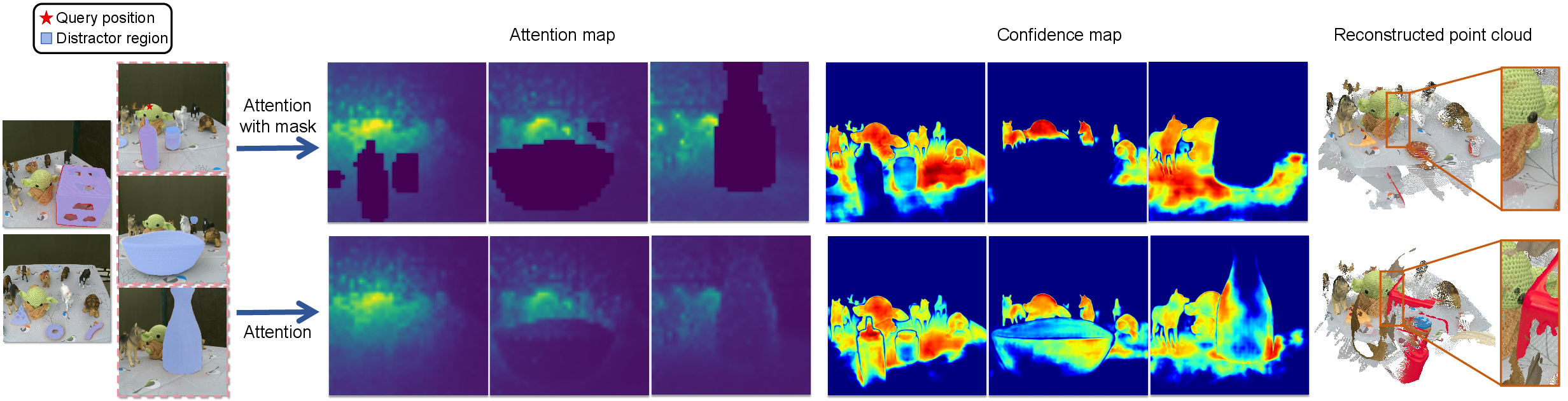
- The authors found that standard attention sometimes pays too much attention to moving things, which then sneak into the 3D result.
- If you block attention to those distractors, the 3D result gets much cleaner.
Distractor-Aware Training (DAT)
To teach the model to do this automatically, they fine-tune the attention using a small, efficient add-on called LoRA (Low-Rank Adaptation). They use two training goals:
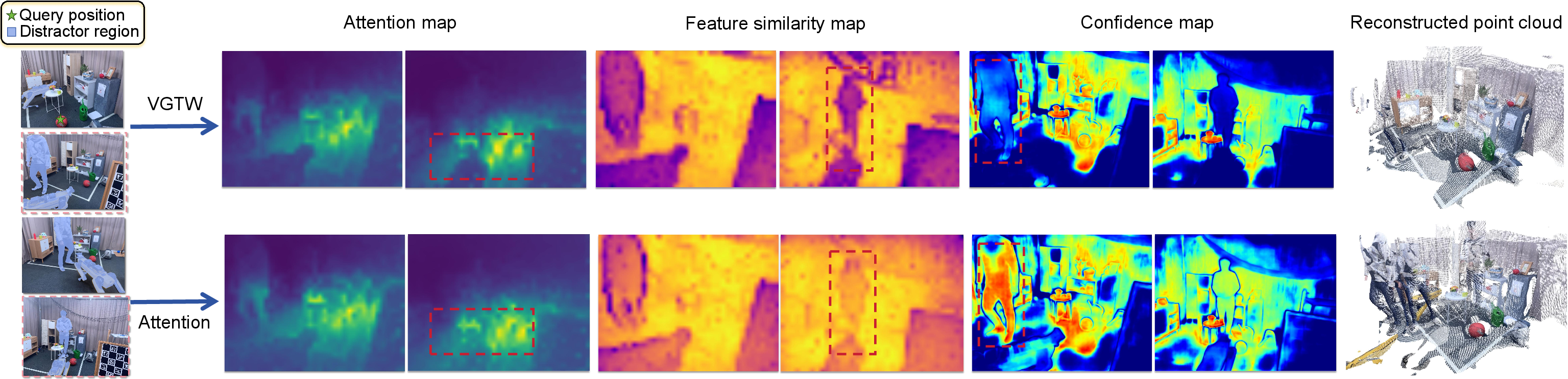
- Distractor Suppression Loss: pushes features from moving regions to be less similar across photos, so the model stops trusting them.
- Cross-View Consistency Loss: pulls features from stable regions closer together across photos, so the model trusts them more.
You can think of these as:
- “Push apart the noise” (moving things),
- “Pull together the truth” (static parts).
A “mask head” and a new dataset
- The model also learns to predict a simple “mask” for each photo: which pixels belong to distractors.
- To train this, the authors collected and annotated a dataset (RobustNeRF-Mask) with pixel-level labels showing moving/distracting regions.
- Important: they only used 2D masks for training—no 3D ground-truth—making training faster and easier.
One-pass 3D output
- After training, VGTW processes a set of photos in one forward pass and outputs:
- camera parameters,
- a depth map for each photo,
- and a clean “point cloud” (a 3D dot model) of the scene,
- while filtering out distractors.
What they found and why it matters
The researchers tested VGTW on challenging, real-world photo sets where people and objects move between shots. They compared it to strong existing methods (like DUSt3R, MASt3R, VGGT, π³, Fast3R). The key results:
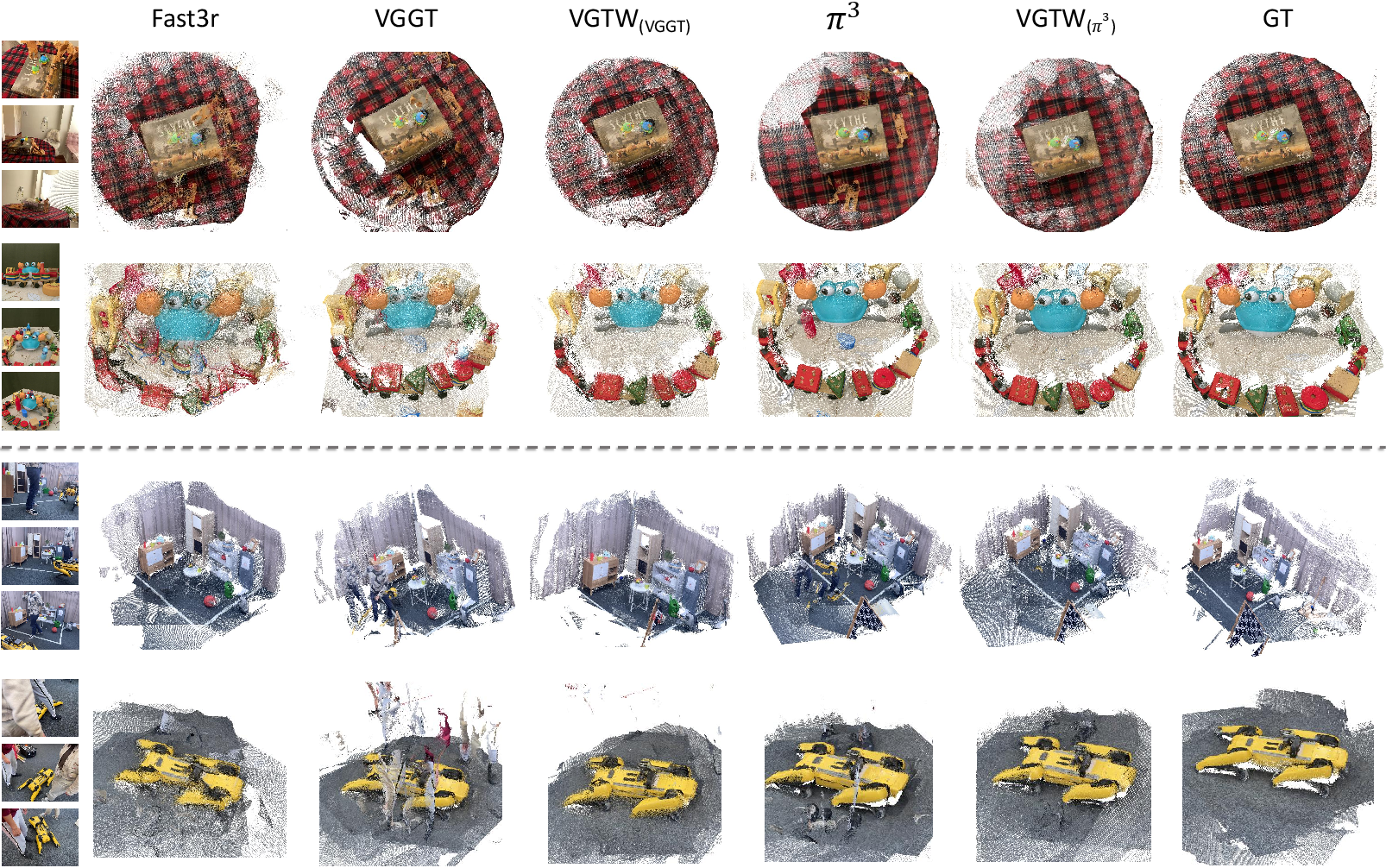
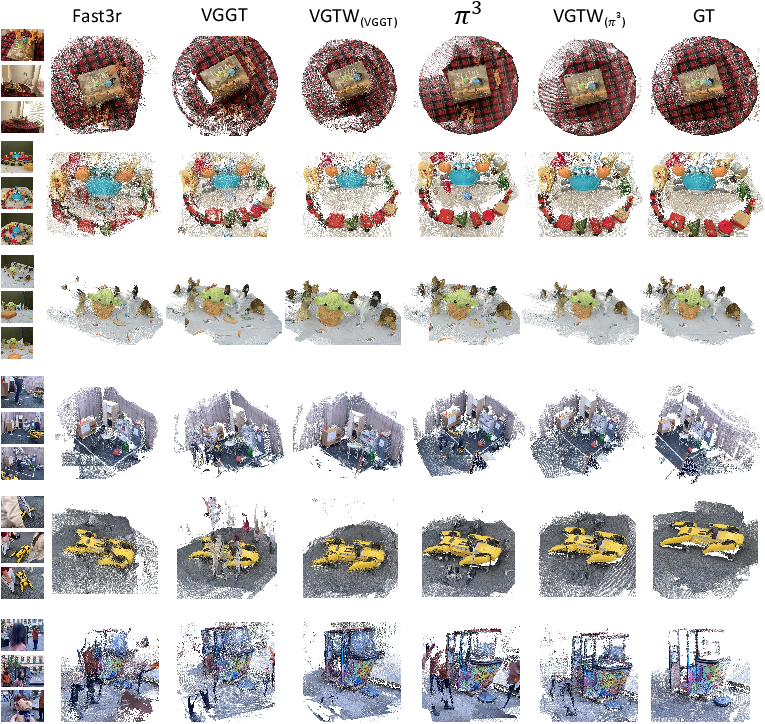
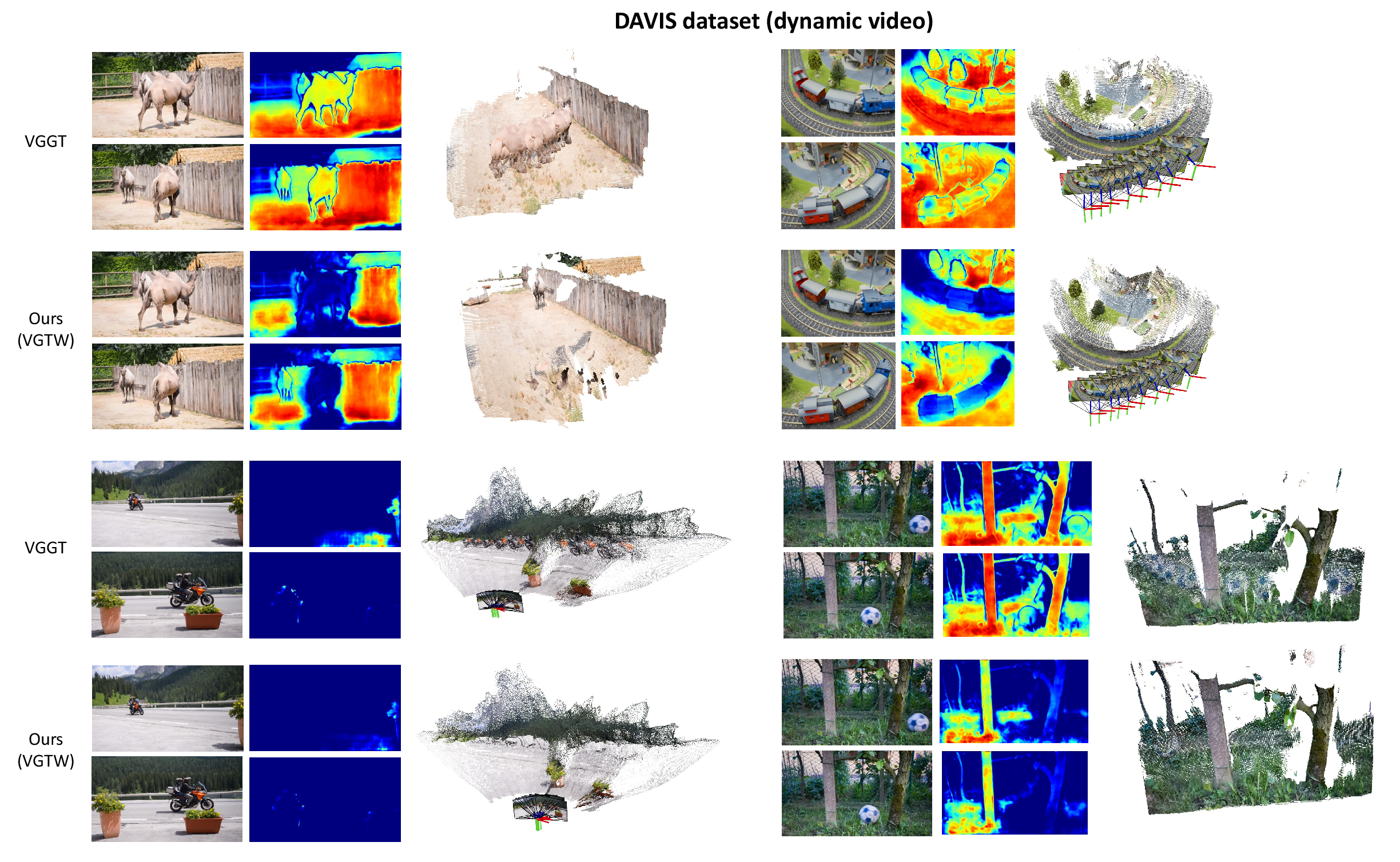
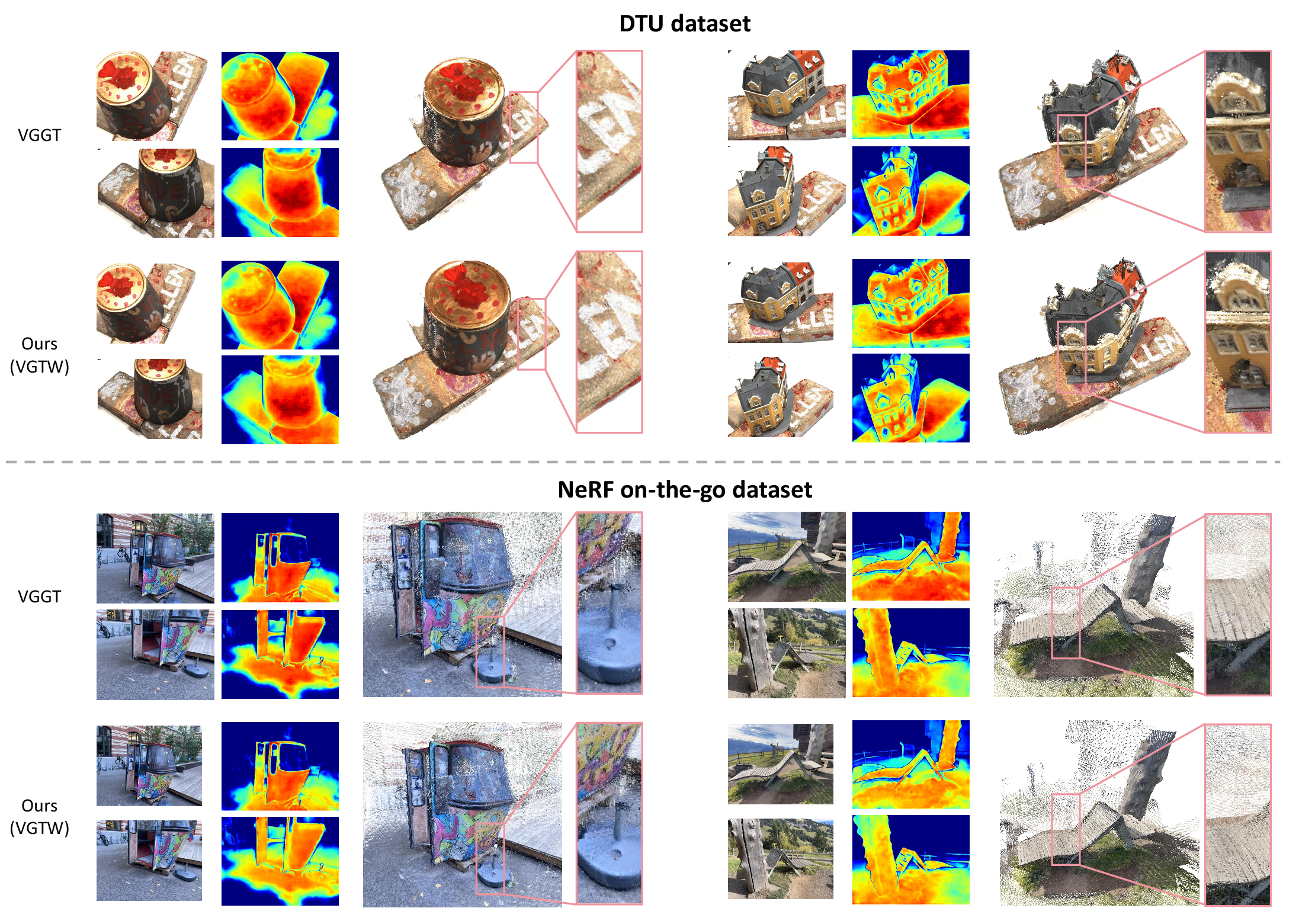
- Cleaner 3D: VGTW produced point clouds with fewer “ghost” artifacts from moving people/cars.
- Strong under occlusion: It kept better accuracy when scenes had medium to high occlusions (things blocking the view).
- Better depth: It improved depth estimates on dynamic datasets, showing it really learned to ignore distractors.
- Efficient and general: It handled unseen scenes well and didn’t need slow per-scene optimization or 3D ground-truth during training.
In simple terms: VGTW pays attention to the right stuff and stops being fooled by things that move, giving a better 3D model faster.
Why this work is important
- Real-world ready: Most photos “in the wild” include people, cars, or other clutter. A model that can ignore those distractions is much more practical.
- Fast and simple: Because it’s feed‑forward, it works in a single pass—useful for quick reconstructions without heavy computation.
- Easy to train: It relies on 2D labels (distractor masks) instead of expensive 3D ground-truth, lowering the barrier for training and improving scalability.
- Plug-and-play: It can be added to existing 3D pipelines (like VGGT or π³) to make them more robust.
Overall, VGTW moves 3D reconstruction closer to everyday, real-world use by making it cleaner, faster, and more resistant to distractions.
Knowledge Gaps
Knowledge gaps, limitations, and open questions
Below is a concrete, actionable list of what remains missing, uncertain, or unexplored in the paper.
- Dataset adequacy and bias: RobustNeRF-Mask reportedly includes only “about 1000” labeled images with SAM2-assisted masks, but the paper does not quantify scene diversity (indoor/outdoor balance, occlusion types, lighting, seasons), distractor categories, or mask quality/consistency across views—leaving unclear whether the training set sufficiently covers real-world variability.
- Mask annotation quality and consistency: The accuracy of SAM2-derived “pixel-perfect” distractor masks and their cross-view consistency are not validated; no inter-annotator agreement, mask noise analysis, or robustness-to-noise ablations are provided.
- Mask head performance is unevaluated: The paper omits precision/recall, ROC, or IoU metrics for the distractor head, and does not analyze failures (e.g., false positives on thin structures, shadows, reflections) or sensitivity to binarization thresholds.
- Use of masks during inference inside attention: VGTW fine-tunes attention via DAT but only uses predicted masks to filter outputs; it does not apply inferred masks to modulate attention weights at test time, despite earlier evidence that explicit attention masking helps—leaving a design gap and unexplored potential gains.
- Sensitivity to hyperparameters and architecture choices: No ablations are reported for LoRA rank, which attention layers are adapted (view-wise vs global), margin values (), loss weights (), or confidence threshold —hindering reproducibility and deployment tuning.
- Evaluation ground-truth bias: Point-map “ground truth” is generated by a pretrained on distractor-free frames, which may bias evaluation toward -like predictions and hides absolute accuracy; there is no assessment against independent ground truth (e.g., LiDAR/laser scans, high-quality SfM+MVS).
- Camera pose accuracy is unreported: Although the model outputs camera parameters, no pose metrics (e.g., ATE/RPE, rotation/translation errors, scale drift) are presented; the reliance on Umeyama alignment for point-cloud comparison further obscures scale and pose accuracy.
- Trade-off between distractor removal and scene completeness: The paper does not quantify how much static geometry is mistakenly removed (coverage/recall of static regions), nor calibrates the precision-recall trade-off of distractor filtering across occlusion severities.
- Generalization to clean static scenes: There is no evaluation showing that DAT and the mask head do not degrade performance on canonical static benchmarks (e.g., Tanks & Temples, ETH3D), leaving the risk of unnecessary suppression on clean inputs unresolved.
- Robustness to challenging appearance phenomena: Handling of moving shadows, specular highlights, reflections, semi-transparent objects, fine structures, and subtle non-rigid background motions (e.g., foliage) is not analyzed—these can confound mask prediction and similarity-based losses.
- Persistent but “static-in-capture” movers: The method’s behavior when a dynamic object appears in all (or most) views (e.g., a person/car present throughout) is unspecified; it is unclear whether such elements should be reconstructed or filtered, and how the method distinguishes them.
- Sparse and wide-baseline inputs: The cross-view consistency loss relies on nearest-neighbor similarity; failure modes under very sparse views, extreme viewpoint changes, and large parallax are not explored.
- Scaling and efficiency: While labeled “computationally efficient,” there are no wall-clock benchmarks, memory footprints, or scaling analyses with large (e.g., 100–1000 images), nor comparisons to Fast3R-level throughput.
- Ablations on training signals: It is unclear whether the suppression/consistency losses use ground-truth masks or predicted masks during training; the impact of training with noisy vs clean masks and the risk of confirmation bias or error reinforcement are not studied.
- Backbone and feature dependence: The method relies on DINOv2 features and VGGT/ backbones, but there are no tests with alternative encoders/heads or analysis of how backbone choice affects distractor suppression.
- Compatibility with optimization-based pipelines: Although the paper claims compatibility with existing pipelines, no experiments integrating VGTW outputs with NeRF/3DGS optimization (e.g., as cleaner priors) are shown or quantified.
- Downstream tasks and additional 3D outputs: Beyond point maps and depths, the method is untested for tracking (noted as a limitation), surface reconstruction/meshing, texturing, or novel view synthesis quality—leaving practical utility across tasks uncertain.
- Confidence calibration: The confidence maps guiding filtering are not calibrated or evaluated (e.g., ECE or reliability diagrams), and threshold sensitivity is not assessed—limiting principled deployment.
- Failure characterization and uncertainty: There is no analysis of where and why VGTW fails (e.g., qualitative taxonomy of errors), nor mechanisms to express uncertainty about filtered vs retained geometry.
- Comparisons beyond feed-forward methods: The paper does not compare quality-vs-time trade-offs against dynamic-aware NeRF/3DGS methods (e.g., NeRF-W, Wild-GS, SpotLessSplats) under standardized time budgets—leaving the practical accuracy/efficiency frontier unclear.
- Theoretical grounding of attention suppression: While empirical evidence suggests attention suppression helps, there is no theoretical analysis of when similarity-based pushing/pulling yields correct cross-view associations versus collapsing or fragmenting features.
- Impact near motion boundaries: The effect of DAT on preserving fine static details adjacent to distractors (e.g., boundary bleeding) is not quantified; metrics targeting boundary fidelity are absent.
- Handling multi-modal distractor semantics: The approach does not leverage semantics or language (e.g., to recognize common distractor classes), and it is unknown whether semantic cues would improve robustness to unseen distractor types.
- Internet-scale, long-horizon image collections: Generalization to unordered, heterogeneous Internet photo sets with severe temporal/appearance variation is not evaluated.
- Reproducibility details: Training compute, exact data splits, annotation process (human-in-the-loop steps, QA), and release plans for RobustNeRF-Mask are insufficiently detailed to ensure independent replication and benchmarking.
Practical Applications
Practical Applications of “Visual Geometry Transformer in the Wild (VGTW)”
Below are actionable applications derived from the paper’s findings, methods, and innovations. They are grouped by time-to-deploy and note the relevant sectors, potential tools/workflows, and key dependencies/assumptions.
Immediate Applications
- Distractor-free photogrammetry preprocessor [software, media/VFX, AEC]
- Tools/workflow: Add VGTW as a pre-filter to COLMAP/Metashape/RealityCapture pipelines to generate masks and clean point clouds from internet photo collections or site captures; pipeline = image ingestion → VGTW (mask head + feed-forward recon) → clean point cloud → downstream MVS/mesh/NeRF.
- Assumptions/dependencies: Multi-view coverage with sufficient baseline and overlap; GPUs for inference; at least some static content across views; domain alignment to VGTW pretraining.
- Robust mobile 3D capture in dynamic scenes [consumer apps, AR/VR, real estate]
- Tools/workflow: Integrate VGTW into scanning apps (cloud or on-device) so users can capture apartments, rooms, or furniture while people move around; output a “people/vehicle-free” model for listings and AR staging.
- Assumptions/dependencies: Multi-image capture (N≥3–5) with varied viewpoints; on-device compute or offloading to cloud; privacy handling for human masking.
- Pre-filtering and initialization for NeRF/3D Gaussian Splatting [graphics/VFX]
- Tools/workflow: Use VGTW’s predicted masks and clean point cloud to (a) ignore transient pixels during NeRF/3DGS optimization and (b) initialize Gaussians from the static point cloud for faster, cleaner convergence.
- Assumptions/dependencies: Good mask precision/recall on transients; integration glue (e.g., masking dataloader, static-only bootstrapping); enough static views.
- SLAM/VIO frontend with dynamic suppression [robotics, autonomous systems]
- Tools/workflow: Insert VGTW as a ROS node or library before feature tracking/pose estimation to filter dynamic regions and pass static keypoints/point clouds to ORB-SLAM/VINS-Fusion; improves map stability in crowds.
- Assumptions/dependencies: Latency within SLAM budget (batch size, resolution trade-offs); at least partial static scene; camera motion covers parallax for depth.
- Construction/facility digital twins in live environments [AEC, facilities]
- Tools/workflow: Weekly site scans while crews move; VGTW outputs a consistent static-as-built model for progress tracking, clash detection, and as-built vs. BIM comparisons.
- Assumptions/dependencies: Sufficient view coverage of static elements; accurate registration to BIM; compute budget on site or cloud.
- Cultural heritage scanning in crowds [museums/tourism]
- Tools/workflow: Capture monuments during peak hours; VGTW suppresses tourists/vehicles to produce clean meshes for preservation, interactive exhibits, and virtual tours.
- Assumptions/dependencies: Occlusion not total; enough diverse viewpoints of static structure; adherence to site capture policies.
- Privacy-preserving public mapping [policy, mapping/GIS]
- Tools/workflow: Default “human removal” in city-scale imagery pipelines; publish static-only 3D models, reducing PII exposure while retaining useful geometry for planning.
- Assumptions/dependencies: Human/vehicle masks are sufficiently accurate; governance around residual artifacts; documented limitations in metadata.
- Research and teaching: dataset and training recipe [academia]
- Tools/workflow: Use RobustNeRF-Mask and the Distractor-Aware Training (DAT) with LoRA to fine-tune other attention-based models (stereo, multi-view depth, pose) for dynamic robustness; build robustness benchmarks.
- Assumptions/dependencies: Dataset licensing; compute for fine-tuning; transferring DAT beyond VGGT/π3 may require hyperparameter search and domain-specific masks.
Long-Term Applications
- Real-time, on-device distractor-aware VSLAM for AR glasses and robots [robotics, AR]
- Tools/workflow: Streaming VGTW-style attention suppression and mask prediction in the SLAM loop for stable mapping and occlusion handling on edge hardware.
- Assumptions/dependencies: Model compression/quantization; memory-efficient attention (stateful/online variants); low-latency camera sync.
- Joint static–dynamic scene decomposition and editing [graphics/VFX, AR/creative tools]
- Tools/workflow: Extend VGTW with tracking to produce static geometry + dynamic actor trajectories; enable crowd removal, object retiming, and scene re-lighting in consumer/pro VFX tools.
- Assumptions/dependencies: Additional labels or self-supervised motion cues; temporal consistency objectives; handling non-rigid and partial occlusion.
- City-scale mapping from crowd-sourced imagery [maps/GIS, policy]
- Tools/workflow: Distributed ingestion of heterogeneous, dynamic photo/video collections; VGTW-like modules produce clean static 3D for open maps and infrastructure audits.
- Assumptions/dependencies: Scalable batching and deduplication; diverse domains (cameras, weather, time-of-day); QA pipelines and governance for public datasets.
- Automated QA in construction progress monitoring [AEC]
- Tools/workflow: Compare weekly clean reconstructions against BIM to flag deviations, measure volumes, and verify installs without clearing sites of personnel.
- Assumptions/dependencies: Robust alignment and tolerance models; accuracy certification; integration with CDEs (common data environments) and issue trackers.
- Assistive navigation and safety analytics in dynamic spaces [healthcare, smart buildings]
- Tools/workflow: Stable depth and static layout extraction in hospitals, malls, or airports for path planning, obstacle anticipation, and AR guidance for visually impaired users.
- Assumptions/dependencies: Reliability under dense crowds; sensor fusion (IMU, depth, LiDAR) for redundancy; safety validation.
- DAT as a general adaptation recipe for attention models [software/ML platforms]
- Tools/workflow: Package Distractor-Aware Training with LoRA as a reusable library to suppress nuisances beyond motion (rain, reflections, shadows, smoke) across vision transformers.
- Assumptions/dependencies: Task-specific nuisance labels or proxy signals; careful loss balancing (suppression vs. consistency) to avoid over-suppression.
- Multimodal fusion for static-map-first autonomy [autonomy, sensors]
- Tools/workflow: Fuse VGTW masks with LiDAR/RADAR to ignore dynamic returns in map building; maintain clean static HD maps while tracking dynamics separately.
- Assumptions/dependencies: Time-sync and calibration; datasets with aligned multimodal streams; conflict resolution across sensors.
- Standardization and policy for “distractor-robust” 3D capture [policy, standards]
- Tools/workflow: Establish benchmarks, reporting standards (accuracy/completeness under occlusion), and privacy-by-default guidelines for public digital twins.
- Assumptions/dependencies: Multi-stakeholder consensus (cities, vendors, citizens); clear definitions of acceptable residuals and redaction requirements.
Notes on general feasibility across applications:
- VGTW depends on multi-view visual diversity and the presence of static scene components across views; performance drops when occluders dominate all views or parallax is insufficient.
- The method is feed-forward and can be fine-tuned with LoRA using only 2D distractor masks, but domain shifts (e.g., thermal, fisheye lenses) may necessitate domain-specific fine-tuning and/or additional mask supervision.
- Throughput and latency hinge on image resolution, number of views, and hardware; on-device use likely needs pruning/quantization and incremental/online variants.
- Outputs (poses, point maps, masks) are compatible with existing reconstruction stacks, but end-to-end QA and safety-critical deployments require additional validation and fallback mechanisms.
Glossary
- 3D Gaussian Splatting (3DGS): An explicit scene representation that uses 3D Gaussian primitives for efficient, real-time radiance field rendering and reconstruction. "With the emergence of 3D Gaussian Splatting (3DGS), methods~\cite{kulhanek2024wildgaussians,sabour2025spotlesssplats,xu2024wild,zhang2024gaussian,dahmani2024swag} have shifted toward explicit representations for efficiency."
- Absolute relative error (Abs Rel): A depth evaluation metric measuring the average absolute relative difference between predicted and ground-truth depths. "Performance is evaluated by valid-point depth differences using absolute relative error (Abs Rel ) and the percentage within a 1.25 threshold ( )."
- AdamW optimizer: A variant of Adam with decoupled weight decay, commonly used for training deep networks. "Training uses AdamW optimizer with a cosine learning rate scheduler for 50 epochs."
- Auxiliary mask prediction head: A model component that predicts per-pixel distractor masks to guide training and inference. "we train the model with an auxiliary mask prediction head, using supervision from a new dataset we collected with pixel-level distractor masks."
- Back-projection: Mapping a 2D pixel and its depth into a 3D point using camera parameters. "a pixel in image is back-projected to a 3D point using its depth and camera pose "
- bfloat16 precision: A reduced-precision floating-point format that saves memory and computation while maintaining numerical stability. "We employ bfloat16 precision, gradient checkpointing to improve GPU memory and computational efficiency."
- Binary cross-entropy (BCE) loss: A loss function for binary classification tasks, applied here to mask prediction. "The training loss for the distractor head is defined using the binary cross-entropy (BCE) loss:"
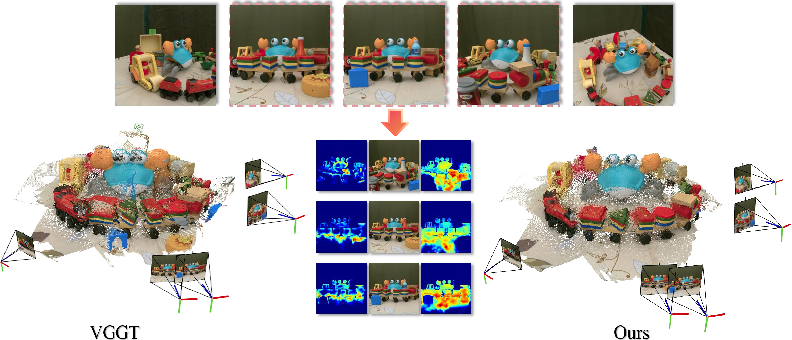
- Confidence map: A per-pixel measure of prediction reliability used to filter outputs. "we visualize (1) the attention map, (2) the confidence map, and (3) the reconstructed point cloud"
- Cosine learning rate scheduler: A schedule that varies the learning rate following a cosine curve over training. "Training uses AdamW optimizer with a cosine learning rate scheduler for 50 epochs."
- Cross-view Consistency Loss: A training objective that encourages feature consistency across different views of the same scene. "and a Cross-View Consistency Loss to reinforce the consistency of geometric features."
- DINO encoders: Self-supervised vision transformers that produce robust visual features for downstream tasks. "embed them into patch tokens using pretrained DINO encoders~\cite{oquab2023dinov2}."
- DPT heads: Dense Prediction Transformer heads that output depth, point maps, and related dense attributes. "These dense outputs are generated by their respective DPT~\cite{ranftl2021vision} heads in VGGT"
- Distractor head: A dedicated decoder head that predicts binary distractor masks for filtering and training. "we design a distractor head that outputs binary masks to indicate which regions are distractors:"
- Distractor Suppression Loss: A training loss that reduces cross-view similarity of distractor features to prevent their influence. "a Distractor Suppression Loss to penalize the influence of distractors"
- Distractor-aware Training (DAT): A finetuning strategy that modifies attention to separate clean static features from distractor-contaminated ones. "Specifically, we introduce a Distractor-aware Training (DAT), a strategy that fine-tunes the attention mechanism"
- Epipolar constraints: Geometric constraints relating corresponding points across views given camera poses; violations indicate motion or mismatches. "detecting attention to tokens violating epipolar constraints (e.g., from motion) via aggregated cross-attention maps."
- Feed-forward network: A model that produces outputs in a single forward pass without per-scene iterative optimization. "The resulting VGTW model is a feed-forward network that directly outputs clean, distractor-free point clouds."
- Gradient checkpointing: A memory-saving technique that recomputes intermediate activations during backpropagation. "We employ bfloat16 precision, gradient checkpointing to improve GPU memory and computational efficiency."
- Hinge-like loss: A margin-based loss that penalizes similarity above or below a threshold, used here to control distractor feature similarity. "This hinge-like loss mitigates the polluting effect of distractors on cross-view reasoning by keeping their similarities below the margin."
- Low-Rank Adaptation (LoRA): A parameter-efficient finetuning method that injects low-rank updates into existing weights. "Specifically, we employ Low-Rank Adaptation (LoRA)~\cite{hu2022lora} for this fine-tuning"
- Multi-view 3D reconstruction: Recovering 3D geometry from multiple images of a scene captured from different viewpoints. "Current end-to-end multi-view 3D reconstruction methods achieve impressive results"
- NeRF (Neural Radiance Fields): A neural volumetric representation that models scene appearance and geometry for novel view synthesis. "Prior methods based on NeRF~\cite{martin2021nerf,ren2024nerf} and 3D Gaussian Splatting"
- Normal consistency (NC): A metric evaluating alignment of surface normals between predicted and ground-truth geometry. "Metrics include accuracy (Acc ), completeness (Comp ), and normal consistency (NC )"
- Permutation-equivariant network: A model whose outputs are invariant to input order permutations, used to handle unordered multi-view inputs. "~\cite{wang2025pi}, which employs a permutation-equivariant network for geometry learning without a fixed reference."
- Point map: A dense mapping from image pixels to 3D points in a camera frame. "process image pairs to predict dense pointmaps aligned to a reference camera frame"
- Re-projection: Projecting a 3D point back into another image using relative camera pose. "then re-projected to image via the relative pose "
- Triplane sampling: A technique that samples features from three orthogonal planes to efficiently encode 3D information. "aligns pixel appearance features to local Gaussians through triplane sampling from reference images"
- Transient distractors: Dynamic or inconsistent scene elements (e.g., moving objects) that break cross-view consistency. "real-world captures frequently contain transient distractors, such as moving people or vehicles"
- Umeyama alignment: A similarity transform estimation method for aligning point clouds via least squares. "computed after Umeyama alignment of predicted point clouds to ground truth."
- View-wise and global self-attention: Attention layers that aggregate information within each view and across all views in the sequence. "through a series of interleaved view-wise and global self-attention layers"
- Volumetric field: A continuous 3D field representing scene density and color used in volumetric rendering. "via a separate volumetric field with uncertainty estimation."
Collections
Sign up for free to add this paper to one or more collections.

