- The paper introduces a novel SU(1,1) interferometer scheme using Rydberg atoms to achieve vector polarimetry with sensitivity beyond the standard quantum limit.
- It employs dual coherent and hybrid coherent/squeezed vacuum inputs to map polarization angles via absorption indices, achieving sub-microdegree sensitivity.
- Results highlight practical tunability and robustness for advanced RF field sensing applications in quantum communications and radar technologies.
Standard-Quantum-Limit-Surpassing Vector Polarimetry Using Rydberg Atoms in an SU(1,1) Interferometer
Introduction and Background
This work establishes a rigorous framework for vector polarimetry that leverages Rydberg atoms within an SU(1,1) quantum interferometer, achieving polarization-angle sensitivities clearly surpassing the standard quantum limit (SQL). Rydberg atoms, noted for their exaggerated electromagnetic properties and tunable quantum coherence, have become critical in advanced electromagnetic field sensing, including amplitude, phase, and, increasingly, vector-polarimetric (direction-sensitive) applications.
Conventional Rydberg-atom polarimetry protocols are fundamentally limited by technical and quantum noises, constraining the achievable sensitivity. This paper systematically integrates Rydberg-atom physics with quantum metrological tools, harnessing the nonclassical correlations accessible through SU(1,1) interferometry to break the SQL for polarimetric measurements, particularly in the weak-field regime crucial for applications such as passive radar and electromagnetic intelligence.
SU(1,1) Interferometry for Absorptive Vector Polarimetry
The proposed protocol embeds the Rydberg atomic system in one arm of an SU(1,1) interferometer. The atomic medium introduces both a polarization-dependent phase and amplitude attenuation, which are mapped onto homodyne-detected quadratures at the interferometer output. This configuration models the atomic ensemble as a dispersive and absorptive element, effectively realizing a "quantum-absorbing beam splitter."
A schematic of the interferometric setup, illustrating state preparation, phase manipulation, and detection, is shown in (Figure 1).
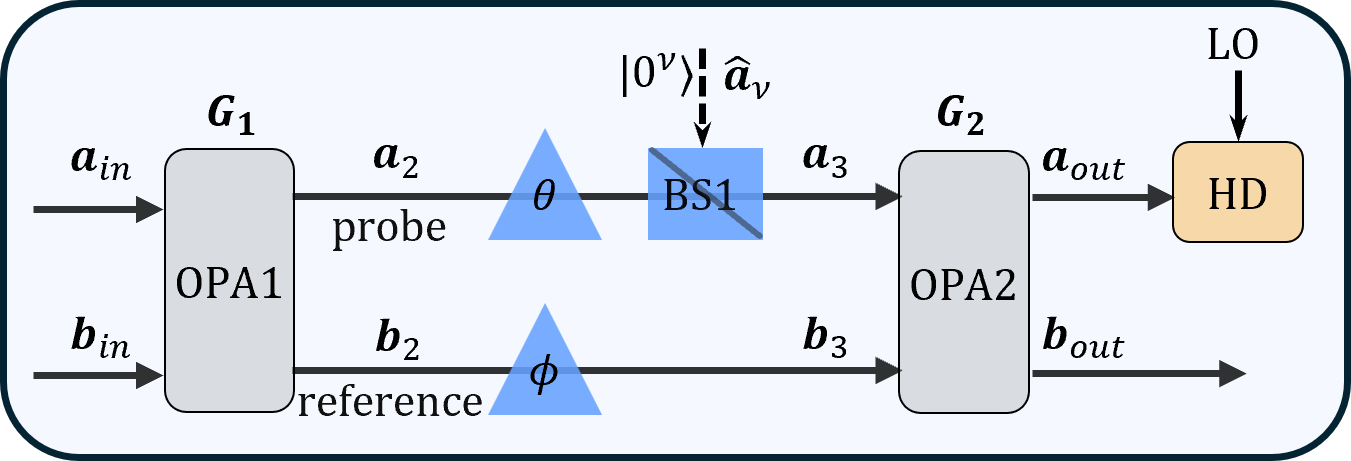
Figure 1: Schematic of the absorptive SU(1,1) interferometric measurement incorporating the Rydberg ensemble as a quantum phase and absorption element.
Two complementary input strategies are explored: dual coherent inputs, and hybrid coherent/squeezed-vacuum inputs. The SU(1,1) architecture enables amplification of both the signal and quantum correlations between interferometer arms, resulting in noise suppression and quantum-enhanced sensitivity when extracting the polarization state—quantified as two angles (θp,θa)—of an incident RF field.
Polarization Mapping and Quantum Probing in a Four-Level Rydberg System
The measurement relies on a static magnetic field to set a quantization axis, lifting Zeeman degeneracy and producing four independent Rydberg transitions, each selectively dipole-coupled to one of the electric field's spherical polarization components. As the polarization vector of the RF field is varied, the coupling strengths modulate the absorption index, which is then precisely inferred via homodyne measurement.
The configuration of the Rydberg atomic levels, field geometry, and selection rules are depicted in (Figure 2).
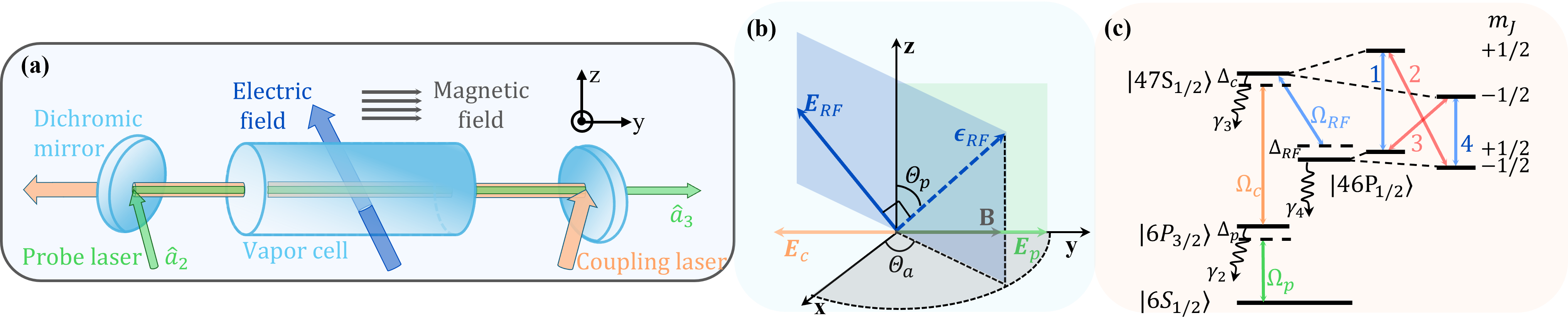
Figure 2: (a) RAP schematic, (b) polarization vector definition by θa and θp, (c) Zeeman-split Λ-type four-level scheme illustrating transition pathways coupled to specific RF polarization components.
The explicit mapping from polarization angles to measurable absorption is highly nonlinear yet monotonic over a controllable domain (Figure 3), enabling unique extraction of vector polarization information through error-propagated or independent single-parameter estimation protocols.
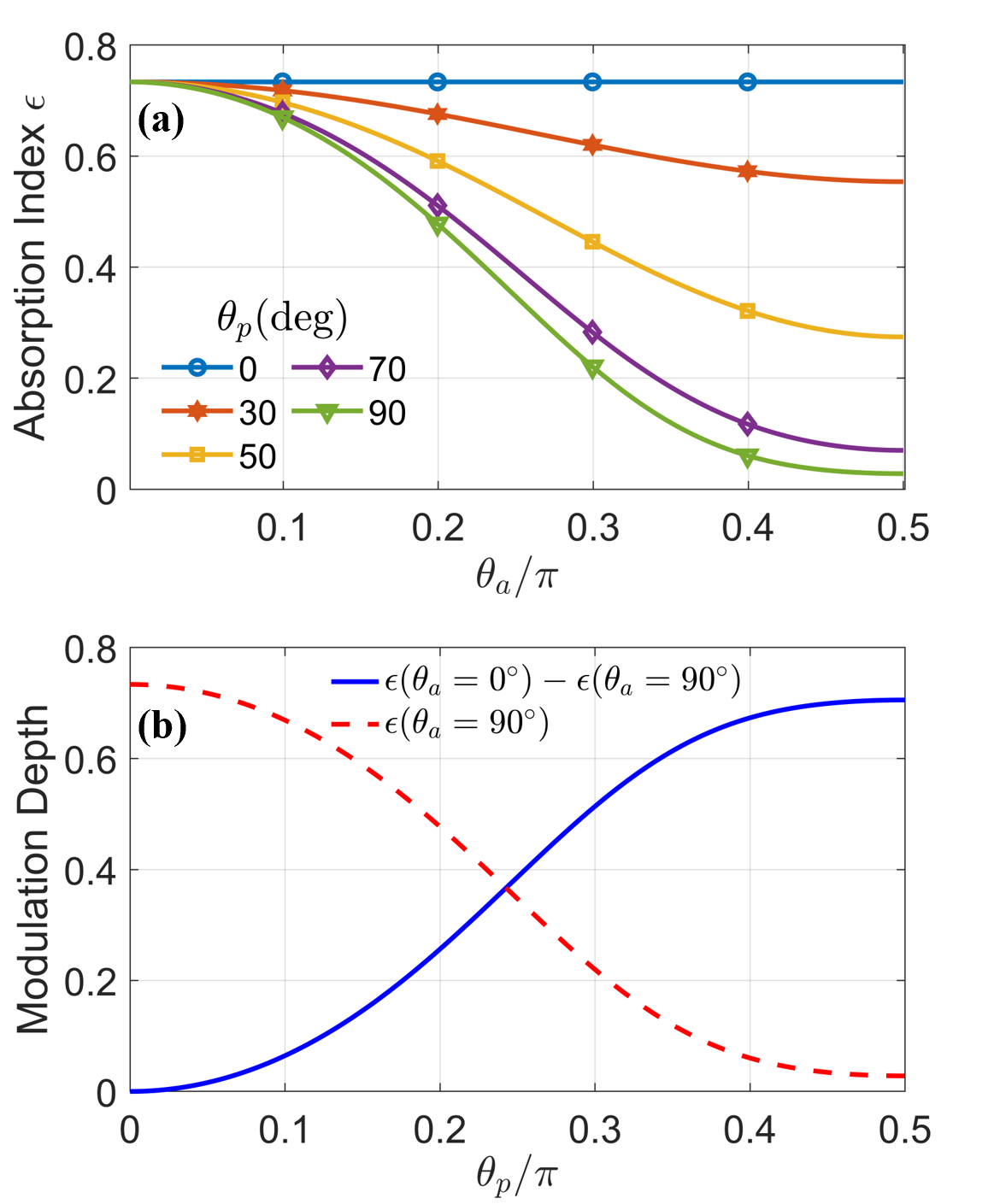
Figure 3: (a) Absorption index ϵ as a joint function of polarization angles, (b) modulation depth and single-point index as a function of polar angle.
The rotation experiments required to isolate each parameter are illustrated in (Figure 4).
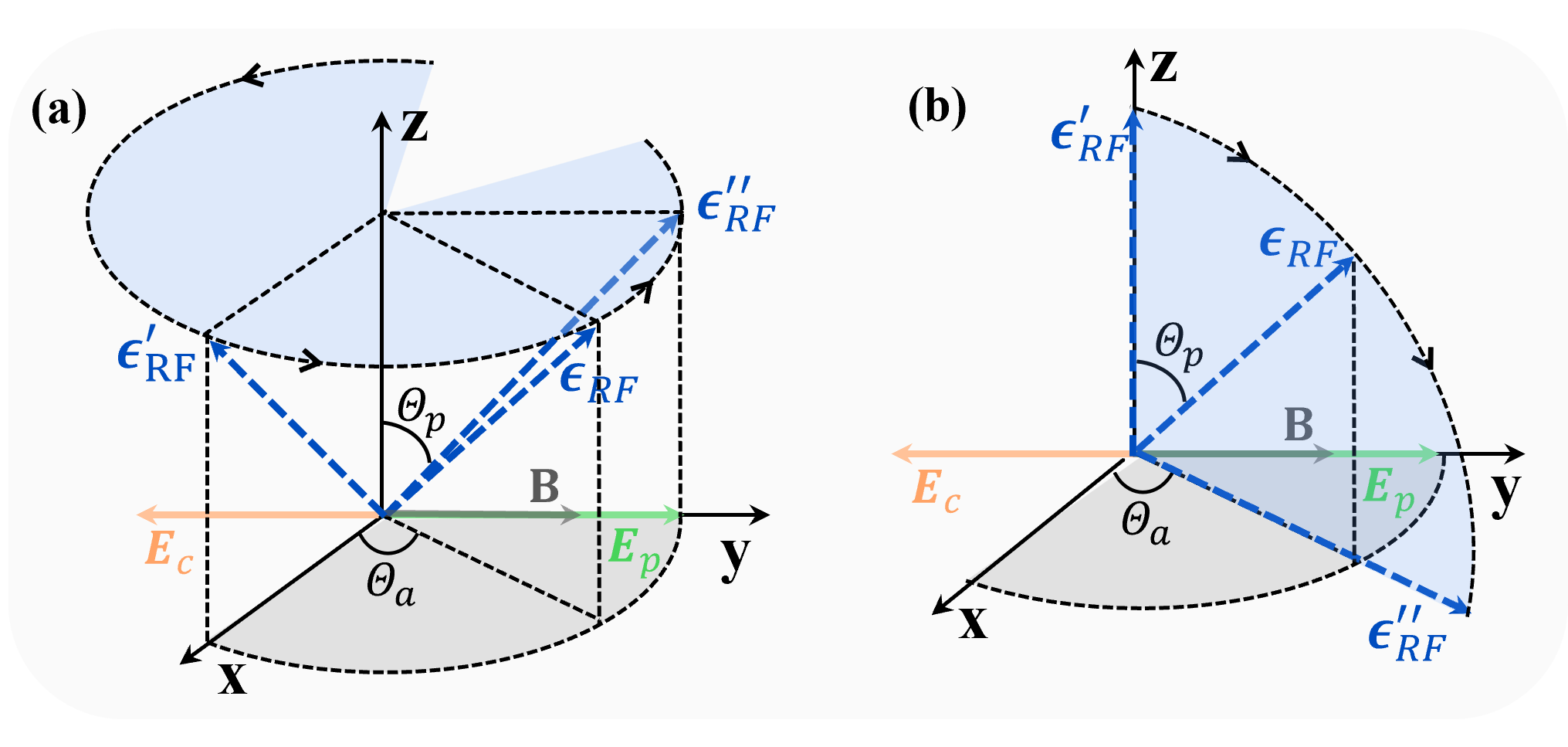
Figure 4: Polarization vector rotations for discriminative measurement of θa and θp.
Quantum-Limited Sensitivity and Parameter Estimation
Theoretical analysis yields analytic forms for both the SQL and the Quantum Cramér–Rao bound (QCRB) for vector-polarimetric estimation, computed via the quantum Fisher information for the relevant probe states. Sensitivity expressions assign key roles to both the probe amplitude (number of injected photons) and, for the nonclassical case, the input squeezing parameter.
Numerical results establish that, for both dual coherent input (Figure 5a) and coherent + squeezed vacuum input (Figure 5b), the quantum protocol achieves polarization angle sensitivities well below 10−3 degrees across most of the accessible angular range, with minima below 10−6 degrees around optimal angles. In the squeezed-vacuum-enhanced scenario, the sub-SQL regime spans up to 0.42π radians; for dual-coherent input, about θa0 radians.
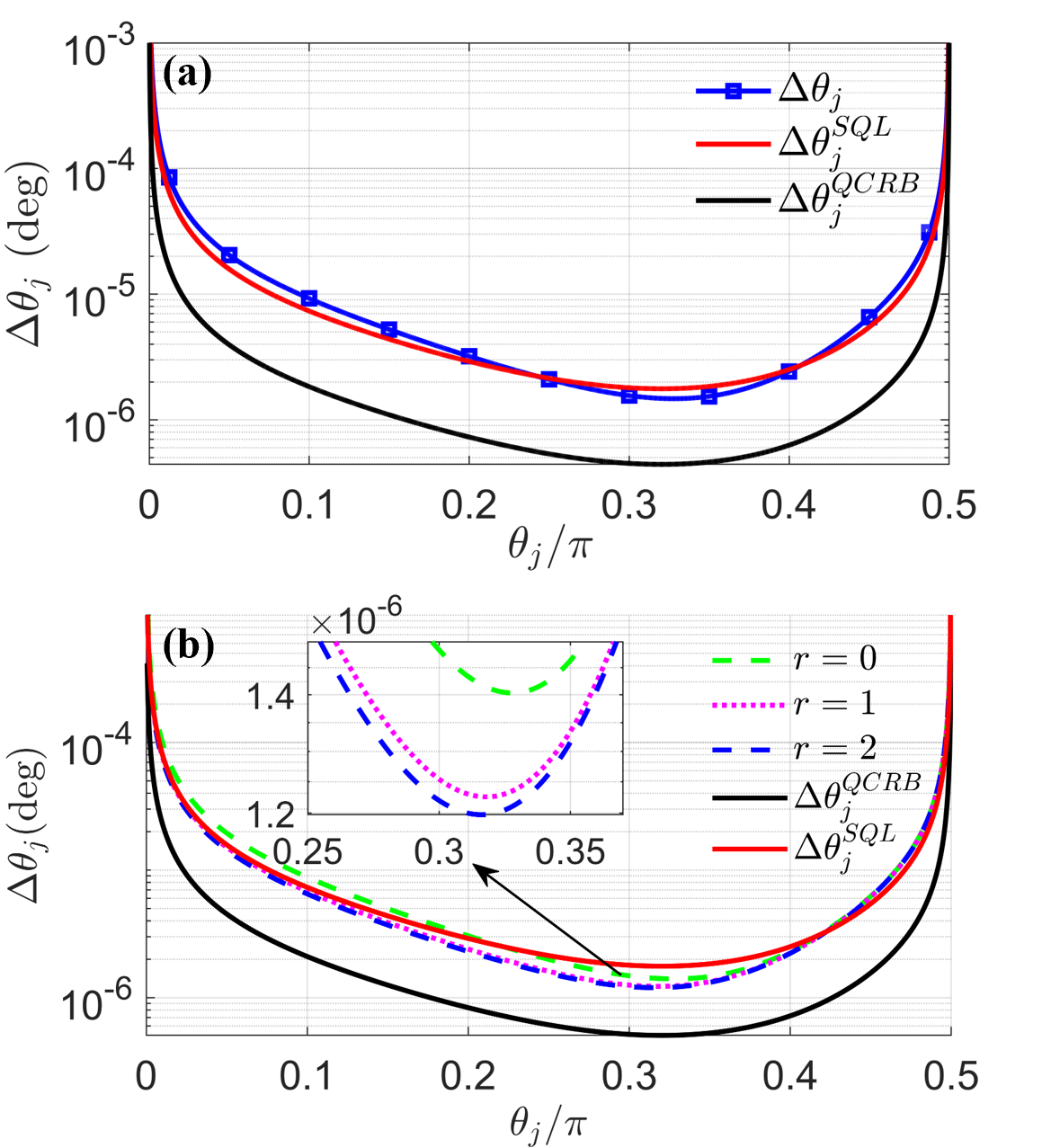
Figure 5: (a) Polarization angle sensitivity versus angle for dual-coherent-state input; (b) Sensitivity versus angle for coherent plus squeezed vacuum input with variable squeeze parameter θa1.
The optimality and tunability of the sensitive region are further analyzed in the context of practical system parameters: laser amplitude, squeezing, and atomic and optical detunings (Figure 6 and Figure 7). Maximum sensitivity is realized when the magnetic field and coupling laser are tuned close to the resonance of a selected atomic pathway, exploiting the field-induced level splitting.
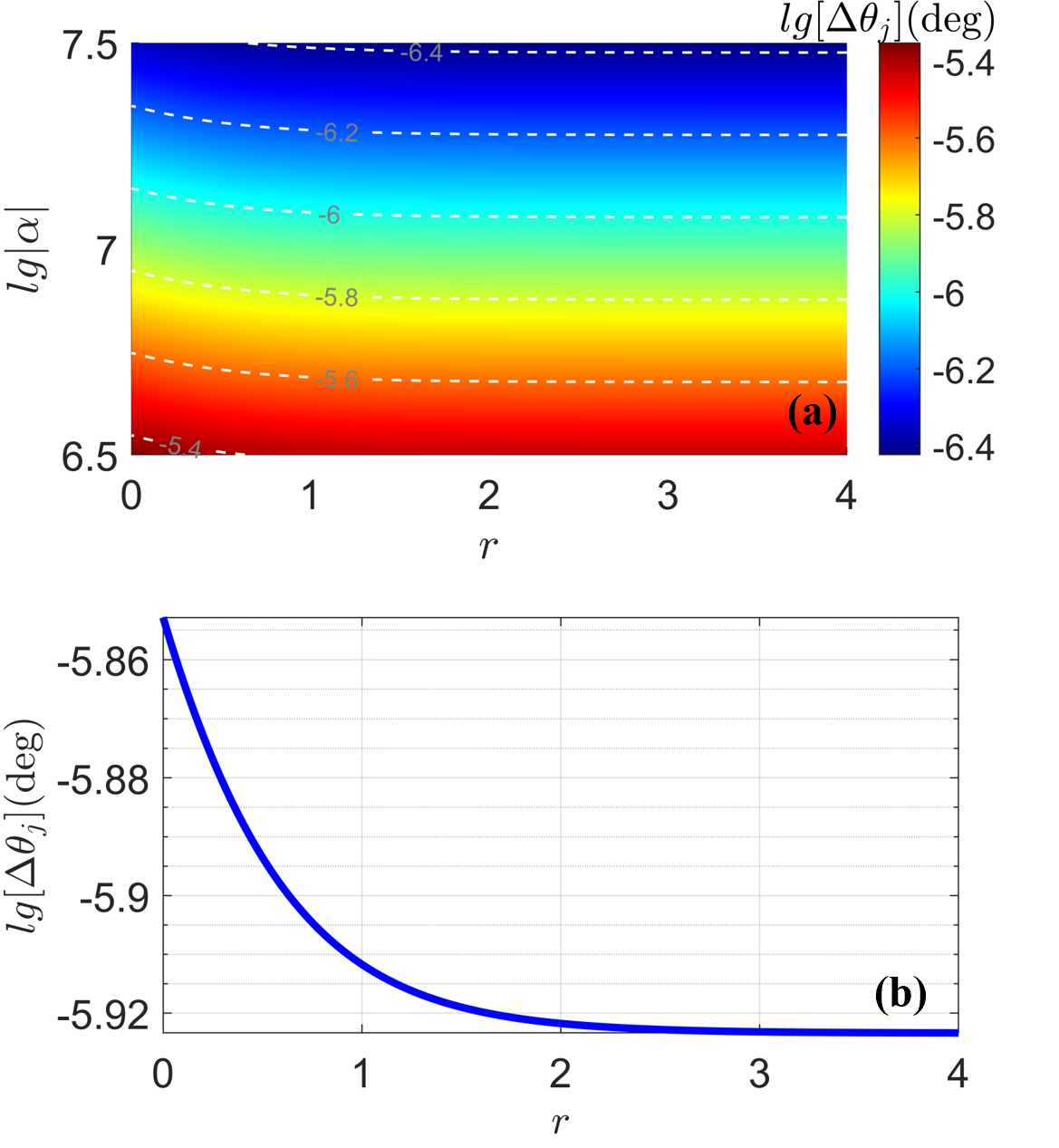
Figure 6: Optimal sensitivity θa2 mapped over amplitude and squeezing parameter space; (b) sensitivity saturation with increasing θa3 at fixed amplitude.
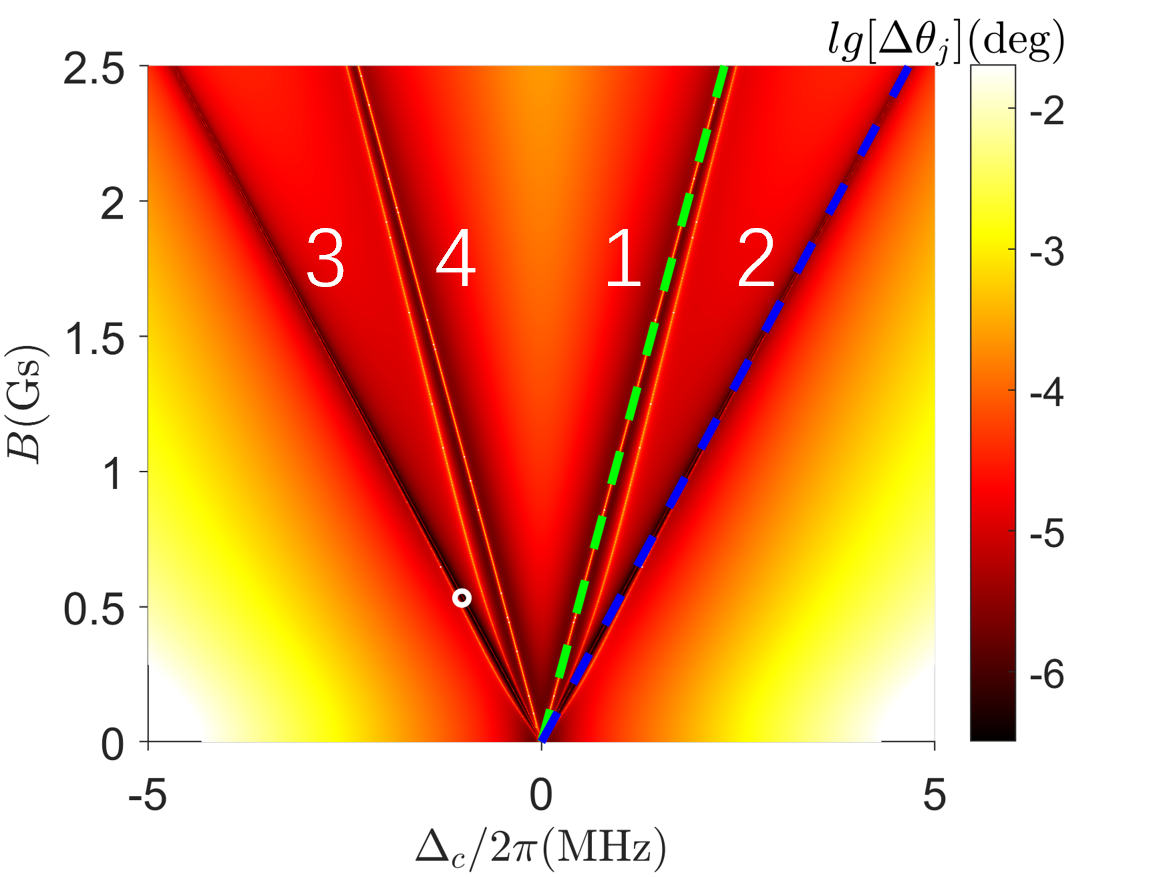
Figure 7: Sensitivity landscape as a function of magnetic field strength θa4 and detuning θa5, showing resonance-tracing for optimal operation.
Implications and Future Prospects
This protocol generalizes quantum-enhanced metrology to vector polarimetry using Rydberg atomic ensembles, demonstrating significant SQL-surpassing capability for real, weak RF fields without recourse to strong-field AT splitting or cavity enhancement. The capability to independently and precisely resolve polarization direction parameters, decoupled from amplitude estimation, consolidates the feasibility of Rydberg-based sensors for advanced quantum-enabled RF field mapping and DOA localization.
The flexibility in angular placement of the optimal-sensitivity region (through static field and laser tuning), along with evident compatibility with low-power, nonclassical light sources, suggests practical utility in quantum communications, radar, and metrology infrastructures. The methodology can be extended to higher dimensions, more complex polarization spaces, or entanglement-enabled sensor arrays.
The results clarify that, even in the presence of photon shot noise and technical limitations, quantum resources such as squeezing and entanglement can yield tangible improvements in the metrological performance of atomic vector sensors.
Conclusion
This paper rigorously develops and validates a protocol for Rydberg-atom-mediated vector polarimetry using SU(1,1) interferometry, achieving sensitivities that surpass the SQL by leveraging quantum correlations and optimized measurement sequences. Both theoretical and simulation evidence underpin the practical feasibility of sub-θa6degree sensitivity across a wide operational parameter space. This advance provides a foundation for quantum-enhanced electromagnetic metrology that is robust, tunable, and broadly extensible to related sensing paradigms.