Flow Reasoning Models: Scaling Reasoning Through Iterative Self-Refinement
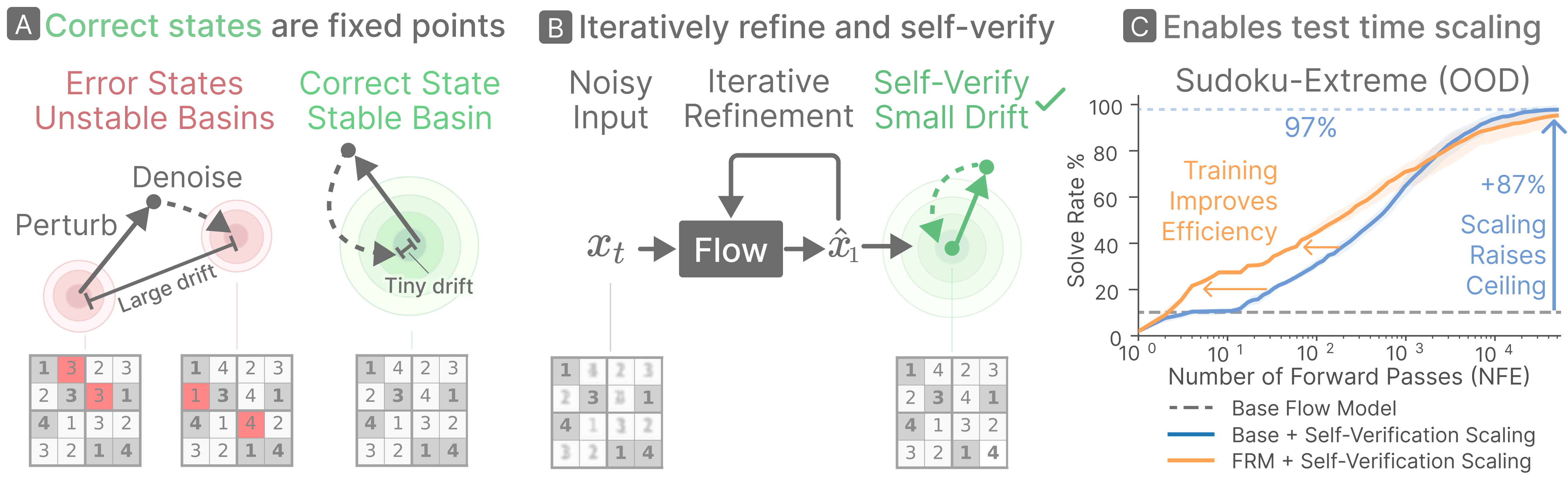
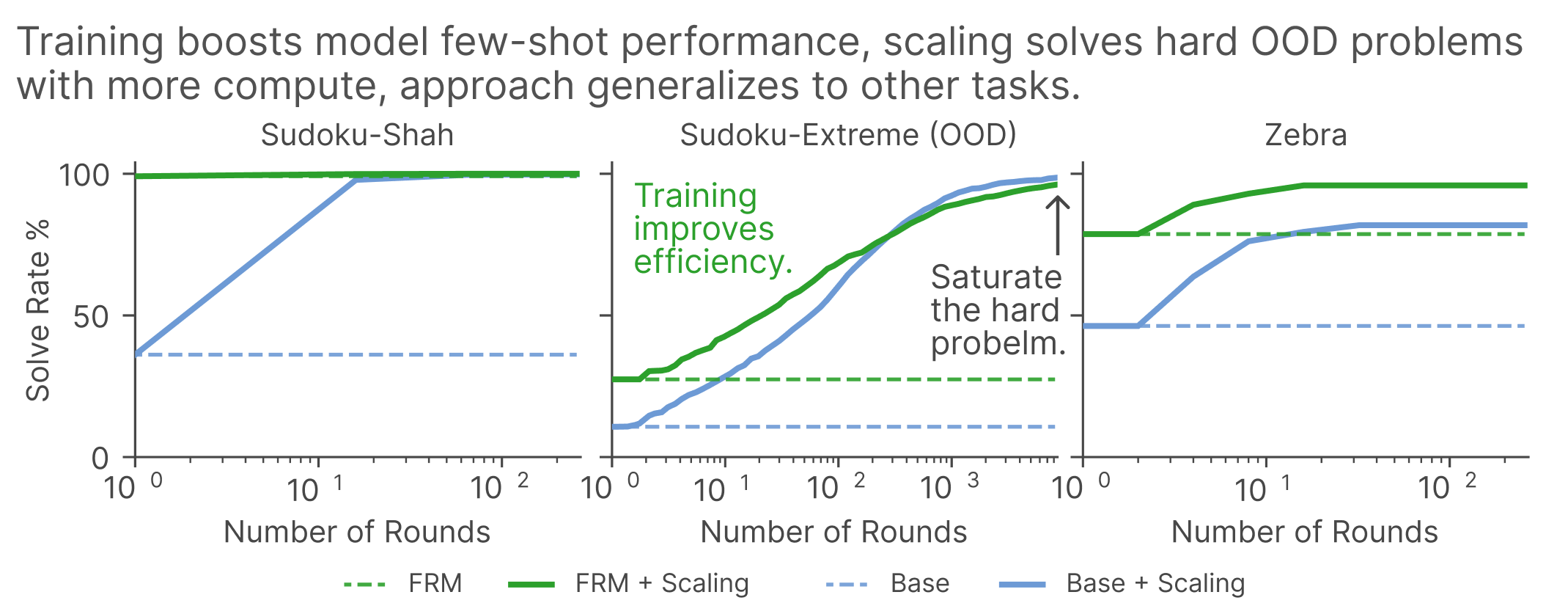
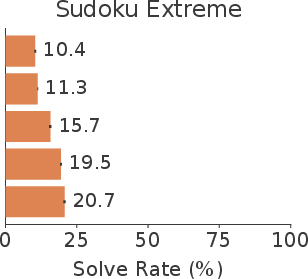
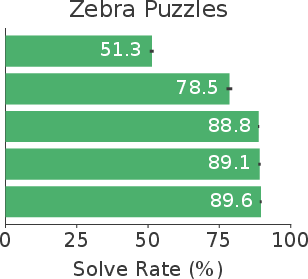
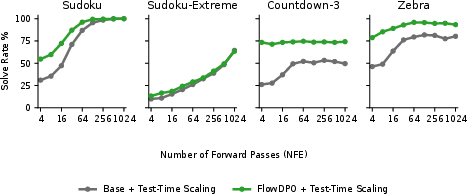
Abstract: Discrete flow models have recently shown promising performance on few-step text generation; however, when naively applied to structured reasoning tasks such as Sudoku and Zebra puzzles, they converge confidently to incorrect answers (solving only $\sim$36% of Sudoku puzzles). We introduce Flow Reasoning Models (FRMs), a training and test-time-scaling framework for structured reasoning with flow models. We make the observation that, despite their poor solve rate, flow models can act as their own verifiers. A correct answer is a stable fixed point of the denoising dynamics, returning to itself when re-noised and re-solved. This enables a test-time-scaling paradigm: propose many candidate solutions and keep those that are dynamically stable, which alone reaches high solve rates on Sudoku-Shah (~$100\%$) and Zebra ($95.9\%$). This even generalizes to harder out-of-distribution puzzles like Sudoku-Extreme ($96.1\%$), without ever training on that distribution. This pure search, however, wastes a great deal of computation generating incorrect candidate solutions. We therefore design a training recipe to improve the base model's efficiency. First, we train flow models with a self-conditioning channel and close it at inference, letting them refine their own past predictions. Second, we train models to avoid their own failed generations using direct preference optimization. These changes substantially improve the base model's efficiency, letting it reach $99.2\%$ on Sudoku in just $7$ forward passes, over $8\times$ fewer than the strongest matched masked-diffusion baseline we compare needs for the same accuracy. When combined with test-time scaling, this lets flow models solve hard out-of-distribution puzzles (e.g. Sudoku-Extreme) far more efficiently.
Paper Prompts
Sign up for free to create and run prompts on this paper using GPT-5.
Top Community Prompts
Explain it Like I'm 14
Easy-to-Understand Explanation of “Flow Reasoning Models: Scaling Reasoning Through Iterative Self-Refinement”
What is this paper about?
This paper is about teaching an AI to solve logic puzzles (like Sudoku and the Zebra/Einstein puzzle) more reliably and efficiently. The authors use a kind of AI called a “flow model” and show two big ideas:
- The AI can check its own answers without needing a separate checker.
- With some clever training and a “try, refine, and verify” process, the AI becomes both very accurate and much faster.
What questions were the researchers trying to answer?
The team focused on simple, practical questions:
- Can flow-based AIs (which usually generate answers in a few steps) handle structured reasoning tasks like Sudoku?
- Even if they make mistakes at first, can these AIs tell when their answers are right or wrong on their own?
- Can we make them more efficient—solving puzzles correctly with fewer attempts—by training them to learn from their own mistakes?
How did they do it? (With simple analogies)
Think of solving a puzzle like finding a marble’s resting spot in a landscape of bowls:
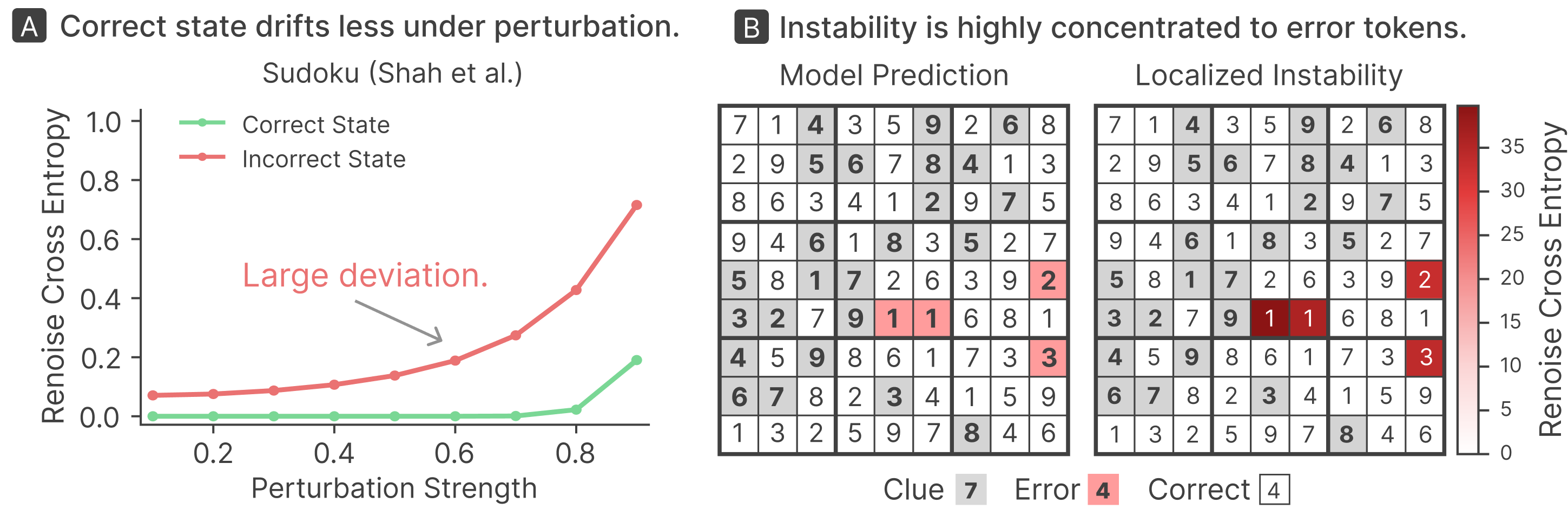
- A correct solution is like a marble sitting at the bottom of a bowl—if you poke it (add a little noise) and let go, it rolls back to the same place. That’s a “stable fixed point.”
- A wrong solution is like a marble balanced on a bump—if you poke it, it rolls away to somewhere else. That’s “unstable.”
The researchers used three key ideas:
- Self-verification (the “wobble test”):
- After the AI finishes a puzzle, they “shake” the answer a bit and see if, when the AI tries to fix it, it returns to the same answer.
- If it returns to the same result, it’s probably right. If it changes a lot, it’s probably wrong.
- This lets the AI act as its own judge without needing a separate grading system at test time.
- Iterative self-refinement (the AI’s “short-term memory”):
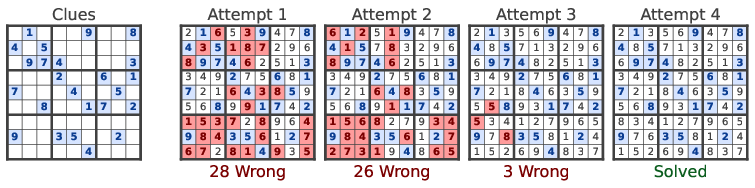
- Instead of making one guess and stopping, the AI remembers its last guess, uses it as a hint, and refines it step by step—like rewriting a draft to fix mistakes.
- This “memory” is called self-conditioning: each step feeds the previous step’s prediction back into the model, nudging it toward a stable, correct answer.
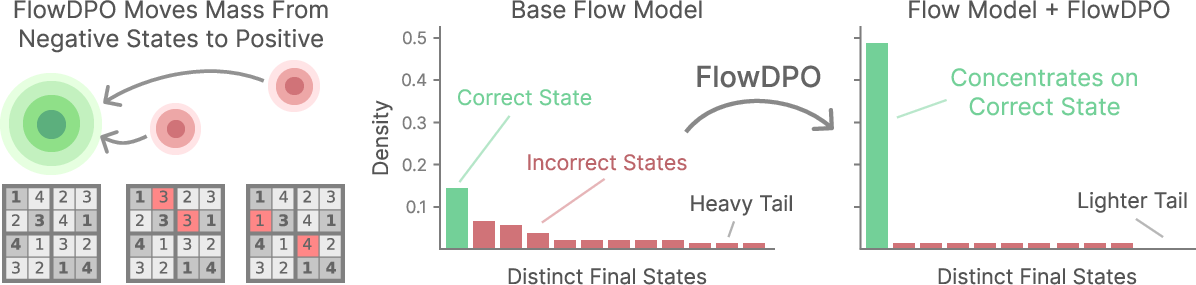
- Learning from its own mistakes (FlowDPO: “prefer the better one” training):
- The AI generates some wrong answers and compares them directly to the correct answer.
- It then learns to prefer the correct answer over those specific wrong ones—especially on the exact cells/tokens where they differ—so it avoids making the same mistakes again.
- This is like practicing the tricky parts of a math problem, not redoing the entire sheet.
To make this practical, the researchers used a two-loop process:
- Inner loop: refine one attempt using self-conditioning until it settles.
- Outer loop: if the stability “wobble test” says the answer is unstable, restart with a new attempt and try again—only keeping answers that pass the stability check.
What did they find, and why does it matter?
The results are strong and surprisingly simple:
- Flow models can be their own verifiers:
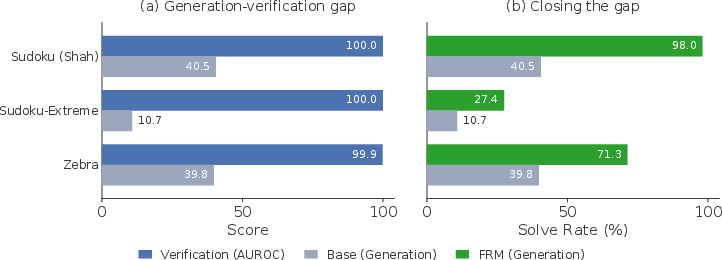
- Even when the AI’s first try is often wrong, its “wobble test” is excellent at telling correct from incorrect answers.
- This creates a “generation–verification gap”: it’s much better at checking answers than at guessing them on the first try—so checking multiple guesses and keeping only stable ones works really well.
- Test-time scaling (try more, keep stable ones) achieves very high accuracy:
- Sudoku: 100% solved with enough attempts.
- Zebra (logic puzzle): 95.9%.
- Harder, unseen Sudoku puzzles (“Sudoku-Extreme”): about 96.1%, even though the model was never trained on those harder puzzles.
- Training for self-refinement and preferences cuts compute a lot:
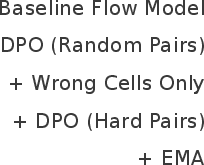
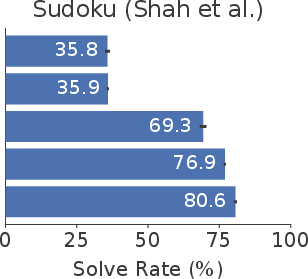
- Adding self-conditioning (memory) and FlowDPO (learning from its own wrong answers) made the model much more efficient.
- On standard Sudoku, the improved model reached 99.2% accuracy in about 7 forward passes—over 8 times fewer steps than a strong diffusion-based baseline (which needed ~57 passes for the same accuracy).
- Single-try accuracy also jumped a lot (for one training setup, from ~36% to ~81%), meaning the model gets it right much more often without needing many retries.
Why this matters:
- Accuracy: It solves tough, checkable logic tasks very reliably.
- Efficiency: It uses far fewer compute steps to get there, saving time and energy.
- Generalization: It works surprisingly well on harder puzzles it never trained on, thanks to the stability-based verification.
- Fewer external tools: It doesn’t need a separate learned “verifier”—it relies on its own dynamics to judge stability.
What could this mean for the future?
- Smarter puzzle and planning tools: The same approach could help with other tasks where answers can be checked (like scheduling, constraint solving, or certain math problems).
- More reliable AI systems: The “wobble test” offers a simple way to tell if an answer is solid, improving trust in AI outputs without extra models or labels at test time.
- Better use of compute: Iterative self-refinement and preference training cut the cost of reaching high accuracy, which is important for scaling AI to more complex tasks.
- A new way to think about reasoning: Instead of “predicting a next word,” this shows how AI can “settle into” correct solutions by refining toward stable fixed points—like finding the bottom of the right bowl.
Overall, the paper shows that by letting an AI refine its own answers and judge their stability, we can get both high accuracy and efficiency on logic-heavy problems—without relying on extra verifiers or tons of extra labels.
Knowledge Gaps
Knowledge gaps, limitations, and open questions
Below is a concise, actionable list of what remains uncertain or unexplored in the paper.
- Task generality beyond Sudoku/Zebra: Does fixed-point stability reliably correlate with correctness on broader reasoning tasks (e.g., arithmetic proofs, code synthesis, SAT/graph problems, long-form QA) with larger vocabularies and much longer sequences?
- Multiple valid solutions: How do FRMs behave on tasks with non-unique valid solutions where “exact match” is inappropriate? Can stability-based acceptance be adapted to set-valued correctness without gold references?
- Dependence on checkability and labels: FlowDPO requires gold solutions to define wrong-cell masks. Can the method be extended to weak/no-label regimes using self-identified unstable cells, unsupervised constraints, or verifier-free preference signals?
- Robustness far beyond in-task difficulty shifts: OOD tests are limited to Sudoku-Extreme. How does the approach fare under different rule sets, puzzle sizes (e.g., 16×16), changed constraint structures, noisy/contradictory clues, or entirely different domains?
- Theoretical guarantees: Under what conditions are correct solutions provably stable fixed points of the discrete flow dynamics? Can we characterize convergence (or cycling) of the self-conditioning loop and bound false-stable wrong attractors?
- Failure-mode characterization: When do incorrect completions form stable attractors (false positives), or correct states appear unstable (false negatives)? What patterns or data properties induce these cases and how can training mitigate them?
- Hyperparameter sensitivity of the verifier: The renoise-CE score depends on the re-noise time , number of draws , and acceptance threshold . How sensitive is performance to these, and can be calibrated automatically without labels?
- Noise path and schedule design: The verifier uses a straight-path interpolant and fixed . Do alternative paths/schedules, multi- scoring, or adaptive selection improve discriminative power and robustness?
- Compute and latency trade-offs: While NFEs are reported, wall-clock time, memory, and energy are not. How do FRMs perform under strict latency constraints, and can adaptive halting schedule compute dynamically across instances?
- Scaling to long sequences and large models: Self-conditioning feeds previous logits at each step; what are the memory/latency implications for thousands of tokens and larger parameter counts? Are there architectural tricks to keep compute linear?
- Interaction with search: Can the stability score drive structured search (e.g., tree search, beam, MCTS) using cell-level discrepancy as a heuristic, and does this outperform verify-and-restart/passive best-of-?
- Comparisons to strong autoregressive baselines: Results focus on masked-diffusion comparisons. How do FRMs compare against modern AR LMs with CoT, majority vote, or process/outcome verifiers at matched compute and parameter scales?
- Generality of cell-local signals: Wrong-cell localization works for grid tasks with local constraints. Does a comparable localization signal exist for non-grid, compositional reasoning (e.g., program traces, proof steps)?
- Adaptive budgets and stopping: Verify-and-restart uses fixed budgets. Can one learn instance-wise stopping rules or budget allocation policies that optimize expected solve rate under compute constraints?
- Stability-score calibration: Can be mapped to a probability of correctness with reliability guarantees (e.g., conformal methods), enabling principled acceptance without task-specific tuning?
- Mining hard negatives at scale: The FlowDPO loop depends on mining confident mistakes; how does mining cost grow with output dimension, and what sampling/priority heuristics maximize training signal per compute?
- Preference-learning design choices: What is the impact of EMA reference decay, KL regularization, or alternative preference objectives (e.g., diffusion ELBO surrogates) on stability, calibration, and generalization?
- Interaction of self-conditioning and verifier: The verifier resets self-conditioning during re-solves; does allowing (or partially retaining) self-conditioning change stability discrimination or lead to gaming/overfitting?
- Coverage limits and support expansion: Test-time scaling saturates at the generator’s support. What training or proposal strategies expand support (not just reweight it) to raise ceilings on hard OOD distributions?
- Cycles and non-convergent dynamics: Do cyclic denoising attractors occur in FRMs for discrete text, and how can cycles be detected and broken during inference?
- Targeted repair vs. global restart: The cell-level renoise-CE highlights unstable positions, yet the algorithm opts to restart. Can targeted edits guided by instability reduce compute relative to restarts?
- Argmax vs. stochastic inner-loop updates: The inner loop uses argmax decoding; does controlled stochasticity during refinement help escape wrong basins without hurting convergence?
- Sensitivity to clue clamping: The approach assumes accurately clamped clues; how robust is it to noisy, missing, or adversarially perturbed clues?
- Safety/adversarial robustness: Can an adversary craft instances that induce stable but wrong attractors fooling the stability verifier, and what defenses (e.g., ensemble verifiers, randomized ) are effective?
- Reproducibility across seeds and implementations: The paper reports means/SEMs but lacks broader stability analyses across architectures/integrators; how sensitive are results to optimizer, discretization schedule, and embedding choices?
Practical Applications
Immediate Applications
The following applications can be deployed now by leveraging the paper’s core ideas: self-conditioned refinement loops for discrete flow models, stability-based self-verification via re-noise and re-solve (renoise-CE), and FlowDPO preference training on self-mined mistakes localized to wrong cells.
- Solver-augmented assistants for constraint satisfaction (software, operations research, education)
- Use FRM-style “verify-and-restart” loops to solve mid-scale CSPs that resemble Sudoku/Zebra: timetabling (classroom/exam schedules), shift rostering, small logistics assignments (vehicle-to-route, pick-slotting variants), and resource-to-task matching with hard constraints.
- Workflow: propose many solutions with a low-step self-conditioned flow model; accept only candidates with low stability score (renoise-CE) within a compute budget; optionally pass survivors to an external checker or SAT/SMT solver for final validation.
- Assumptions/dependencies: problem encodable as discrete tokens with a known mask/clamp interface for given clues/constraints; a trained discrete flow LM; thresholds for acceptance (τ) calibrated; performance may degrade on very large or high-arity CSPs without further scaling.
- Reliability gating for structured generation (software, MLOps, enterprise applications)
- Add a stability-based self-verifier as a lightweight gate before committing outputs from generative systems that produce structured artifacts (e.g., forms, tables, schemas).
- Tools/products: a “renoise-CE confidence head” that flags brittle outputs; a “verify-and-restart” wrapper for production inference to meet SLA-level accuracy with bounded compute.
- Assumptions: availability of a flow or diffusion model with accessible denoising logits; outputs must be re-encodable for perturbation; budget for extra forward passes.
- Spreadsheet, database, and form completion under constraints (software, productivity, daily life)
- Auto-complete missing cells while respecting uniqueness, type, and cross-field rules (akin to Zebra-like attribute grids).
- Tools: an add-in that iteratively refines candidate tables, accepting only stability-verified completions; highlight cells with high renoise-CE to focus user review.
- Assumptions: rules expressible as masked positions and clamped fields; tokenization of discrete domains; small to medium table sizes.
- Data cleaning and constraint-consistent imputation (data engineering, analytics)
- Fill missing categorical values and correct inconsistent entries by proposing candidates that are dynamically stable under the FRM loop, prioritizing cells with high instability for human review.
- Assumptions: datasets with explicit constraints (keys, uniqueness, allowed value sets); domain embeddings that make re-noising meaningful.
- Test-time scaling as a configurable accuracy–compute trade-off (MLOps, platform engineering)
- Expose a knob for number of restarts and verifier passes to reach target accuracy/SLA; log renoise-CE as a decision-time quality metric for A/B testing and alerting.
- Assumptions: production infra supporting multi-pass inference; monitoring to prevent budget overruns; careful τ calibration per task.
- Educational tutoring for logic reasoning (education, consumer apps)
- Interactive puzzle solvers that show iterative refinement (cell errors shrinking over steps) and explain which cells are unstable to guide learners.
- Assumptions: tasks similar to Sudoku/Zebra; UI to surface step-by-step refinements; modest model sizes suffice.
- Preference training to reduce common failure modes (ML tooling, research-to-production)
- Use FlowDPO-style training on self-mined mistakes to increase single-shot pass@1 and reduce compute needed at inference; localize contrast to “wrong cells” to avoid fighting CE on already-correct tokens.
- Tools: a “FlowDPO trainer” that mines hard negatives on-policy, applies EMA-referenced preference updates, and logs proposal coverage curves to validate basin-deepening.
- Assumptions: training data with gold completions or high-quality synthetic labels; stable replay/mining pipeline; model access to token-level logits.
- Hybrid FRM + classical solvers (software, operations research)
- Use FRM to quickly propose few consistent candidates; validate and/or finalize with OR-Tools/SAT/SMT for exactness. This can dramatically cut solver search space.
- Assumptions: interface to export candidates/constraints; classical solver availability; domain mapping between tokenized states and solver variables.
Long-Term Applications
These applications require further research, scaling, domain adaptation, or integration with external systems beyond what is demonstrated on puzzles.
- Safety-critical planning with self-verification (robotics, autonomous systems, aerospace)
- Apply stability-as-correctness to plan validation: accept only plans that are attractors under re-perturbation of internal state representations; restart otherwise.
- Potential products: “self-verifying planner” modules for task/motion planning stacks.
- Dependencies: robust tokenization for plans; alignment of stability with safety metrics; guarantee that spurious stable fixed points are rare; stronger OOD robustness.
- Program synthesis and bug fixing with internal stability checks (software engineering)
- Use FRM-like dynamics on discrete code tokens to propose patches that remain stable under re-noise-and-re-solve; localize “wrong cells” to suspect lines for targeted edits.
- Workflows: generate multiple candidate patches; keep stability-verified ones; verify with tests/type-checkers as a second stage.
- Dependencies: pretraining on code; mapping stability signal to semantic correctness; integration with CI pipelines and test or formal verifiers.
- Scheduling and resource allocation at industrial scale (energy, manufacturing, logistics, healthcare)
- Tackle unit commitment, microgrid scheduling, nurse rostering, vehicle routing with time windows, airport gate assignment—using FRM to seed high-quality solutions and self-verify before invoking heavy-duty optimizers.
- Products: “FRM-seeded optimizer” services that cut solver time while maintaining feasibility.
- Dependencies: large-instance scaling (sequence length, vocabulary size); domain-specific tokenizations; hybrid continuous-discrete variables; guarantee feasibility under complex constraints.
- Portfolio construction and risk controls with constraint-aware generation (finance)
- Generate candidate portfolios subject to regulatory/mandate constraints and accept only those that are stable under FRM perturbations; use stability as an internal risk proxy before downstream backtesting.
- Dependencies: finance-specific encodings (assets, buckets, constraints); link between token-level stability and economic risk; strict compliance validation.
- Policy design and public resource allocation (public sector)
- Support fair, constraint-heavy allocations (school choice, housing assignments, exam scheduling) by proposing stable assignments and providing interpretable “unstable cell” diagnostics for oversight.
- Dependencies: transparent mapping of rules to model constraints; fairness and audit requirements; governance for spurious attractors and bias.
- Scientific discovery assistants for combinatorial design (academia, biotech, materials)
- Propose stable candidate designs under hard rules (e.g., ligand docking constraints, CRISPR guide selection, combinatorial library design), then validate experimentally or with physics-based models.
- Dependencies: accurate discrete encodings; coupling to simulators/assays; evidence that stability correlates with downstream validity in these domains.
- Multi-agent reasoning with fixed-point consensus (AI agents, distributed systems)
- Use stability signals to detect when a team of agents has converged to a consistent joint plan; re-perturb to test robustness; restart sub-teams that fall into spurious attractors.
- Dependencies: coordination protocols; mapping joint state to token sequences; compute budgets for repeated re-solves.
- General-purpose confidence estimation for generative AI (cross-sector)
- Extend “stability under perturbation” as a label-free verifier beyond CSPs (structured text, tables, code) to complement or replace majority-vote self-consistency and learned verifiers.
- Products: “stability score API” for gating, routing, and human-in-the-loop triage.
- Dependencies: demonstration that stability correlates with correctness in less-structured tasks; efficient perturbation schemes; calibration across domains and scales.
- Integrated learning-to-search systems (AI platforms)
- Combine FRM stability scoring with tree/graph search (e.g., ToT) to prioritize branches that lead to stable attractors; apply FlowDPO to prune known-bad basins discovered during search.
- Dependencies: tight coupling between search policy and flow denoiser; scalable credit assignment; memory/compute management for many re-solves.
- Governance, auditing, and certification of AI solvers (policy, compliance)
- Use stability-based self-verification logs as auditable evidence that a system did not “luck into” a solution; require minimum stability thresholds in regulated deployments.
- Dependencies: standardization of metrics (renoise-CE variants), thresholds, and test-time budgets; certification processes; adversarial testing against spurious stable wrong states.
Cross-cutting assumptions and dependencies
- Checkability and structure: The strongest gains arise when tasks are checkable and token-structured with clear masks/clamps; performance on open-ended language remains to be proven.
- Model class and access: Requires discrete flow or diffusion LMs with access to token-level logits and the ability to re-encode and perturb completed states.
- Compute budgets: Test-time scaling trades compute for accuracy; deployments must budget forward passes and tune acceptance thresholds.
- Stability–correctness alignment: While shown on Sudoku/Zebra (and some OOD puzzles), further evidence is needed that “stability under re-noising” reliably tracks correctness in other domains.
- Scalability: Sequence length, vocabulary size, and combinatorial explosion may require architectural scaling, domain-specific tokenization, or hybridization with exact solvers.
- Training data and mining: FlowDPO assumes availability of gold labels for mining and localizing wrong cells (or high-quality proxies), plus infrastructure for on-policy hard-negative mining and EMA-referenced training.
- Risk of spurious attractors: Some wrong solutions can be stable; production systems should combine stability checks with domain verifiers where possible.
Glossary
- AUROC: Area Under the Receiver Operating Characteristic curve; a measure of how well a binary classifier separates classes. "AUROC is ≈1.0 on Sudoku and Sudoku-Extreme and 0.999 on Zebra"
- Attractor: A state or set of states toward which a dynamical system tends to evolve. "a lens shared with recurrent-depth and attractor accounts of reasoning"
- Basin: The region of state space that flows toward a particular attractor or fixed point under the system’s dynamics. "a correct solution sits in a stable basin and returns consistently to itself after perturbations, while error states occupy unstable basins that drift away when re-resolved."
- best-of-N selection: A selection strategy that picks the best candidate from N proposals according to a chosen score. "passive best-of- selector: keep the most stable proposal"
- Clamping: Forcing certain variables (e.g., clue tokens) to fixed values during sampling or optimization. "clue cells are clamped to their given values"
- Cross-entropy: A loss function measuring the difference between two probability distributions, commonly used for classification. "We train the token distribution with cross-entropy on the true tokens at every noise level,"
- Denoiser: A model that predicts the clean signal from a noisy input; here, the conditional expectation of the clean endpoint. "The network is the denoiser, the conditional expectation of the clean endpoint given the noisy state,"
- Denoising dynamics: The iterative process by which noise is removed from inputs, guiding them toward clean states. "the denoising dynamics of discrete flows expose an internal signal that distinguishes correct from incorrect solutions."
- Direct Preference Optimization (DPO): A learning framework that optimizes models using pairwise preference data without reinforcement learning. "we train models to avoid their own failed generations using direct preference optimization."
- EMA-pinned reference: Using an exponential moving average of model parameters as a fixed reference to stabilize preference training. "an EMA-pinned reference pins the endpoint used in our reported ablation."
- Euler steps: Numerical integration steps using the Euler method to simulate continuous-time dynamics. "sampling integrates the learned flow from a noise draw at to a clean embedding at in a handful of Euler steps"
- Fixed point: A state that remains unchanged under the system’s update dynamics. "a correct solution is a stable fixed point of the denoising process"
- Fixed-point stability: The property that small perturbations around a fixed point decay, causing trajectories to return to that point. "Fixed-point stability as an internal correctness signal."
- Flow LLM: A LLM that generates discrete sequences by integrating a continuous flow in embedding space. "A flow LLM generates discrete sequences by running a continuous flow in an embedding of the vocabulary"
- Flow matching: A training approach aligning a model’s velocity field with a target flow to enable generative modeling. "Flow LLMs connect flow matching with simplex-aware discrete flows."
- FlowDPO: The paper’s preference-training method that contrasts gold solutions with self-mined mistakes within the flow model framework. "FlowDPO turns the same fixed-point view into training"
- Masked diffusion models: Generative models that iteratively denoise masked tokens, often used for discrete data like text. "Recent masked diffusion models have shown promising performance on structured reasoning tasks"
- Nearest-embedding decode: Decoding by selecting the vocabulary embedding closest to the model’s continuous output (often via argmax). "read back by a nearest-embedding (argmax) decode."
- NFE (Number of Function Evaluations): A compute metric counting forward passes or integrator evaluations during sampling. "when run in the NFE-matched regime"
- On-policy (data): Preference or training data generated by the current policy/model, as opposed to fixed or external datasets. "echoing on-policy over off-policy preference data"
- pass@1: The fraction of instances solved correctly with a single sampled completion. "Pass@1 means one sampled completion scored by the task checker:"
- Probability simplex: The set of all discrete probability distributions (nonnegative and summing to one), often the space of softmax outputs. "and a token distribution on the simplex"
- Re-noising: Perturbing a completed solution by adding noise and then re-solving to assess stability. "re-noising it and resolving returns the same answer"
- renoise-CE: A stability score computed via cross-entropy after re-noising and re-solving a candidate. "Renoise-CE perturbs a finished state and asks whether it returns"
- Recurrent-depth: Architectures that apply certain layers repeatedly to refine representations, akin to deeper recurrence at test time. "recurrent-depth and looped transformers"
- Self-conditioning: Feeding the model’s previous predictions back as inputs to refine future predictions. "Self-conditioning supplies that short-term memory"
- Self-verification: Using the model’s internal signals (e.g., stability under re-noising) to assess correctness without external labels. "Self-verification enables test-time scaling across tasks."
- Stochastic interpolant: A construction that interpolates between noise and data in continuous time to define training/sampling paths for flows or diffusions. "the stochastic-interpolant / straight-path construction"
- Test-time scaling: Increasing inference-time compute (e.g., by multiple attempts or verification) to improve accuracy. "test-time-scaling paradigm: propose many candidate solutions and keep those that are dynamically stable"
- Velocity (of the interpolant): The derivative of the interpolation path in state space, used to define the flow’s dynamics. "the velocity of the linear interpolant is recovered from in closed form."
- verify-and-restart: An inference strategy that verifies a candidate and restarts from noise if it fails the verification criterion. "verify-and-restart, testing whether the readout becomes an efficient solver"
- Wrong-cell mask: A mask that isolates exactly the positions where a wrong completion differs from the gold solution, focusing the preference loss. "gold-supervised wrong-cell mask"
Collections
Sign up for free to add this paper to one or more collections.

