- The paper demonstrates that collective cooperation emerges among LLM agents even without individual behavioral fidelity.
- It employs repeated Prisoner's Dilemma simulations on structured networks, using metrics like RMSE, MAE, and Wasserstein distances to analyze dynamics.
- The study highlights that introducing stochastic random agents recovers empirical heterogeneity, though achieving micro-level realism remains challenging.
Collective Cooperation Without Individual Fidelity in LLM Agents
Experimental Design and Simulation Framework
The study explores the collective behavior of LLM agents in repeated Prisoner's Dilemma interactions on structured networks, focusing on whether emergent cooperation necessitates individual behavioral fidelity. Each node in the simulation represents either an LLM-driven agent (implemented via CrewAI and llama4_16x17b, accessed through an Ollama endpoint) or a purely random agent. The fraction ρ of random agents is systematically varied to interrogate the impact of stochasticity on collective dynamics.
Agents receive localized observations: prior choices and normalized payoffs for all neighbors, along with their own prior decision and reward. The decision protocol and reward function are strictly enforced; agent responses must conform to a JSON schema specifying both the action ("GREEN" or "BROWN") and reasoning. Network topologies, including lattice and heterogeneous graphs, as well as dynamic controls, are derived from previous empirical work [gracia2012heterogeneous].
Parsing robustness is emphasized: agent responses undergo normalization and multiple retries on failure, defaulting to a safe GREEN cooperation in rare cases. This ensures simulation fidelity regardless of transient LLM output errors.
Quantitative Metrics and Analytic Techniques
The paper employs diverse analytic metrics to disentangle macro- and micro-level dynamics:
- Macro-level: Fraction of cooperating agents per iteration; trajectory errors (RMSE, MAE); Pearson correlation (on both level and differenced series); AR(1) persistence parameter discrepancies (Diffϕ); unconditional mean increment (Diffμ).
- Micro-level: Individual cooperation propensity (Pi); switching rates and persistence; conditional cooperation rules parameterized by neighborhood cooperation and prior action; first-order Wasserstein distance (W1) quantifying mismatches in agent-level heterogeneity.
Null models are constructed by randomizing empirical marginal distributions, establishing a rigorous reference for significance testing of trajectory similarity and persistence.
Results: Macro and Micro Patterns
Temporal Evolution and Cooperation Rates
Time-series analysis demonstrates that LLM agents, even in the absence of individual behavioral fidelity, closely track empirical patterns of iterated cooperation in diverse network topologies. Mean cooperation rates over rounds, as visualized in the lattice network under the STUDENT condition, exhibit substantial alignment with empirical data, with statistical significance in RMSE, MAE, and correlation metrics (Table: Errors_types).
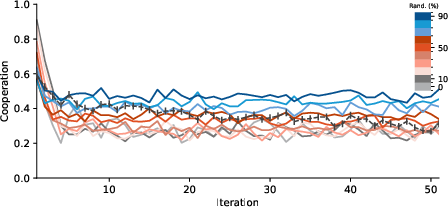
Figure 1: Cooperation over iterations for the lattice network, varying ρ, under the STUDENT condition (llama4_16x17b), with empirical data shown as the black dashed line.
Agent-Level Propensities and Distributional Heterogeneity
Distributional analysis reveals markedly reduced variability in simulated LLM agent cooperation rates compared to empirical human data. This effect is replicated across both lattice and heterogeneous networks, regardless of backstory variants or LLM architecture (llama4_16x17b, qwen3_32b). The introduction of random agents (ρ>0) partially recovers empirical heterogeneity, minimizing Wasserstein distances for intermediate ρ values.
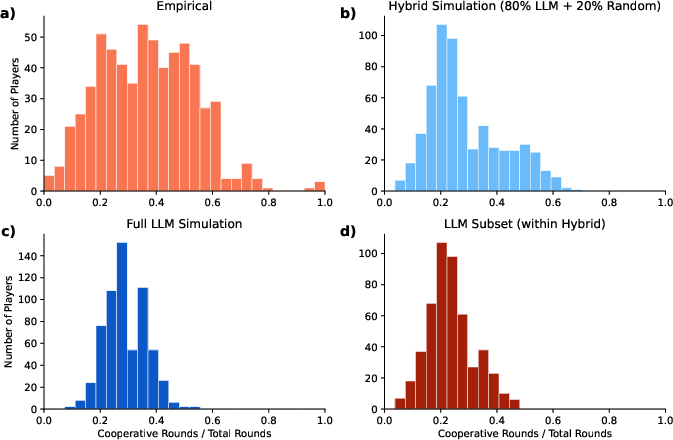
Figure 2: Distribution of per-agent cooperation rates for the lattice network (ρ=0.2) under the STUDENT condition, illustrating narrowed distribution compared to empirical variability.
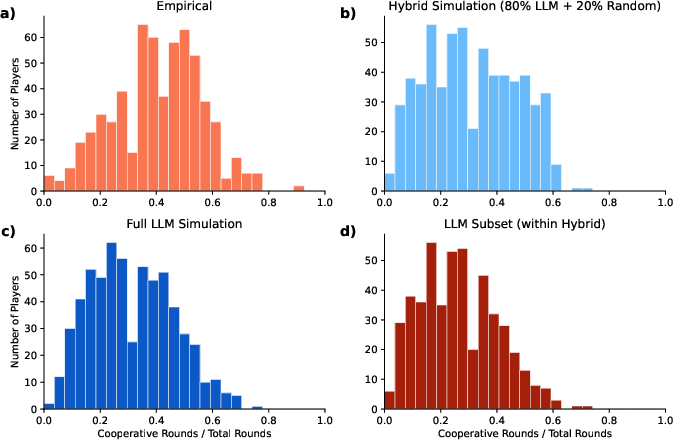
Figure 3: Distribution of per-agent cooperation rates for the heterogeneous network (ρ=0.2) under the STUDENT condition, showing similar reduction in variability.
Control Analyses
Control network configurations demonstrate parallel patterns, reinforcing the robustness of the narrowed simulated distribution and confirming the absence of topology-specific artifacts.
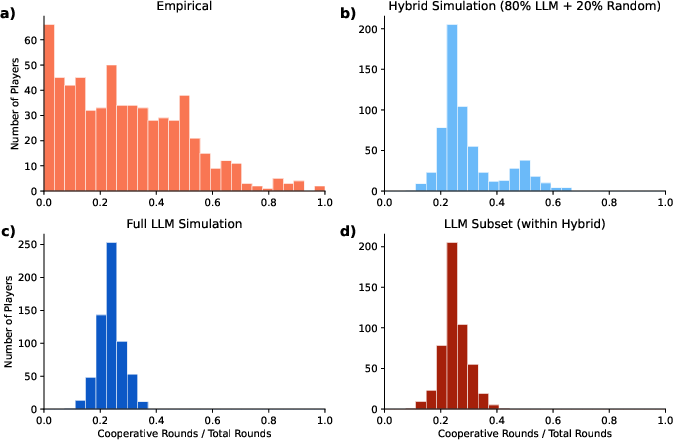
Figure 4: Control: Distribution of per-agent cooperation rates for the lattice control network (Diffϕ0) under the STUDENT condition.
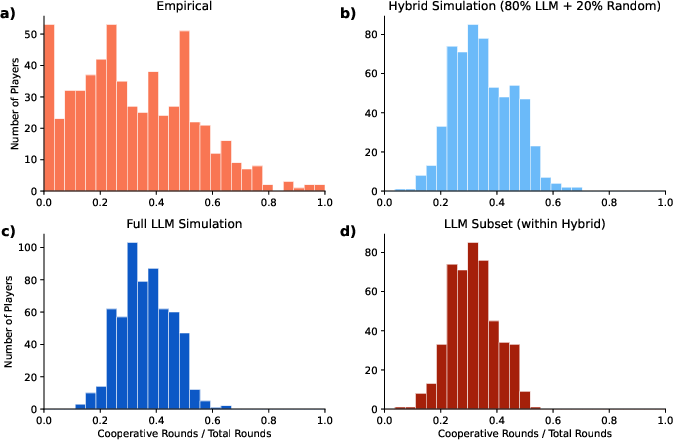
Figure 5: Control: Distribution of per-agent cooperation rates for the heterogeneous control network (Diffϕ1) under the STUDENT condition.
Conditional Cooperation Rules
The conditional probability of agent cooperation, given the local neighborhood's prior cooperation and the agent’s own prior action, mirrors empirical response tendencies as Diffϕ2 increases. A monotonic improvement is observed in RMSE/MAE with higher randomness, underscoring the role of stochastic behavior in bridging gaps between simulated and empirical conditional cooperation.
Temporal Dynamics and Autoregressive Structure
AR(1) analyses on series of cooperation differences reveal that simulated dynamics, especially with nonzero Diffϕ3, reproduce empirical persistence and mean increment properties, with statistically significant but finite discrepancies in Diffϕ4 and Diffϕ5 (Table: Errors_runs, trajectory_metrics). Pearson correlations on both levels and increments reinforce this temporal alignment.
Conditional Neighborhood Response
Analysis of conditional cooperation as a function of previous neighborhood cooperation (after agent cooperation or defection) shows robust replication of empirical conditional rules in both lattice and heterogeneous networks.
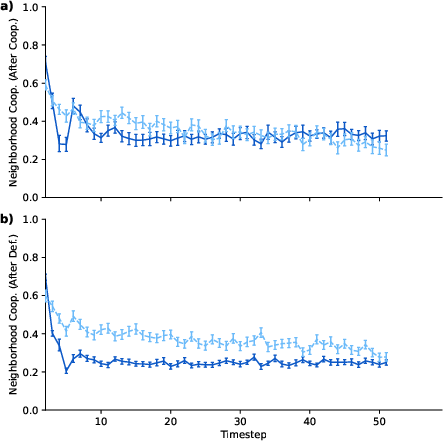
Figure 6: Average fraction of cooperating neighbors over time for the lattice network, separated by agent’s prior action; simulated results track empirical patterns.
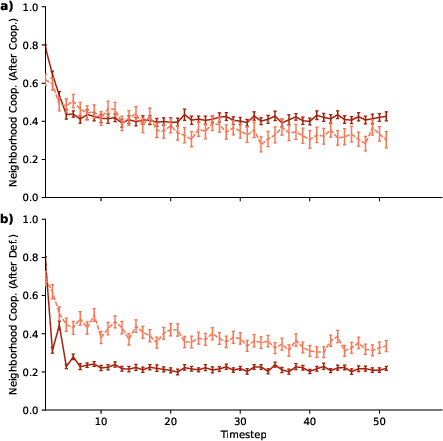
Figure 7: Average fraction of cooperating neighbors over time for the heterogeneous network; simulation closely follows empirical conditional dynamics.
Implications and Theoretical Considerations
The results demonstrate that collective cooperation emerges robustly in populations of LLM agents, even when individual-level behavioral fidelity is absent. However, LLM-driven populations exhibit systematically reduced behavioral heterogeneity relative to human experimental data, likely due to inherent model homogeneity and prompt determinism.
The stochasticity introduced by random agents is necessary to recover the empirical spectrum of propensities, indicating that aggregate cooperation does not imply realistic individual behavior modeling. The findings thus highlight limitations in the use of homogeneous LLM agents for simulating social systems, particularly in the context of behavioral diversity—a salient feature in real-world human interactions.
Practically, these results imply that LLM-based social simulations can reliably replicate macro-level cooperation but require carefully tuned agent diversity (e.g., prompt randomization, temperature adjustment, or explicit stochastic policies) to achieve realistic micro-level distributions.
Future Directions
Future research should focus on:
- Integrating architectural or prompt-level diversity to enhance behavioral heterogeneity among LLM agents.
- Developing frameworks for conditional stochasticity within LLM decision-making to mimic human behavioral noise.
- Extending analysis to richer social dilemmas and network structures, incorporating memory, reputation, and bounded rationality.
- Utilizing reinforcement learning fine-tuning or population-level training to induce parameterized agent diversity.
These directions are essential for advancing the fidelity of LLM-driven social simulations and for the theoretical understanding of emergent collective behaviors arising from synthetic agent populations.
Conclusion
LLM agent populations can reproduce aggregate cooperation dynamics in structured social dilemmas, without requiring individual behavioral fidelity. However, macro-level alignment does not entail micro-level realism—agent-level heterogeneity is systematically underrepresented. Hybrid populations and calibrated randomness are required to bridge this gap, informing both practical AI-based modeling and the theoretical study of artificial collective behavior (2606.30454).