- The paper introduces a novel framework that integrates language and visual modalities without catastrophic forgetting by leveraging the MAOP mechanism for gradient orthogonalization.
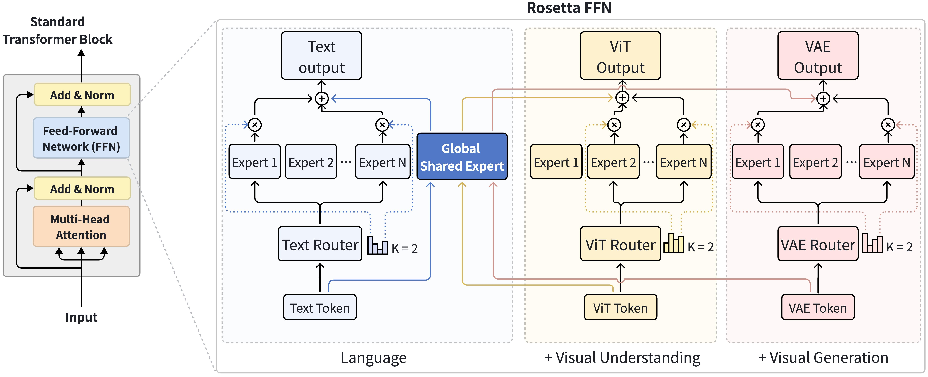
- It employs unified attention and composable FFN routing with a global shared expert to maintain cross-modal alignment and support non-destructive expansion.
- Empirical results demonstrate Rosetta’s superiority over MoE and MoT, achieving stable language metrics and high-fidelity visual generation.
Composable Native Multimodal Pretraining via Rosetta: Architecture, Optimization, and Empirical Analysis
Introduction
Rosetta presents a composable native multimodal pretraining framework targeting the non-destructive integration of heterogeneous modalities—discrete (language understanding) and continuous (visual generation)—in large-scale foundation models. The core motivation stems from the limitations of contemporary sparse architectures, such as standard Mixture-of-Experts (MoE) and structurally partitioned Mixture-of-Transformers (MoT), which are highly vulnerable to representation overwriting and catastrophic forgetting during functional expansion. Rosetta is constructed to overcome the fundamental Forgetting-Synergy Dilemma: efficiently expanding generative capabilities without degrading foundational knowledge, and simultaneously facilitating synergistic cross-modal learning.
Rosetta proposes both architectural and optimization-level innovations. Architecturally, it partitions expertise into global shared experts (the semantic anchor) and plug-and-play, modality-specific experts. On the optimization front, the novel Momentum-Anchored Orthogonal Projection (MAOP) mechanism neutralizes conflicting cross-modal gradient interference with zero memory overhead by leveraging the optimizer’s momentum state as a dynamic anchor. Extensive empirical results demonstrate Rosetta’s efficacy in preserving and augmenting language and visual understanding while achieving strong performance in visual generation.
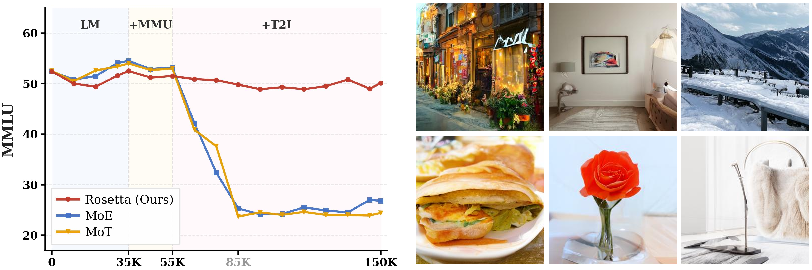
Figure 1: Left—MMLU dynamics across compositional pretraining stages highlight the catastrophic collapse in MoE and MoT, while Rosetta maintains performance stability; Right—Rosetta enables high-fidelity image generation while preserving foundational knowledge.
Rosetta Architecture
Rosetta’s architectural principles are summarized as follows:
The explicit structural decoupling in the FFN, with architectural constraints on routing, is critical in eliminating destructive capacity competition and enables non-destructive modality extension, as evidenced by expert routing distribution stability during expansion phases.
Conflict-Free Optimization via MAOP
Introduction of new generative tasks fundamentally alters the loss landscape, creating high-gradient-conflict regimes in shared parameters. Conventional gradient surgery approaches for multi-task optimization (e.g., PCGrad) are computationally and memory-infeasible at scale due to O(N) memory overhead from instantiating task-specific gradient buffers.
The MAOP mechanism addresses this by exploiting the optimizer's running momentum as an implicit semantic anchor—effectively representing the historical trajectory of established knowledge. When a new gradient exhibits destructive interference (negative inner product with the momentum), the component antagonistic to existing knowledge is orthogonally projected out. This guarantees that only synergistic updates affect the shared parameters, fully eradicating catastrophic forgetting without incurring additional memory cost or introducing training instability under large-scale FSDP.
Experimental Analysis
Rosetta is benchmarked against strict MoE and MoT baselines, all upcycled from the Qwen3-0.6B backbone, ensuring precise parity in parameter activation, initialization, and curriculum. The evaluation spans three composable pretraining regimes: language foundation, visual understanding, and visual generative expansion.
Key findings:
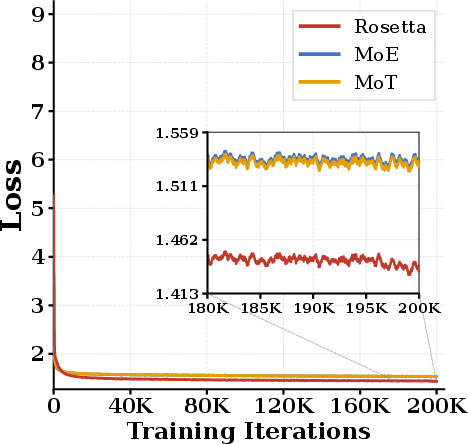
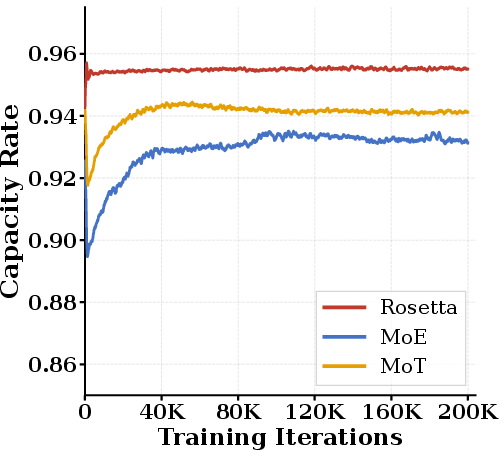
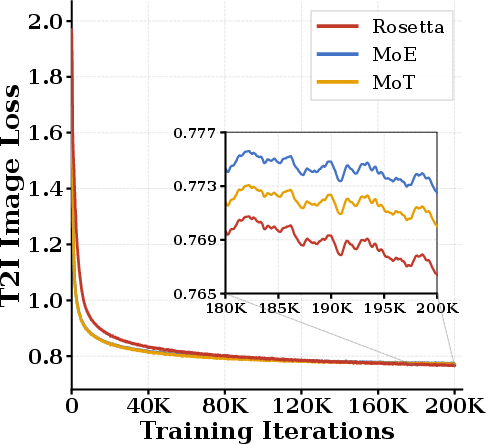
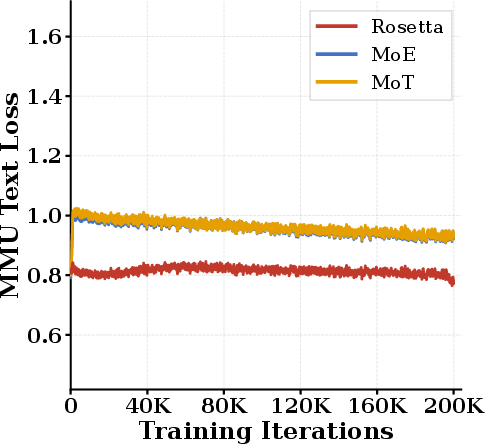
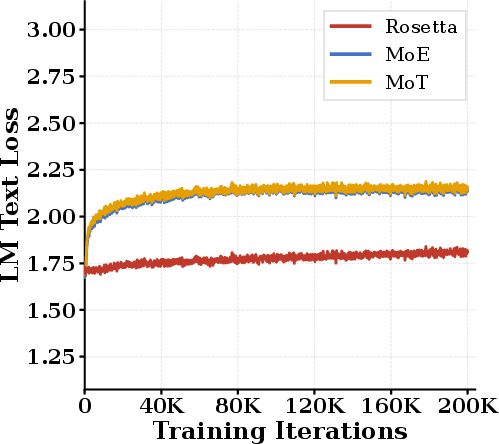
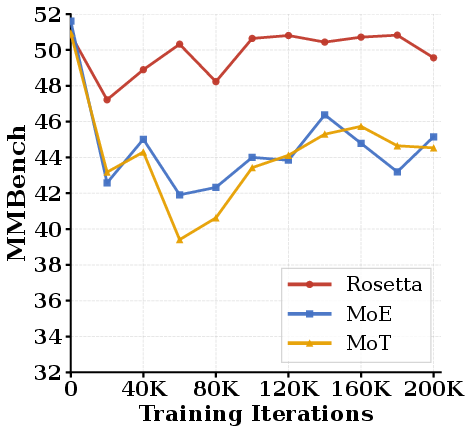
Figure 4: Top row—Rosetta surpasses MoE/MoT in maintaining upward MMBench trajectory, optimization bound, and capacity rate. Bottom row—Rosetta accelerates T2I convergence and stabilizes loss in visual and language domains.
Ablation studies confirm that removing the global shared expert or MAOP either severely impedes compositional generation and reasoning (without shared expert) or reintroduces catastrophic forgetting (without MAOP), thus establishing both as indispensable.
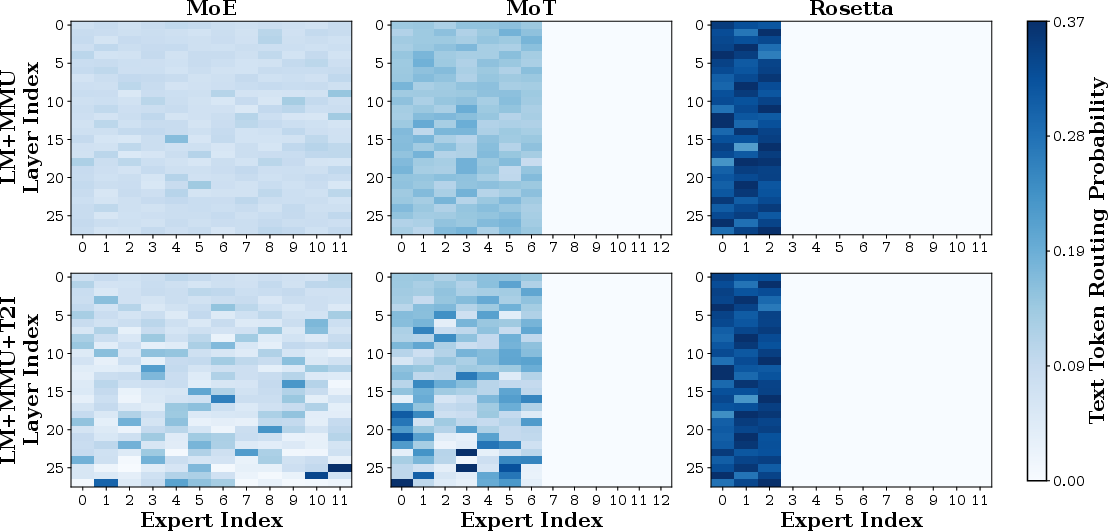
Figure 5: Routing heatmaps evidence that only Rosetta maintains stable expert selection before/after generative expansion; MoE and MoT suffer severe routing drift and interference.
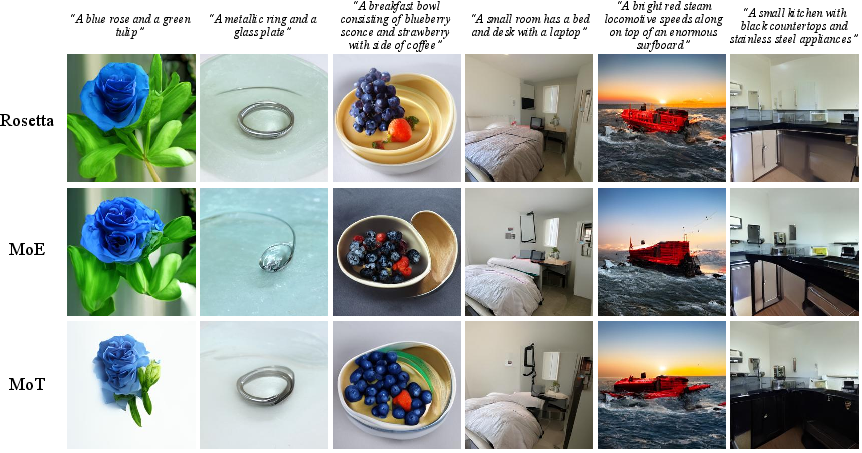

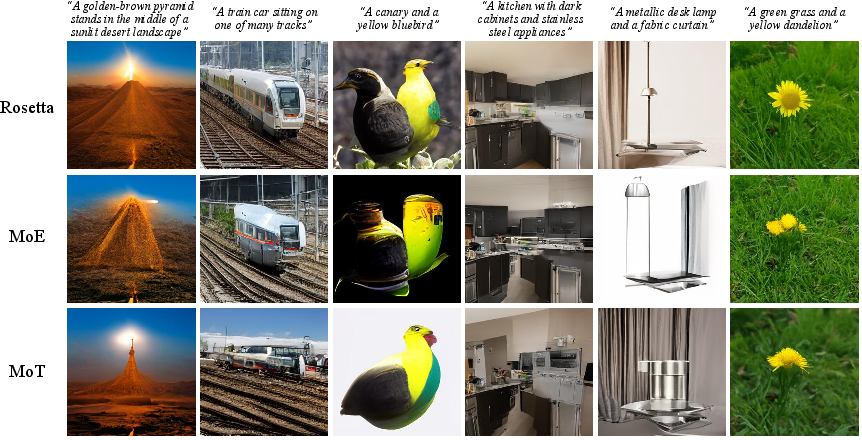
Figure 6: Qualitative generations—Rosetta preserves scene geometry and object semantics, whereas MoE suffers from texture corruption and MoT omits important compositional elements.
Implications and Future Directions
Rosetta introduces a scalable paradigm for continual modality expansion and non-destructive multimodal pretraining. The MAOP optimization principle, leveraging implicit momentum instead of explicit buffers, provides a foundation for scaling conflict-aware updates in other parameter-sharing settings beyond multimodal integration. Architecturally, plug-and-play extensibility via composable routing, combined with a global semantic anchor, supports integration of arbitrarily heterogeneous objectives (including audio, temporal, and 3D modalities) without architectural retraining.
As foundation model complexity grows, ensuring stability and synergy across expanding functional domains will become increasingly central. The demonstrated monotonic scaling properties with respect to expert pool size (without sacrificing established knowledge or incurring computational overhead) indicate Rosetta's practical relevance for future AGI systems.
Conclusion
Rosetta resolves the inherent tension between stability and plasticity in composable multimodal pretraining by unifying structural and optimization-level mechanisms. The combination of modality-aware FFN routing, a global semantic bridge, and memory-free gradient orthogonalization (MAOP) achieves non-destructive, synergistic expansion of both discrete and continuous modalities within a single architecture.
This framework establishes new state-of-the-art resilience to catastrophic forgetting and cross-modal interference, enabling the tractable integration of future modalities crucial for general-purpose artificial intelligence.
Reference: "Rosetta: Composable Native Multimodal Pretraining" (2607.00293)