- The paper introduces a novel framework that separates lexical memory from a hierarchical temporal evidence graph to support update-aware, multi-hop reasoning in conversational systems.
- It details an offline graph construction and online query processing approach that boosts temporal and multi-hop performance by up to 18.6 percentage points.
- The work demonstrates efficiency with reduced token budgets and greater explainability, providing a scalable solution for evolving conversational memory.
TRACE: State-Aware Query Processing over Temporal Evidence Graphs for Conversational Data
Long-term conversational assistants and LLM agents require robust mechanisms for retrieving and reasoning over dynamic interaction histories, where user states, intentions, and facts frequently evolve via updates and contradictions. Existing memory architectures primarily treat conversational records as flat or semantically indexed stores, which is insufficient for high-fidelity state reconstruction. This causes errors such as retrieving semantically similar but obsolete facts, failure to propagate recent updates, and incoherent multi-hop reasoning over fragmented evidence.
The TRACE framework introduces a fundamentally different approach by operationalizing conversational memory as a temporal hierarchical evidence graph. Conversations are not treated as static, linearly indexed corpora, but as temporally extended, multi-granular data structures where facts, plans, and preferences are linked—within and across sessions—by typed relational and temporal edges.
TRACE Architecture and Methodology
The core architectural innovation in TRACE is the separation of lexical memory from structured temporal evidence, implemented as a tuple (N,G∗) where N is the note memory for verbatim recall and G∗ is the hierarchical temporal evidence graph for update-aware, multi-hop reasoning.
Offline Evidence Graph Construction
TRACE begins with dense ingestion of conversational histories. It distills session-level event summaries and links them into a composite evidence graph through four sequential stages:
- Session-level Event Distillation
- Cross-session Linking with Candidate Gating (participant overlap and topic congruence)
- Temporal/Evolution Relation Inference (support edges: causes, before, prevents, enables; evolution edges: updates, contradicts)
- Hierarchy Injection (session and topic vertices; membership and ordering edges)
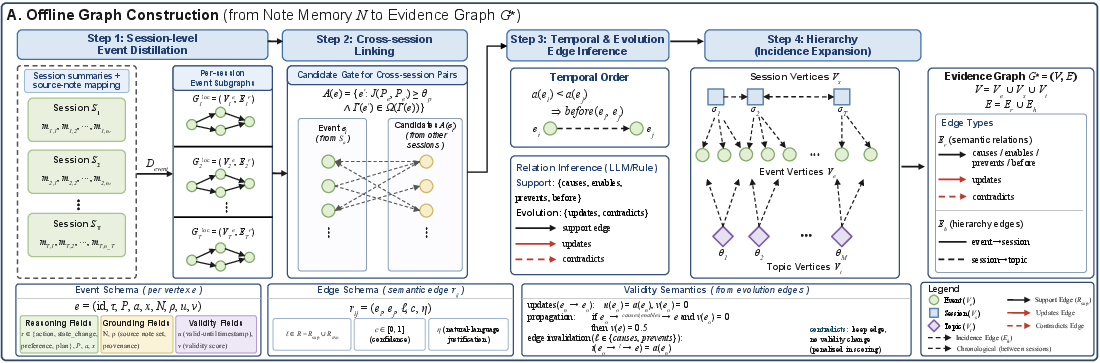
Figure 1: Offline graph construction from session-level memory, yielding a directed, hierarchical evidence graph encoding events, sessions, and topics connected by semantic, temporal, and evolutionary relations.
Validity Propagation and Annotation
Temporal evolution is tracked with graded per-event validity. Updates strictly supersede prior facts (setting v(eold)=0), contradicts mark explicit conflict, and causal links are degraded if they propagate from stale events (v=0.5). This schema ensures TRACE can support both current-state and historical queries by assigning valid-until stamps and differentiating between resolved and unresolved evidence paths.
Online Query Processing and Hybrid Context Assembly
TRACE decomposes query-time reasoning into three phases:
- Seed Selection: Dense retrieval over N, entity-based and update-aware expansion in G∗.
- Bounded Path Traversal: Generation of candidate evidence paths with strict pruning (invalid, loop, contradiction constraints) and scoring based on neural similarity, path reliability, temporal consistency, and update validity.
- Hybrid Context Assembly: Combination of top-k lexical chunks (Cnote) and validity-aware evidence chains (Cpath) within a fixed token budget. Context planning is query-shape-adaptive: temporal queries, preference tracking, and multi-hop questions receive tailored instructions.
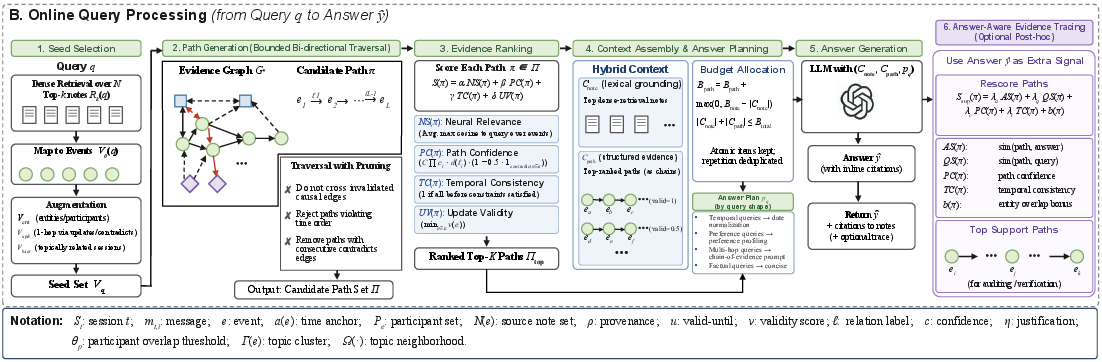
Figure 2: Online query processing in TRACE: from hybrid seed selection, through bounded, validity-annotated path traversal, to hybrid context assembly and LLM answer generation.
Provenance and Post-hoc Tracing
For auditability, TRACE supports post-hoc evidence tracing, ranking provenance chains according to overlap with both query and output, enabling transparent explanation of derived answers and flagging reliance on stale or conflicting context.
Empirical Evaluation
Benchmarks and Baselines
TRACE is evaluated on LoCoMo (N024K tokens/dialogue) and LongMemEval\textsubscript{S} (N1115K tokens/dialogue) using non-adversarial and stress-test questions targeting state evolution, contradiction resolution, and multi-hop reasoning. Baselines include Full-Context, RAG, Nemori, Mem0, LangMem, Zep, and A-Mem.
Main Results
TRACE consistently achieves the highest scores across LLM-grading, F1, and BLEU, with especially large gains on temporal (+18.6 pp LLM over Nemori) and multi-hop (+8.9–9.7 pp) categories on LoCoMo. Notably, Open-Domain performance shows high LLM scores but lower token-overlap metrics, indicating semantically correct but more concise answers.
Crucially, on the stress test set, which isolates supersession and contradiction phenomena, TRACE achieves superior valid accuracy and the lowest outdated leakage, tightly matching Full-Context despite a 5×-10× context size reduction. This demonstrates that explicit validity and path tracking, rather than raw context size, is the limiting factor for update-aware question answering.
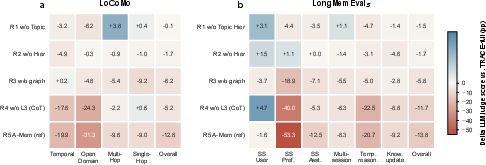
Figure 3: Ablation analysis of TRACE, showing drops in LLM score upon removal of components such as hierarchy, the evidence graph, or query-shape-aware planning.
Ablation and Component Analysis
Trace's effectiveness is not attributable to a single mechanism, but rather to the interplay of:
- The hierarchical, multi-granular event/session/topic evidence graph (consistent N2+6 pp gains over note-only retrieval)
- Graded update-aware validity and path scoring (N310 pp gain on update-heavy slices)
- Query-shape-specific answer planning, especially for temporal and preference tracking (+30–50 pp improvements in some sub-categories on LongMemEval\textsubscript{S})
Ablation reveals a clear structure: removal of query planning or graph evidence produces the largest degradations, particularly for categories that require temporal or preference resolution.
Efficiency and Interpretability
TRACE's evidence graph construction is tractable (hours-scale for dense benchmarks; subsecond per event at scale) due to semantic and participant gating. At inference, TRACE delivers answers with N4–N5 lower token budgets than Full-Context, and remains within sub-1.2s median latency even at haystack scale.
Interpretability probes show high factual (N6) and type-label accuracy (N7) for edges, and human evaluators rate evidence chains as substantially more glanceable and less misleading than similarity-only retrievals.
Theoretical and Practical Implications
From a practical standpoint, TRACE offers a scalable solution to core deficiencies in current agent memory systems: accurate current-state reasoning, update/contradiction awareness, and faithful multi-hop evidence consolidation under bounded latency and context constraints. The explicit graph-layer and update semantics mitigate major known failure cases for LLM agents operating on evolving conversational corpora.
Theoretically, TRACE bridges conversational QA with database principles: it operationalizes valid-time semantics and provenance—canonical in temporal and probabilistic databases—within unstructured, heterogeneous agent memories. It positions conversational memory as a query engine problem, not simply a retrieval or ranking one.
Future Directions
Key next steps include incremental graph construction for real-time agents (to handle open-ended conversations with continuous graph growth), finer-grained time anchor resolution (sub-session/turn granularity to address temporal edge ambiguities), and expansion to collaborative, multi-agent conversational graphs.
Conclusion
TRACE advances the state of long-term agent memory by introducing a state-aware, temporally valid, and hierarchically structured evidence graph. Its modular architecture, combining vector-based retrieval, graph-based path expansion, validity-aware reasoning, and transparent explainability, yields measurable improvements over previous systems, especially in temporal and update-sensitive conversational QA. This approach provides a robust foundation for the next generation of interpretable, trustworthy, and scalable AI assistants.
References:
This essay is based on the content and empirical findings of "TRACE: State-Aware Query Processing over Temporal Evidence Graphs for Conversational Data" (2607.00339).

