- The paper introduces a unified world-action model that bridges temporal, modality, and action space gaps in mobile manipulation.
- It employs a hierarchical cascade with dual-level Mixture-of-Transformers to optimize both long-horizon planning and fine-grained control.
- Dream Forcing and latent action pretraining yield robust sim-to-real transfer, achieving state-of-the-art performance on challenging benchmarks.
ABot-M0.5: Unified World-Action Modeling for Mobile Manipulation
Introduction
ABot-M0.5 introduces a unified alignment-aware World Action Model (WAM) specifically architected to address the unique requirements of mobile manipulation. Unlike conventional VLA and WAM approaches, ABot-M0.5 systematically resolves three core structural mismatches in mobile manipulation: temporal granularity misalignment, heterogeneity in action spaces, and inconsistent train-test rollout regimes. Through cascading the generation pipeline and jointly optimizing world modeling, intermediate latent action abstraction, and embodiment-specific control, ABot-M0.5 advances the state of the art on both long-horizon mobile manipulation and fine-grained control.
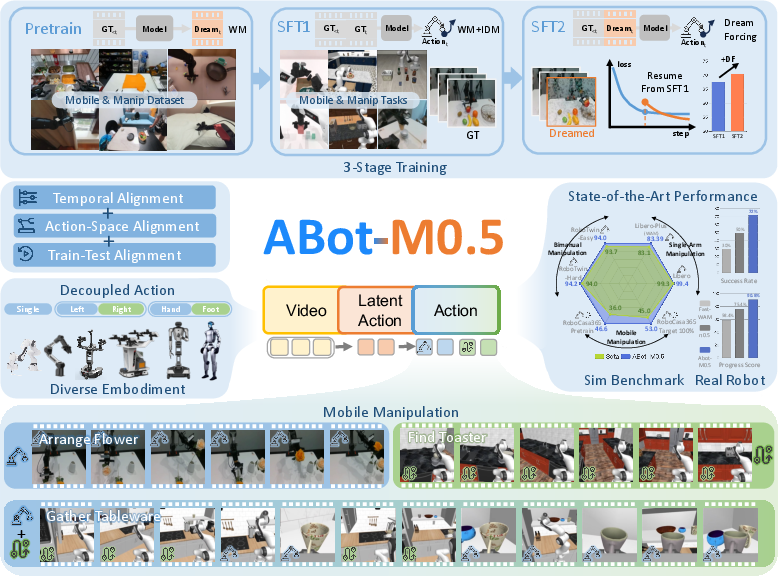
Figure 1: Overview and training pipeline of ABot-M0.5, demonstrating the integration of granularity alignment, action disentanglement, and inference consistency.
Model Architecture
Hierarchical World-Action Cascade
ABot-M0.5 implements a joint generative cascade with three stages: future video latent prediction, frame-level latent action abstraction, and executable action generation. Video encodings are extracted with a 3D VAE, while language instructions are embedded with a dedicated text encoder. The core innovation is the introduction of frame-level latent actions, which function as a bridging space, decoupling embodiment-agnostic local motion intents from embodiment-specific controls. This mitigates the semantic and temporal gap inherent in direct video-to-action prediction.
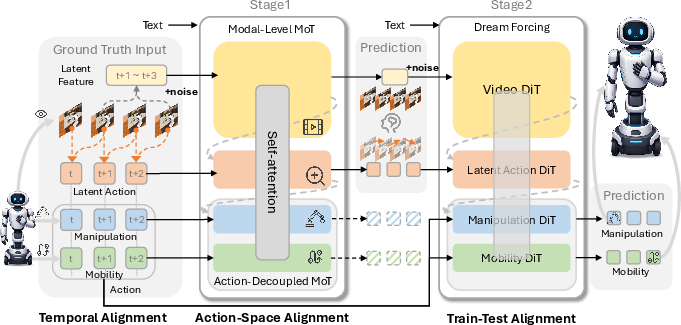
Figure 2: The ABot-M0.5 architecture: joint video, latent action, and action prediction implemented by a dual-level Mixture-of-Transformers design.
To address action space heterogeneity, ABot-M0.5’s Dual-level Mixture-of-Transformers (D-MoT) architecture explicitly separates modality representations and action subspaces. At the modality level, video, latent action, and action tokens have unique heads and projections but share the main transformer trunk for cross-modal reasoning. At the action subspace level, base movement and arm manipulation are manipulated by specialized subtowers within the action token pipeline, ensuring optimization stability and mutual coordination.
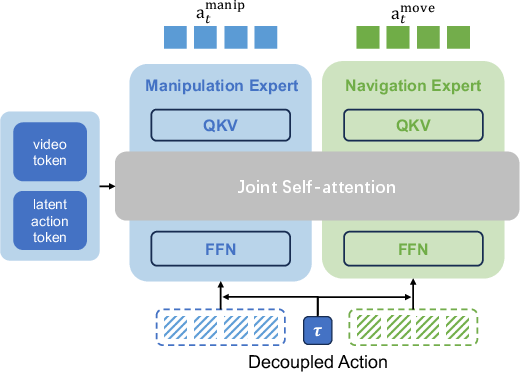
Figure 3: Dual-level Mixture-of-Transformers for modality disentanglement and explicit action subspace separation with coordinated attention.
Train-Test Robustness: Dream Forcing
Canonical WAM training with teacher forcing or even synchronous denoising results in significant train-test distributional shift, as real deployment always operates on self-generated, imperfect visual rollouts. ABot-M0.5’s Dream Forcing mechanism conditions action learning on internally-predicted (dreamed) visual latents during training, precisely matching the inference regime. This is implemented via a two-phase rollout and dramatically stabilizes long-horizon policy execution.
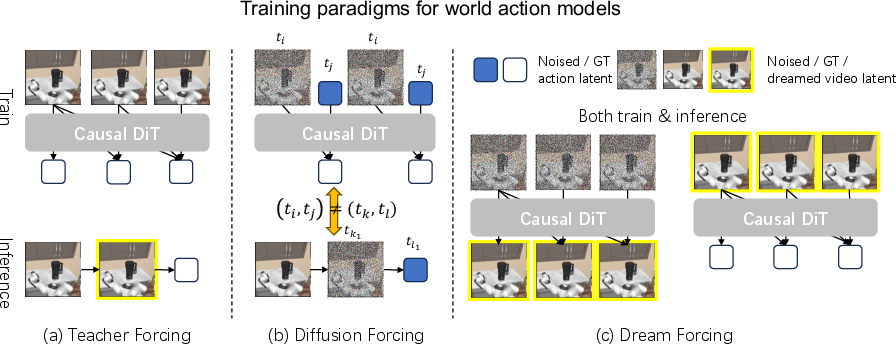
Figure 4: Comparison of training paradigms in WAMs; Dream Forcing (c) achieves faithful train-test alignment by conditioning action prediction on self-dreamed videos.
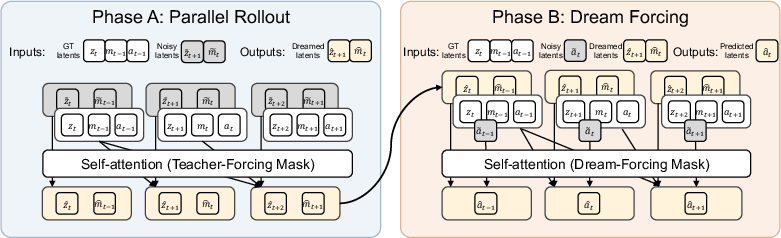
Figure 5: Two-phase training strategy of Dream Forcing: generating dreamed latents (Phase A) and using them for conditional action prediction (Phase B).
Training Paradigm
The model is trained in progressive phases:
- Large-Scale World Model Pretraining: Visual dynamics are learned on diverse multi-embodiment, synthetic, and real datasets.
- Self-Supervised Latent Action Pretraining: Frame-level latent actions are extracted from unannotated videos with algebraic consistency, leveraging data without explicit control labels.
- Progressive Supervised Fine-tuning: Inverse dynamics is initially trained under ground-truth future context, then switched to Dream Forcing for deployment-aligned rollouts.
Extensive structured attention optimization and offset-based latent augmentations substantially reduce the computational cost for long-sequence joint modeling.
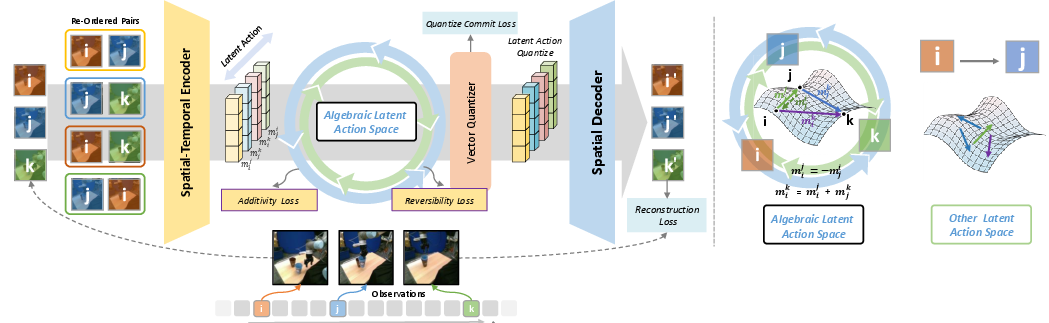
Figure 6: Structure of the algebraically consistent latent action encoder used for motion abstraction supervision in the pipeline.
Experimental Results
Mobile Manipulation (RoboCasa365)
ABot-M0.5 achieves state-of-the-art mean success on RoboCasa365, with 54.2% average on the full Target 100% suite, outperforming Fast-WAM, GR00T, and Lingbot-VA on all subcategories and exhibiting especially strong gains on composite long-horizon tasks. Notably, scaling to 10% of training data still outperforms prior models, reflecting efficient sample utilization.
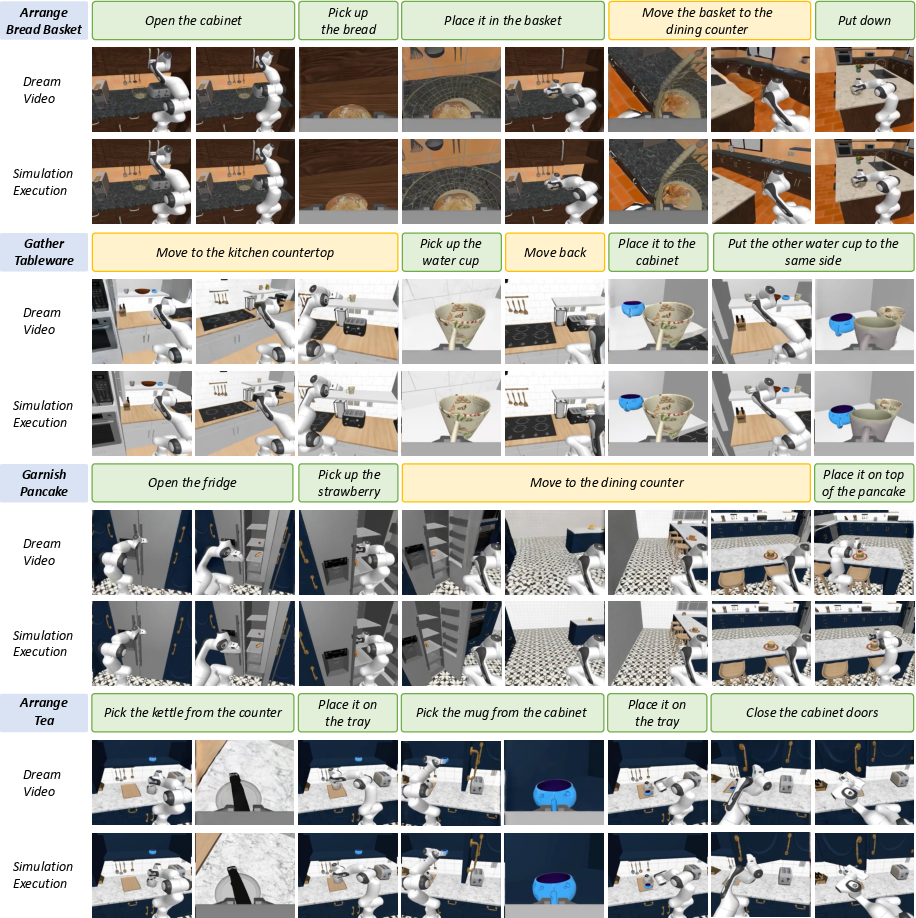
Figure 7: Qualitative rollouts on RoboCasa365 decomposing tasks into mobility (yellow) and manipulation (green) subtasks—demonstrating both spatial coverage and precise control.
Stationary Manipulation: Generalization
Despite being formulated for mobile manipulation, the explicit temporal and action decoupling translates to strong results on RoboTwin 2.0 (bimanual manipulation, 94.1% average) and LIBERO/Plus. ABot-M0.5 shows robust compositional, language, and domain generalization—competitive with or exceeding dedicated stationary manipulation WAMs and VLAs.
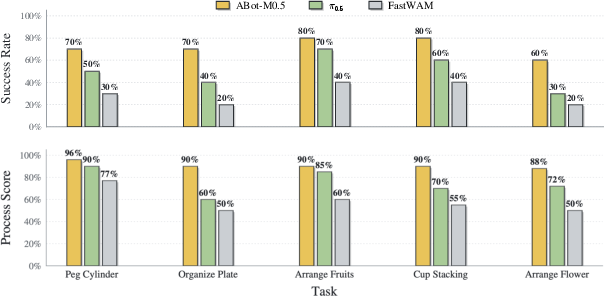
Figure 8: Quantitative performance on real-world tasks validating simulation-to-reality transfer and fine manipulation precision.
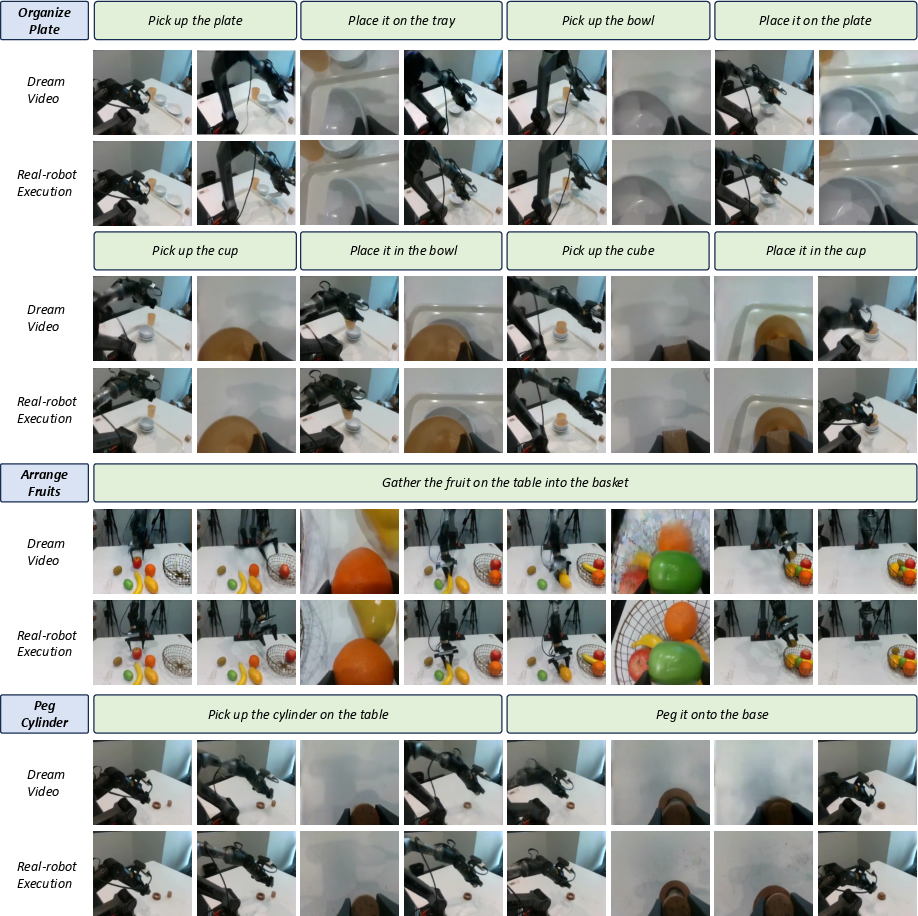
Figure 9: Visual comparison of real camera frames and model-dreamed scenarios during real-world rollouts.
Real-World Experiments
On a 6-DoF arm, ABot-M0.5 achieves up to 80% success rates in multi-stage long-horizon tasks and >96% process scores in fine manipulation, substantially outperforming π0.5 and Fast-WAM. No architectural changes were required to transfer from simulation to hardware, demonstrating practical deployability.
Ablations
Targeted ablation validates:
- Latent action modeling is essential for fine control (success rate drops by over 6 points if omitted).
- Strict modality and action-level decoupling accelerates convergence and improves final policy stability.
- Dream Forcing provides a >3% absolute success boost in alignment with deployment rollouts, while naive teacher-forcing stagnates.
- Pretraining on diverse embodied experience is indispensable for transferable, grounded visual priors enabling effective SFT (over 30% improvement in low-shot fine-tuning).

Figure 10: Structural ablations of latent action embedding and corresponding impact on downstream control accuracy.
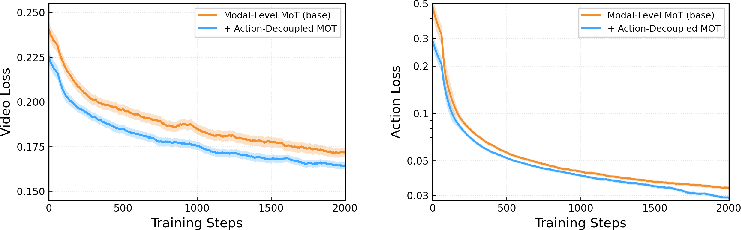
Figure 11: Training dynamics reflecting faster and more stable convergence for action-decoupled MoT.
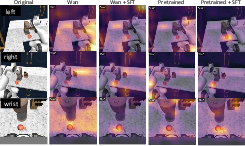
Figure 12: Attention heatmap evolution, illustrating pretraining and SFT synergistically encouraging precise, task-relevant visual focus.
Implications and Future Directions
ABot-M0.5’s architectural motif—bridged granularity, modality separation, and deployment-aligned training—establishes clear principles for future WAM design. Its robust cross-domain performance and straightforward sim2real deployment validate abstraction-oriented approaches over brute-force scale increases. Practically, the model’s framework is extensible to new robot morphologies and environments with only minor retraining, promoting generalist embodied agents. Theoretically, the cascade, explicit flow-matching, and Dream Forcing may inform the development of scalable, robust world modeling for open-ended tasks and weaker supervision.
Scaling laws, memory-augmented context, and hardware-aware inference optimization remain key open directions for the WAM paradigm, as does analysis of abstraction capacity and downstream error accumulation in arbitrarily long-horizon settings.
Conclusion
ABot-M0.5 demonstrates that unified, alignment-centric world-action modeling—integrating temporal, action, and inference structure—enables robust, general-purpose mobile manipulation. By introducing a hierarchical video-latent-action-action pipeline, dual-level Mixture-of-Transformers, and Dream Forcing, the model closes longstanding gaps in existing WAM-based approaches to embodied policy learning. Comprehensive empirical results on simulation and physical robots confirm not only new state-of-the-art performance but also provide clear evidence for the practical readiness of foundation WAMs in diverse, real-world robotics deployments.
(2607.00678)