Don't Let Gains FADE: Breaking Down Policy Gradient Weights in RL
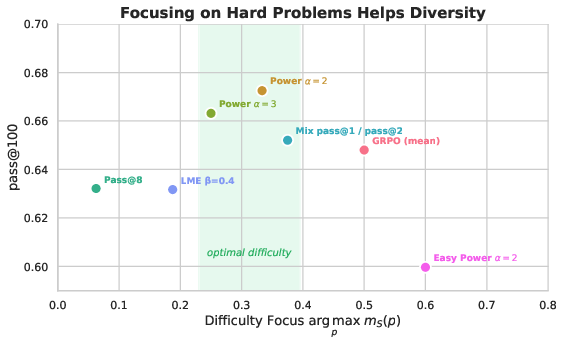
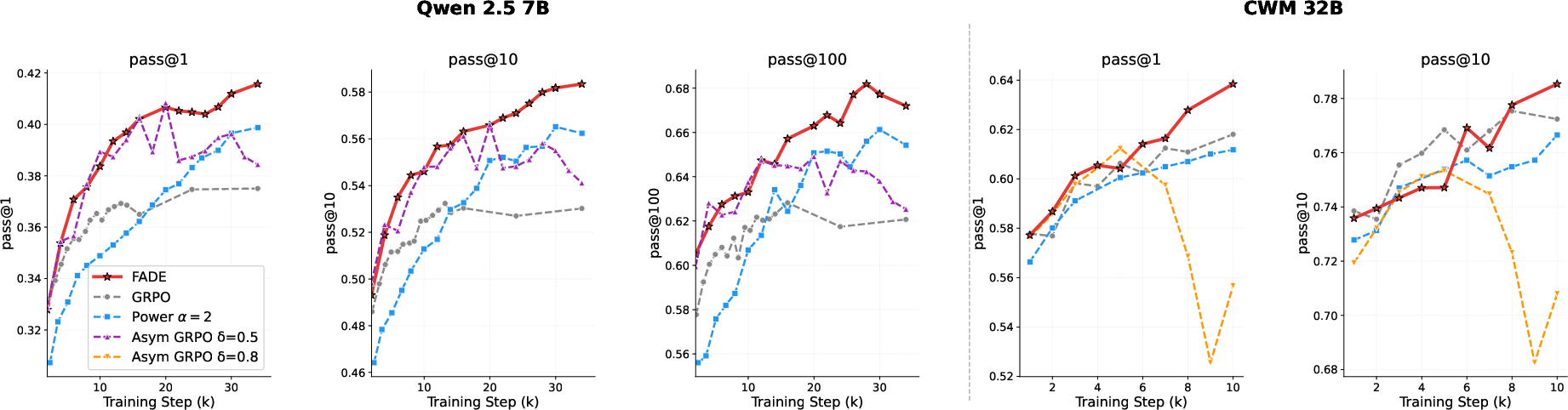
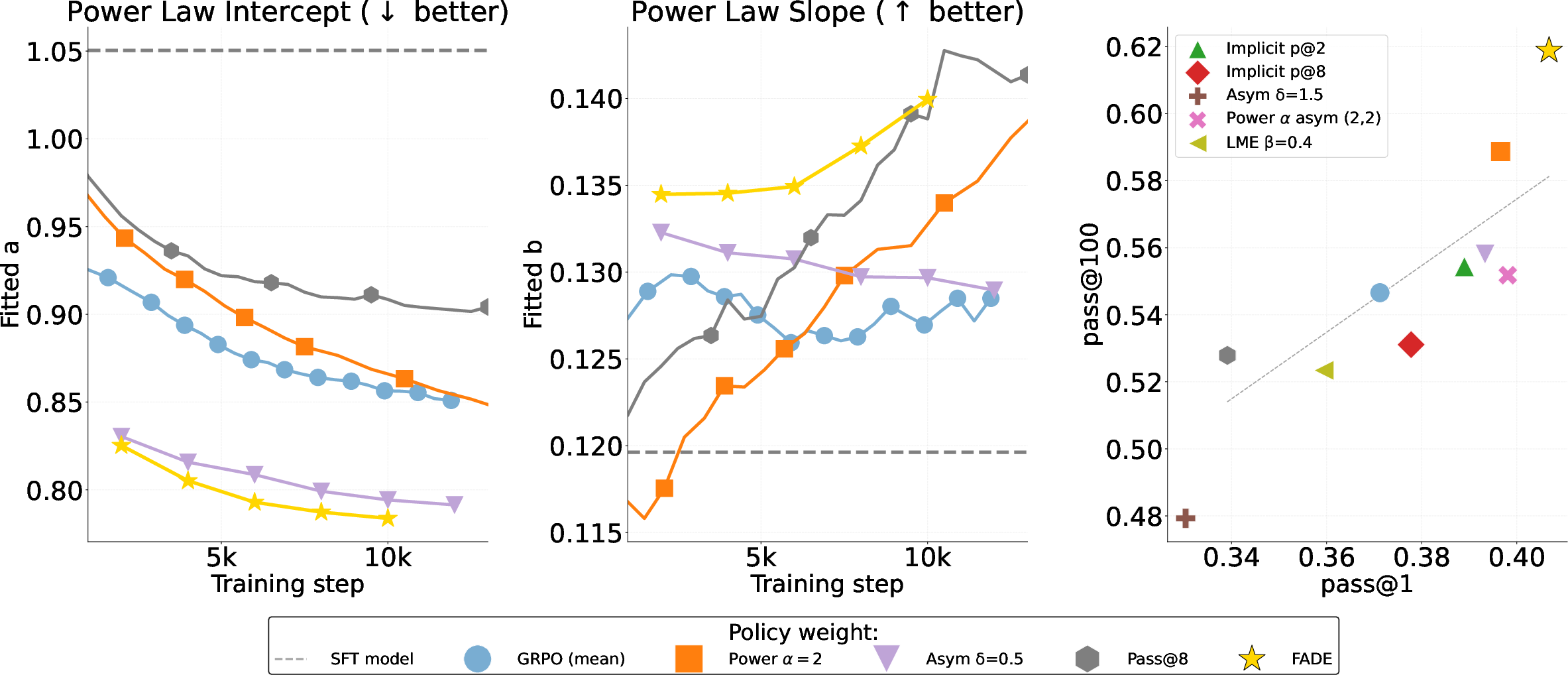
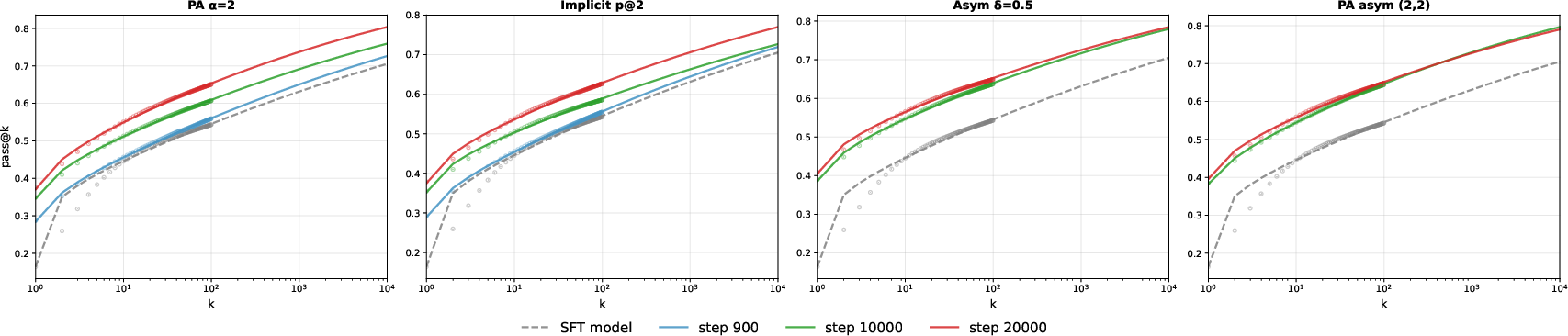
Abstract: Reinforcement learning post-training dramatically improves LLM reasoning, but suffers from training instability and diversity collapse. Advantage functions offer an appealing fix: they reshape the training objective, reweight which rollouts drive learning, and are trivial to implement. Yet a proliferation of methods makes it unclear which advantage to use and when. We cut through the confusion with a unifying framework that decomposes any advantage into its positive and negative gradient mass along two orthogonal axes. On the sign axis, imbalanced updates collapse either entropy or weight geometry. On the difficulty axis, hard-problem focus sharpens signal but costs sample size. Both trade-offs shift during training: exploration favors balance and hard focus; exploitation favors suppression and medium focus. This motivates FADE (Focal Advantage with Dynamic Entropy), a self-adapting advantage that reads training dynamics to schedule the gradient weight automatically. FADE reaches peak pass@1 20k steps earlier than the best static baseline at the 7B scale and 2k steps earlier at the 32B , while achieving the best accuracy-diversity trade-off across all pass@k on LiveCodeBench and AIME.
Paper Prompts
Sign up for free to create and run prompts on this paper using GPT-5.
Top Community Prompts
Explain it Like I'm 14
A simple guide to “Don’t Let Gains FADE: Breaking Down Policy Gradient Weights in RL”
What this paper is about (big picture)
The paper is about teaching LLMs to reason better using reinforcement learning (RL), especially on tasks like writing code or solving math problems. Many RL methods work well but can be unstable: the model can learn quickly at first and then get stuck, or it can become too “narrow,” giving similar answers every time. The authors explain why this happens and introduce a new method, called FADE, that adjusts how the model learns over time so it improves faster while keeping its answers diverse.
What questions the authors asked
The authors wanted to answer three simple questions:
- How should we decide which model answers to learn the most from—correct ones, wrong ones, easy problems, or hard problems?
- Why do some methods make the model’s answers become less varied (everyone says the same thing), and others make learning stall?
- Can we design a simple rule that automatically changes focus during training so we get fast improvement and keep variety?
How they approached it (in everyday terms)
Think of training the model like coaching a team:
- Each practice (batch) has multiple attempts (model answers).
- A checker (verifier) says if each attempt is correct (1) or incorrect (0).
- The coach then decides how much to “push” the player based on that attempt. That push is a weight—bigger weight = the model learns more from that attempt.
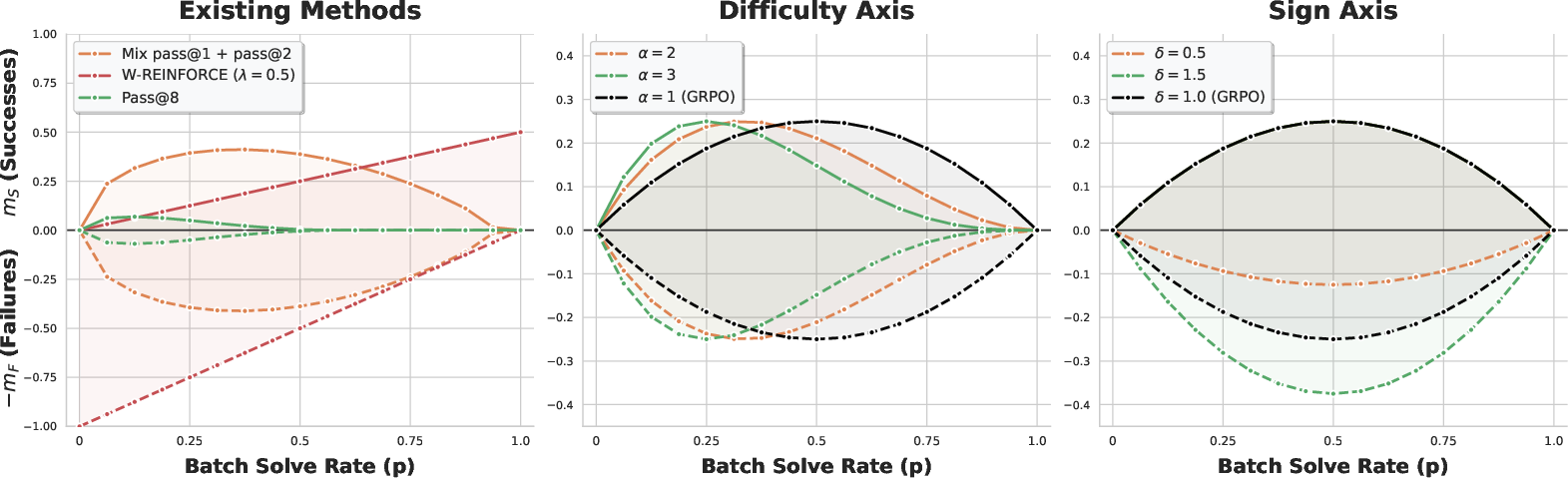
The authors say almost all existing methods can be understood by looking at two “axes” of these weights:
- The sign axis: Are we pushing more from successes or from failures?
- More from successes = cheering what worked.
- More from failures = correcting what didn’t.
- The difficulty axis: Are we focusing on easy problems, medium ones, or hard ones?
- Easy problems give more frequent feedback but less new information.
- Hard problems teach more but are rarer and noisier (fewer usable examples per batch).
There’s also a third factor (scale), which is basically how big the overall push is—similar to turning the learning rate up or down.
They trained code/math models using a standard RL setup where:
- The model generates several answers for each problem.
- A program checks if the final answer is correct (binary reward: 1 or 0).
- The training uses a common RL recipe (policy gradients with a clip)—but with different ways to set the weights on successes and failures.
They tested many weighting strategies and analyzed what happens inside the model’s weight updates (like checking whether updates point in many directions or collapse into just one direction).
What they found and why it matters
The authors discovered three important trade-offs:
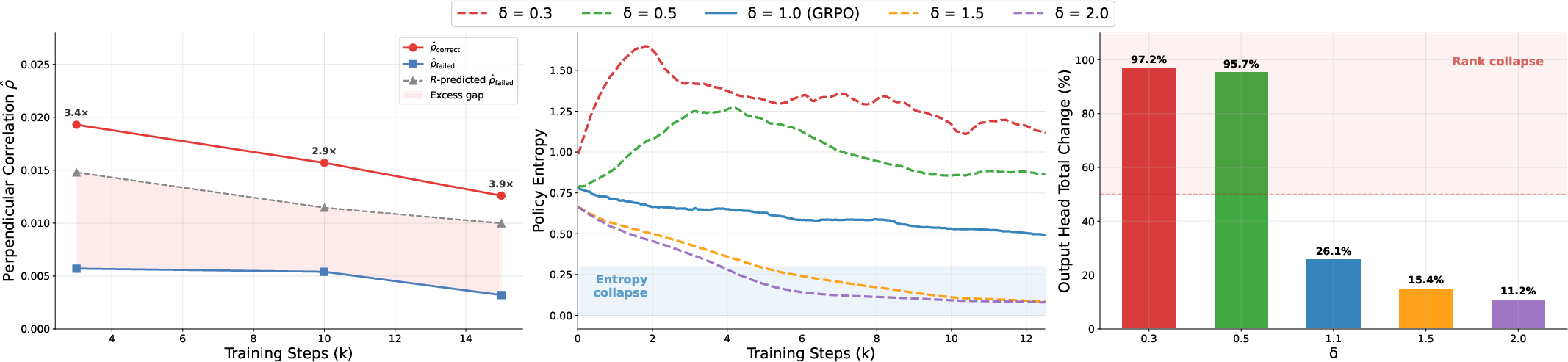
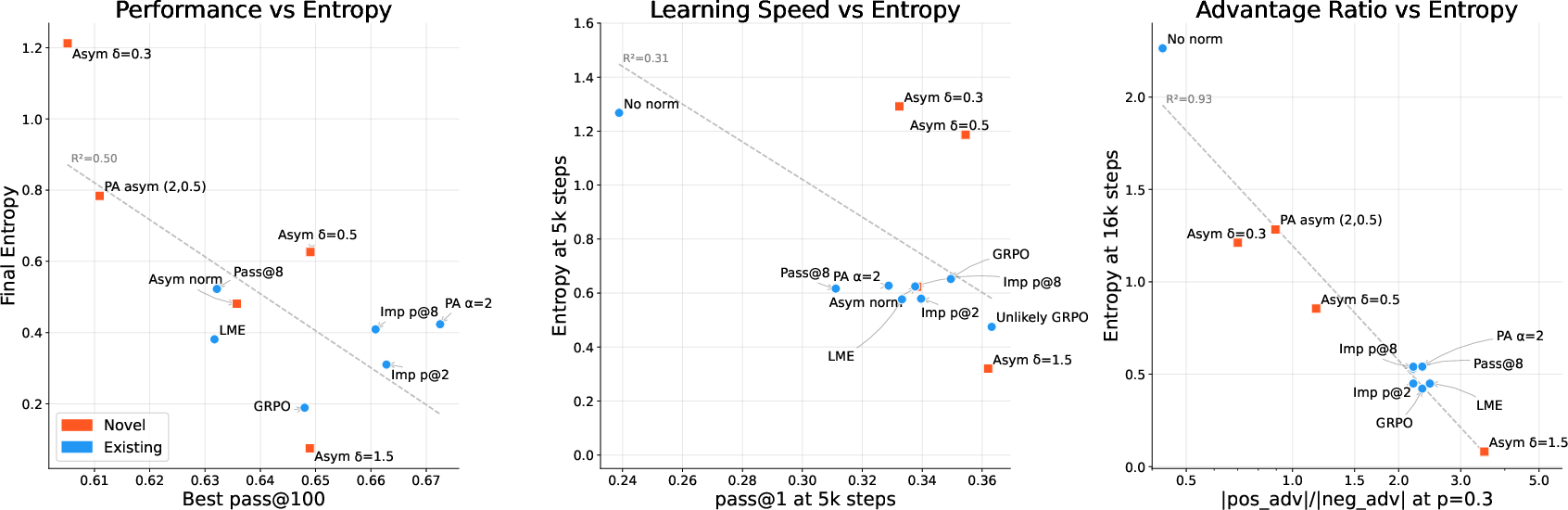
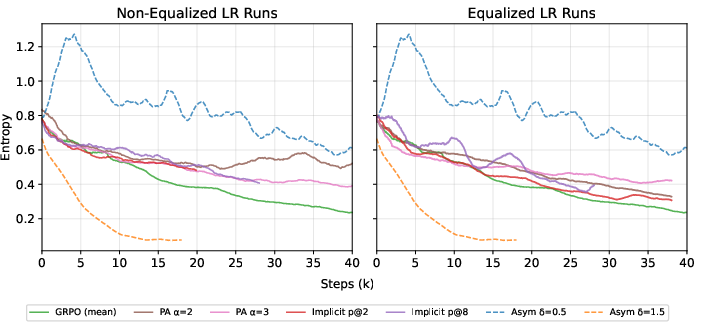
- Too much cheering for successes shrinks variety (entropy collapse).
- Correct solutions tend to look similar (they “cluster”).
- If you mostly reward successes, the model learns to produce a narrow set of answers. It gets good at one way of solving problems but loses creativity and diversity.
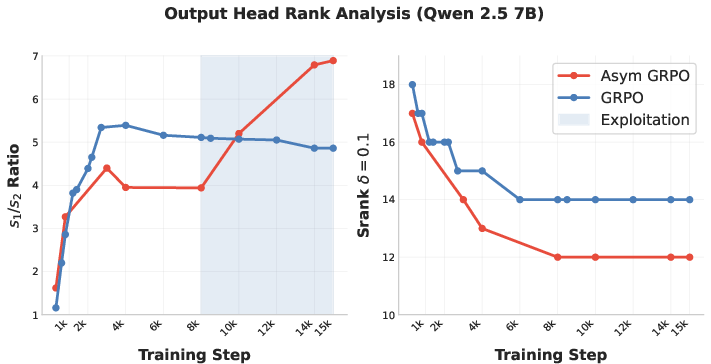
- Too much punishment for failures stalls learning in one direction (rank‑1 update collapse).
- Wrong attempts are very diverse.
- If you mostly learn from failures, their differences cancel out—leaving only one strong “don’t do that” direction. The model keeps pushing in that same single direction and stops learning other useful things. Early progress can be fast, but it later plateaus and hurts diversity.
- Focusing on hard problems is a double-edged sword.
- Hard problems give more useful learning signals (you learn more).
- But they are rarer and noisier—so you get fewer batches where learning really happens.
- Early in training, focusing on harder problems is great. Later, when many problems get easier, staying locked on the hardest tail can waste chances to improve.
Because these trade-offs change over time (early stage needs exploration; later stage needs exploitation), the authors argue that a single fixed rule for weights is not enough.
Introducing FADE:
- FADE stands for Focal Advantage with Dynamic Entropy.
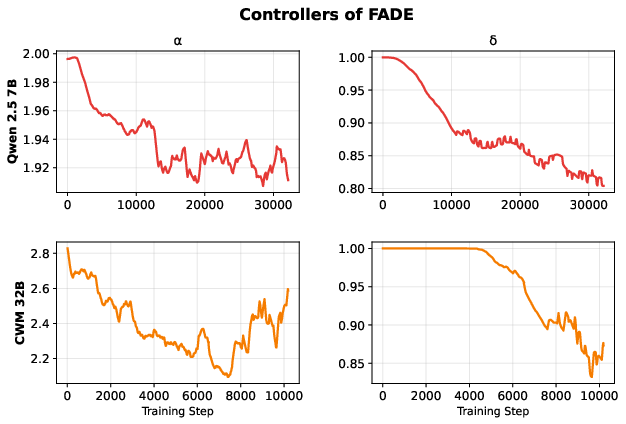
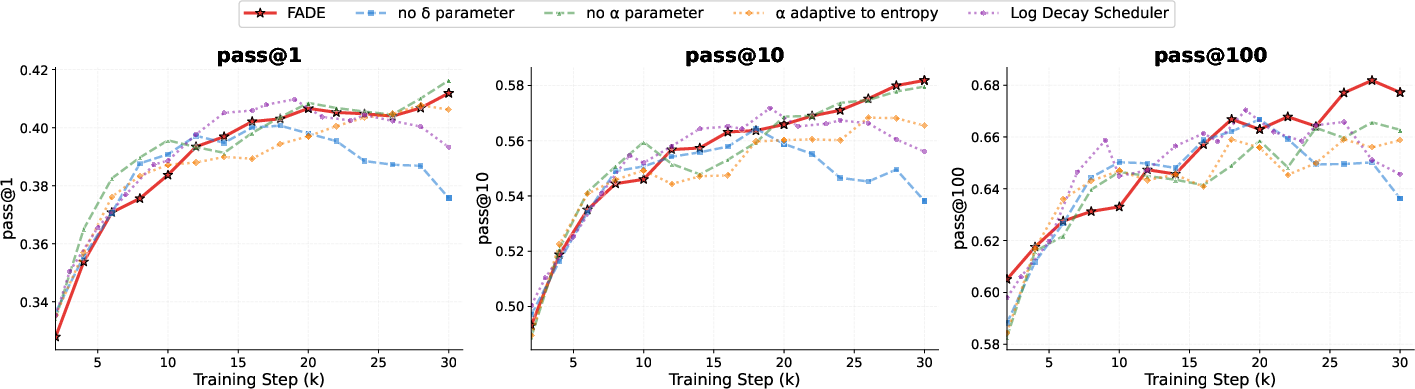
- It’s a smart scheduler that adapts two dials during training:
- A difficulty dial (alpha): early on, it focuses more on hard problems; later, it relaxes toward medium difficulty as the model improves.
- A sign-balance dial (delta): it balances how much to learn from successes vs. failures. It uses the model’s answer variety (entropy) as a signal. If variety drops too low, it avoids over-rewarding successes or over-punishing failures to keep diversity alive.
Results:
- On code (LiveCodeBench) and math (AIME) benchmarks, FADE reaches its best single-try accuracy (pass@1) faster than other methods:
- About 20,000 steps earlier than the best fixed method at the 7B model size.
- About 2,000 steps earlier at the 32B model size.
- FADE also gives a better balance: strong single-try accuracy (pass@1) and strong diversity (high pass@k for larger k, which means when you try multiple answers, at least one is more likely to be correct).
Why pass@k matters:
- pass@1 = “Can the model solve it in one try?”
- pass@k = “If we let the model try k times, do we get at least one correct?” Higher pass@k means the model keeps diverse ways to solve, which is important for hard or open-ended problems.
What this means going forward
- Training isn’t one-size-fits-all. Early on, the model should explore and learn from hard problems without collapsing into one way of answering. Later, it should exploit what it knows to get more reliable.
- FADE acts like a coach who changes strategy as the season goes on—first broad and exploratory, then focused and efficient.
- This idea could be extended beyond binary rewards or single-turn problems to settings where the model gets more detailed feedback step by step. It could also help when we can only afford a few attempts per problem.
In short: The paper shows that “how you weight each attempt” during RL has a huge effect on both speed and diversity of learning. By balancing learning from successes vs. failures and adjusting focus from hard to medium problems over time, FADE helps models learn faster and keep multiple ways of solving problems—a win for both accuracy and creativity.
Knowledge Gaps
Knowledge gaps, limitations, and open questions
Below is a focused list of what remains missing, uncertain, or unexplored, framed so that follow-up research can act on it.
- Extension beyond binary, terminal rewards: The framework and FADE are derived and validated for binary, end-of-trajectory rewards; it is unclear how the decomposition, entropy/rank-1 phenomena, and FADE generalize to per-token credit assignment, dense/continuous rewards, or learned reward models with noise and bias.
- Low-rollout (small G) regime: The analysis assumes reasonably accurate per-prompt solve-rate estimates ; quantify how different weights (including FADE) behave when is very small (e.g., 1–4), where is highly noisy, and design weights or estimators robust to this noise.
- Multi-turn and agentic settings: All experiments are single-turn; test whether the sign/difficulty trade-offs and rank-1/entropy collapse persist with intermediate feedback, tool use, or multi-step planning, and whether FADE needs new signals (e.g., turn-level entropy/solve rates).
- Domain generality: Results are for code and math with verifiable rewards; evaluate on other domains (e.g., reasoning-heavy QA, dialogue, theorem proving, coding with semantic tests only) and with noisier/non-deterministic verifiers to assess robustness.
- Interaction with PPO clipping and KL regularization: FADE is implemented within PPO; systematically study how clip ranges, KL penalties to a reference policy, or alternative optimizers (TRPO, NPG, DPO-like) alter the effect of sign/difficulty scheduling.
- Theoretical guarantees: Provide convergence analysis or sufficient conditions under which FADE avoids entropy collapse and rank-1 update collapse; formalize the link between the advantage sign ratio and (i) entropy dynamics across layers, (ii) rank concentration beyond the output head.
- Identifying the “signal” function s(p): The optimal difficulty weighting analysis relies on an unobserved signal term ; develop empirical estimators for and test whether it is monotone with difficulty across scales and tasks.
- Controller design and stability: FADE uses two hand-crafted signals (moving-average entropy and solve rate) and a fixed entropy target ; characterize sensitivity to , , smoothing windows, and controller stability (e.g., oscillations) across seeds and datasets; explore learned or adaptive controllers.
- Online detection and mitigation of rank-1 collapse: SVD diagnostics are done offline on the output head; develop efficient, training-time proxies (e.g., gradient alignment metrics, layer-wise spectral surrogates) to trigger interventions before collapse.
- Sample-efficiency accounting: Quantify whether FADE reduces total tokens-to-target vs. strong baselines when holding compute constant; disentangle gains from implicit learning-rate rescaling (scale axis) versus genuine optimization improvements.
- Group size, batch size, and effective sample size: The analysis references Kish’s but experiments do not sweep rollout/batch sizes; characterize how , batch size, and dataset diversity interact with power- weighting and FADE.
- Alternative or richer scheduling signals: Evaluate whether signals beyond entropy and solve rate (e.g., gradient cosine similarity, pass@k slope , reward variance, ratio of positive/negative mass, layerwise spectral measures) improve scheduling.
- Data curriculum and sampling: The dataset distribution is fixed; study joint optimization of policy weights and data sampling (difficulty-aware curricula, active selection) to avoid the “hard-problem trap” while maintaining .
- Robustness to verifier noise and partial credit: Analyze how different weights (and FADE) respond to stochastic/verifier errors or graded rewards; determine whether sign-imbalanced schemes amplify verification noise.
- Beyond the output head: Rank-1 funnel is measured primarily at the output projection; extend analysis to deeper layers and attention/MLP blocks to confirm whether collapse is localized or network-wide.
- Interaction with supervision/regularizers and optimizers: Assess how mixing in SFT loss, different weight decay, AdamW hyperparameters, or gradient clipping interacts with FADE’s sign/difficulty scheduling.
- Evaluation breadth and statistical reliability: Report seed variance, confidence intervals, and significance; test robustness across decoding temperatures/top-p and across more benchmarks beyond LiveCodeBench/AIME.
- Scaling across model sizes and training horizons: Results are at 7B and 32B for specific horizons; map how the optimal / trajectories vary with larger models, longer training, and different initialization (e.g., with/without reasoning SFT).
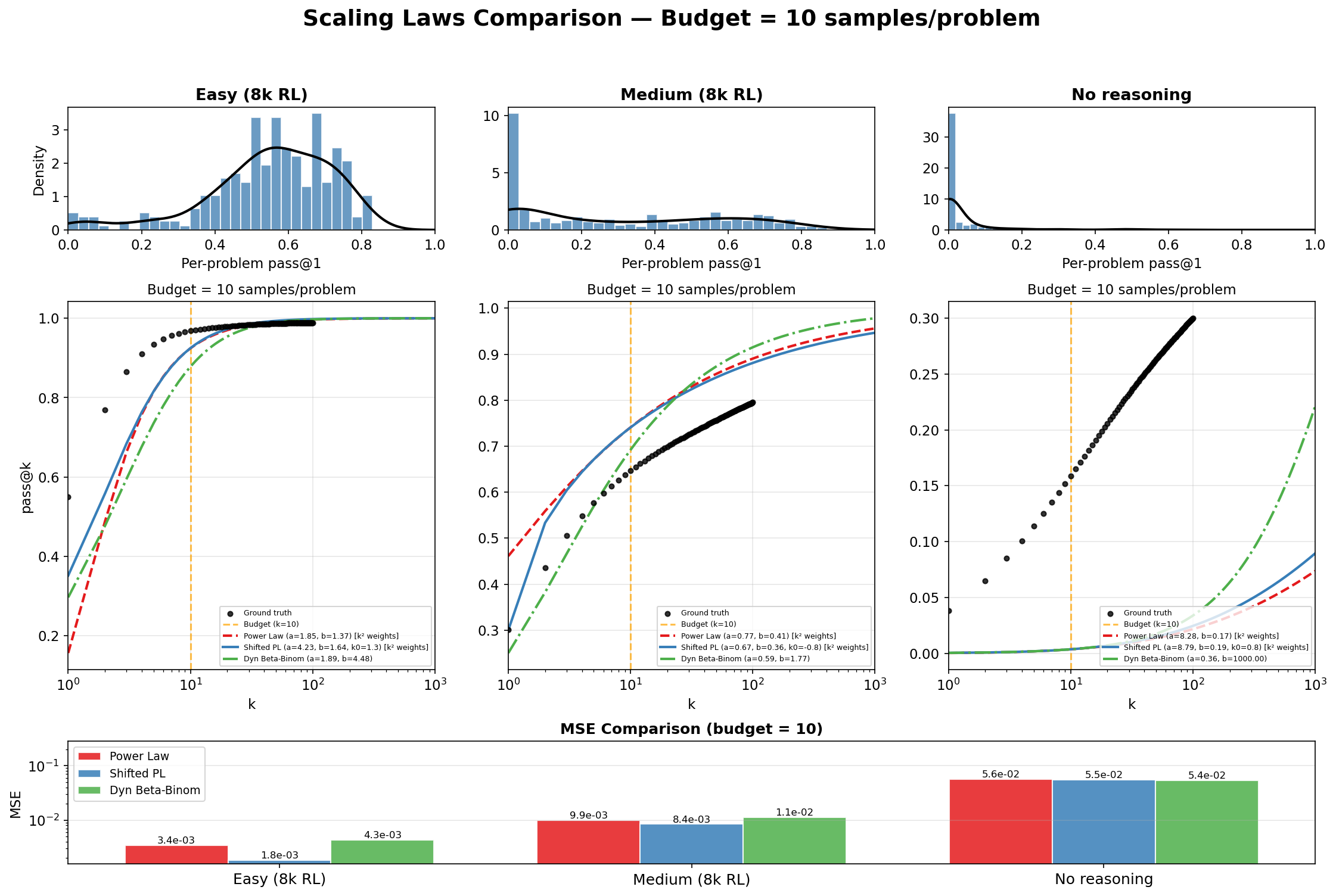
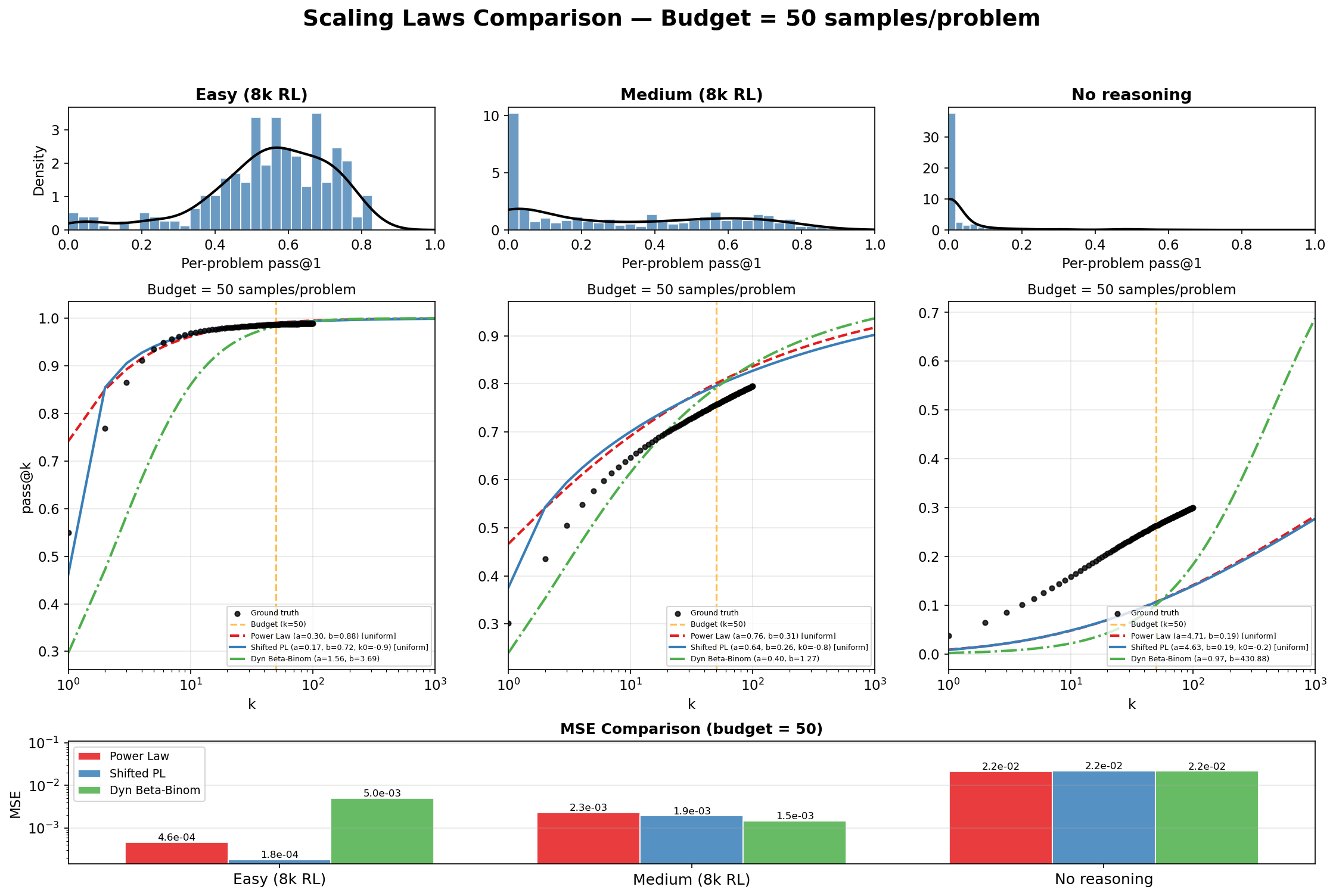
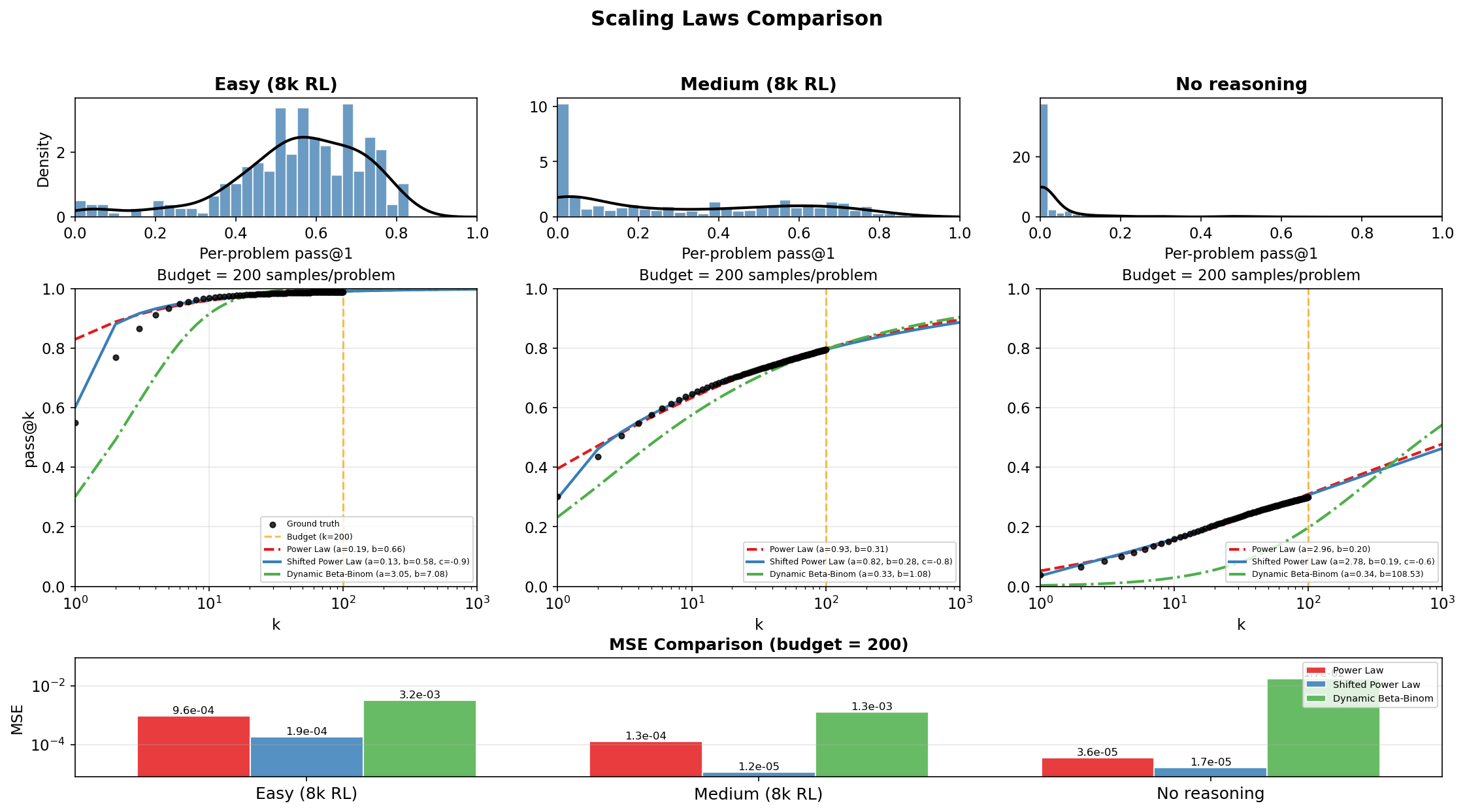
- Power-law pass@k characterization: The paper fits pass@k with a shifted power law but does not analyze fit reliability or causality; validate whether FADE systematically affects the slope and intercept across tasks and over training.
- Sensitivity to entropy measurement: Policy entropy estimates can be token-budget-, temperature-, and length-normalization–dependent; standardize entropy measurement and verify FADE’s behavior under different entropy estimators.
- Safety and alignment considerations: Sign-imbalanced weighting could favor aggressive exploitation; evaluate whether FADE affects harmfulness, hallucination, or miscalibration, and consider integrating safety-aware constraints into the scheduler.
- Weight forms that avoid p-estimation: Explore alternative weightings that do not require per-prompt (e.g., token-level uncertainty proxies, confidence-weighted advantages) for settings with tiny groups or costly rollouts.
- Generalization under distribution shift: The paper measures AIME transfer; broaden tests to more out-of-domain shifts (different code domains, math styles, languages) and analyze which parts of FADE (sign vs difficulty) drive transfer.
Practical Applications
Immediate Applications
Below are practical, deployable uses of the paper’s findings and methods, with sector tags, potential tools/workflows, and key dependencies noted.
- Deploy FADE as a drop-in advantage module in RL-with-verifiable-rewards (RLVR) pipelines for code/maths LLMs
- Sectors: software, education
- What: Replace static GRPO-style weighting with FADE’s dynamic scheduler (α for difficulty focus, δ for sign balance) to accelerate pass@1 improvements while preserving pass@k diversity.
- Tools/workflows: PPO-based post-training; binary verifiers (unit tests, answer checkers); integrate a FADE module that maintains EMAs of solve rate p and policy entropy H, adjusts α and δ per Eq. (FADE), and logs pass@k curves.
- Assumptions/dependencies: Requires verifiable, binary rewards; multiple rollouts per prompt (G>1) to estimate p; stable PPO/clip configuration; sufficient compute to maintain moving averages.
- Cut training cost/time for code assistants and reasoning LLMs by reaching target accuracy earlier
- Sectors: software, platforms
- What: Use FADE to reach peak pass@1 earlier (e.g., ~20k steps earlier at 7B, ~2k steps at 32B), reducing wall-clock compute or enabling faster iteration cycles.
- Tools/workflows: Training schedulers that terminate runs on target pass@1; cost dashboards.
- Assumptions/dependencies: Similar training regimes and data distributions as the paper; benefit magnitude depends on baseline stability and solver difficulty distribution.
- Maintain diversity and avoid mode collapse in deployed assistants that rely on n-best sampling
- Sectors: software, education
- What: Train with FADE or Power-α weighting to preserve pass@k slope, improving the quality of n-sample search (self-consistency, majority-vote).
- Tools/workflows: Pass@k curve fitting (shifted power law) in evaluation; adjust α to sustain diversity; test-time decoders (temperature/top-p) remain effective.
- Assumptions/dependencies: Verifier-backed training; evaluation must track pass@k, not just pass@1.
- Use Power-α weighting to focus learning on hard problems for small/early-stage models; migrate toward medium difficulty as p rises
- Sectors: software, education
- What: For 7B-class or similar, set α>1 early to emphasize frontier prompts; decay α as solve rates increase to recover sample efficiency.
- Tools/workflows: Difficulty-aware batching; scheduler that decays α as p increases; data statistics pipelines that track distribution of p over time.
- Assumptions/dependencies: Reliable estimate of batch-level solve rate; enough hard examples to avoid collapsing effective sample size.
- Stabilize early training with sign-balanced or mildly failure-biased updates to prevent entropy and rank-1 collapse
- Sectors: software
- What: Use AsymGRPO (δ≈1 to start; δ<1 only once entropy drops below target H*) to avoid early entropy collapse and late-stage rank-1 update funneling.
- Tools/workflows: Entropy tracking and a target entropy setpoint; δ controller that clamps within [0.3, 1.0] per the paper; alerting when entropy falls too fast.
- Assumptions/dependencies: Accurate entropy measurement under training sampling; PPO setup compatible with dynamic advantage scaling.
- Add model-update diagnostics to training dashboards to catch brittleness early
- Sectors: software, MLOps
- What: Monitor sign ratio (mS·p)/(mF·q), policy entropy, output-layer SVD metrics (s1/s2, rank-1 fraction), and pass@k shape parameters (a, b).
- Tools/workflows: Lightweight SVD on output head deltas at checkpoints; EMA metrics; traffic-light dashboards for “diversity health.”
- Assumptions/dependencies: Extra logging/compute overhead; proper checkpoint cadence; care with measurement noise.
- Standardize comparative studies in academia using the mS/mF and difficulty-axis decomposition
- Sectors: academia
- What: Report advantage designs in terms of sign balance (mS vs mF), difficulty focus (where mass peaks over p), and scale; control for each axis in ablations.
- Tools/workflows: Shared evaluation suites (LiveCodeBench, AIME) with pass@k reporting; open-source advantage probes (Power-α, AsymGRPO).
- Assumptions/dependencies: Community uptake; clarity in reporting “effective LR” (scale axis) to avoid confounds.
- Practical curriculum/data filtering guided by solve-rate p
- Sectors: software, education
- What: Automatically upweight or oversample prompts in the [~0.3–0.5] solve-rate band where signal-to-noise is strongest for many settings; reduce allocation to ultra-easy or ultra-hard tails unless α-tilt is justified.
- Tools/workflows: Dataset stratification by p; dynamic sampling policies; Kish’s effective sample size as a guardrail.
- Assumptions/dependencies: Stationarity of p estimates within epochs; distribution shifts monitored.
- Safer training policies that avoid brittle over-optimization
- Sectors: policy, compliance, safety
- What: Introduce internal guidelines to monitor and bound entropy loss and update rank concentration during RLFT/RLVR; treat extreme sign bias as a risk factor for brittleness.
- Tools/workflows: Internal model governance checklists; acceptance criteria on pass@k diversity; thresholds on rank-1 fraction.
- Assumptions/dependencies: Organizational willingness to monitor internal metrics; agreement on thresholds and their link to real-world robustness.
- Product-facing improvements via more reliable single-sample and better few-sample outcomes
- Sectors: software, consumer productivity
- What: After FADE-trained models, default single-sample suggestions improve (pass@1), while users who request multiple candidates benefit from sustained diversity (pass@k).
- Tools/workflows: UX that surfaces multiple suggestions when needed (e.g., coding/autocomplete); better de-duplication/selection strategies.
- Assumptions/dependencies: Model retraining or fine-tuning cycles adopting FADE; product telemetry to validate gains.
Long-Term Applications
These opportunities require additional research, engineering, or domain adaptation beyond the current paper’s scope.
- Generalize FADE to token-level/process rewards and multi-turn agent settings
- Sectors: software, robotics, agents
- What: Extend the mS/mF and difficulty framework beyond binary terminal rewards to per-step/process feedback (GAE-style), multi-turn interaction, and agentic planning.
- Tools/products: “FADE-Process” modules that handle non-binary, temporally dense rewards; integration with trajectory credit assignment.
- Assumptions/dependencies: Robust estimators of per-step solve probabilities; verifier availability for partial credit; theoretical adaptation of drift/variance analyses.
- Low-rollout regime robustness (few samples per prompt)
- Sectors: software, academia
- What: Design advantage weightings that remain stable when p is very noisy (G small). Potential approaches include Bayesian p-estimators, variance-aware clipping, or weight smoothing across batches.
- Tools/products: Lightweight estimators and uncertainty-aware schedulers; empirical benchmarks at G∈{1–4}.
- Assumptions/dependencies: Access to uncertainty quantification; careful bias-variance trade-offs.
- Automated training controllers for exploration–exploitation budgets
- Sectors: MLOps, platforms
- What: Build “FADE controllers” that manage target entropy (H*), solve-rate windows, and clip ranges, optimizing for speed-to-metric under compute/energy budgets.
- Tools/products: Control-theory-inspired trainers; policy dashboards with setpoint control; cost-to-accuracy optimizers.
- Assumptions/dependencies: Reliable online metrics; guardrails to avoid oscillations or instability.
- Co-design of training-time weighting and test-time compute allocation
- Sectors: software
- What: Jointly learn FADE schedules and test-time sampling policies (e.g., dynamic k, temperature) to maximize end-task utility per unit compute.
- Tools/products: Meta-controllers for joint training/inference policies; simulators for end-to-end cost/benefit.
- Assumptions/dependencies: Clear product utility metrics; capacity to iterate on both training and inference stacks.
- Domain extensions where verifiers exist or can be constructed
- Healthcare: training reasoning LLMs with verifiable medical calculators, dosing checks, guideline conformance
- Tools/products: Medical-grade verifiers; FADE-tuned RL pipelines; safety monitoring of entropy/rank metrics.
- Dependencies: High-stakes validation; regulatory compliance; expert-curated verifiers.
- Finance/compliance: contracts or report generation validated by rule engines
- Tools/products: Rule/verifier libraries; FADE-driven post-training to reduce hallucinations while keeping diverse drafts.
- Dependencies: Strong rule coverage; audit trails.
- Robotics/control-in-simulation: binary success/failure tasks or dense proxies mapped to binary thresholds
- Tools/products: Simulation verifiers; curriculum by p; FADE schedules matching exploration phases.
- Dependencies: Simulator fidelity; bridging sim-to-real; safety constraints.
- Energy/grid operations simulators with crisp success criteria
- Tools/products: Sandbox verifiers (stability, constraint satisfaction); FADE-tuned controllers.
- Dependencies: Accurate simulators; operational risk management.
- Standards and auditing frameworks around training diversity and stability
- Sectors: policy, governance
- What: Develop evaluation standards that include pass@k curves, entropy trajectories, sign ratio balance, and update-rank metrics as part of model cards or audit reports.
- Tools/products: Open audit checklists; reproducible metrics packages; threshold recommendations per use case.
- Assumptions/dependencies: Community consensus on metrics’ link to downstream robustness and fairness.
- Active data acquisition guided by solve-rate distributions
- Sectors: software, academia
- What: Use p-driven analytics to target underrepresented difficulty bands, improving N_eff and signal-to-noise over time; automated “frontier mining” for hard-but-solvable examples.
- Tools/products: Data pipelines that estimate and stratify by p; sampling controllers to re-balance datasets.
- Assumptions/dependencies: Accurate and timely p estimates; bias controls to avoid overfitting to hard tails.
- Safety-oriented exploration constraints
- Sectors: policy, high-stakes applications
- What: Incorporate guardrails that cap δ and α in sensitive domains, preventing extreme sign bias (entropy collapse) or prolonged failure bias (rank-1 collapse).
- Tools/products: Safety profiles for FADE; escalation triggers when diversity drops below thresholds.
- Assumptions/dependencies: Domain-specific risk tolerance; mapping training metrics to real-world safety outcomes.
- Tooling for weight-space health monitoring at scale
- Sectors: MLOps
- What: Operationalize SVD-based rank diagnostics, aligning changes in rank concentration with regressions in OOD performance; build early-warning systems.
- Tools/products: Efficient approximate SVD; drift detection pipelines; automatic interventions (schedule adjustments).
- Assumptions/dependencies: Cost-effective approximations for very large models; careful interpretation to avoid false positives.
- Cross-model and cross-domain transfer policies for α/δ schedules
- Sectors: academia, platforms
- What: Learn transferable priors or meta-policies that predict good α/δ schedules from model size, initial p-distribution, and domain characteristics.
- Tools/products: Meta-learning or Bayesian optimization over training runs; schedule libraries per archetype (e.g., 7B code vs 70B math).
- Assumptions/dependencies: Large experiment banks; reproducibility across stacks.
Notes on feasibility and assumptions (global):
- Strongest gains are in verifiable, binary-reward domains (e.g., unit-testable code, math with known answers). Extension to softer or subjective tasks requires new verifiers or proxy rewards.
- FADE depends on reliable online estimates of solve rate p and policy entropy H. Noisy estimates (low rollouts per prompt) reduce effectiveness without additional smoothing/robustness mechanisms.
- Monitoring update-rank metrics adds overhead; scalable approximations are advisable in large models.
- Benefits vary with model scale: smaller models often benefit from stronger hard-problem focus (higher α) early; larger models may favor medium-difficulty focus closer to GRPO (α≈1).
Glossary
- Advantage function: A weighting function used in policy gradient methods to determine how much each trajectory contributes to the update, often differing from the classical RL advantage. "The weights, commonly called ``advantage functions,'' rarely correspond to the classical advantage (value of an action minus the value of the average action in a state); they simply determine how much each rollout contributes to the gradient."
- Analytical pass@: A formulated objective that directly optimizes pass@ success by shaping policy weights based on the probability of at least one success in samples. "Analytical pass@ \citep{chen2025pass}"
- Asymmetric GRPO: A GRPO variant that scales the negative (failure) mass by a factor to bias the sign balance between reinforcing successes and suppressing failures. "We introduce AsymGRPO, a single-parameter variant of GRPO that keeps the same positive mass and rescales the negative mass by , ."
- Asymmetric Power : A policy-weighting scheme that applies different exponents to successes and failures, enabling explicit control over sign bias and difficulty focus. "Asymmetric Power : We decouple the exponents: for and for ."
- Bernoulli form: The specific variance/standard-deviation form for binary rewards used to normalize advantages. "the empirical standard deviation reduces to the Bernoulli form "
- Binary verifier: A deterministic checker that labels a rollout as success or failure with a binary reward. "score them with a binary verifier"
- Delta method: A statistical approximation technique to estimate the variance of a function of a random variable, used here to analyze weight-estimation noise. "Using the Delta method, we can estimate the total per-update noise as:"
- DR-GRPO: A GRPO-style algorithmic variant for policy-gradient training in LLM RL with different normalization choices. "DR-GRPO \citep{drgrpo}"
- Entropy collapse: The rapid reduction of policy entropy leading to narrowed outputs and reduced diversity during RL updates. "Entropy collapse is proportional to the sign ratio and success rates"
- FADE (Focal Advantage with Dynamic Entropy): A self-adapting advantage scheduler that jointly tunes difficulty focus and sign balance based on online solve rates and entropy. "This motivates FADE (Focal Advantage with Dynamic Entropy)"
- Focal loss: A loss function that down-weights easy examples and focuses learning on hard ones, inspiring the Power weighting. "inspired by the focal loss of \citet{lin2017focal}"
- GRPO: A group-based policy-gradient method that uses the mean reward as a baseline to reduce variance within batches of rollouts. "Since GRPO \citep{deepseek_grpo}, which uses the mean reward as a baseline for updates, a host of alternative policy weights have appeared"
- Kish's effective sample size: A measure of the effective number of samples after weighting, accounting for variance in weights. "is Kish's effective sample size."
- Log-mean-exp weighting: A reweighting scheme that uses the log-mean-exp of rewards to shape advantages. "log-mean-exp weighting \citep{lme}"
- Monte Carlo rollouts: Multiple sampled trajectories from the current policy used to estimate solve rates and gradients. "we estimate via Monte Carlo rollouts"
- pass@: The probability that at least one of sampled outputs is correct; used both as a metric and as a basis for policy weights. "pass@-based objectives \citep{tang2025optimizing,chen2025pass}"
- Policy gradient: The gradient of expected reward with respect to policy parameters, used to update the model in RL. "update the policy via a weighted policy gradient"
- Policy gradient estimator: The REINFORCE-style Monte Carlo estimator for the policy gradient. "policy gradient estimator~\citep{Williams1992}:"
- Policy weight: The per-trajectory scalar that reweights gradients in policy-gradient updates, often derived from rewards/baselines. "we can write the policy weight as:"
- PPO clipping: A mechanism in Proximal Policy Optimization that clips policy-ratio updates for stability; used here as the training framework. "within the PPO clipping framework"
- Power : A focal-style weighting that emphasizes harder problems (lower solve rates) as increases. "Power (ours)"
- Quantile baseline: A baseline that subtracts a chosen quantile of rewards to compute advantages, altering sign balance. "Quantile baseline \citep{dabney2018distributional}"
- Rank-1 funnel: A phenomenon where updates concentrate along a single dominant direction, restricting further learning capacity. "We call this the rank-1 funnel"
- Rank-1 update collapse: The degeneration of parameter updates to effectively rank-1, limiting model improvements and diversity. "Suppressing failures induces rank-1 update collapse."
- RLOO: The REINFORCE Leave-One-Out baseline that uses batch rewards excluding the current sample to reduce variance. "RLOO \citep{ahmadian2024back}"
- Signal-to-noise ratio: The ratio of gradient signal strength to its variance, used to assess update quality across difficulties. "the signal-to-noise ratio of the weighted gradient"
- Singular value decomposition (SVD): A matrix factorization used to analyze the rank structure of parameter updates during training. "using SVD analysis on "
- Singular-value ratio: The ratio of the top singular values (e.g., ) used to quantify rank concentration in updates. "singular-value ratio "
- Solve rate: The probability that a prompt is solved by the policy; used to shape and analyze gradient mass. "based on the estimated solve rate "
- Test-time compute scaling: An inference strategy that samples many candidates and selects the best to improve accuracy. "Test-time compute scaling, sampling candidate solutions and selecting the best, has become a standard strategy"
- W-REINFORCE: A weighted variant of REINFORCE that adjusts update magnitudes based on reward sign or magnitude thresholds. "W-REINFORCE \citet{w_reinforce}"
Collections
Sign up for free to add this paper to one or more collections.

