- The paper introduces general stability as a distance-sensitive extension that aggregates ranking regions using an exponential kernel to weigh changes by their impact.
- The paper presents both efficient exact/sampling methods and a convex-body algorithm (Conv-SC) to compute stability, achieving polynomial runtime under quasiconvex distances.
- The paper demonstrates empirically that general stability offers more robust and interpretable rankings compared to exact stability, especially in high-dimensional and real-world settings.
The General Stability of Ranking: A Technical Analysis
Introduction and Motivation
Weighted-sum linear scoring functions underpin ranking systems across domains such as university rankings, hiring, and resource allocation. The selection of attribute weights is inherently subjective, introducing the possibility that small perturbations in weights may yield markedly different rankings, undermining the robustness and interpretability of published ranked lists. Although prior frameworks formalized "exact" stability as the fractional volume of the weight space preserving a particular ranking, this approach fails to differentiate between ranking changes with minor utility loss (e.g., lower-ranked item swaps) and those with major impact (e.g., shifting the top-ranked choice).
This paper advances the state-of-the-art by proposing general stability, a distance-sensitive generalization of stability in rankings, parameterized by user-defined metrics over the space of permutations. This framework enables robust inference about ranking sensitivity to weight variations, discriminating between disruptions that do and do not affect substantive conclusions (e.g., who is first, or membership in the top-k). The authors analyze the computational aspects of general stability, develop both efficient exact/sampling-based and novel convex-body-based algorithms, and empirically validate the utility and tractability of the proposed estimators on real and synthetic data.
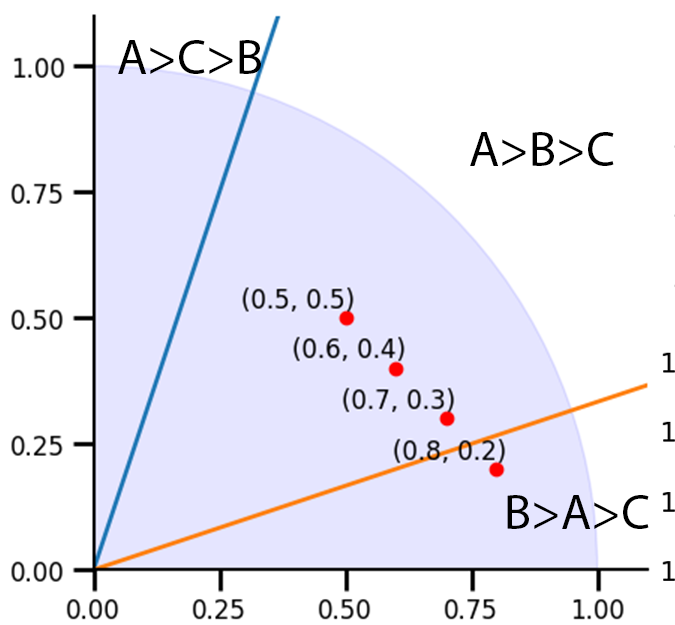
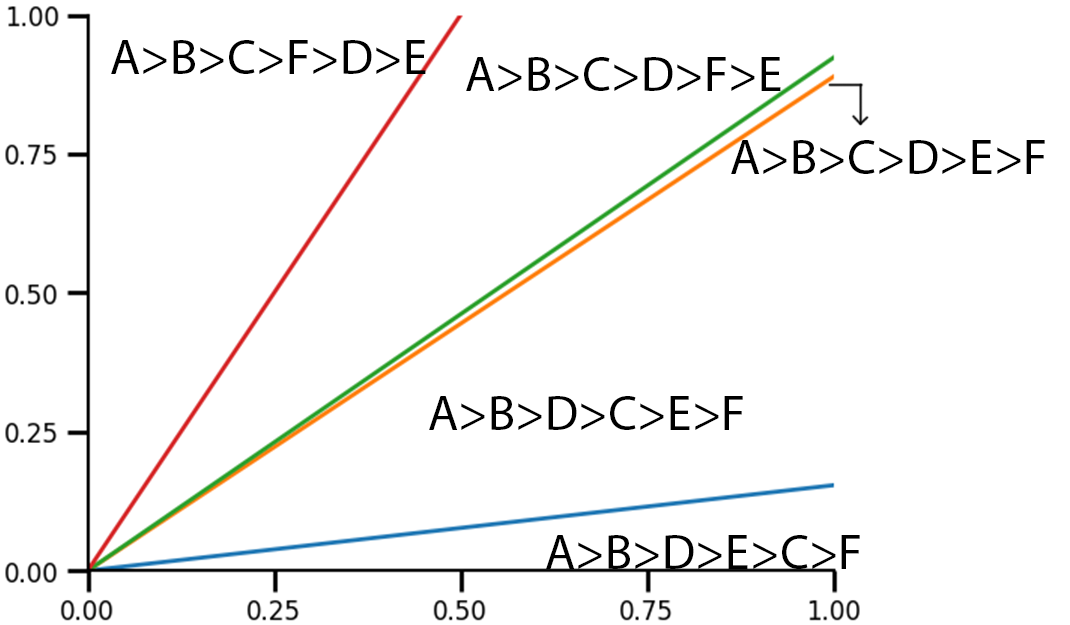
Figure 1: Ranking regions in two-dimensional weight space for illustrative examples; left—large exact-stability region, right—small region with "nearby" similar rankings.
Given a database D of n items, each with d standardized features, the ranking induced by a weight vector w is defined by the relative ordering of items' scores under fw(t)=w⋅t. The ranking region associated with a permutation r is the set of all nonnegative unit-norm weight vectors yielding r as the induced order.
Exact stability is the ratio of the volume of the corresponding ranking region to the volume of all admissible weights. General stability extends this by aggregating over all ranking regions, weighting each by a function of its distance from a user-specified target r0. The distance function used must satisfy identity-of-indiscernibles and symmetry (not necessarily the triangle inequality), and the aggregation employs an exponential kernel for compatibility with strict stability as a limiting case.
Key formal definitions:
- Let dist(r1,r2) denote the user-chosen distance.
- General stability is
D0
This formulation encompasses exact stability as a special case where all pairwise distances are infinite except for D1, ensuring only the region for the target ranking has nonzero weight.
Distance Functions and Quasiconvexity
The choice of distance is critical: it encodes application-specific notions of "closeness". The authors propose and analyze several distances:
- First Differing Position (D2): Small for rankings that agree on more prefix items.
- Exponentially Position-Weighted Kendall's Tau and Spearman's Footrule: Generalizations of classical permutation metrics, down-weighting errors at lower ranks.
- 0/D3: Recovers exact stability.
Only specific distances are compatible with efficient convex-body computation. The concept of quasiconvexity of the distance function is central; for quasiconvex distances, all rankings within threshold D4 of a target induce a convex region in weight space, making volume computation tractable.
Computational Methods
2D Algorithm (GSC_2d)
For D5, ranking regions correspond to angular intervals partitioned by D6 pairwise comparison boundaries; these intervals and their contributions to stability can be exactly enumerated in D7 time.
High-Dimensional Unbiased Sampling (GSC_md)
For general D8, computing region volumes is D9-hard. The paper adopts and extends an unbiased rejection-sampling approach: weights are uniformly sampled from the feasible ball, the induced ranking for each sample is determined, and contributions are aggregated according to the specified kernel. The sample complexity for achieving fixed relative error with constant failure probability is n0, where n1 is the stability value; when n2 is exponentially small (as it may be for high n3 or large n4), this becomes computationally infeasible.
Convex-Body Volume Algorithm (Conv-SC)
The central algorithmic contribution is Conv-SC, which is designed for cases where the distance is quasiconvex. By grouping ranking regions by distance from the target and exploiting the convexity of their unions, Conv-SC reduces stability computation to a sequence of convex volume approximations (using hit-and-run MCMC or other state-of-the-art methods). For fixed n5 and quasiconvex distances, the total runtime is polynomial in n6, suppressing n7- and n8 factors.
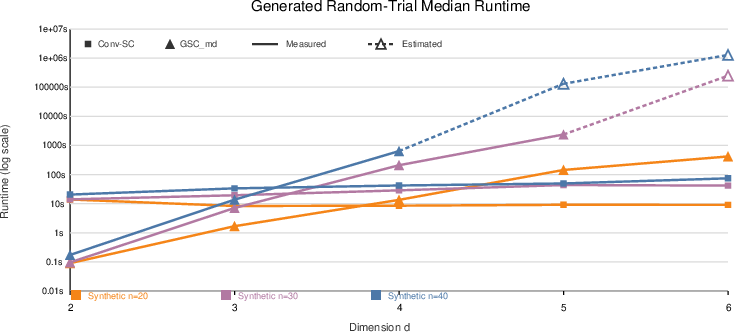
Figure 2: Scaling of Conv-SC and GSC_md on synthetic data; Conv-SC demonstrates polynomial scaling whereas GSC_md becomes rapidly infeasible with increasing dimension.
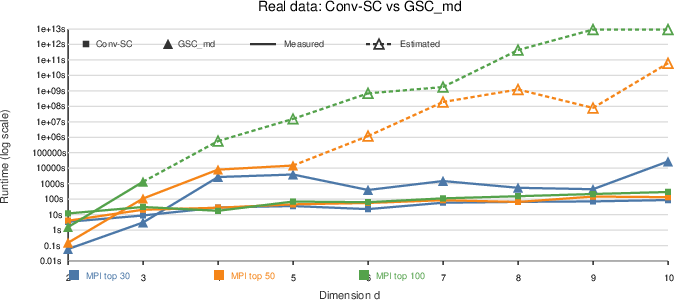
Figure 3: Runtime scaling on real-data (MPI) prefixes, showing Conv-SC's consistent polynomial cost, while sampling-based GSC_md quickly incurs high computational demands.
Experimental Results
The empirical analysis demonstrates key properties and advantages of the framework:
- Interpretive Value: General stability prevents over-penalization of minor changes—e.g., small swaps in lower-ranked positions. In real-world datasets (e.g., CWUR patents, QS rankings), exact stability values can be minuscule, while general stability remains high, providing a more meaningful signal about the resilience of critical ranking features.
- Robustness to Noise: Distance-sensitive stability is much less sensitive to minor swaps compared to exact stability, as shown by normalized stability drop data for small perturbations across eight datasets (see Table 1 in the paper).
- Computational Efficiency: For high-dimensional tasks, Conv-SC achieves polynomialtime runtime scaling in n9 for the relevant class of distances. In both synthetic and real-data experiments, Conv-SC significantly outperforms sampling-based estimators when region volumes are small or the number of regions is large, with observed runtimes in the low seconds range for realistic tasks even as d0 approaches 10.
Theoretical and Practical Implications
This work addresses key limitations of prior ranking stability measures:
- Theoretical: By parameterizing stability with a general, user-chosen distance, the framework formalizes nuanced robustness questions that reflect real-world decision sensitivity. The identification of quasiconvexity as the structural property that enables efficient volume computation expands the range of feasible analyses in high dimensions.
- Practical: The general stability scores can guide auditors, stakeholders, and designers of ranking systems in determining whether published (or policy-relevant) results are robust to reasonable parameter misspecification. The tractability of Conv-SC under quasiconvex distances enables real-time or at-scale stability analysis, which may inform best practices for transparent reporting or fairness constraints.
Limitations and Future Perspectives
While general stability is flexible, certain application-relevant distances (e.g., arbitrary position-weighted Kendall's tau, for all choices) fall outside the quasiconvex tractable regime. Additionally, the volume computation for nonconvex or highly fractured regions remains computationally hard.
There is substantial opportunity for further research into:
- Hybrid algorithms that combine sampling and convex approaches.
- Extensions to probabilistic or noisy data models.
- Application to fairness and diversity-constrained ranking generation and certification protocols.
Conclusion
General stability is a robust, application-driven extension of volume-based ranking stability. It provides interpretable, distance-sensitive stability estimates, leveraging user-defined metrics to account only for substantively meaningful changes. With both algorithmic and empirical contributions, the framework delivers efficient, precise robustness quantification for linear ranking functions under weight uncertainty—especially for the broad class of settings with quasiconvex distances—enabling theoretically sound and computationally viable deployment in practice.