- The paper demonstrates that parameter identifiability of spatial stochastic dynamics critically depends on source structure, boundary conditions, and the chosen stochastic convention.
- It employs rigorous structural analysis and ambiguity operators to reveal limits in recovering variable diffusivity and related parameters from single snapshots.
- Practical methods such as DTO, PINN, and BiLO are benchmarked, showing robust recovery of relative spatial patterns under identifiable regimes.
Problem Statement and Motivation
The paper “Identifiability Limits of Physics-Informed Inference for Spatial Stochastic Dynamics from Static Snapshots” (2607.01749) addresses a fundamental problem in quantitative biology: to what extent can the spatially heterogeneous parameters of stochastic biological transport and reaction processes—specifically, diffusivity D(x), source B(x), degradation γ(x), and boundary exchange—be identified from a single, static snapshot of particle positions? The scenario is quintessential in settings where destructive measurements (e.g., single-molecule fluorescence in situ hybridization) record only spatial distributions, not temporal evolution, thus precluding direct trajectory-based inference.
The work focuses on steady-state systems where particles are produced by a (possibly spatially structured) source, diffuse with spatially variable diffusivity, and are subject to degradation and exchange at boundaries. The observed snapshot—the locations of all particles—forms a spatial Poisson process with intensity u(x), itself determined by the forward PDE for the process.
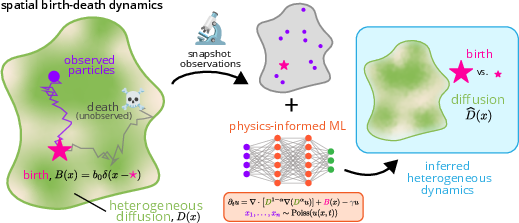
Figure 1: Visual summary of the inverse problem: reconstructing D(x) and related parameters from a single spatial Poisson realization generated by the underlying stochastic dynamics.
Structural Identifiability Analysis
A central contribution is a rigorous characterization of structural identifiability for these inverse problems. The paper demonstrates that identifiability is highly sensitive to several modeling choices:
- Source Structure: When B(x) is a diffuse (non-singular) function, D(x) and B(x) are non-identifiable: independent perturbations in B can be exactly compensated by adjustments in D to reproduce the same observed B(x)0. This leads to infinite-dimensional non-identifiability, applicable across stochastic conventions.
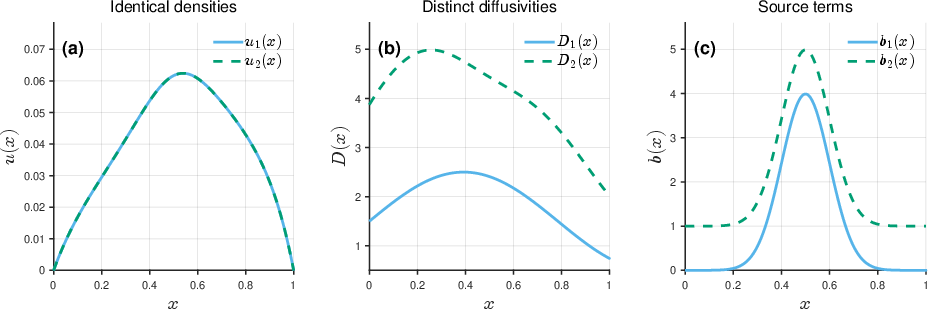
Figure 2: Example construction of indistinguishable alternative pairs B(x)1 and B(x)2 under Itô diffusion with Dirichlet boundaries, both producing the same density profile.
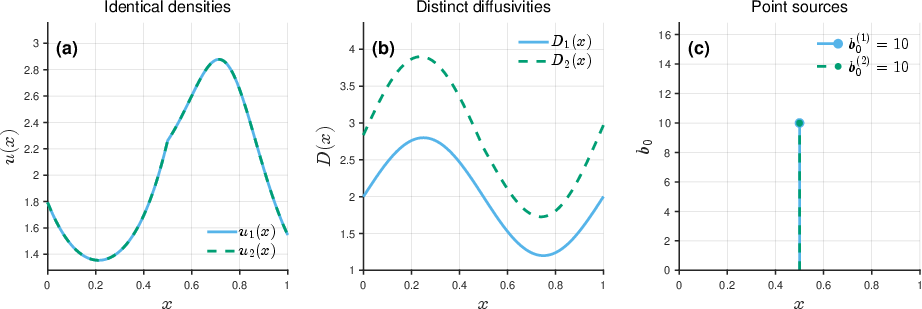
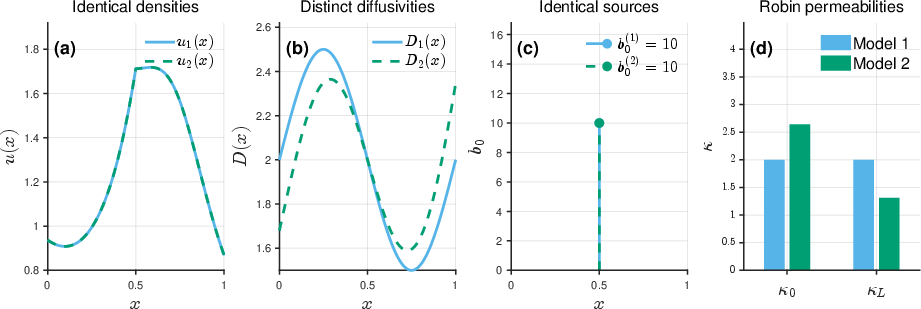
- Point sources: If B(x)3 consists of one or more point sources (e.g., a gene locus), identifiability is restored under certain conditions. Specifically, if the diffusion coefficient is B(x)4 at the source (assigning the singularity to the source, not the medium), the pair B(x)5 (where B(x)6 is the source strength) becomes identifiable from B(x)7. This rests on the unique jump conditions imposed by point sources, which cannot be mimicked by smooth changes in B(x)8.
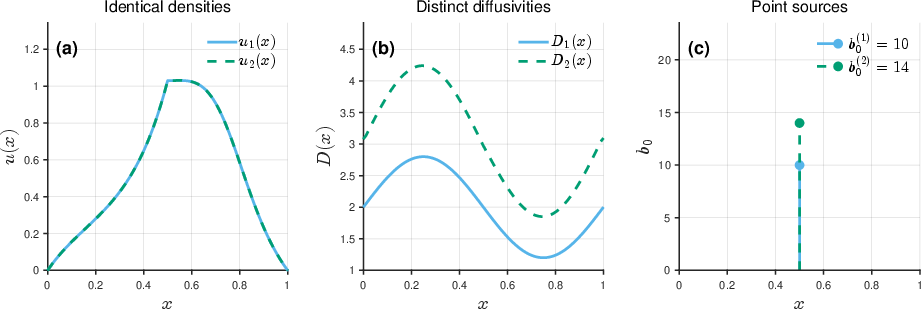
Figure 3: Comparison of alternative diffusivity constructions in the presence of point sources and Dirichlet boundaries, demonstrating the role of source regularity in ensuring identifiability.
- Stochastic Convention (B(x)9 parameterization): The identifiability structure depends critically on the stochastic calculus convention (Itô, Stratonovich, Fickian) governing the definition of spatially heterogeneous diffusion. The PDE operator's order with respect to γ(x)0 shifts with γ(x)1, altering which combinations of model parameters are confined by a single snapshot.
Influence of Boundary Conditions and Additional Constraints
The inference landscape is further complicated when boundary conditions are partially or wholly unknown:
The study benchmarks three physics-informed inference schemes across identifiable scenarios:
Discretize-then-Optimize (DTO): Differentiable finite-volume solver for the steady-state PDE; strong performance and accurate enforcement of boundary/source constraints.
- Physics-Informed Neural Networks (PINNs): Mesh-free function approximations for u(x)2 and u(x)3 with soft residual loss; effective but regularization-dependent.
- Bilevel Local Operator Learning (BiLO): Neural local solution operator trained to locally satisfy the PDE and sensitivity constraints; mitigates the trade-off between physics and data loss.
Numerical experiments reflect several robust findings:
- For point-source, known-boundary regimes, all methods can recover the spatial shape of u(x)4 and source strengths from a single noisy snapshot, with reliability improving as particle counts increase.
- Recovery of relative spatial shape of u(x)5 is markedly more robust than absolute scale, owing to approximate scaling symmetries in the steady-state equation, especially when degradation is not dominant.
- Over-regularization—particularly in PINN—can erase spatial heterogeneities in u(x)6, highlighting a need for method-specific regularization calibration.
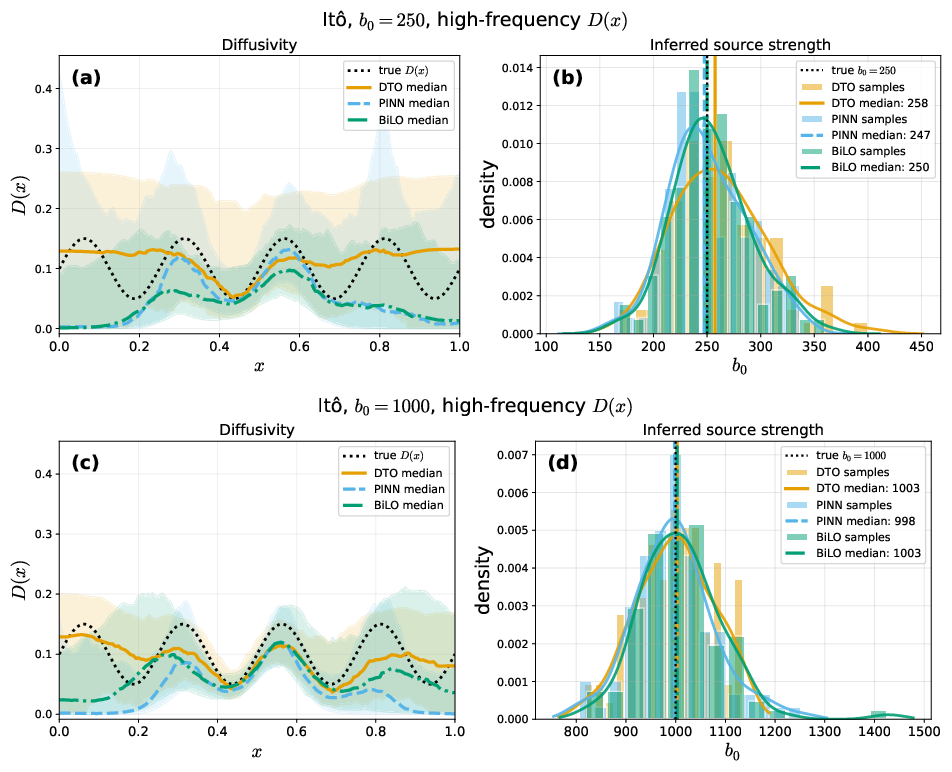
Figure 6: DTO, PINN, and BiLO recoveries for oscillatory u(x)7 reconstructing shape with varying accuracy as source strength increases.
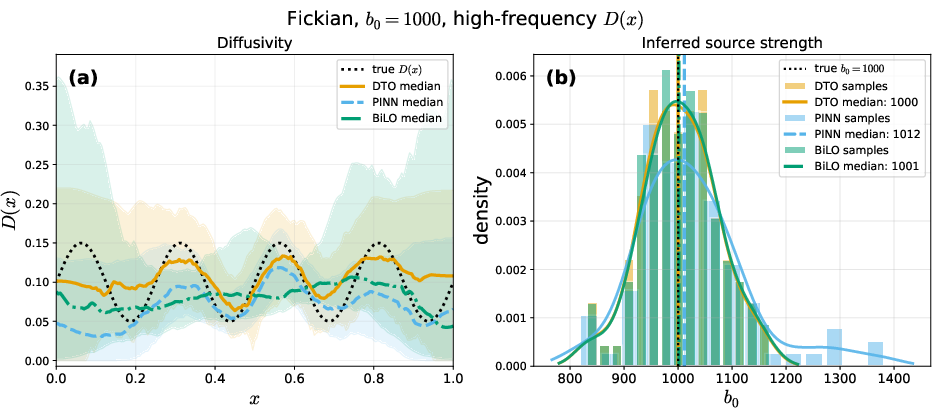
Figure 7: Under the Fickian-Neumann scenario, DTO tracks fine-scale oscillations better than PINN/BiLO, but all methods benefit from lower spatial frequencies and higher particle counts.
Theoretical and Practical Implications
This analysis provides a comprehensive framework for evaluating the limitations of inference from spatial snapshot data in biological transport-reaction systems. The work reveals that:
- Mechanical or biological conclusions about spatial heterogeneity (e.g., subcellular domains of restricted diffusion) from static snapshots must be scrutinized via explicit identifiability analysis—otherwise, observed patterns may confound unidentifiable blends of source, boundary, and transport effects.
- The stochastic calculus convention is a crucial modeling choice affecting identifiability; it cannot be determined from static data and should be fixed using physical or experimental rationale.
- In practice, single snapshots may suffice to recover functionally meaningful spatial structure—provided model structure and data acquisition satisfy the identifiability requirements outlined.
- For applications in cell biology, mapping relative heterogeneity (e.g., regions of low/high u(x)8 reflecting chromatin compaction or nuclear substructure) is feasible, even if absolute diffusivities require complementary calibration.
- Extensions to higher dimensions, nonlinear kinetics, or temporally non-stationary scenarios are not directly addressed, but the paper's ambiguity-operator approach should generalize with sufficient theoretical development.
Future Directions
Potential extensions and open questions include:
- Higher-dimensional and anisotropic systems: Singularities and identifiability structure become more involved; explicit ambiguity operators and regularity properties need confirmation.
- Nonlinear reaction kinetics: The effect of mass-action or saturation dynamics on identifiability merits formal analysis.
- Joint inference of stochastic convention: With time-resolved or multi-modal data, it may be feasible to infer or select the appropriate convention.
- Sample complexity and stability bounds: Statistical theory for finite-sample inverse recovery is an open challenge, especially in the functional setting.
Conclusion
The paper precisely delineates where and how physics-informed machine learning can, or cannot, recover spatially varying dynamical parameters from static biological data. Identifiability relies on the interplay between source structure, boundaries, stochastic convention, and observed variables. The proposed practical algorithms, when applied within identifiable regimes, yield sharp reconstructions of fine-scale spatial heterogeneity—enabling functional spatial inference from data that, prima facie, appear too impoverished for the task.
Figure 1: The inverse problem visualization: inferring spatially heterogeneous dynamics from a single point pattern using physics-informed machine learning.
Reference:
"Identifiability Limits of Physics-Informed Inference for Spatial Stochastic Dynamics from Static Snapshots" (2607.01749).