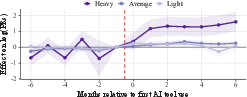
- The paper demonstrates that sustained AI tool usage led to a near doubling (2.09x) of per-developer pull requests over two years.
- The study employs a staggered difference-in-differences design to isolate within-developer productivity gains and establish a dose–response relationship among heavy users.
- The mandate restructured downstream code review by shifting load to automation, highlighting a trade-off between review efficiency and human evaluation.
Doubling Developer Throughput with AI: Analysis of an Enterprise-Wide AI Productivity Mandate
Study Context and Motivation
This longitudinal study (2607.01904) presents a rare multi-year quantitative evaluation of an explicit enterprise-wide "2× mandate" intended to double engineering throughput through AI code tools. The intervention took place at a mid-sized, AI-forward B2B software firm between January 2024 and April 2026, involving 802 developers and over 196,000 pull requests. This setting is notable for its nearly ideal conditions: explicit executive commitment, generous tool provisioning, and an explicit organizational metric (merged PRs/engineer/month) against which to calibrate outcomes.
The study adopts a staggered difference-in-differences (DiD) design leveraging high-resolution telemetry on both code production and AI tool activity, enabling attribution of observed productivity changes to AI adoption and distinguishing the effect of cumulative use from one-off adoption events.
Empirical Findings: Magnitude and Distribution of Productivity Gains
Analysis reveals a significant, gradual, within-developer productivity increase following AI tool adoption. Average per-capita throughput, measured as PRs per active developer, rose from 21.2 (pre-mandate baseline) to 44.3 in April 2026, corresponding to a 2.09× increase.
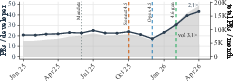
Figure 2: Per-developer throughput grows ≈2× over baseline, while aggregate PR volume grows 3.1×.
Crucially, the increase is primarily attributable to within-developer changes—developers individually accelerating output after adopting AI tools—rather than compositional or organization-wide shocks. Decomposition of effect sources shows that:
A pooled event study further supports parallel trends and isolates the productivity jump to the period immediately following each developer's AI adoption, with flat trends pre-adoption and persistent, growing gains thereafter.
Heterogeneity of Effects
- Seniority: Gains do not vary significantly across IC–principal tiers, but managers realize the largest proportional increases (+86%), attributed to lowered barriers for direct contribution from non-IC roles.
- Codebase Age: Gains are concentrated in newer repositories (post-2022, +44%) and nearly absent in legacy ones (+12%, not significant).
- Model Generations: The study finds no separable gains attributable to specific AI model releases; cumulative tool use, not frontier model capability, is the dominant driver. Placebo tests confirm that purported model step-changes are confounded with ramped tool usage over time.
The throughput increase induced a substantial process reallocation downstream, particularly in code review.
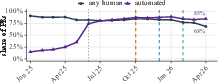
Figure 6: Share of PRs with human review drops to 68\%, while automated (AI) review rises to 84\% and surpasses human review post-mandate.
Key process shifts include:
- Automated review overtakes human review: Human review coverage falls from 89% to 68%; automated review climbs to 84%, with per-reviewer load doubling.
- Human review thins: The substantive portion of human reviews declines, while silent approvals persist, so residual human review is increasingly bare approval.
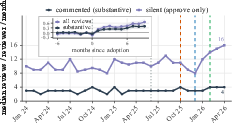
Figure 8: Review activity increases for approve-only reviews much faster than for substantive reviews, indicating growing reliance on lightweight approvals.
- Cycle time bottleneck: As workload surges, 90th-percentile PR cycle time initially rises, then recedes only as PRs increasingly bypass human review. The review bottleneck—rather than authoring latency—becomes the limiting factor.
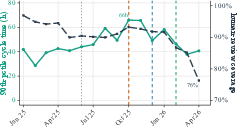
Figure 1: End-to-end cycle time rises with volume but recedes later as human-review coverage drops, showing work is routed around human review, not through a faster queue.
- Quality signals: Merge and revert rates remain stable; short-horizon proxies show no acute quality collapse as review automates, though downstream risks (technical debt, maintainability) remain unmeasured.
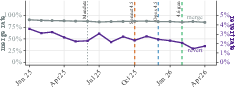
Figure 3: Quality proxies (merge and revert rates) are maintained even as the bulk of review shifts to automation.
Implications for Practice and Theory
Practical Implications
- Mandate as process intervention: The "2×" gain is achievable only as a process problem, not a pure tooling deployment. Gains accrue with intensity and time, not instantaneously.
- Target usage and enablement: Organizational focus should be on deep tool integration, enablement, and continuous usage ramp-up, not on raw adoption statistics.
- Downstream capacity planning: As authoring accelerates, review and integration bottlenecks shift, decoupling human and automated review load and necessitating recalibrated process management.
- Shifting roles and scope: Managers and previously low-volume contributors can more readily re-enter hands-on implementation, blurring traditional hierarchical boundaries and warranting dynamic skill and responsibility management.
- Metrics reassessment: Traditional velocity and throughput metrics (e.g., DORA, SPACE) miss displacement and debt in downstream stages, highlighting the need for output- and outcome-diverse metrics in the agentic era.
Theoretical and Future Research Directions
- Complementary investments matter: The observed learning curve aligns with classic IT literature on productivity gains requiring complementary human and process investment, not just technology infusions.
- Causality constraints: The nonrandom timing of adoption introduces identification limits; within-developer and dose–response evidence strongly implicate adoption and usage, but true causal magnitudes are bounded.
- Generalizability and bias: Effects observed in a best-case setting may overstate expected gains for less AI-forward, more legacy-burdened, or less well-resourced organizations. Mandate-driven measurement also risks target inflation.
- Broader quality measurement: Sustained scaling of automated code review raises open questions about skill atrophy, technical/cognitive debt, and long-term software health, which demands further long-horizon studies.
- Cross-firm, cross-cohort replication: Disentangling model capability advances from experience accumulation will require multi-firm, cohort-staggered, and natural-experiment designs.
Conclusion
In sum, a highly favorable, deeply-instrumented enterprise-wide AI mandate achieved a near doubling of per-capita code throughput over two years, with the realized gain closely tracked to cumulative usage and within-developer process change rather than calendar events or singular mandate effects. This acceleration restructured code review, shifting much load onto automation and reducing the substance of remaining human evaluation without manifest short-term quality regression in observed proxies. The effect is robust but not instantaneous and is heterogeneously distributed, being absent in legacy code and present across the seniority spectrum. For both research and industry stakeholders, these findings underscore that AI productivity mandates are primarily complex process transformations—requiring sustained enablement, adaptive metrics, and anticipation of downstream bottlenecks and role migration—rather than one-time tool adoptions.