- The paper introduces SLV to quantify long-term opportunity cost beyond traditional short-term revenue metrics in inventory-constrained settings.
- It employs multi-output XGBoost regression with normalized SLV (nSLV) to enable actionable forecasts and comparability across interventions.
- The framework validates SLV efficiency via A/B tests, linking short-term experimental results with realized 18-month profits and annualized business impact.
Measuring Long-Term Opportunity Cost via Stock Lifetime Value in Fashion E-Commerce
Introduction
The paper "Measuring Opportunity Cost with Stock Lifetime Value" (2607.01905) presents a rigorous framework for capturing long-term opportunity cost in inventory-constrained e-commerce experimentation, specifically within fashion retail at Zalando. Standard short-term A/B test metrics such as revenue or profit are misaligned with strategic objectives: they incentivize immediate gains without accounting for the cost of liquidating perishable or seasonal inventory either too early or too late. The authors introduce Stock Lifetime Value (SLV) to bridge this gap, enabling actionable, quantitative inference of long-term profit outcomes from short-run experiments.
Definition and Rationale of SLV
SLV is defined as the expected aggregate marginal profit extractable from the current stock, spanning all selling channels and liquidation paths, until the stock's terminal clearance. It explicitly operationalizes the sunk cost view dominant in dynamic pricing—future profit potential, not sunk procurement cost, determines commercial efficiency. The normalized version, nSLV, adjusts for the purchase value of inventory, enhancing interpretability and comparability across articles and intervention arms. This normalization localizes the break-even point (nSLV = 1) as an actionable signal for profitable versus loss-making liquidation.
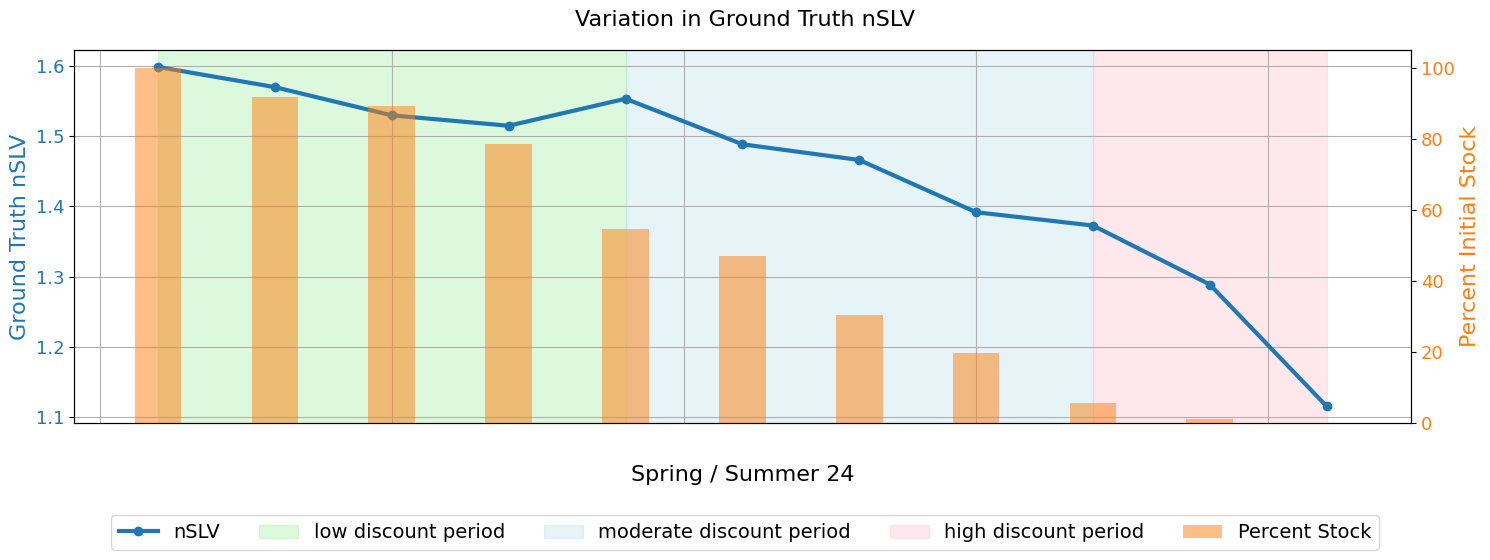
Figure 1: Variation in nSLV and stock over a season for a footwear SKU; aggressive discounting near season end drives nSLV to the break-even point.
Crucially, the SLV methodology discards short-termism, explicitly quantifying the trade-off between immediate liquidity and deferred higher-margin sales. The approach diverges from the traditional customer lifetime value (CLV) construct by centering the quantification on stock units—a vital generalization for perishable or non-repeatable goods.
Forecasting SLV and Stationarity
The efficacy of SLV-based measurement depends on robust forecasting of nSLV, which in turn hinges on stationarity in lifecycle patterns and pricing strategies. The authors empirically demonstrate that, in Zalando's operations, nSLV manifests regular seasonality—initial high profit potential followed by a predictable decay as inventory is gradually discounted.
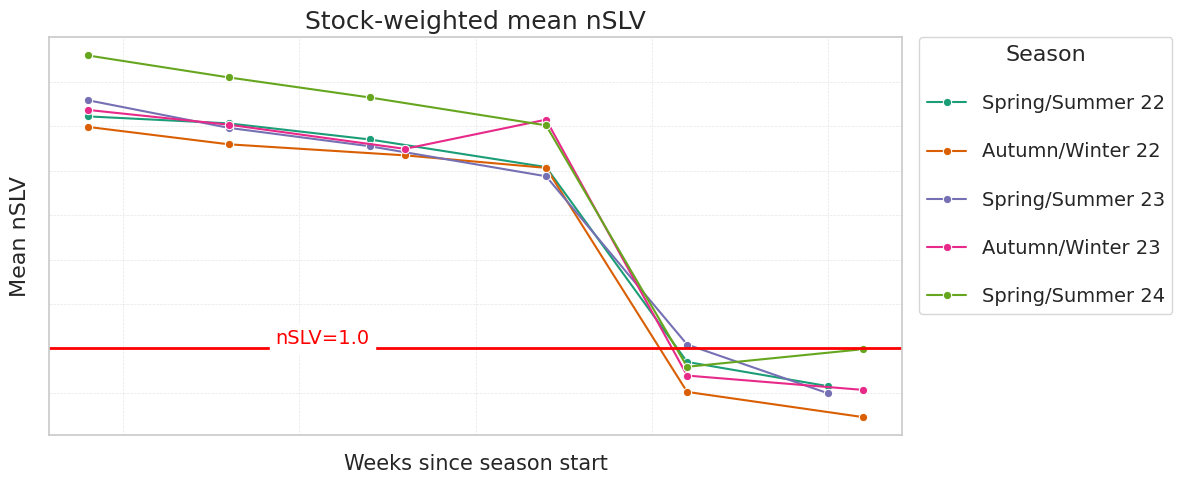
Figure 2: nSLV trajectory across five consecutive seasons; seasonal stationarity supports transferability of forecast models.
Forecasting is performed by multi-output XGBoost regression, leveraging a dense feature set: static attributes, lifecycle position, dynamic stock levels, and recent commercial performance. The authors show that aggregate SLV forecasts achieve a weighted absolute percentage error of 15%, with further gains on assortment-level aggregation, supporting their use in business-critical interventions.
SLV Efficiency: Measuring True Impact in A/B Tests
SLV efficiency is proposed as a direct test metric: it quantifies the incremental lifetime value generated (or destroyed) by an intervention relative to "business-as-usual," net of the opportunity cost of stock consumed during the experiment.
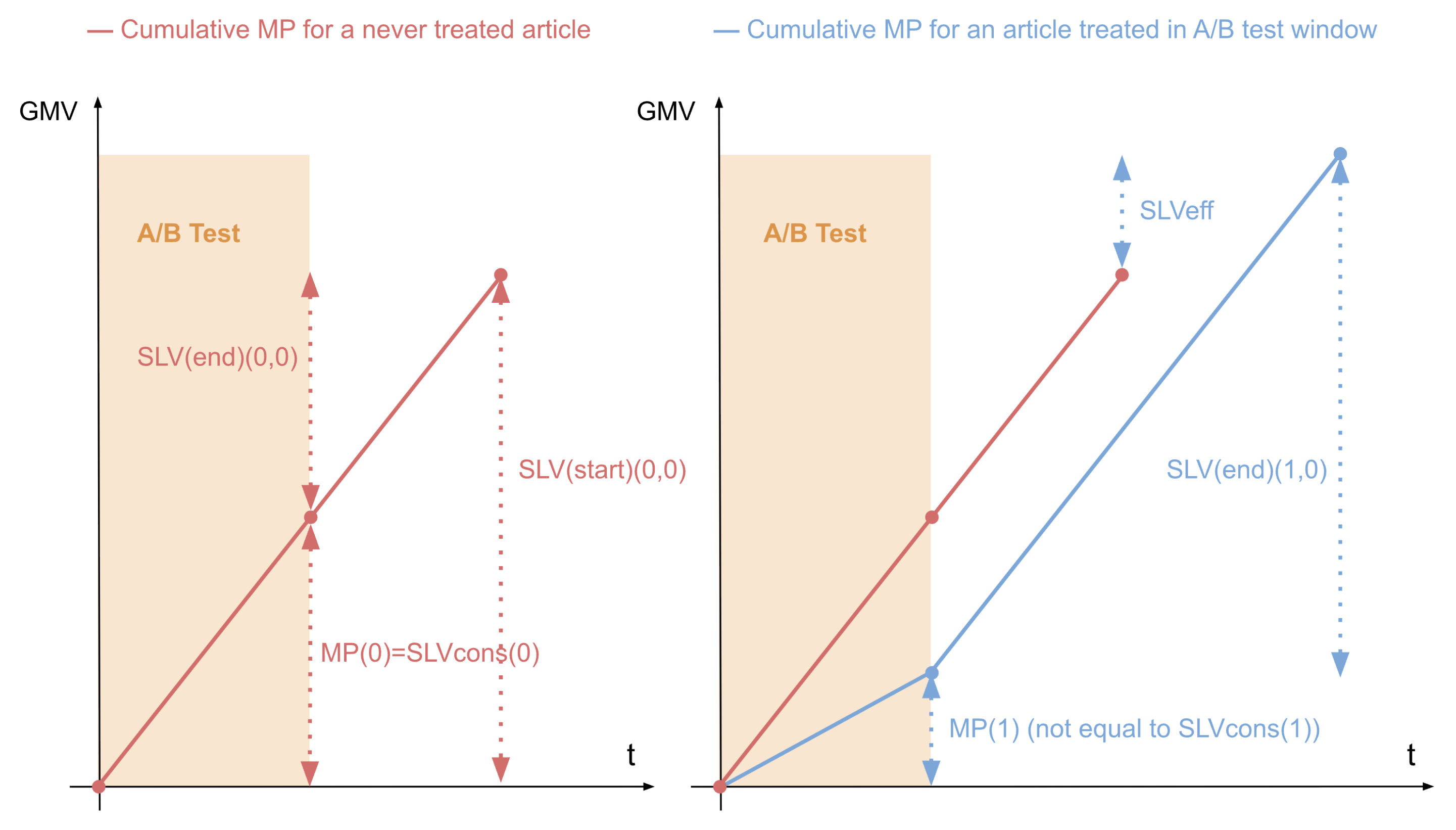
Figure 3: SLV efficiency illustration—left: never-treated counterfactual; right: positive SLV efficiency from deferred, higher-margin sales.
The methodology ensures average SLV at test baseline is balanced by randomization. Delta SLV efficiency captures the causal effect of a policy shift, conditioned on post-intervention reversion to BAU. The link to surrogate index frameworks (cf. [athey2019surrogate], [zhang2024evaluating]) is explicit: observed short-term profit plus end-of-test stock fully mediates long-term profit, under plausible assumptions of stationarity and absence of memory effects. Empirical validation through a large-scale pricing experiment demonstrates alignment between SLV efficiency at experiment end and actual realized 18-month profits, even in challenging, high-variance settings.
Generalization to Customer-Level Interventions
Customer-facing interventions—such as voucher campaigns or algorithmic ranking changes—dynamically reallocate demand, complicating measurement of inventory efficiency. The paper generalizes SLV efficiency to customer-level A/B testing, decomposing individual purchase events against contemporaneous nSLV forecasts. This captures the latent effect of demand shifting on future stock clearance and profit, exposing cases where apparent revenue uplifts are offset by hidden inefficiencies in inventory flow.
Integration with Pricing Optimization
Modern pricing systems at Zalando employ forecast-then-optimize architectures, facing a trade-off between revenue maximization and long-term profit resilience. The framework operationalizes SLV as a tunable optimization target, harmonizing the objective of algorithmic pricing with the measurement system used for causal inference. Articles' future value is parametrized by nSLV, conditionally forecasted on all available state variables.
This approach enables Pareto-efficient solutions across the NMV/LTP frontier and ensures that algorithmic choices are directly auditable against post-hoc A/B test results, strengthening system integrity and stakeholder trust.
Annualization for Financial Reporting
A key business need is the translation of short-term experimental results into annualized financial forecasts. The relative SLV efficiency metric supports direct, assumption-light scaling to annualized GMV and profit by leveraging the proportionality of profit and revenue across operational regimes.

Figure 4: Schematic for mapping measured short-term SLV efficiency improvements to annualized business impact.
Under fixed-stock and cost-independence assumptions, empirical evidence demonstrates that annualized uplifts in revenue and profit follow from the experimental delta in relative SLV efficiency. This allows experiment results to be credibly, consistently rolled up for strategic planning and stakeholder communication.

Figure 5: Temporal stability in profit cost share to NMV substantiates the validity of annualization assumptions.
Empirical Insights and Limitations
The framework yields actionable, robust decision metrics in Zalando’s operational context, with projected annual impacts in the multi-million euro range for both revenue and profitability following validated rollouts. However, limitations exist:
- Forecast uncertainty is not fully propagated into post-experiment inference, which may inflate Type I error.
- Assumptions of structural stationarity and surrogacy may not generalize trivially across radically different inventory or demand regimes.
- Within-season restocking is not modeled, which could bias SLV-based projections if significant.
Conclusion
This work presents SLV as a unifying concept for inferring, optimizing, and reporting long-term opportunity cost in inventory-constrained e-commerce, fully integrating measurement, causal inference, and algorithmic decision-making. SLV efficiency enables rigorous, quantitatively justified interventions within tight experimental windows, supports annualized business impact assessments, and extends naturally to customer-centric and algorithmic optimization problems.
Future research directions include explicit modeling of forecast uncertainty, extension to more complex inventory flows, and broader application across other domains with decaying or perishable value inventories. The SLV methodology offers a blueprint for experimental measurement that aligns with the operational realities and financial constraints of high-scale retail and beyond.