- The paper introduces ANISRO, a fully differentiable framework replacing discrete ARMC with a continuous SRO inversion protocol for HEA design.
- It leverages a generalized NIMM thermodynamic regularizer and an MLP property surrogate to enable closed-loop targeting of mechanical properties.
- Benchmarking demonstrates the gradient-based method's superior scalability and accuracy over traditional ARMC, especially in large, multi-component systems.
Differentiable Inverse Design of Short-Range Order in High-Entropy Alloys: From Target SRO to Target Property
Introduction and Motivation
Short-range order (SRO), often characterized by the Warren–Cowley α parameter, is a key descriptor governing the mechanical properties of concentrated solid solutions and high-entropy alloys (HEAs). Conventional approaches to tailor SRO and link it to target mechanical properties entail a sequence of disconnected stages, typically coupling atomistic reverse Monte Carlo (ARMC) generation of SRO-matched configurations with property evaluations, breaking the gradient flow through the design pipeline. This lack of differentiability hinders efficient, end-to-end optimization for inverse design tasks, especially as system size or species count increases.
The presented work proposes ANISRO: an end-to-end differentiable framework that bridges the gap between SRO specification and property-driven design through gradient-based methods. ANISRO leverages a differentiable SRO-to-structure inversion protocol parameterized by soft site occupancies, regularized by a generalized Non-Interacting Molecule Method (NIMM) thermodynamic prior, and incorporates a property surrogate for closed-loop property targeting.
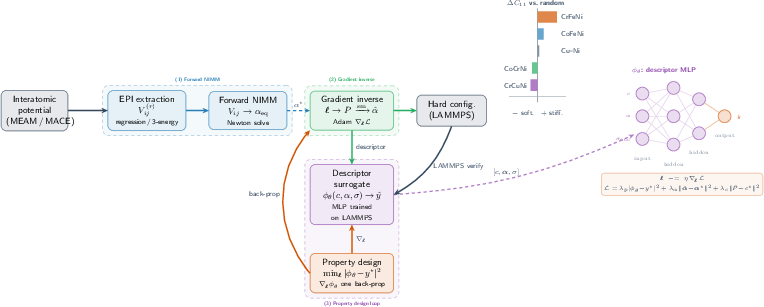
Figure 1: ANISRO overview: forward EPI extraction and SRO prediction, differentiable SRO-to-structure inversion, and closed-loop end-to-end property design with gradients.
Technical Contributions
Differentiable SRO-to-Structure Inversion
The core advancement is the replacement of discrete ARMC with a continuous, differentiable inverse mapping from a target α to atomic configuration via a softmax parameterization of site occupancies. The SRO loss drives the configuration towards the target Warren–Cowley signature through gradient-based optimization (Adam), enforcing composition and binarization via additional regularizers. The method operates on an N×K logit field, enabling efficient global updates irrespective of the number of species and delivering significant gains over ARMC in large or multi-component systems.
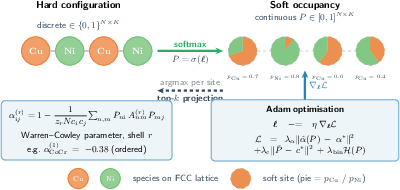
Figure 2: Schematic for differentiable SRO-to-structure inverse: each lattice site is controlled by logits mapping through a softmax to species assignments.
Thermodynamic Regularization via Generalized NIMM
To ensure physical realizability and anchor designed configurations to the correct free-energy landscape, ANISRO includes a differentiable NIMM-based free-energy regularizer that generalizes the binary scheme of Rao and Curtin to arbitrary K-species alloys. This regularizer biases the optimization toward thermodynamically plausible solutions given a set of effective pair interactions (EPIs), computed via analytical or regression-based projection from any arbitrary interatomic potential.
End-to-End Surrogate-Driven Property Design
ANISRO incorporates a multi-layer perceptron (MLP) property surrogate trained on descriptors encoding composition, multi-shell SRO, and site occupancy statistics extracted from real interatomic-potential (LAMMPS-MEAM) data. This surrogate forms a differentiable mapping from atomic configuration to property, thereby supporting automated gradient-based closed-loop inverse design targeting arbitrary elastic constants or other properties.
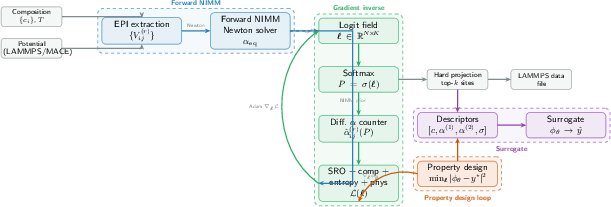
Figure 3: Pipeline view: EPI extraction, forward NIMM prediction, gradient-based SRO inversion, and end-to-end property targeting via MLP surrogate.
Benchmarking and Numerical Results
Forward Model Validation
Analytical NIMM predictions for Warren–Cowley parameters accurately match Metropolis Monte Carlo benchmarks within the established validity regime (0.5<xij<1.5) across diverse compositions and temperatures, exhibiting typical Δα<0.03 deviations for physically reasonable EPI values.
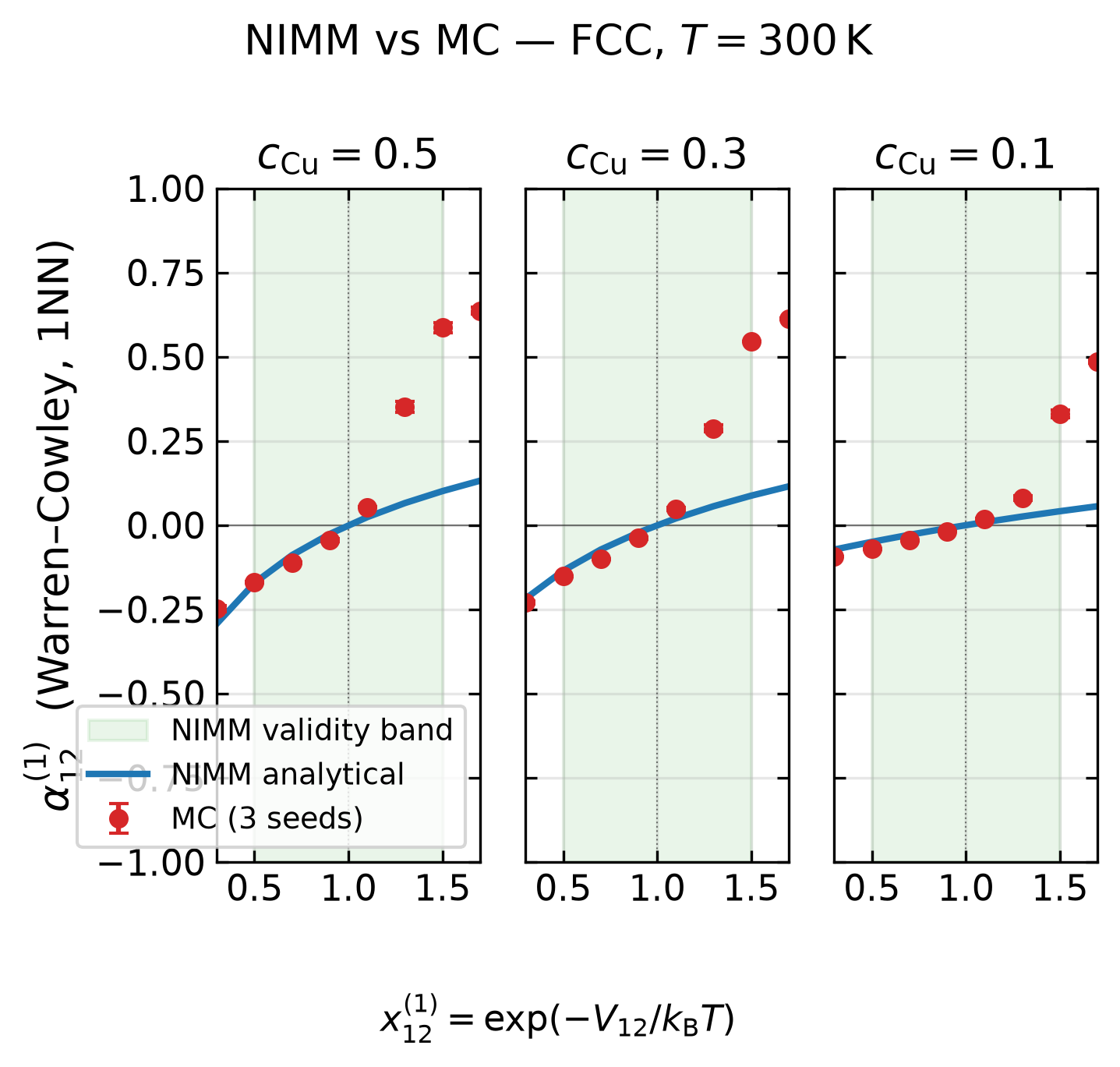
Figure 4: Agreement between NIMM analytical predictions and MC SRO values for Cu–Ni across fugacity regimes and compositions.
Gradient Inverse vs. ARMC
At moderate system sizes (e.g., 256 atoms), ARMC achieves marginally lower SRO residuals than the gradient method within the same wall time. However, as supercell size scales, the gradient approach demonstrates clear superiority: at 4000 atoms, it is 6× faster and 8× more accurate than ARMC, the latter's convergence being arrested by per-move bond list update complexity.
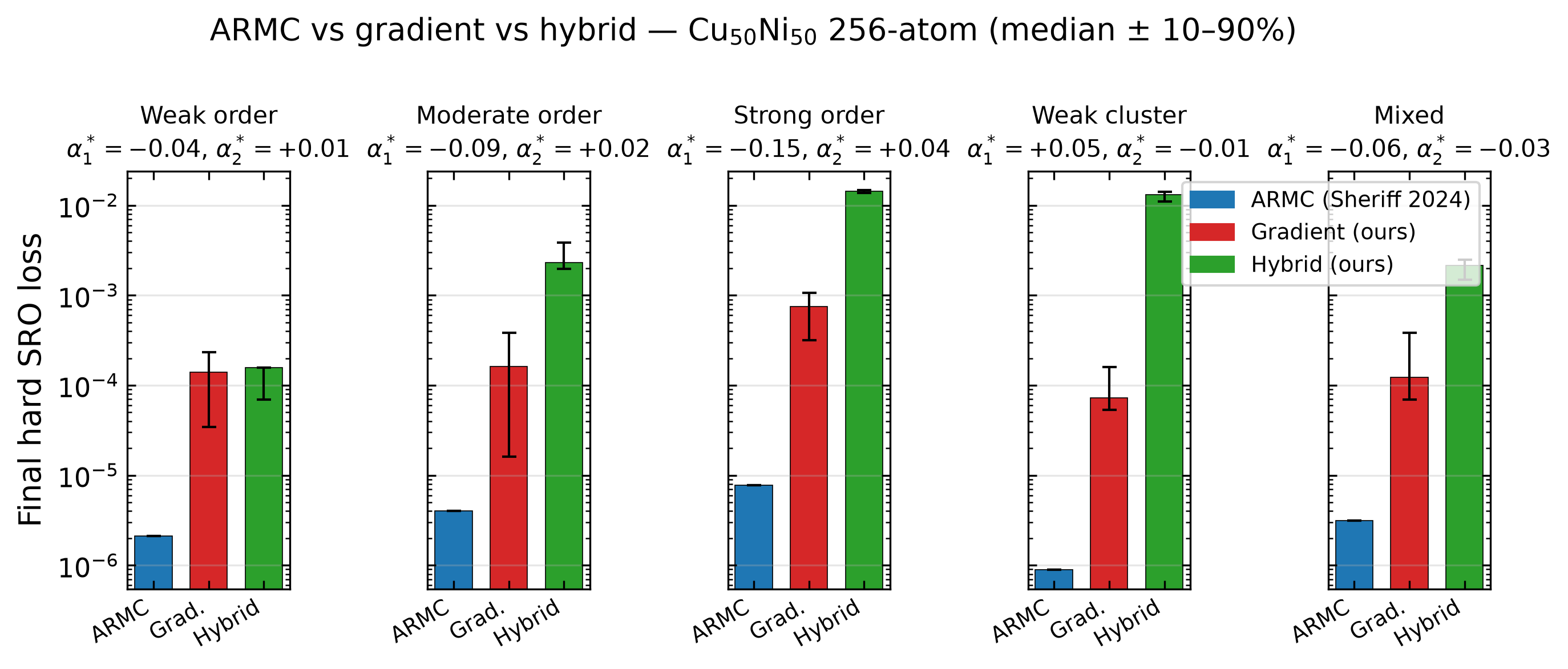
Figure 5: Loss convergence for ARMC, gradient, and hybrid methods on Cu–Ni, showing the gradient method's smoother, monotonic cost decline.
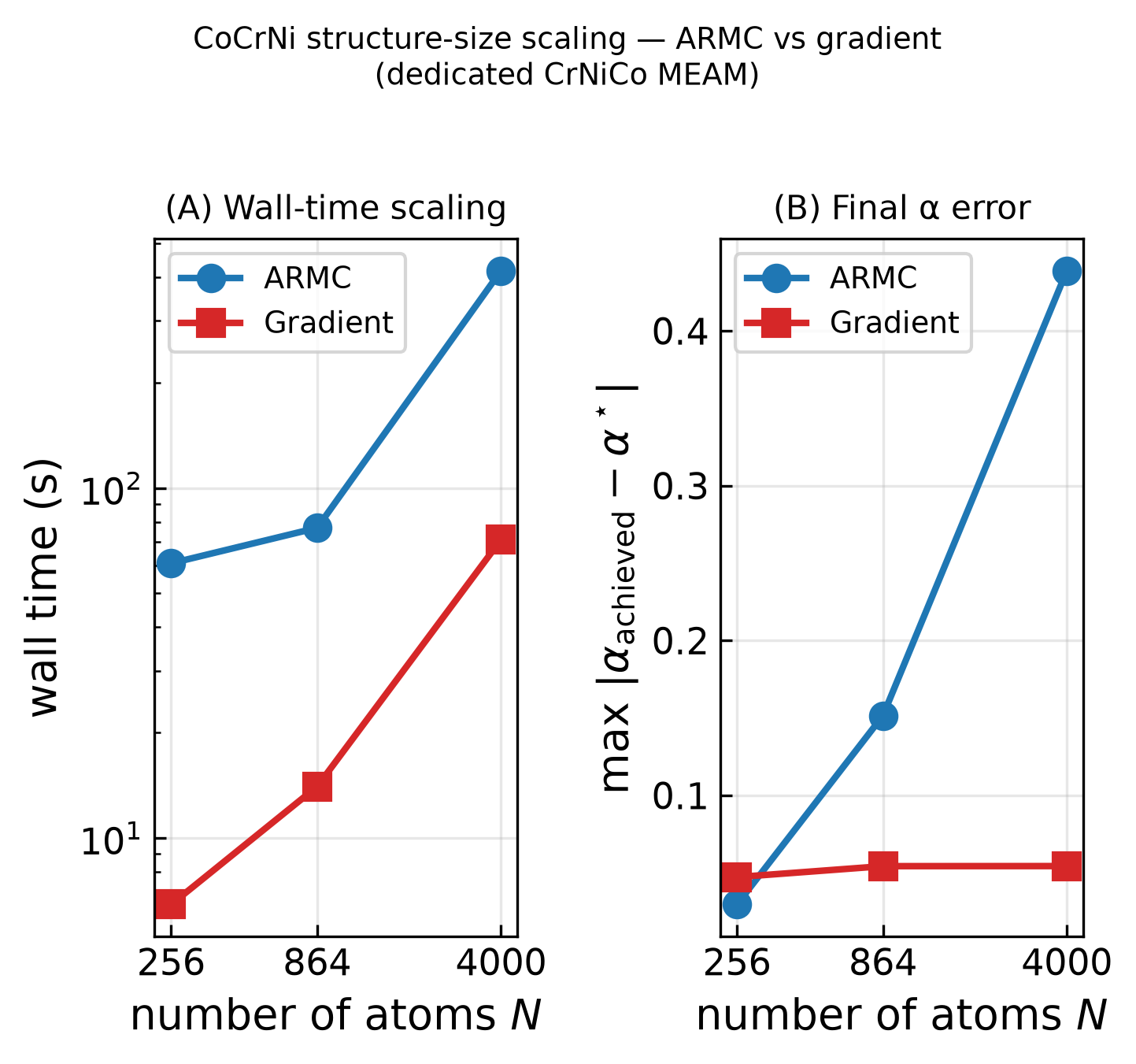
Figure 6: Timing and error scaling of ARMC vs gradient-inverse on Co–Cr–Ni as system size increases; the gradient method outpaces ARMC at large scale.
Generalized EPI Extraction and Practical Validation
ANISRO validates multiple EPI extraction strategies—direct energy differences, regression over random configurations, and cluster-expansion-based methods. All reproducibly capture MC SRO statistics for representative Cu–Ni cases, with regression and CE offering improved accuracy in many-body-dominated systems and for larger K.
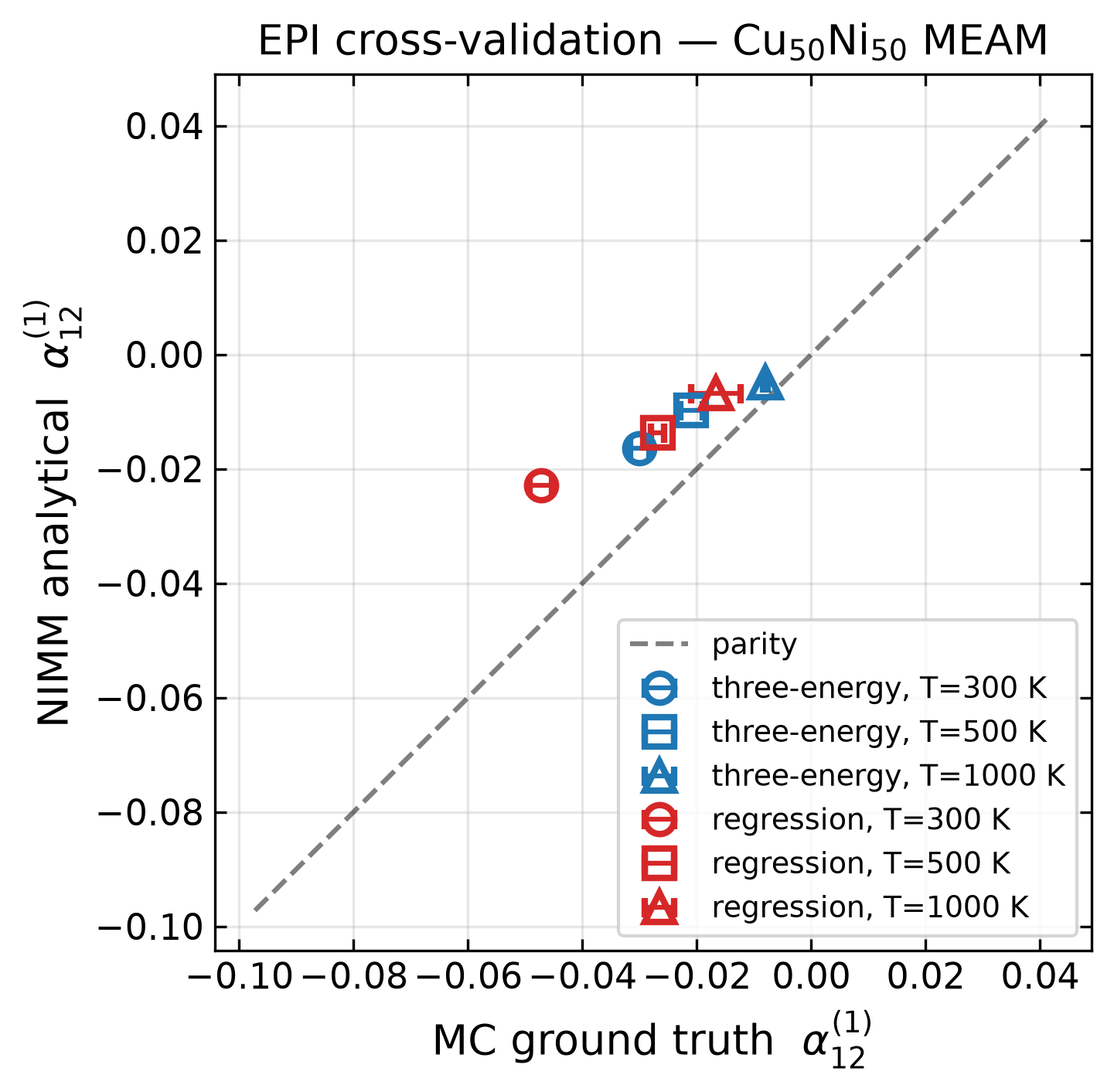
Figure 7: EPI regression validation against MC and NIMM for Cu–Ni.
Cross-System SRO-Property Survey
A systematic sweep across nine FCC and BCC HEAs demonstrates that SRO-induced changes in the elastic modulus C11 are substantial and chemistry-dependent. Notably, Cr–Fe–Ni alloys exhibit a remarkable α0 increase in α1 upon SRO induction, while other chemistries (e.g., Cr–Cu–Ni) show up to α2 softening. These results, confirmed via direct LAMMPS-MEAM calculations on 108-atom supercells, highlight the non-universal link between SRO sign/magnitude and resultant mechanical response.
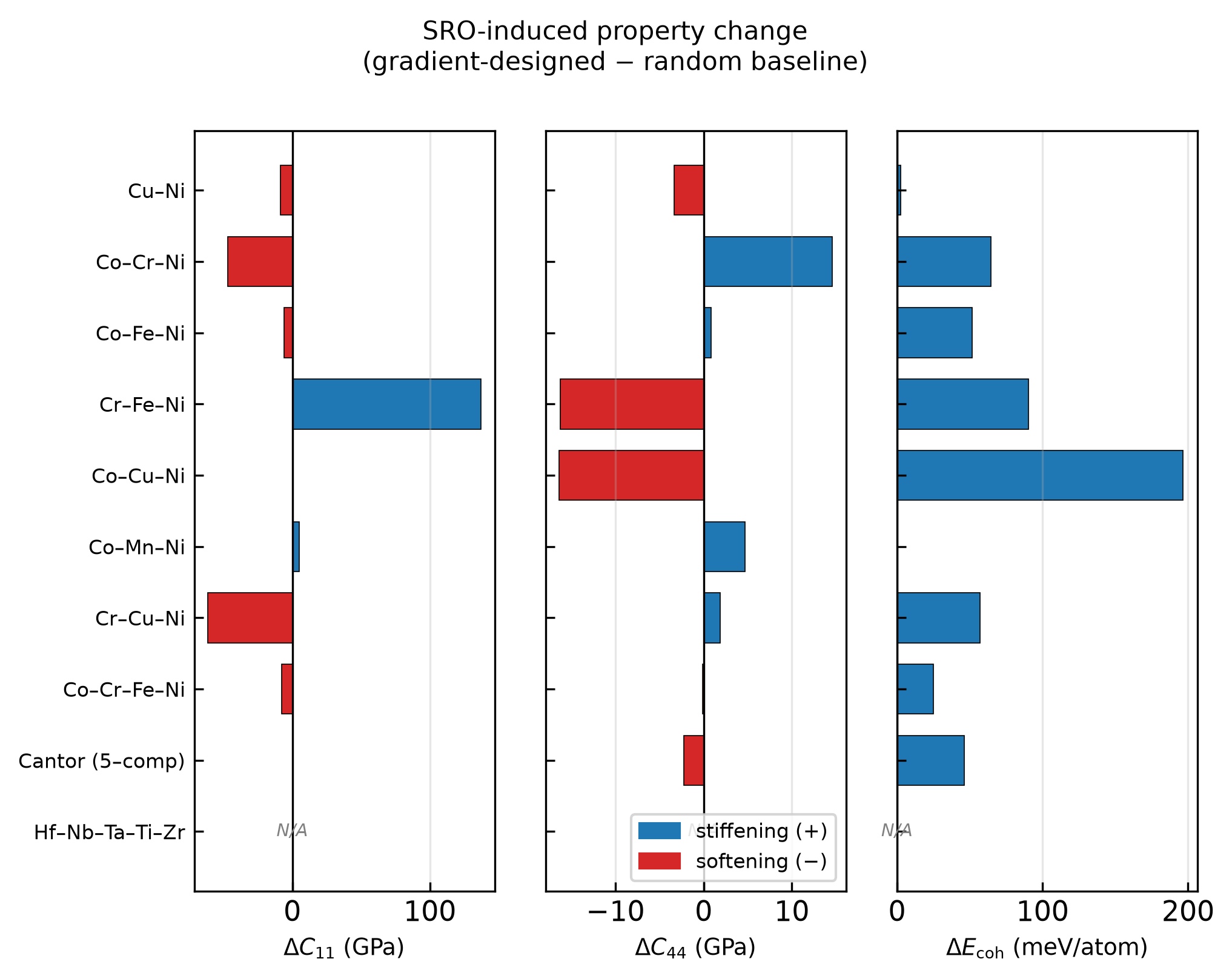
Figure 8: Bar chart of SRO-induced changes in α3 and α4 across studied alloys.
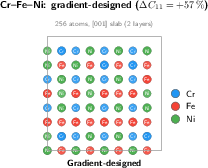
Figure 9: Visualization of a gradient-designed Cr–Fe–Ni structure with strong Cr–Fe pair enrichment underpinning modulus stiffening.
Cantor Alloy and Backend Transferability
Performance on the five-species Cantor alloy (CoNiCrFeMn) underscores method generality and highlights potential-dependent SRO motifs; comparing Choi–Lee MEAM with MACE-MP-0 backends exposes motif shifts (e.g., from Ni–Mn avoidance to Co–Fe ordering) while the optimization pipeline, loss protocols, and accuracy persist unaltered.
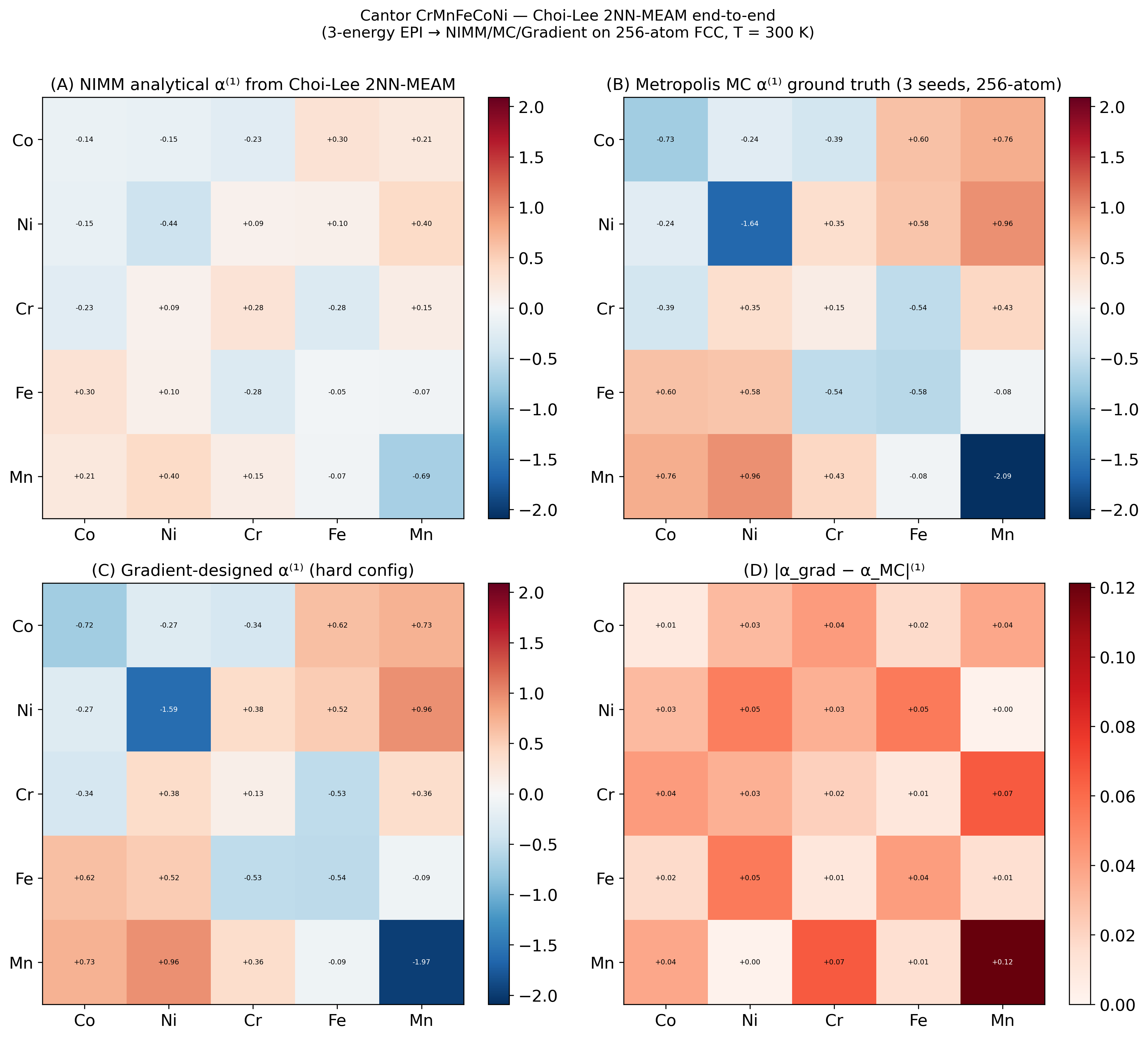
Figure 10: MC equilibrium vs NIMM vs gradient-inverse SRO for Cantor alloy; gradient method reproducibly matches MC across all pairs.
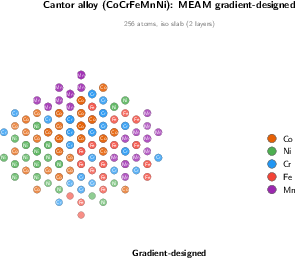
Figure 11: Gradient-designed Cantor alloy structure displaying separation of dominant ordering motif.
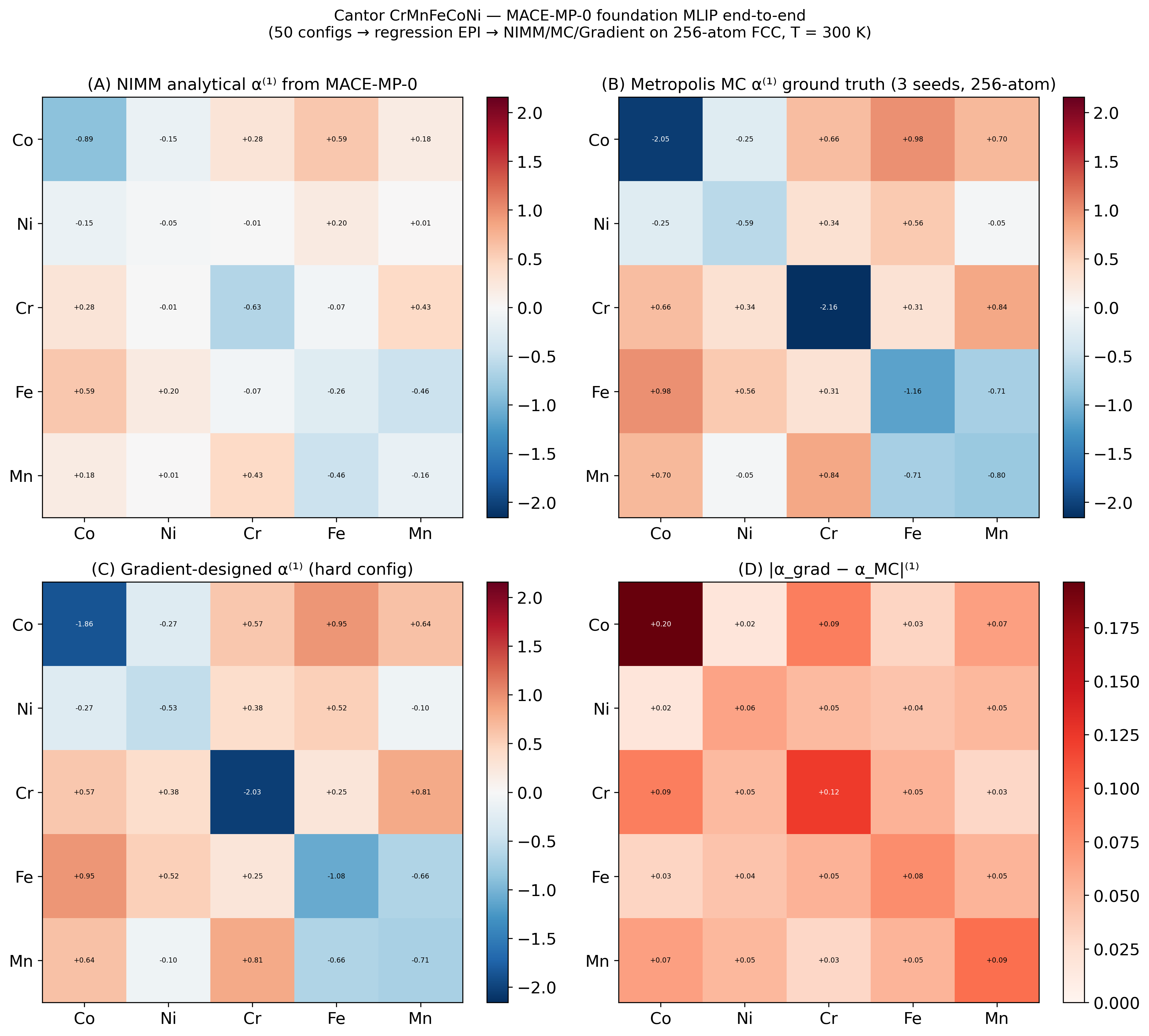
Figure 12: Shift in dominant motif (Ni-Mn to Co-Fe) for same pipeline executed with different interatomic potentials.
Closed-Loop Property Targeting
Gradient-based backpropagation from property surrogate to atomic logit field enables on-demand design of SRO-matched configurations with prescribed α5. Verification on Co–Cr–Ni shows three of four targets reached within α6 of LAMMPS-evaluated ground truth, demonstrating practical, real-data property targeting in sub-second optimization time per instance.
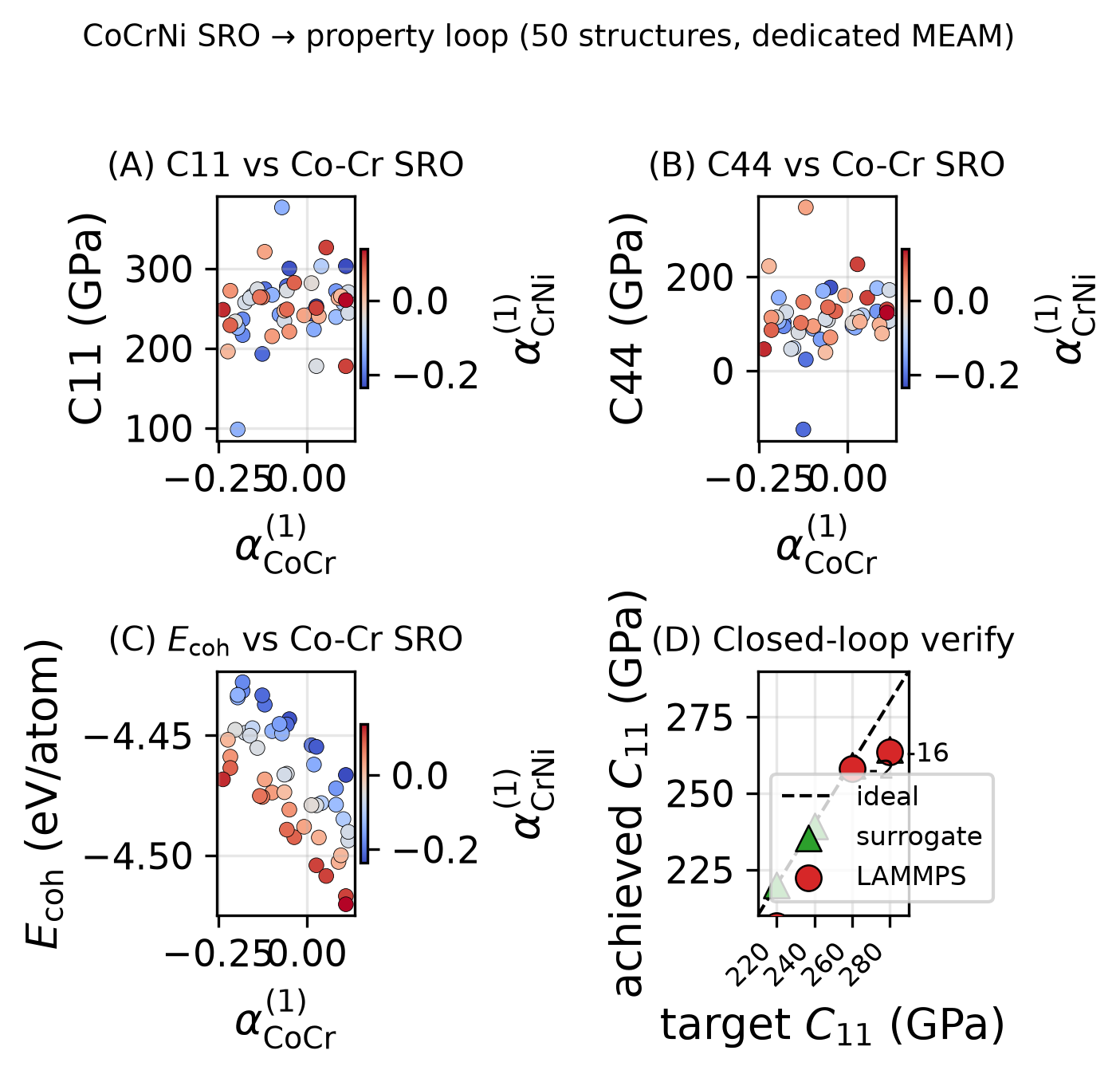
Figure 13: Design of 50 SRO-encoded configurations spanning wide α7 and α8 ranges; summary of four closed-loop design runs showing target/actual α9 agreement.
Theoretical and Practical Implications
The proposed framework establishes the feasibility and value of differentiable inverse statistical mechanics for alloy design, closing the loop from abstract SRO descriptors to physically meaningful, property-optimized atomic configurations. The methodology is highly scalable; gradient-based global updates are critical for large cells—essential for defect or microstructure studies—and species-rich scenarios.
Chemistry-specific variation of SRO-mechanical property linkages underpin the necessity of such property-aware design: sign and magnitude of N×K0 changes are dictated not solely by N×K1, but by pairwise bond stiffness contrasts only accessible by detailed, system-specific EPI analysis.
Potential-agnostic execution enables systematic inter-comparison of interatomic models, useful for uncertainty quantification and for identifying model/experiment mismatches in SRO energetics.
Future Prospects for AI-Guided Alloy Design
The demonstrated gradient-based, end-to-end differentiable design protocol provides a foundational toolkit for accelerating alloy optimization in silico. Extension to higher-order clusters, more sophisticated surrogates (e.g., Gaussian processes for uncertainty estimation), and integration with experimental feedback loops are natural future directions. Further, the integration of more accurate DFT-derived MLIPs and large-scale structure-property datasets can robustly expand designable property windows while maintaining physical plausibility. Real-time, property-constrained microstructure generation for deployment in mesoscale simulation workflows or direct process-structure-property pipeline integration are now feasible.
Conclusion
ANISRO provides a rigorously validated, computationally efficient, and chemically generalizable approach for the inverse design of SRO and corresponding target properties in HEAs. The combination of differentiable SRO inversion, thermodynamically grounded regularization, and end-to-end property optimization sets a new standard for alloy informatics platforms, making scalable, real-data-driven, and physically consistent structure-property design accessible for the community.
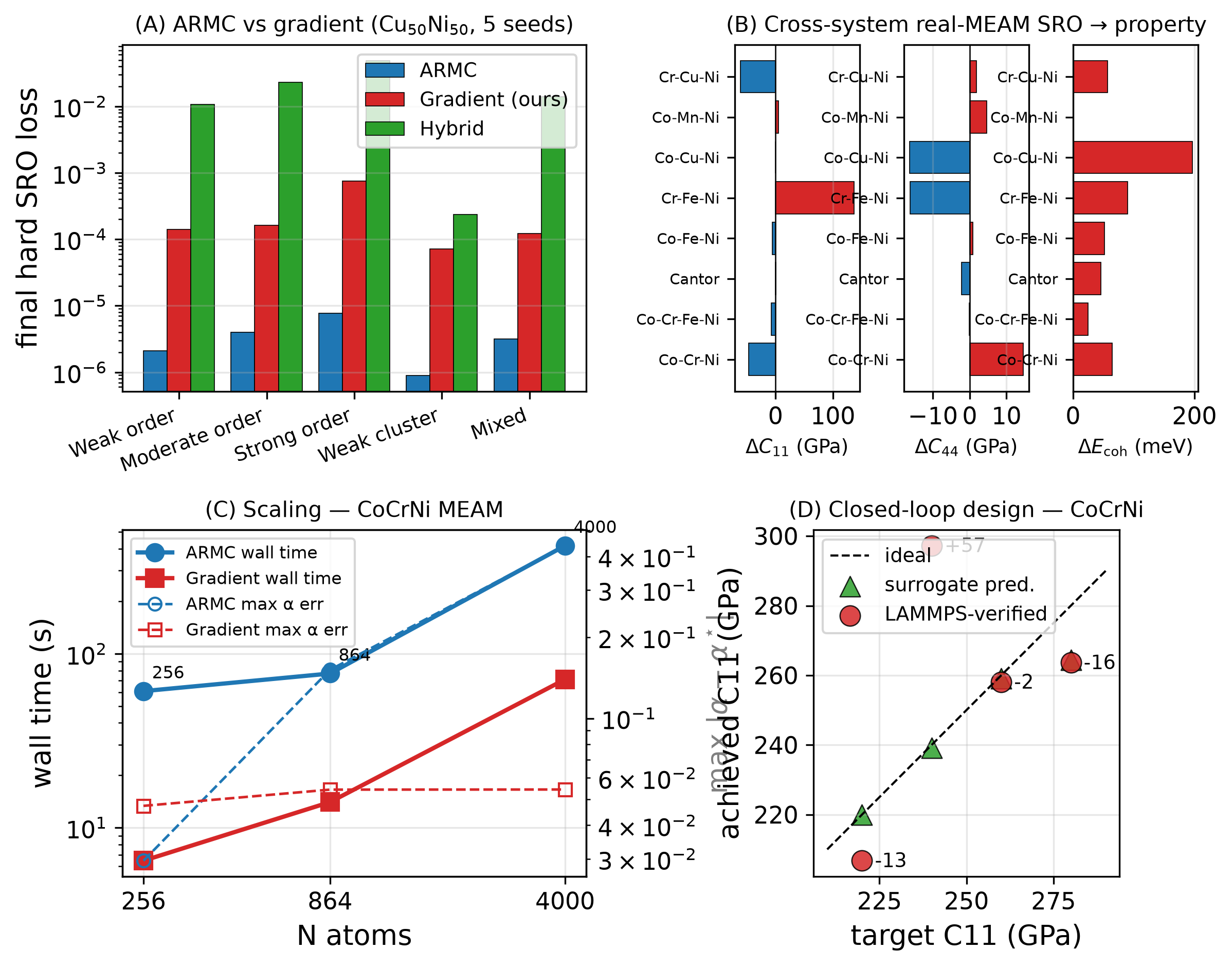
Figure 14: Master summary: accuracy/timing crossover, cross-system N×K2, scaling envelope, and closed-loop property verification—highlighting central results and future directions.