- The paper introduces a hardware-adapted recovery algorithm tailored for permutation-invariant quantum codes to correct correlated amplitude-damping errors.
- It presents an analytical construction of CAD4 and CAD9 codes and details mapping optimized recovery channels onto physical circuits using geometric phase gates.
- Numerical benchmarks show that CAD codes reduce logical infidelity by over one order of magnitude compared to previous short-length PI codes under collective noise.
Introduction and Motivation
Permutation-invariant (PI) quantum codes offer a practical framework for encoding logical quantum information with global, rather than local, addressability—making them appealing for hardware platforms where individual control is costly or infeasible. Motivated by the prevalence of amplitude-damping (AD) noise (e.g., T1 decay) in major quantum computing architectures, this work addresses the need for quantum error codes and recovery algorithms that are tailored for correlated (collective) non-Pauli noise, particularly for globally symmetric AD environments. Stabilizer codes excel for Pauli channels but their performance and resource scaling degrade substantially under AD-dominated noise due to the intrinsically non-Pauli nature of the process.
This study introduces a hardware-aware, circuit-level quantum error recovery (QER) protocol for PI codes, incorporating explicit construction and compilation to experimentally available primitives—specifically, geometric phase gates (GPGs). A new code family, termed collective amplitude-damping (CAD) codes, is analytically constructed with focus on CAD4 (4 qubits) and CAD9 (9 qubits) as minimal and practical exemplars for correlated noise. The recovery protocols leverage semidefinite program (SDP) optimization and Petz/Barnum-Knill recovery, with explicit analyses of gate complexity and fidelity under hardware-level noise.
Quantum Error Recovery Framework
A central contribution is the explicit mapping from optimized CPTP error-recovery channels to physical quantum circuits. The proposed protocol implements a K-Kraus recovery channel R via a sequence of K−1 binary branching operations, coherently storing Kraus indices in ancillary qubits and implementing feedback unitaries via controlled operations. The number of required ancillae and the circuit depth both scale linearly with the Kraus rank K, while compiled GPG-gate cost exhibits O(KN2) scaling for N-qubit Dicke subspaces (Figure 1).

Figure 1: Compiled recovery circuit for CAD4 PI code, decomposed into Dicke-subspace and geometric-phase-gate primitives, showing explicit gate connectivity and feedback structure for a single AD error.
The protocol avoids the need for measurement-based syndrome extraction and classical decoding, as required by stabilizer codes, capitalizing on the dramatically reduced syndrome space of PI codes. This design is particularly compatible with hardware exhibiting native global control, such as cavity-QED or ion-trap systems.
Analytical Construction of CAD PI Codes
Classical combinatorics—specifically, analysis of the Knill-Laflamme error correction conditions for noise models generated by J− polynomials—enables the systematic construction of CAD codes. For k-error-correcting capacity under global symmetric (collective) AD, analytical procedure shows that a PI code on (k+1)2 qubits can be constructed with codewords supported at Dicke weights separated by K0, and amplitudes calculated by nullspace analysis of a structured matrix.
The concrete CAD4 and CAD9 codes obtained by this method are given by:
- CAD4: K1, K2
- CAD9: K3, K4
Analytical comparison highlights that, for K5-qubit codes, CAD codes correct up to K6 AD errors, while previous PI designs such as K7 codes correct only K8 errors—representing a significant increase in correction breadth without entailing exponential resource overhead.
Physical Compilation and Gate Complexity
The recovery algorithm is compiled down to geometric phase gates using explicit spectral decompositions and optimal control for state preparation. Arbitrary Dicke-subspace unitaries (for state preparation and spectral feedback) and ancilla-controlled operations are both constructible with polynomial overhead using a modest set of GPGs and global single-qubit rotations. The protocol's gate count is tightly characterized: an K9-qubit, R0-Kraus recovery circuit requires R1 GPG steps, with time steps and ancilla usage minimized via unary encoding.
Extensive numerical benchmarking compares CAD codes to existing PI constructions (gnu, bg, bgm, AAB, PR, KT) for both global symmetric and local symmetric (i.i.d.) AD noise, as well as for various recovery strategies—SDP-optimized, truncated Petz, and no recovery.
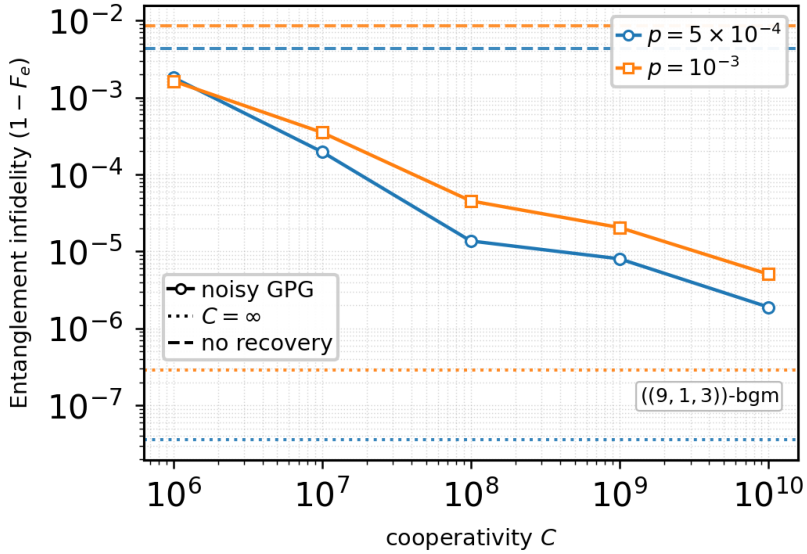
Figure 2: Entanglement infidelity versus cavity cooperativity for the compiled recovery circuit on the ((9,1,3))-bgm code, demonstrating the tradeoff between implementation quality and recovery effectiveness.
The strong numerical result is that CAD9 outperforms existing short-length PI codes by over an order of magnitude in logical infidelity at R2 and by more than two orders at R3 for collective AD. In contrast, for local symmetric (i.i.d.) AD, the 7-qubit AAB code is optimal—demonstrating empirically that code performance is dictated by matching the error structure to the environment.

Figure 3: Logical infidelity for the ((9,1,3))-bgm code under global versus local symmetric AD noise, with and without optimized recovery. Active recovery is essential for performance; uncorrected codespace degrades below bare qubit fidelity.
Crucially, application of a QER map (even Petz formula with second-order truncation) provides several orders of magnitude suppression compared to the no-recovery scenario, and hardware-level gate noise does not eliminate the advantage as long as the cooperativity parameter R4 is within experimentally reasonable regimes.
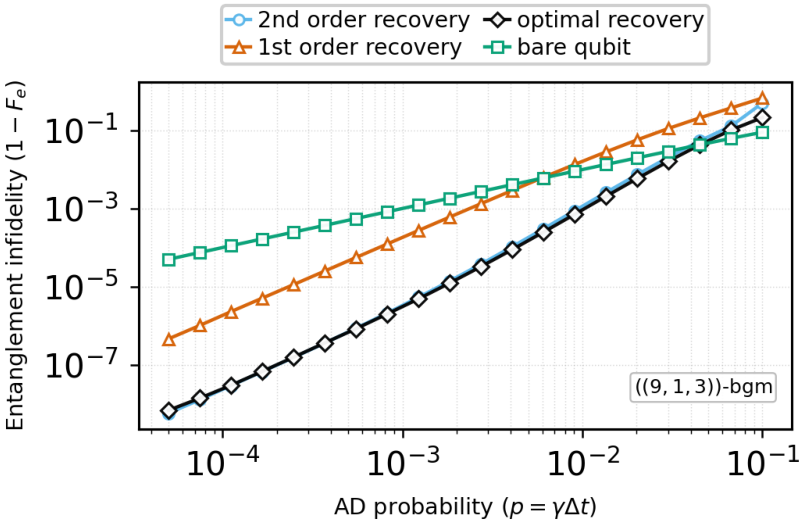
Figure 4: Comparison of SDP-optimal, Petz (first and second order), and bare-qubit recovery fidelity. Higher-order correlated errors dominate; second-order truncation suffices for practical implementation.
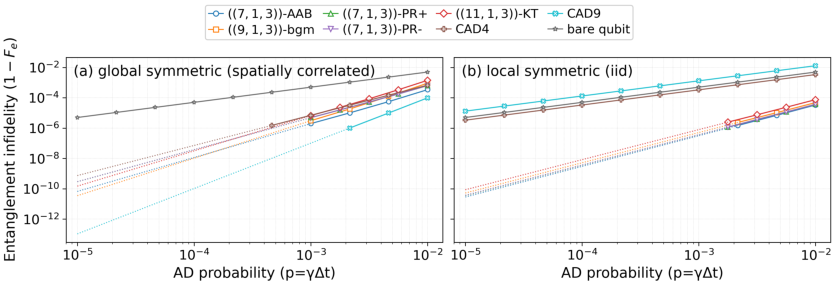
Figure 5: Benchmarking of all studied short-length PI codes (including CAD) under both global and local AD noise with optimal SDP recovery. CAD9 shows superiority in the global case; AAB dominates in local/i.i.d. settings.
Practical and Theoretical Implications
The results have direct implications for near- and medium-term quantum computing:
- Experimental Feasibility: Circuits require only collective control plus a small, linearly growing number of ancillas. Short-length codes (CAD4, CAD9) are accessible for demonstration in systems such as superconducting qubits, cavity-coupled neutral atom arrays, and trapped ions.
- Low-Overhead Inner Coding: The architecture enables a two-level coding strategy, where each physical qubit in a larger Pauli-based code (e.g., surface, LDPC) is realized as a PI-encoded block, using an explicit, hardware-adapted QER at the inner layer to substantially reduce the “raw” error rate seen by the outer code.
- Channel-Adaptivity and BESPOKE Design: The advantage of PI and CAD codes is maximal when the noise has spatial (correlated) structure known at compile time, as is the case for many quantum hardware platforms.
- Decoding Simplicity: The syndrome space is R5 for R6-error-correcting PI codes, reducing the classical decoding complexity compared to the R7-sized syndrome space for generic R8 stabilizer codes.
Conclusion
This study systematically connects optimal recovery channels for non-Pauli, correlated noise to experimentally deployable quantum circuits, harnessing the advantages of PI codes and advancing hardware-adapted QEC. The analytical and numerical evidence shows that code/channel co-design—exemplified by the new CAD family—can substantially improve practical quantum memory and logic even at modest qubit numbers. Anticipated future work includes scaling to higher-distance CAD/BGM codes, concatenated hybrid architectures, and implementation in existing quantum hardware with collective control capabilities.
References
For detailed proofs, full code listings, and supplementary numerical data, see the full paper (2607.02346) and associated software repository [chandra_qer_pi_2026].