A theory of quantum error correction for permutation-invariant codes
Abstract: We present for the first time a general theory of error correction for permutation invariant (PI) codes. Using representation theory of the symmetric group we construct efficient algorithms that can correct any correctible error on any PI code. These algorithms involve measurements of total angular momentum, quantum Schur transforms or logical state teleportations, and geometric phase gates. For erasure errors, or more generally deletion errors, on certain PI codes, we give a simpler quantum error correction algorithm.
Summary
- The paper introduces a systematic theory for permutation-invariant quantum error correction that leverages Dicke state superpositions and group representation techniques.
- It details novel decoding algorithms using SYT syndrome extraction, amplitude rebalancing, and teleportation-based recovery, offering robust error correction.
- The study demonstrates linear complexity and hardware-friendly implementations, propelling advances in architectures like ion traps and cavity-coupled arrays.
Theory and Decoding of Permutation-Invariant Quantum Error Correction Codes
Motivation and Background
Quantum error correction (QEC) is critical for scalable quantum computation, as physical qubits remain vulnerable to a range of errors arising from environmental decoherence and imperfect control. Conventional stabilizer codes, while widely adopted, demonstrate limited performance against non-Pauli errors such as amplitude damping and are incapable of correcting deletion errors, which are increasingly relevant in architectures with qubit loss and leakage, e.g., trapped Rydberg atom arrays or ion traps. The scope of correctable transversal logical operators is limited, and code-switching protocols required for non-Clifford gates incur substantial overhead.
This paper introduces a systematic theory of quantum error correction for permutation-invariant (PI) codes, a class of non-stabilizer codes defined on strictly permutation-symmetric subspaces. The permutation symmetry fundamentally eliminates sensitivity to error location, simplifies the correction of amplitude and deletion errors, and enables correction of insertion errors, which are challenging for existing quantum codes. Furthermore, PI codes show deep connections to quantum sensing, quantum storage, and emerging code families such as spin and bosonic codes.
Structure and Properties of PI Codes
Permutation-invariant codes are constructed from superpositions of Dicke states, with codewords defined over symmetric subspaces. A notable family is the s-shifted gnu codes, characterized by logical codewords indexed by combinatorial parameters (g,n,u,s), yielding code distances min{g,n} and supporting correction of up to min{g,n}−1 deletion errors and ⌊(min{g,n}−1)/2⌋ arbitrary errors. The initial plus-state realization of a gnu code is visualized in the Dicke basis to highlight the amplitude structure and logical symmetry.
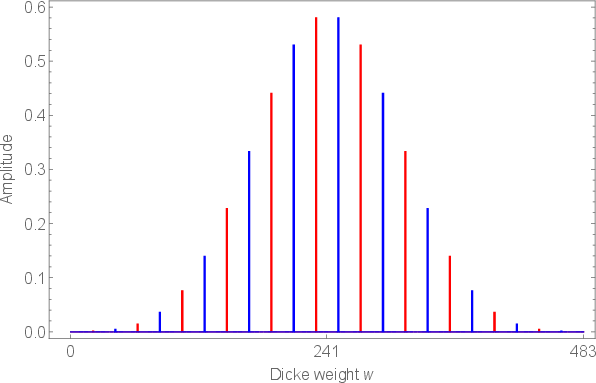
Figure 1: Dicke weight and amplitude structure for a logical plus-state in a s-shifted gnu code, illustrating the symmetric distribution of amplitudes across logical codewords.
Decoding Algorithms: Measurement and Recovery Protocols
The proposed decoding procedure for general errors—up to distance t—proceeds via two primary stages:
- Syndrome Extraction: The corrupted state is projected onto the irreducible representations of the symmetric group SN by measuring the total angular momentum on consecutively nested subsets of qubits. The outcomes correspond to a unique standard Young tableau (SYT) syndrome that encodes the angular momentum coupling path.
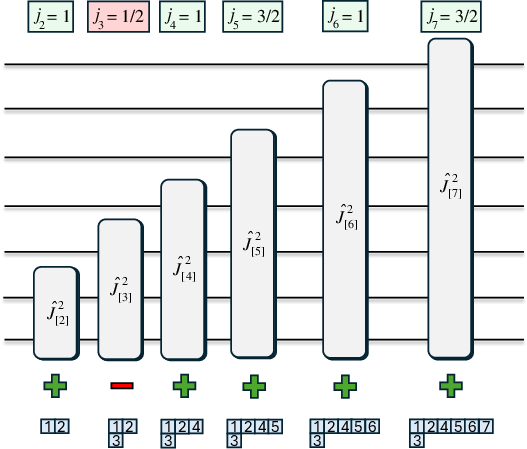
Figure 2: Constructing the SYT syndrome via measurements of total angular momentum on nested sets of qubits.
- Recovery: Using the SYT syndrome, adaptive operations bring the state back into the codespace. This employs either partial inverse quantum Schur transforms and amplitude rebalancing steps, or a teleportation-based protocol with logical ancilla PI states. For deletion errors, the recovery is streamlined: projective modulo measurements on Dicke weights followed by geometric phase gates suffice.
The recovery process is operationalized by decoupling the error subspace via inverse Clebsch-Gordan transformations, computational basis measurements, and iterative amplitude rebalancing, illustrated as a branching process in the Bratelli diagram.
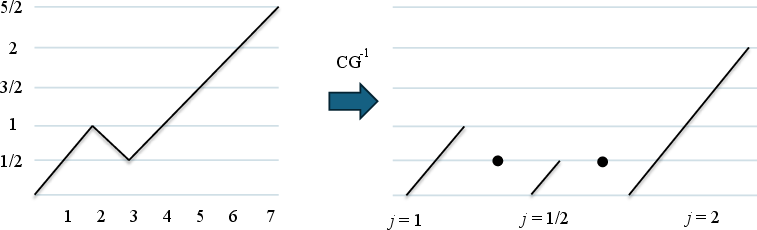
Figure 3: Decoupling protocol for error correction: branching per SYT and inverse Clebsch-Gordan transformation to isolate error subspaces.
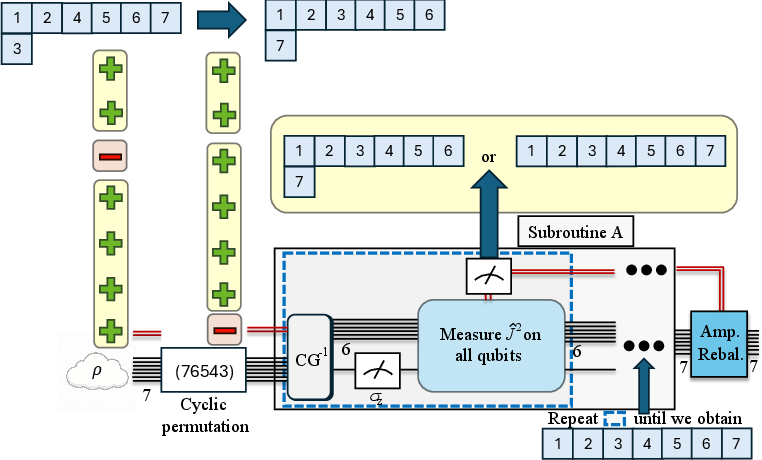
Figure 4: Application of the recovery circuit after SYT measurement; logical codeword amplitudes are adaptively rebalanced in the codespace.
Teleportation-based recovery relies on logical CNOT operations, modular measurements, and controlled-X corrections, agnostic to SYT specifics and physical register size.
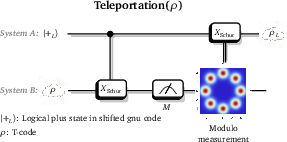
Figure 5: Schematic of the teleportation protocol for syndrome agnostic transfer of corrupted code states into PI logical codes.
Physical Implementation: Bosonic Mode Mediated Control
PI code decoding leverages interactions with bosonic modes to implement both syndrome extraction and recovery:
- Total Angular Momentum Measurement: Hamiltonians coupling spins to bosonic modes induce pointer state separation in phase space, projecting onto total angular momentum eigenspaces. Homodyne or heterodyne detection distinguishes angular momentum sectors as required for SYT extraction.
- Modular Dicke Weight Measurement: Dispersive mode coupling enables projection onto modular Dicke weight subspaces, non-destructively identifying insertion/deletion error syndromes.
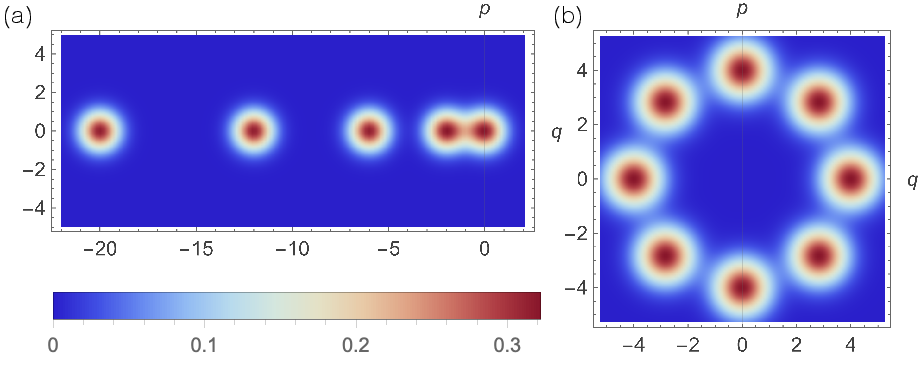
Figure 6: Wigner distributions for bosonic mode quadratures encode spin observables: (a) total spin angular momentum, (b) modular Dicke weight.
- Logical Gate Synthesis: Geometric phase gates, such as Mølmer-Sørensen-type operations, provide efficient synthesis of PI logical states and implement syndrome-resolved conditional rotations and controlled operations with linear resource scaling.
Complexity and Efficiency
The syndrome extraction and recovery protocols require at most N−1 steps for angular momentum measurement and linear scaling in N for elementary operations. For teleportation-based QEC, the gate count is ⌈2N/3⌉ linear GPGs, one dispersive GPG, and up to $4N/3 + 3$ transversal spin rotations plus one measurement, obviating the need for individual qubit addressability. For gate-based Schur transform decoding, complexity for N qubits is O(tlog(N/ϵ)) gates, where t is the SYT second-row box count, typically sublinear in N. These resource counts validate the computational tractability and hardware efficiency of PI code QEC protocols.
Contrasts and Implications
Permutation-invariant codes fundamentally alter the QEC landscape by removing error-location tracking and parity constraints—error correction is enacted via global measurements, modular projections, and geometric phase gates. The theory clarifies that any correctible channel can be reduced (by symmetrization) to block-diagonal recovery in the Schur-Weyl basis, thus extending the Knill-Laflamme framework to non-stabilizer, symmetric codes with efficient physical implementation.
Strong claims include:
- Error Location Agnosticism: Correction performance is independent of the location of individual particle errors.
- Linear Complexity: All steps in syndrome extraction and recovery scale linearly with system size, contrasting the quadratic or higher overhead of many stabilizer-based codes.
- Efficient Hardware Deployment: Schemes are tailored for architectures with global addressing constraints, notably cavity-coupled arrays and ion traps, and for error models that include unknown loss and insertion events.
- No Additional Addressability Required: Fully geometric phase gate libraries mitigate the need for per-qubit control.
- Teleportation Agnostic of SYT and Register Size: Logical state transfer protocols are fully scalable and robust to register variation.
Potential Developments
Practically, the presented decoding protocols suggest immediate utility in neutral atom and ion trap platforms, with bosonic modes facilitating scalable measurement and entanglement operations. Theoretically, the symmetry-based syndrome extraction may be extensible to other physical systems including spin codes and hybrid bosonic-spin architectures. The representation-theoretic approach opens avenues for QEC-enhanced quantum metrology, storage, and sensor networks, as error tracking is replaced by global projections amenable to hardware-friendly implementation.
Future research should address:
- Performance under correlated error models and experimental non-idealities.
- Integration with fault-tolerant logical gate libraries beyond the Clifford hierarchy.
- Embedding of PI codes in modular architectures for distributed quantum processing and quantum networks.
Conclusion
This paper provides a comprehensive theory of quantum error correction for permutation-invariant codes, combining group representation techniques with practical quantum control protocols. By rigorously characterizing syndromes via Young tableaux and leveraging angular momentum measurements, it enables efficient recovery from general and deletion/insertion errors without per-qubit addressability. The symmetry-driven paradigm advances both the theoretical underpinning and the experimental realization of quantum error correction in next-generation architectures, bridging mathematical structure with hardware efficiency and broadening the scope of fault-tolerant quantum computation and sensing (2602.13638).
Paper to Video (Beta)
No one has generated a video about this paper yet.
Whiteboard
No one has generated a whiteboard explanation for this paper yet.
Paper Prompts
Sign up for free to create and run prompts on this paper using GPT-5.
Top Community Prompts
Open Problems
We found no open problems mentioned in this paper.
Continue Learning
- How do permutation-invariant codes simplify the correction of deletion and insertion errors compared to traditional QEC methods?
- What role does Dicke state superposition play in the construction of permutation-invariant codes?
- Can the syndrome extraction via standard Young tableaux be integrated with existing fault-tolerant protocols for non-Clifford gates?
- How does the linear scaling in resource requirements impact the feasibility of implementing these codes on current quantum hardware?
- Find recent papers about bosonic mode mediated quantum error correction.
Related Papers
- Exponential suppression of bit or phase flip errors with repetitive error correction (2021)
- Demonstration of quantum error correction and universal gate set on a binomial bosonic logical qubit (2018)
- Demonstration of logical qubits and repeated error correction with better-than-physical error rates (2024)
- Hardware-efficient quantum error correction via concatenated bosonic qubits (2024)
- Class of codes correcting absorptions and emissions (2024)
- Permutation-invariant qudit codes from polynomials (2016)
- Quantum error correction for long chains of trapped ions (2025)
- Developments in superconducting erasure qubits for hardware-efficient quantum error correction (2026)
- Entangling logical qubits without physical operations (2026)
- Quantum Error Correction and Dynamical Decoupling: Better Together or Apart? (2026)
Authors (2)
Collections
Sign up for free to add this paper to one or more collections.
Tweets
Sign up for free to view the 2 tweets with 51 likes about this paper.