VT-WAM: Visual-Tactile World Action Model for Contact-Rich Manipulation
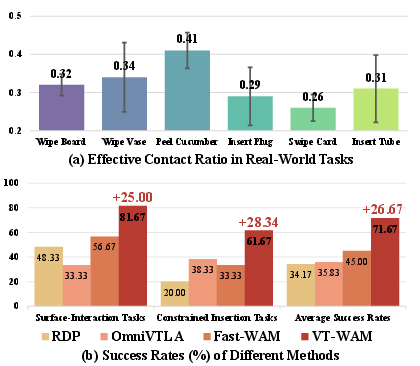
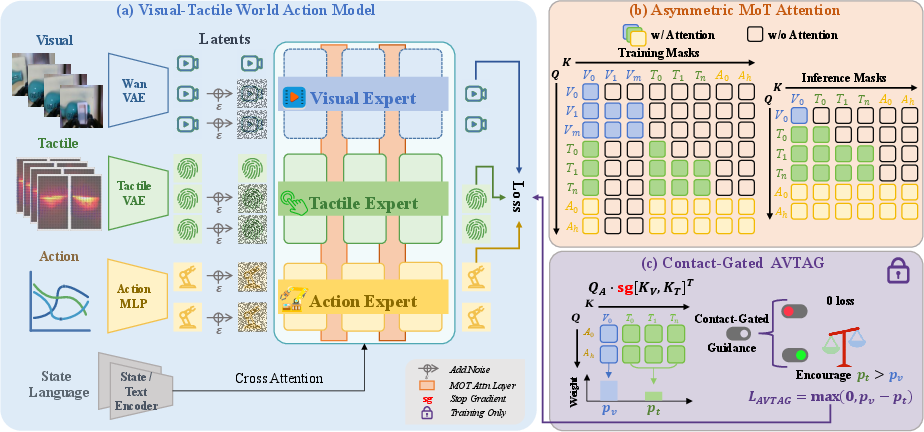
Abstract: Contact-rich manipulation requires policies to react to local deformation, pressure, slip, and friction, yet these cues are temporally sparse and often invisible in visual observations. Existing visual-tactile policies usually feed tactile observations directly into action prediction, but rarely model tactile deformation dynamics during action generation. In this paper, we introduce VT-WAM, a Visual-Tactile World Action Model that jointly learns future visual prediction, tactile deformation prediction, and action prediction within a unified flow matching framework. In particular, VT-WAM introduces (1) Asymmetric Mixture-of-Transformers (MoT) attention to bridge a first-frame visual anchor with temporal tactile dynamics, and (2) contact-gated Action-Visual-Tactile Attention Guidance (AVTAG) to encourage action queries to rely on tactile evidence during contact phases. Across six real-world contact-rich manipulation tasks, VT-WAM achieves a 71.67% average success rate, outperforming Fast-WAM by 26.67% and OmniVTLA by 35.84%. Ablations demonstrate that modeling tactile deformation dynamics and guiding contact-phase tactile attention are both important for contact-rich tasks. Project website: https://vt-wam.github.io/.
Paper Prompts
Sign up for free to create and run prompts on this paper using GPT-5.
Top Community Prompts
Explain it Like I'm 14
What is this paper about?
The paper introduces VT-WAM, a new robot control system that helps robots handle tasks where they must keep touching things while they work—like wiping a curved vase, plugging in a cable, or sliding a card. In these “contact-rich” tasks, seeing isn’t enough. The robot also needs to “feel” with its fingertips to notice pressure, slip, and small shape changes. VT-WAM combines what the robot sees (vision) and what it feels (touch) to predict what will happen next and choose the right actions.
What questions were the researchers trying to answer?
- How can a robot pay attention to touch exactly when it matters (during contact), instead of relying too much on vision?
- Can we predict how touch signals will change over time (how the robot’s “skin” squishes or slides) and use that to pick better actions?
- Can we do this efficiently, so the robot reacts quickly in the real world?
How did they do it? (Methods in simple terms)
Think of the system as three teammates working together:
- A “Vision expert” that looks at the camera image to understand the overall scene.
- A “Touch expert” that reads the fingertip sensors to track how the surface is pressing, slipping, or deforming over time.
- An “Action expert” that decides what the robot should do next.
Two key ideas make these teammates work well together:
- Asymmetric Attention with a “visual anchor”
- The action expert reads:
- a single “anchor” snapshot from the camera (the very first image), to know the general layout, and
- the entire sequence of touch signals over time, to feel how contact is changing.
- Why this helps: Predicting future camera images can be slow and not always necessary. Using a single visual anchor keeps context, while the action expert focuses on the evolving touch signals that really matter during contact.
- Contact-gated guidance (AVTAG)
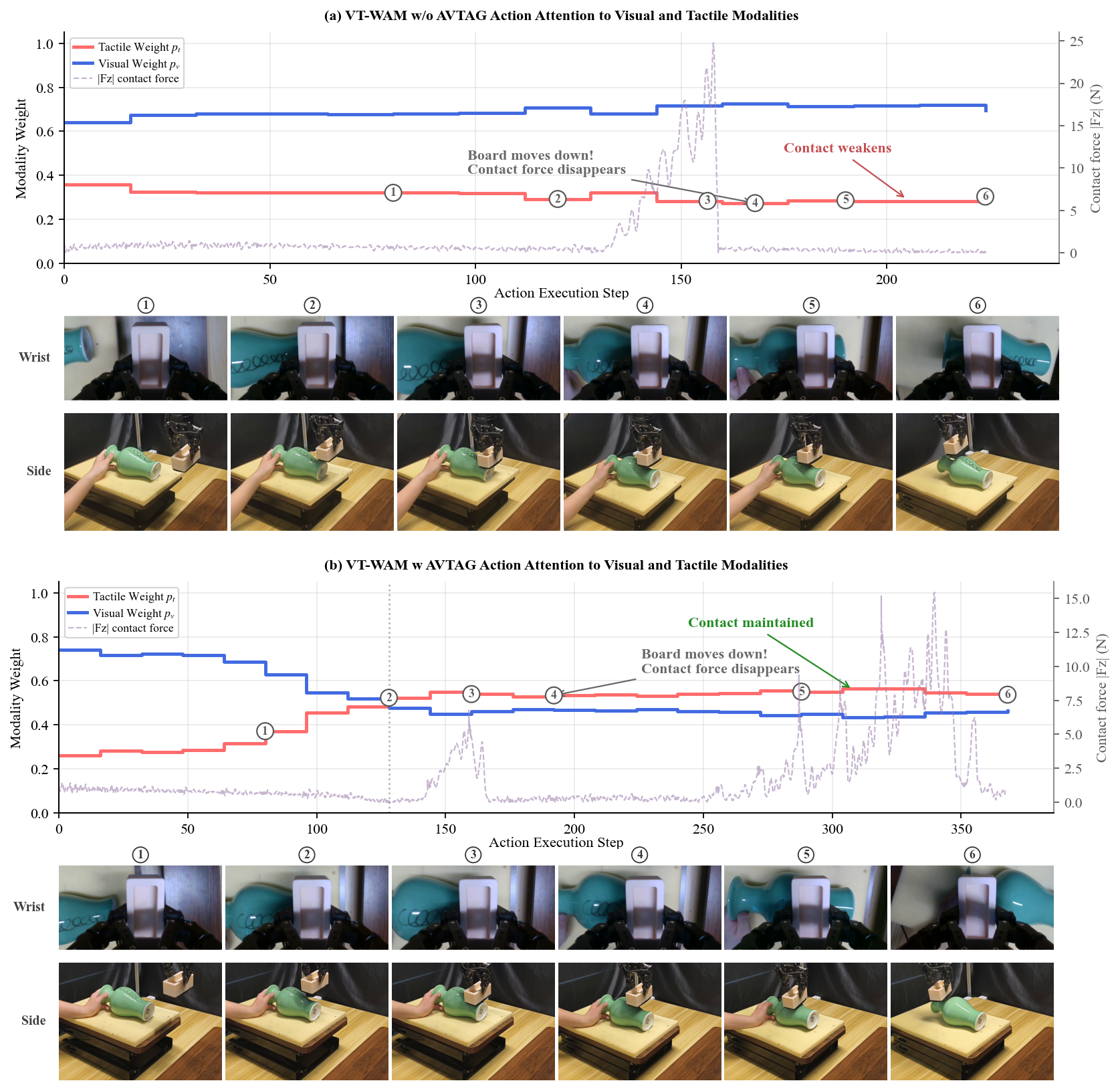
- During training, the model is gently “coached” to pay more attention to touch than vision while the robot is actually in contact.
- If the model tries to rely on vision more than touch during contact moments, it gets a small penalty. This teaches it to trust its “fingertips” when that information is most useful.
- Important: This guidance is used only during training. At run time, the model is fast and doesn’t need extra parts.
How the model learns to predict and act (flow matching)
- The system learns by practicing how things change step-by-step: how future camera frames would change, how touch patterns would change, and which actions lead to good outcomes.
- You can think of “flow matching” as learning the best direction to move from “now” to “what should happen next” for vision, touch, and actions, all at once.
Fast, real-world use (visual-cache inference)
- When the robot is actually working, it uses the first camera frame as a steady reference and focuses on predicting the touch evolution and the best actions. This makes decisions faster without wasting time predicting future images.
What did they find, and why is it important?
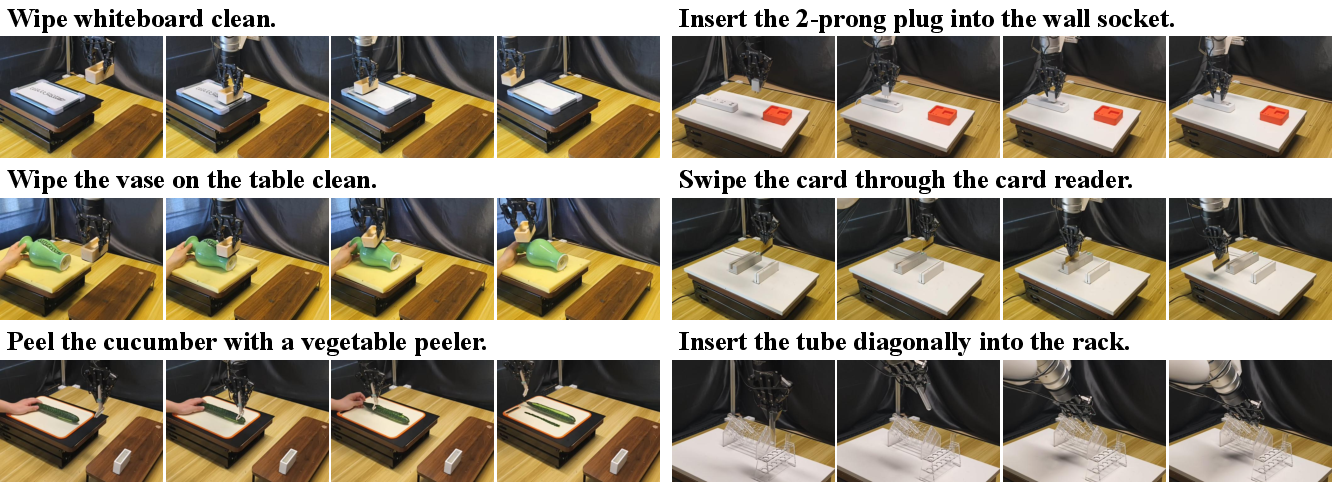
They tested VT-WAM on six real-world tasks:
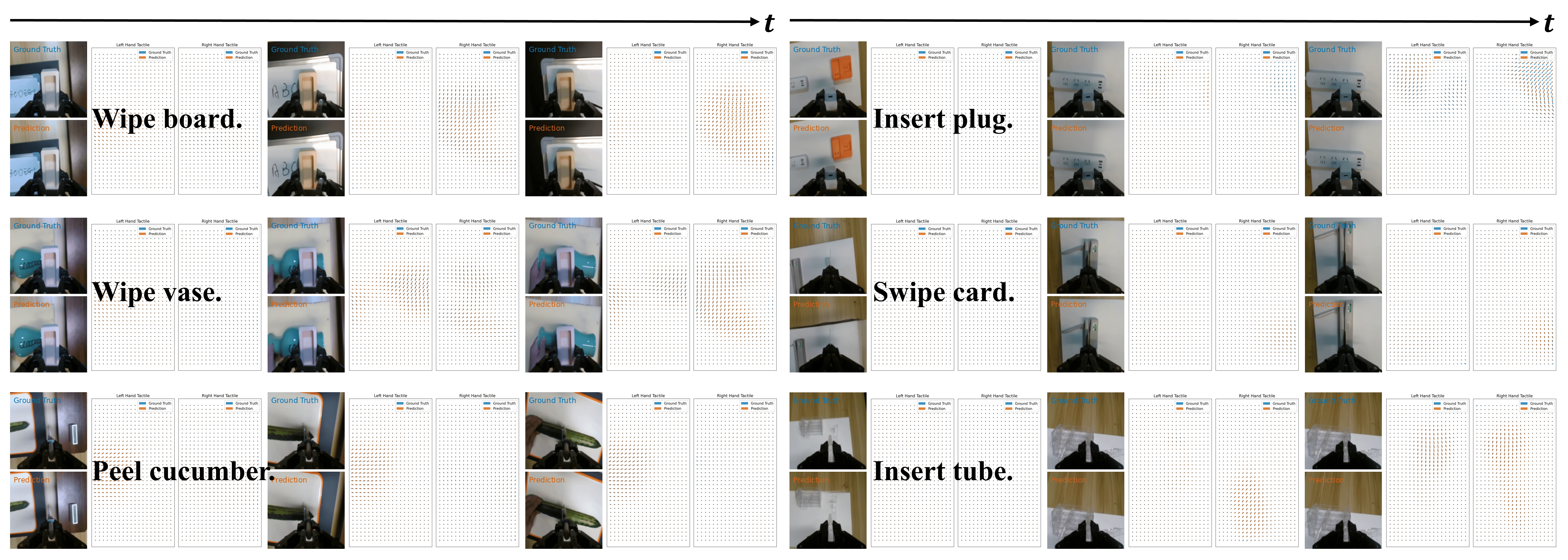
- Surface-interaction: wipe a board, wipe a curved vase, peel a cucumber
- Constrained insertion: insert a plug, swipe a card, insert a tube
Main results:
- VT-WAM achieved a 71.67% average success rate.
- It beat a strong previous method (Fast-WAM) by 26.67 percentage points and another visual-tactile baseline (OmniVTLA) by 35.84 points.
- It especially helped in tasks where vision alone struggles—like aligning a plug you can’t fully see or keeping steady contact on a curved or slippery surface.
Why it works:
- Touch signals are brief and happen mainly during contact. Many models ignore this because vision is always available. VT-WAM fixes that by:
- making the action expert focus on the full timeline of touch signals, and
- teaching it to prefer touch over vision during contact.
- Ablation studies (turning pieces on/off) showed:
- Using the full touch sequence works much better than using only a single touch snapshot.
- The contact-gated guidance (AVTAG) further boosts success by reducing “vision over-reliance” during contact.
What does this mean for the future?
This research shows that giving robots “a good sense of touch” and teaching them when to trust it can dramatically improve their performance in real, physical tasks. With VT-WAM:
- Robots can be better at careful jobs like assembly, plugging in cables, or cleaning curved surfaces.
- The approach balances speed and accuracy by using a simple visual anchor and focusing on evolving touch.
Long term, this could lead to more reliable home, factory, and hospital robots that handle delicate tasks safely and effectively. Future work could train one model on many tasks at once, making the system even more general and robust.
Knowledge Gaps
Below is a concise, actionable list of knowledge gaps, limitations, and open questions that remain unresolved by the paper. These points are intended to guide follow-up research.
- Generalization across hardware and sensors
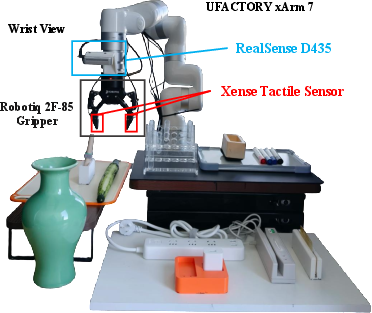
- Validity beyond a single robot and gripper: results are limited to an xArm7 with a Robotiq 2F-85 and specific Xense tactile sensors; portability to other arms, grippers (incl. dexterous hands), and tactile modalities is untested.
- Dependence on a pretrained tactile VAE from OmniVTA: robustness to different tactile sensor geometries, noise characteristics, and calibration procedures is not evaluated; whether end-to-end finetuning of the tactile encoder improves performance is unknown.
- Wrist camera configuration: sensitivity to different camera placements, focal lengths, and lighting changes is not analyzed.
- Data efficiency and scaling
- Demonstration efficiency: the method uses 100 expert trajectories per task; the marginal gains vs. demonstrations and performance under low-data regimes remain unquantified.
- Multi-task and cross-task transfer: the model is trained per task; whether VT-WAM scales to multi-task settings, supports continual learning without catastrophic forgetting, or benefits from shared tactile dynamics priors is open.
- Scaling laws: no analysis of how model size, dataset size, and training compute affect performance or sample efficiency.
- Evaluation breadth and robustness
- Object and environment diversity: it is unclear how the method performs with broader variations (novel geometries, materials, friction, deformability, clutter, lighting/domain shifts).
- Robustness tests: no systematic evaluation under sensor dropout, delayed/async streams, tactile saturation, or noisy/missing data; resilience to network latency (remote inference) is not measured.
- Statistical rigor: success rates from 20 trials lack confidence intervals or significance tests; per-task variability and failure taxonomies are not reported.
- Control and deployment characteristics
- Real-time performance: end-to-end control frequency, latency per control cycle (10 flow-matching denoising steps, remote A100 server), and their impact on closed-loop stability are not reported.
- Action representation: the paper does not specify the control mode (e.g., joint-space vs. Cartesian, position vs. force/impedance); how different action parameterizations or action-horizon lengths affect contact-rich performance is unstudied.
- Safety/compliance: no analysis of force limits, safe recovery from large contact errors, or integration with impedance/force control for safer execution.
- Asymmetric MoT Attention and visual-cache inference
- Scene-motion assumptions: visual-cache inference uses a first-frame visual anchor; robustness to viewpoint drift, significant scene changes, or long-horizon tasks with evolving global context is not quantified.
- Train–test mismatch: training uses joint future prediction while inference drops future visual tokens; potential distribution shift and its effect on accuracy and stability are not analyzed.
- Alternative fusion topologies: comparisons to simpler cross-attention baselines or other asymmetric/sparse fusion schemes (and their compute–performance trade-offs) are missing.
- Contact-gated AVTAG design
- Contact-phase detection: contact gating depends on “pronounced tactile deformation”; the detection rule/thresholding is unspecified, and sensitivity to mislabeling or domain-specific tuning is not evaluated.
- Guidance objective: only a hinge-ranking loss with fixed weight is explored; alternatives (e.g., curriculum schedules, entropy regularization, contrastive objectives, or differentiable contact estimators) are untested.
- Overfitting risk: whether AVTAG induces overreliance on tactile features or degrades performance when contact cues are weak/ambiguous is not studied.
- Tactile dynamics modeling
- Temporal modeling depth: gains are shown for attending to full tactile sequences, but the role of sequence length, temporal resolution, and history windows (and their compute costs) is not explored.
- Quantitative metrics coverage: tactile prediction is evaluated, but visual prediction quality (e.g., PSNR/SSIM/LPIPS) and its relationship to control success are not reported.
- Physical fidelity: no explicit modeling or validation against physical quantities like friction, stick–slip, or shear; whether incorporating physics-informed priors improves generalization is open.
- Baseline scope and fairness
- Comparisons to visuo-tactile world models that plan (e.g., VT-WM, OmniVTA controllers) are absent; it is unclear whether VT-WAM’s joint training advantage persists against strong planning-based baselines on the same setup.
- Capacity parity and tuning: differences in model scale and hyperparameter tuning across baselines are not normalized, which may confound performance comparisons.
- Hyperparameter sensitivity and ablations
- Loss weights and architectural choices: no sensitivity analysis for λv, λt, λa, or λAVTAG; the number of MoT layers/heads, tokenization granularity, and action chunk length S_a are not ablated.
- Denoising steps: the accuracy–latency trade-off vs. the number of flow-matching steps is not characterized for control.
- Uncertainty, OOD detection, and reliability
- Uncertainty calibration: the model provides no uncertainty estimates over actions or tactile predictions; how to detect OOD states or trigger safe fallbacks remains open.
- Recovery policies: strategies for confidence-aware replanning, safety filters, or switching to reactive controllers when tactile signals conflict with the visual anchor are not addressed.
- Task scope and long-horizon behaviors
- Multi-stage, long-horizon tasks: performance on tasks requiring extended sequences with evolving goals/subtasks (beyond short contact events) is untested.
- Language grounding: language is included but tasks are single-instruction; generalization to diverse, compositional language and instruction-conditioned contact strategies is not evaluated.
- Reproducibility and resource requirements
- Compute and memory footprint: training/inference costs (GPU-hours, memory usage) are not reported; feasibility for on-robot or edge deployment is unclear.
- Code, pretrained models, and sensor calibration procedures: reproducibility relies on the project website; detailed release status and calibration protocols for tactile sensors are not specified.
Practical Applications
Immediate Applications
The paper’s main contribution—coupling tactile deformation dynamics with action prediction via a unified flow-matching World Action Model with Asymmetric MoT Attention and contact-gated AVTAG—directly improves success in contact-rich tasks (71.67% avg., +26.67% over Fast-WAM) and enables latency-friendly “visual-cache” inference. This unlocks several deployable use cases now:
- Precision connector and cable insertion on assembly lines
- Sector: Robotics/Manufacturing; Electronics, Automotive
- What to do: Retrofit cobots (e.g., xArm/UR/Franka) with wrist cameras and finger-mounted tactile sensors to perform plug/socket mating, cable harness insertion, card swipes, and tube seating under occlusion or tight tolerances.
- Tools/products/workflows: “VT-WAM controller” plugin for ROS2; tactile-VAE encoders + Asymmetric MoT block; visual-cache inference runtime for low-latency control; data collection by kinesthetic teaching (~100 demonstrations/task); per-line fine-tuning pipelines.
- Assumptions/dependencies: Availability and robustness of tactile sensors (e.g., gel- or deformation-field sensors); task-specific demonstrations; controller integration with existing safety systems; compute provision for 10-step denoising at ~30 Hz (edge GPU or on-prem server).
- Surface treatment, cleaning, and polishing tasks
- Sector: Service Robotics; Facilities/Manufacturing
- What to do: Deploy for wiping/cleaning planar and curved surfaces (e.g., countertops, appliance exteriors, curved fixtures) where contact quality and slip detection matter.
- Tools/products/workflows: End-effector cleaning kits with tactile skins; “contact-aware coverage” workflows using AVTAG to sustain and recover contact; monitoring dashboards using attention traces for operator QA.
- Assumptions/dependencies: Consistent surface materials and maintainable contact force; periodic tactile sensor calibration; access to task-specific demonstrations.
- Tube/pipe and consumable attachment in lab automation
- Sector: Healthcare/Life Sciences; Lab Automation
- What to do: Pipette tip attachment, tube capping/uncapping, and flexible tubing insertion on benchtop lab robots under partial occlusion.
- Tools/products/workflows: Compact gripper kits with finger tactile arrays; prebuilt VT-WAM policies for common consumables; QA analytics (deformation error, directional consistency) as in-paper metrics to validate setup.
- Assumptions/dependencies: Clean-room compatible tactile covers; sterility protocols; task-specific training.
- Robust pick-to-place with contact alignment
- Sector: Warehouse/Logistics; Manufacturing
- What to do: Use tactile-informed micro-adjustments when placing objects into bins, slots, or fixtures (e.g., dividers, dunnage) where vision alone is insufficient.
- Tools/products/workflows: “Contact alignment” micro-skills library; VT-WAM-based residual controller layered over existing motion planners.
- Assumptions/dependencies: Tactile sensor durability for high-throughput; integration with WMS/MES; standardized bin/fixture geometries.
- Safety-aware cobot deployment with contact gating
- Sector: Policy & Safety; Robotics
- What to do: Use AVTAG’s contact-phase prioritization to limit forces and improve contact event detection for ISO/TS 15066 risk mitigations (e.g., soft re-contact after slip).
- Tools/products/workflows: Auditable attention-weight logs; contact-phase gates triggering force/position blending; safety validation protocols using tactile prediction quality metrics.
- Assumptions/dependencies: Certified force/torque limits; validated detection thresholds; buy-in from safety officers.
- Academic reproducibility and benchmarking for contact-rich manipulation
- Sector: Academia/Research
- What to do: Adopt Asymmetric MoT and AVTAG as baselines for contact-rich tasks; replicate six tasks; evaluate tactile prediction via L2 magnitude error and directional consistency.
- Tools/products/workflows: Modular code for visual/tactile/action flow matching; curriculum for kinesthetic teaching; open benchmarks for contact dynamics modeling.
- Assumptions/dependencies: Access to instrumented grippers; modest compute (single A100-equivalent) or lighter variants; stable data sync at 30 Hz.
- Rapid task onboarding via kinesthetic teaching
- Sector: Robotics Integration Services
- What to do: Collect ~100 demonstrations per new task, fine-tune VT-WAM, and deploy in days rather than months for contact-rich tasks.
- Tools/products/workflows: Turnkey “teach-train-deploy” pipeline; scripted evaluation harness with success scoring.
- Assumptions/dependencies: Expert operators for initial demos; process for periodic re-teach after tool or part changes.
- Developer tooling for tactile-aware robot stacks
- Sector: Software/DevTools
- What to do: Provide ROS2 nodes for tactile VAEs, Asymmetric MoT attention layer, AVTAG training loss, and visual-cache inference; SDK for integrating tactile dynamics with existing planners.
- Tools/products/workflows: Pretrained encoders; reference configs for common sensors (e.g., Xense, GelSight-like); deployment templates for on-robot or remote inference.
- Assumptions/dependencies: Sensor vendor SDKs; CUDA/Triton runtime support; versioned model artifacts and calibration routines.
- Instruction-compliant contact execution
- Sector: Human-in-the-Loop Operations; Manufacturing QA
- What to do: Use language-conditioned prompts to switch between contact strategies (e.g., “wipe with firm contact,” “insert gently then rotate”).
- Tools/products/workflows: Prompt libraries tied to contact-phase thresholds; operator UIs for mode selection; telemetry collection for traceability.
- Assumptions/dependencies: Clear instruction templates; safe defaults for force policies; robust language-to-parameter mapping.
- Education and training labs for multimodal control
- Sector: Education
- What to do: Teach students joint visual–tactile world modeling and control with affordable arms and tactile skins via VT-WAM-style curricula and labs.
- Tools/products/workflows: Course kits (tactile skins, wrist camera, example tasks); visualization tools for attention and deformation fields.
- Assumptions/dependencies: Low-cost sensor options; simplified models (smaller backbones) for classroom GPUs.
Long-Term Applications
Several high-impact applications become feasible as the approach scales to multi-task learning, lighter models, and broader hardware support:
- General-purpose household robots for contact-heavy chores
- Sector: Consumer Robotics
- What to do: Robust wiping, scrubbing, dish handling, door/latch operation, and cable plugging amid clutter/occlusions.
- Tools/products/workflows: Multi-task VT-WAM trained across hundreds of home tasks; compact edge inference with visual-cache; self-supervised contact skill refinement.
- Assumptions/dependencies: Lower-cost, durable tactile skins; large-scale home demonstrations/simulation; robust generalization beyond single-task fine-tuning.
- Flexible, variant-robust assembly lines
- Sector: Manufacturing
- What to do: Zero/low-shot adaptation to new SKUs for connector mating and fastener insertion using multi-task, scalable VT-WAMs with tactile priors.
- Tools/products/workflows: Line-wide policy servers; digital twins generating synthetic tactile traces; automated validation suites.
- Assumptions/dependencies: Reliable sim-to-real for tactile fields; standardization of tactile sensor interfaces; orchestration across many robots.
- Surgical and medical manipulation with haptic intelligence
- Sector: Healthcare
- What to do: Tissue-aware tool guidance, atraumatic grasping, catheter insertion with contact-phase prioritization and slip detection.
- Tools/products/workflows: Sterilizable tactile instruments; regulatory-grade logging of attention/tactile dynamics; surgeon-in-the-loop shared autonomy.
- Assumptions/dependencies: Regulatory approval; ultra-reliable, high-resolution tactile hardware; rigorous verification/validation.
- Advanced prosthetics and exoskeletons with predictive tactile control
- Sector: MedTech
- What to do: Predict and adjust grasp to prevent slip or excessive pressure; contact-phase gating for delicate manipulation.
- Tools/products/workflows: Onboard microcontrollers/edge NPUs running compact VT-WAM variants; training on user-specific demos.
- Assumptions/dependencies: Energy-efficient inference; soft, conformal tactile arrays; personalized adaptation pipelines.
- Field maintenance in extreme/occluded environments
- Sector: Energy, Utilities, Space, Nuclear, Subsea
- What to do: Valve turning, connector coupling, and inspection under poor visibility (mud, radiation shields, darkness) using tactile-driven policies.
- Tools/products/workflows: Ruggedized tactile end-effectors; redundancy and fail-safes; teleoperation with VT-WAM shared autonomy.
- Assumptions/dependencies: Environmental hardening; communication-latency tolerance; remote or on-edge compute.
- Standardized tactile-data ecosystems and certification
- Sector: Policy & Standards
- What to do: Define benchmarks, metrics (e.g., deformation error, directional consistency), logging formats, and safety thresholds for contact-phase behavior.
- Tools/products/workflows: Public datasets and leaderboards; certification protocols for tactile-aware controllers; auditability of attention-guided decisions.
- Assumptions/dependencies: Multi-stakeholder consortia; alignment with existing robot safety standards; vendor-neutral sensor APIs.
- Simulation and synthetic tactile pretraining at scale
- Sector: Software/Simulation; Academia
- What to do: Build differentiable tactile simulators to pretrain VT-WAMs on diverse contact scenarios before real-world finetuning.
- Tools/products/workflows: FEM/ML-based tactile synthesis; domain randomization for material/friction; dataset generators for contact events.
- Assumptions/dependencies: High-fidelity, fast tactile simulation; validated material models; efficient sim-to-real transfer.
- Cloud–edge orchestration for multimodal control
- Sector: Software/Cloud Robotics
- What to do: Offload heavy training and planning to the cloud; run visual-cache inference on edge GPUs; fleet updates with A/B tests.
- Tools/products/workflows: MLOps for multimodal models; streaming frameworks for synchronized visual/tactile data; latency-aware scheduling.
- Assumptions/dependencies: Reliable networking; security and data governance; fallbacks for connectivity loss.
- Human-robot collaboration with intentional contact
- Sector: Manufacturing/Service
- What to do: Safe handovers, co-manipulation, and tactile-guided assistance where robots detect and adapt to human-initiated contact.
- Tools/products/workflows: Contact-phase policies that modulate stiffness/forces; “tactile intent” classifiers; compliance controllers informed by AVTAG.
- Assumptions/dependencies: Robust human-contact detection; advanced HRC safety cases; ergonomic studies.
- Education at scale: tactile-first robotics curricula
- Sector: Education
- What to do: Tactile-focused robotics programs with accessible hardware and simulators, preparing workforce for contact-rich automation.
- Tools/products/workflows: Open modules for VT-WAM components; cloud labs; remote tactile-sim sandboxes.
- Assumptions/dependencies: Affordable kits and grants; institutional partnerships; teacher training.
Cross-cutting dependencies and risks to feasibility
- Hardware availability and robustness: Finger-mounted tactile arrays must be durable, low-drift, and maintainable; protective covers and calibration routines are needed.
- Data and generalization: Current results use ~100 expert demos per task; broader deployment requires better multitask training, data augmentation, and sim-to-real for tactile.
- Compute and latency: While visual-cache inference reduces cost by removing future video denoising, on-edge acceleration or reliable on-prem/cloud inference remains necessary.
- Integration: Requires ROS2 or vendor stack integration, safety interlocks, and force/position blending.
- Environment variability: Changes in materials, friction, lighting, or wear can degrade performance without adaptation.
- Compliance and safety: Especially in HRC and healthcare, robust certification, logging, and traceability (e.g., attention-weight audits) are prerequisites.
Glossary
- Action chunk: A short sequence of low-level control commands grouped as a single prediction target. "the action expert predicts the action chunk from visual and tactile evidence."
- Action queries: The action-side query tokens in attention layers that retrieve information from visual/tactile keys. "encourages action queries to rely on tactile evidence during contact phases."
- Action-Visual-Tactile Attention Guidance (AVTAG): A training-only auxiliary objective that biases action attention toward tactile evidence during contact. "contact-gated Action-Visual-Tactile Attention Guidance (AVTAG) to encourage action queries to rely on tactile evidence during contact phases."
- Asymmetric Mixture-of-Transformers (MoT) Attention: A masked-attention scheme in MoT layers that lets actions read the tactile sequence and only the first-frame visual tokens. "Asymmetric Mixture-of-Transformers (MoT) Attention to bridge a first-frame visual anchor with temporal tactile dynamics"
- Blockwise attention mask: A structured mask matrix that restricts which queries can attend to which keys across modalities. "and applies a blockwise attention mask "
- Contact phases: Intervals when the robot and object are in physical contact, providing informative tactile signals. "attend to tactile evidence during contact phases."
- Contact-rich manipulation: Manipulation tasks where success depends on handling forces, friction, slip, and deformations during contact. "Contact-rich manipulation requires policies to react to local deformation, pressure, slip, and friction"
- Cross-attention: Attention mechanism where one stream (e.g., actions) reads context from another (e.g., language or proprioception). "The language instruction and proprioceptive state are provided to each expert through cross-attention~\cite{vaswani2017attention}."
- Denoising steps: Iterative inference updates in the generative process to refine latent predictions. "and uses 10 denoising steps for action prediction."
- First-frame visual anchor: The initial visual tokens used as a fixed context instead of predicting future visual frames at test time. "bridge a first-frame visual anchor with temporal tactile dynamics"
- Flow matching: A generative training objective that learns velocity fields transforming noise to data distributions. "within a unified flow matching framework."
- Hinge ranking loss: A margin-based loss that penalizes cases where tactile attention is lower than visual attention during contact. "applies a training-only hinge ranking loss that encourages action queries to attend to tactile evidence during contact phases."
- Latent sequence: The internal tokenized representation sequence (e.g., tactile tokens) used during generative denoising. "action tokens attend to the tactile latent sequence being denoised."
- Mixture-of-Transformers (MoT): An architecture that composes multiple transformer experts for different modalities with controlled information exchange. "Asymmetric MoT Attention controls how visual, tactile, and action tokens exchange information in MoT~\cite{liang2025mixture} layers."
- Proprioceptive state: Internal robot state signals (e.g., joint angles/velocities) used as inputs to the model. "proprioceptive state "
- Stop-gradient: An operation that prevents backpropagation through certain tensors to constrain which components receive gradients. "we apply stop-gradient to $\mathbf{K}_{\mathrm{vt}$"
- Tactile deformation dynamics: Temporal evolution of contact-induced deformations measured by tactile sensors, informative for interaction. "model tactile deformation dynamics during action generation."
- Variational Autoencoder (VAE): A generative encoder-decoder used here to tokenize video and tactile observations. "encoded by the Wan2.2 video VAE"
- Velocity field: The predicted vector field over tokens that guides data transformation under the flow matching objective. "the visual, tactile, and action experts each predict the velocity field of their corresponding modality"
- Visual-cache inference mode: An efficient test-time mode that fixes the first-frame visual tokens and skips future visual prediction. "This enables visual-cache inference mode without discarding tactile dynamics needed for contact phases."
- Visual-dominance bias: The tendency during joint training to rely more on abundant visual cues than sparse tactile signals. "Contact-gated AVTAG further reduces visual-dominance bias"
- World Action Model (WAM): A policy class that couples future-state prediction with action generation in a unified model. "World Action Models (WAMs) have provided the ability to predict world dynamics by coupling action prediction and video prediction"
Collections
Sign up for free to add this paper to one or more collections.