- The paper demonstrates that the Schrödinger equation emerges as a slow-envelope description of Newtonian dynamics in a classical oscillator chain.
- It employs a complex variable transformation and temporal scale separation to map classical phonon dynamics onto quantum observables expressed as classical averages.
- The methodology bridges classical field theory with non-Hermitian quantum mechanics, providing insights for applications in cold atoms, optical lattices, and metamaterials.
Introduction and Motivation
The manuscript proposes a technically rigorous framework in which much of the algebra and structure of non-relativistic quantum mechanics (QM) — most notably, the Schrödinger equation and quantum observables — emerges as an exact rewriting of the Newtonian equations for a classical many-body system, specifically a continuous limit of the Frenkel-Kontorova chain. The central assertion is that starting strictly with real, classical equations of motion, one can, via specific complex-valued variable transformations tailored to separate temporal scales, derive the canonical structure of non-relativistic QM for a single spinless particle. Unlike most prior approaches, no appeal is made to canonical quantization or probabilistic measurement theory; instead, the formal apparatus of QM arises as a natural surrogate for describing the slow envelope dynamics in classical coupled oscillators.
This work locates itself in dialogue with prior studies connecting classical field theory and quantum mechanics [Padmanabhan 2018, Barros e Sá & Gomes 2021], reinterpretations of the role of complex numbers in quantum theory [McKague et al. 2009; Renou et al. 2021], and the classical/field-theoretic roots of the Schrödinger equation [Nelson 1966; Feshbach & Villars 1958; Mostafazadeh 2002].
The Classical Model: Frenkel-Kontorova Chain and Klein-Gordon Correspondence
The starting point is the linearized Frenkel-Kontorova model: a one-dimensional chain of N masses m connected via springs with both on-site (K0) and inter-site (K) harmonic interactions, parameterized by lattice spacing a. The degrees of freedom are the transverse displacements un(t), and the Newtonian equations are linearly coupled.
The continuum limit N→∞, a→0, leads rigorously to the classical, real-valued Klein-Gordon (KG) equation for the displacement field ψ(x,t): ψ¨(x,t)−c2ψ′′(x,t)+ω02ψ(x,t)=0
where appropriate identification of parameters (m0, m1) ensures relativistic scaling. An external potential m2 can be incorporated as a spatial modulation of the on-site spring strength, yielding the KG equation with potential.
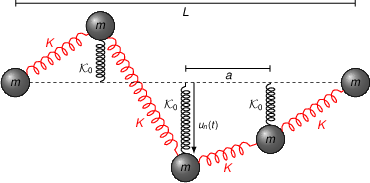
Figure 1: Schematic of the Frenkel-Kontorova chain; the analog system whose classical limit gives rise to the Klein-Gordon field theory.
Remarkably, this mapping holds in arbitrary spatial dimension and for generalizations including site-dependent friction, with the interpretation that the continuous displacement m3 is a configuration field on a classical material substrate.
Temporal Scale Separation and Complexification
Ordinarily, the dynamical variable for the continuum KG field is real. The key innovation here is the adoption of a complexified variable via linear transformation: m4
This is an invertible map from the pair m5 to a single complex function. This variable change exactly rewrites the KG dynamics as a first-order system, and is closely linked to the Feshbach–Villars and Mostafazadeh two-component formalisms [Feshbach & Villars 1958; Mostafazadeh 2002].
Upon factorizing the rapid carrier frequency via m6, the slow envelope m7 is shown to evolve according to a Schrödinger-like equation in the nonrelativistic limit (m8), when the temporal and spatial variation scales are much slower than the oscillation period m9 and the Compton wavelength K00. All fast-oscillatory (nonresonant) terms vanish in the secular approximation.
Consequently, the Schrödinger equation is not an ad hoc quantization, but a systematic rewriting of the classical Newtonian evolution for appropriately reparameterized field variables in the slow envelope regime.
Quantum Observables as Classical Averages
The formalism endows the Hilbert space structure of quantum mechanics with a transparent classical origin. All expectation values and quantum observables — Hamiltonian, momentum, angular momentum, position — arise as classical global quantities (means or inner products) over the phonon field configuration and canonical momentum (i.e., “energy barycenters,” etc), after expressing in the slow envelope complex variable and taking the nonrelativistic limit. For instance, the position expectation value becomes
K01
and similarly for momentum and angular momentum, precisely matching quantum mechanical expressions.
The norm of the Schrödinger wavefunction is directly proportional to the high-frequency energy density of the original classical model. The Laplacian term in the quantum Hamiltonian, usually interpreted as kinetic energy, appears here as a potential energy arising from the “incompressibility” of the phonon system—thus offering an interpretation of Heisenberg uncertainties and confinement energy in terms of classical elasticity.
Strong numerical equivalence is claimed: all standard quantum expectation values are exactly reproduced by the mapped classical averages in the appropriate limit. The work stresses that no probability measure or measurement postulate is imported; rather, the quantum Hilbert space structure arises as the machinery for handling slow modulations in a real classical field.
Non-Hermitian Quantum Dynamics from Classical Friction
The inclusion of friction (non-conservative forces) in the original chain is mapped, via the same procedure, to a Schrödinger equation with complex (non-Hermitian) potentials, mirroring the structure encountered in open quantum systems and effective non-Hermitian quantum mechanics [Breuer & Petruccione 2002; BenBroJon 2003; BenHoo 2024]. In this correspondence, the non-conservation of the norm of the quantum wavefunction under non-Hermitian evolution is directly tracked by the rate of mechanical energy dissipation in the classical chain.
Implications and Future Directions
Theoretical Implications:
This construction demonstrates that much of the formal apparatus of non-relativistic quantum mechanics — complex wave functions, operator algebra, and observables as Hermitian expectation values — can be reproduced without invoking quantum postulates, probabilistic interpretations, or canonical quantization. The only input is Newtonian mechanics for a chain of oscillators, plus temporal scale disparity and a judicious complexification. It is emphasized, however, that this approach is limited to the non-relativistic, spinless, and single-particle regime and makes no claim regarding quantum measurement, indeterminacy, or field quantization. The relationship between commutators and classical Poisson brackets is reserved for the sequel.
Practical Implications:
While not directly a quantization prescription, such a mapping clarifies the connection between classical field evolutions and quantum mechanical evolution in material systems where a phononic interpretation is appropriate (e.g., cold atoms in optical lattices, engineered mechanical metamaterials). Moreover, extensions to non-Hermitian physics and open quantum systems are rendered intuitively accessible via mechanical modeling.
Future Work:
Prospective developments are outlined, including extension of the construction to relativistic regimes via the Hamiltonian framework, treatment of field quantization and particle statistics, and generalization to systems with spin and nontrivial symmetries. The authors suggest investigating how commutator algebra and the Heisenberg uncertainty principle may emerge from the Poisson structure in classical phase space within this framework.
Conclusion
This paper delivers a precise, technically explicit demonstration that the Schrödinger equation and quantum observables for a spinless particle can be derived as a slow-envelope Newtonian description of an infinite one-dimensional chain of classical oscillators (the Frenkel-Kontorova model). The translation to quantum-algebraic structure is achieved by a complex-valued change of variables and temporal scale separation, with all observables emerging as classical averages. The framework enables a reinterpretation of quantum mechanical structure as a formal instrument to describe the coarse-grained dynamics of real-valued classical fields. The approach provides a new vantage point on the mathematical underpinnings of quantum mechanics and clarifies the formal links with classical field theory.
This methodology is poised for natural generalization to relativistic quantum mechanics, canonical operator algebra, and potentially to the foundation of quantum field theory.
References
Full citation list available in the original paper (2607.03897).