- The paper demonstrates a rigorous classical derivation of quantum operator algebra using phonon lattice models and continuous Poisson brackets.
- It recovers relativistic Klein-Gordon dynamics and the full Poincaré algebra by mapping classical observables to quantum operators.
- The transformation to a Foldy representation reveals a direct connection between classical functionals and canonical quantum commutators.
Deriving Quantum Algebra from Classical Phonon Systems: Klein-Gordon, Heisenberg and Poincaré Structures via Continuous Poisson Brackets
Introduction and Motivation
The paper "Algebra of quantum mechanics via classical phonons. II: Klein-Gordon dynamics, the Heisenberg formalism, the Dirac canonical commutation rule and the Poincaré algebra through the continuous Poisson bracket formalism" (2607.03909) systematically builds a rigorous correspondence between the operator algebra of quantum mechanics and a strictly classical Hamiltonian formalism grounded in a phonon lattice model. The work generalizes the previously established non-relativistic case, using the continuous limit of a linearized Frenkel-Kontorova model to recover (1) the real-valued Klein-Gordon dynamics, (2) observables as functionals evolved by Poisson brackets, and (3) a mapping between these classical constructs and the operator algebra of relativistic quantum theory, including the full Poincaré group structure.
Crucially, the paper demonstrates, with explicit formalism, that many essential features usually regarded as intrinsically quantum (e.g., canonical commutators, Hermitian operator algebra, unitarity, relativistic covariance via the Poincaré algebra) can be reconstructed completely within a real, classical dynamical system, without a priori quantization. This is achieved by expressing observables as quadratic functionals in displacement and velocity fields, and by leveraging continuous Poisson brackets in the infinite-lattice limit.
The Classical Phonon Model and the Klein-Gordon Limit
Central to the analysis is the linear Frenkel-Kontorova model: a one-dimensional lattice of masses connected by on-site and intersite (harmonic) springs. The degrees of freedom are real transverse displacements un(t) at lattice site n, subject to a Hamiltonian comprising kinetic and potential (on-site and coupling) energy terms.
The continuum limit (N→∞, a→0 with Na=L fixed) yields fields ψ(x,t), leading to equations of motion for ψ(x,t) and its conjugate momentum. With suitable identification of coupling constants, the resulting field evolution is:
ψ¨(x,t)−c2∂x2ψ(x,t)+ω02(1+2v(x)/mc2)ψ(x,t)=0
which is a generalized Klein-Gordon equation, where v(x) models an external potential (or spatial modulation of the on-site spring). The model thus provides a fully classical mechanical realization of relativistic scalar dynamics.
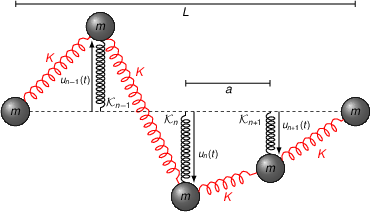
Figure 1: Pictorial representation of the Frenkel-Kontorova chain: un(t) is the transverse displacement variable, n0 is the on-site spring constant, and n1 is the inter-site coupling.
Observables are formulated as quadratic functionals of the field and its time derivative (velocity):
n2
The derivation of classical, continuous Poisson brackets between two such functionals is exact in the limit of the infinite phonon system. For functionals n3 and n4:
n5
This bracket preserves the antisymmetry and Jacobi properties. All time evolution and symmetry transformation laws for functionals are generated by these Poisson brackets, formally paralleling the Heisenberg picture.
Conserved Quantities: Hamiltonian, Inner Products, and Momentums
Functionals invariant under the Hamiltonian flow are explicitly classified:
- Diagonal constants of motion: functionals quadratic and homogeneous in n6 and n7, parameterized by a real n8, generating a continuous family of positive-definite, time-invariant inner products. For instance, Mostafazadeh's Lorentz-invariant inner product is recovered as a special case, serving as the quadratic Casimir of the Poincaré algebra.
- Off-diagonal constants of motion: functionals producing familiar physical momenta (linear, angular), associated with the symmetries of space and time translations and rotations. Their explicit algebraic form is derived as all anti-Hermitian differential operators commuting with the (possibly potential-modified) nonrelativistic Hamiltonian.
Ehrenfest Relations and Localization Functionals
Two families of localization functionals are introduced: (1) energy-density-weighted barycenter, and (2) measures constructed from the distinguished inner products. The Poisson-bracket formalism is used to derive Ehrenfest-type evolution equations, yielding explicit classical analogs of position, momentum, and external force expectation values, all within the real-valued field framework.
Nonlocal Complex Change of Variables and Emergence of Quantum Algebra
A pivotal construction is a parameterized, nonlocal complexification of the field (and its time derivative), generalizing the Foldy transformation:
n9
where N→∞0 and N→∞1 is the single-particle Hamiltonian.
- This transformation brings the second-order real Klein-Gordon equation to a first-order, Schrödinger-like form for N→∞2:
N→∞3
- In the non-relativistic limit, and with suitable fast-phase compensation, the conventional Schrödinger evolution is exactly recovered.
- The mapping to operator algebra becomes apparent in the specific case N→∞4 (Foldy representation), where functionals quadratic in N→∞5 and N→∞6 become Hermitian operator expectation values in the Hilbert space of N→∞7. All positivity and unitarity properties are preserved.
Commutators, Poisson Brackets, and the Dirac Canonical Rule
In the special (Foldy) representation, Poisson brackets between quadratic functionals are mapped directly (up to N→∞8) onto commutators of the corresponding Hermitian operators in the quantum representation. This realizes the Dirac canonical quantization prescription:
N→∞9
This mapping holds for general functionals (energy, momentum, position, etc.), establishing a complete algebraic equivalence between the classical field (phonon) dynamics and quantum operator algebra.
Recovery of the Full Poincaré Algebra
By constructing the classical analogs of translations, boosts, rotations, and verifying their Poisson bracket structure, the paper recovers the full Lie algebra of the Poincaré group of relativistic symmetries. The classical functionals generating these transformations (Hamiltonian, momentum, and center-of-mass type functionals) obey exactly the same algebraic relations as their quantum operator counterparts.
Further, the unique quadratic Casimir invariant of the algebra, corresponding to the mass-shell constraint, is identified with the positively defined inner product (Mostafazadeh, a→00). Upon quantization, this inner product is promoted to the number operator, connecting the particle count to mass.
Theoretical and Practical Implications
The principal implication is the explicit demonstration that the quantum mechanical algebra—including the cornerstone Heisenberg and Poincaré structures—can be formally derived from a classical field model under appropriate limiting procedures and variable transformations. Imaginary numbers and operator ordering, often considered intrinsic to quantum theory, are shown here to arise from a change of variables and operator mapping within a deterministic, Hamiltonian system.
This constructive approach opens several research avenues:
- Alternative quantizations: The results establish a platform for analyzing quantization as a transformation, not an axiom, potentially informing programmatic attempts at algebraic or geometric quantization.
- Relativistic localization: The dual role of various position functionals (depending on measure) connects to ongoing debates about localization, causality, and observer-dependent position in relativistic quantum theory.
- Generalizations: Extension to Dirac fields (spin-a→01), systems with interactions or constraints, and curved backgrounds is suggested, leveraging the flexibility of the classical-quantum mapping.
- Interpretational insights: The status of complex amplitudes, operator-valued dynamics, and probabilistic interpretation in quantum theory may be revisited with an improved understanding of their classical progenitors.
Conclusion
This work provides a comprehensive mathematical construction yielding (i) the Klein-Gordon field equation, (ii) a hierarchy of observable functionals, (iii) exact classical-quantum correspondence for operator algebra (including all commutation relations and Casimir invariants), and (iv) a classical underpinning for the algebraic structure of quantum mechanics in both relativistic and non-relativistic regimes. The detailed derivations, explicit change-of-variable constructions, and mapping of all primary quantum structures into a classical Hamiltonian framework constitute a compelling argument for the foundational sufficiency of classical systems in capturing the algebra of single-particle quantum mechanics.
Figure 1: Pictorial representation of the Frenkel-Kontorova model, which serves as the classical mechanical origin of the Klein-Gordon equation and its quantum algebraic structures in the continuous limit.