- The paper presents the iSTAR framework that freezes stabilized coordinates in simulated bifurcation to reduce the problem dimension in continuous Ising solvers.
- It details an algebraic mechanism that folds the couplings of frozen variables into an effective external field, ensuring optimality in the reduced subsystem.
- Empirical validations show compute savings up to 64% on benchmark problems while maintaining solution quality, highlighting its scalability and transferability.
iSTAR: An Algebraic-Collapse Framework for Variational Reduction in Quantum-Inspired Continuous Ising Solvers
Introduction and Motivation
Combinatorial optimization problems with binary variables, such as Max-Cut, community detection, and circuit layout, are commonly represented by the Ising model. The simulated bifurcation (SB) family of continuous-time solvers, inspired by quantum and classical physics, embed these discrete objectives into continuous dynamical systems, recovering spin configurations by sign readout. However, direct application of these methods incurs O(N2) per-step compute due to dense interaction evaluation.
The presented work introduces an algebraic mechanism—iSTAR (Ising Stable-set Tail-Aware Reduction)—for variational reduction in these quantum-inspired solvers. The core observation is that, at late stages of simulated bifurcation dynamics, many coordinates stabilize onto discrete sign branches, and these can be certified and eliminated from further iteration. Their couplings induce an effective external field on the remaining subsystem, reducing the problem dimension without loss of optimality. This approach bypasses the "brute-force" cost of updating all variables to convergence, yielding significant computational savings while preserving solution quality.
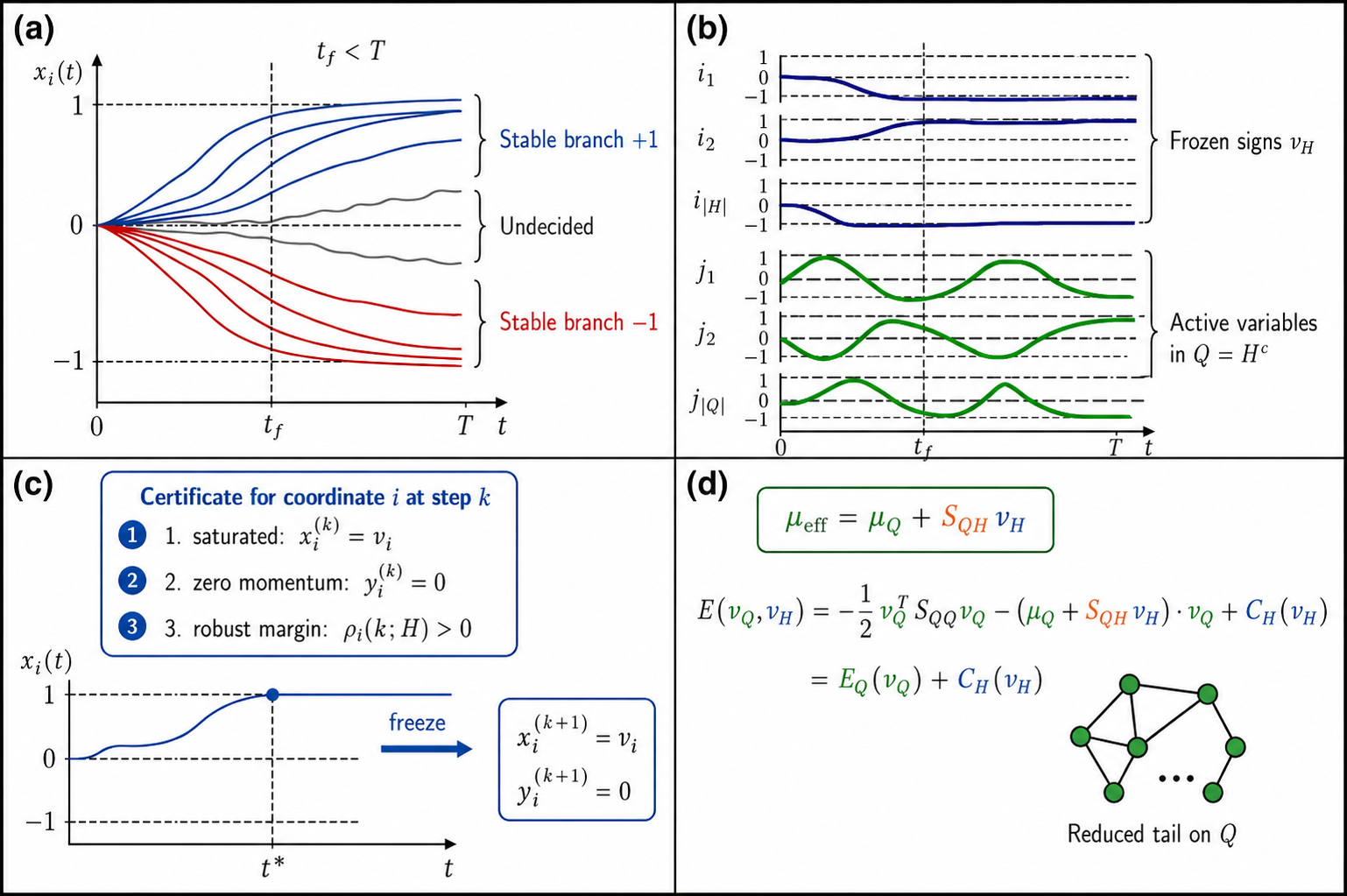
Figure 1: (a) Early bifurcation leads to stabilization of many coordinates. (b) The trajectory induces a split into frozen (H) and active (Q) coordinates. (c) Coordinates are frozen after robust certificate is met, using the compact margin ρi(k;H). (d) Algebraic elimination of frozen signs induces an effective field, and the tail computation continues only on the unresolved subsystem.
Theoretical Framework and Reduction Principle
The Ising optimization is expressed as E(v)=−21vTSv−μ⋅v for v∈{−1,1}n with symmetric S and external field μ. Simulated bifurcation is realized through two related Hamiltonian systems:
- aSB (adiabatic): Employs a quartic double-well potential in x, controlled by pumping parameter α, leading to smooth branch separation and late-stage concentration near lifted spin states H0.
- bSB (ballistic): Enforces strict H1 via direct saturation, removing unbounded amplitude dynamics.
The key insight is that, in both models, once a spin coordinate stabilizes, it can be frozen and eliminated. For a frozen set H2, couplings to active spins H3 induce an effective field H4; the energy minimization then reduces to the lower-dimensional subsystem on H5.
Theoretical contributions substantiate this approach:
- Quartic Model Consistency: A quantitative large-H6 theorem guarantees that, past a computable threshold, every global minimizer of the quartic relaxation matches an Ising minimizer by sign.
- Hard-Confinement bSB Model: The soft-confinement penalty epi-converges to a hard-box constraint, and minimizers under a PSD condition align with the Ising minimum on vertices.
- Frozen-Set Identity: The energy minimization decomposes exactly with fixed spins, providing an exact algebraic reduction.
- Robust Freezing Certificates: A verifiable margin, H7, combines drift, field, and couplings, certifying persistent freezing under monotonic schedules.
Algorithmic Implementation: iSTAR
The iSTAR algorithm embodies the frozen-set reduction via online certification. During simulated bifurcation, at scheduled intervals:
- Coordinates which are saturated in amplitude, have zero velocity, and satisfy the freezing margin are moved to the frozen set.
- Their couplings are folded into the induced field for unresolved coordinates, forming a reduced Ising subsystem.
- Dynamics proceeds only on the active subsystem, initialized from the current state.
- This is repeated until all coordinates are certified or the time horizon is reached; the final solution concatenates frozen and active signs.
This process is robust, local-in-time, and does not require knowledge of the global landscape. Certified freezing is mathematically guaranteed to persist once the margin conditions are met.
Numerical Results and Empirical Validation
The efficacy of iSTAR is validated on the G-set benchmark suite, both under the Goto et al. protocol and a comprehensive all-Gset evaluation. The numerical evidence demonstrates:
- High coverage: The online certified iSTAR activates on all runs with nonzero external field, freezing >99% of variables and matching the solution quality of the full baseline in all seeds.
- Dense Interaction Savings: Mean dense-work (matrix-vector FLOPs) reduction is approximately 56% (G1–G54) and 64% (all-Gset) in the nonzero-field regime.
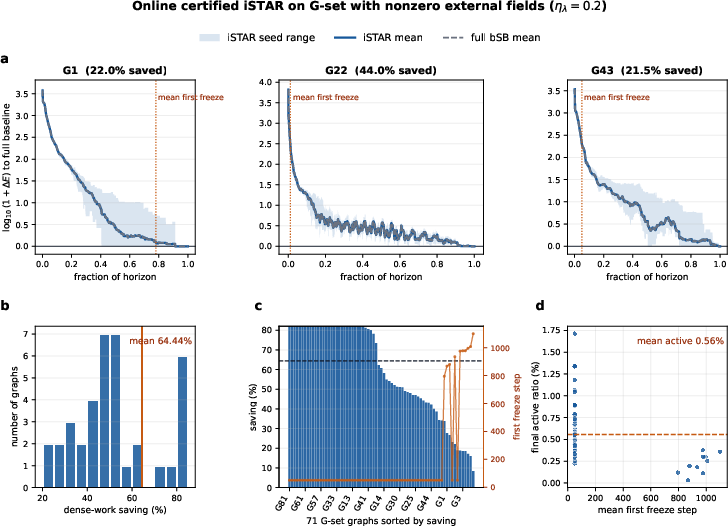
Figure 2: Online iSTAR with external field (H8): (a) Log energy gap vs. baseline. (b) Per-instance compute savings. (c) Sorted instance-wise savings by freeze step. (d) Freeze step vs. active ratio.
- Scalability Across Graph Size: The savings persist across varying graph scales, with compression particularly effective for larger sizes.
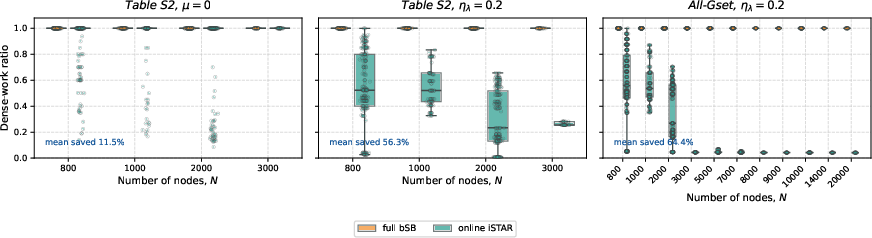
Figure 3: Compute reduction is grouped by graph size, contrasting full (orange) and iSTAR-reduced (teal) bSB FLOPs across several protocols.
- Probe-Sweep Reduction: Even with reduction times selected from a fixed grid post hoc, almost all covered instances admit operating points where over half the dense interaction work may be omitted with no solution degradation.
- Transfer to Alternative Solvers: The reduction principle applies not only to bSB but to aSB, dSB, and even continuous variants such as SimCIM, highlighting broad transferability.
Implications and Future Directions
iSTAR advances continuous Ising optimization by leveraging intrinsic late-stage stabilization for rigorous and efficient reduction. The implications are both theoretical and practical:
- Theoretical: The algebraic reduction exposes a near-terminal collapse to low-dimensional tails, suggesting an underlying backbone structure in continuous relaxations analogous to persistent variable/fixing ideas from classical combinatorial optimization.
- Practical: Substantial compute reduction can be harvested automatically by monitoring local freezing criteria, with immediate implications for large-scale deployments in combinatorial, constraint, and molecular-structure optimization, particularly where dense interactions are a bottleneck.
Notably, the reduction principle is agnostic to the underlying continuous dynamics, provided sign readout and an SB-type mechanism are present. This opens directions for integrating iSTAR-like techniques into other quantum-inspired and neural Ising solvers.
Unresolved Issues
- The theory does not yet provide a comprehensive finite-time guarantee for branch selection in projected Hamiltonian dynamics; the global variational proofs operate under parameter regimes sometimes mismatched with practical SB schedules. Hence, future research should target a dynamical theory of branch stabilization and a more precise ablation of surrogate freeze criteria.
- Realized wall-clock savings may vary based on solver implementation, instance sparsity, and architecture, calling for hardware-level experiments and optimization.
Conclusion
iSTAR presents a mathematically rigorous, algebraically exact reduction rule for continuous Ising solvers that leverages intrinsic late-stage stabilization to deliver substantial computational savings with certified preservation of solution quality. The framework bridges global variational theory and finite-time computational strategy, providing a scalable and solver-agnostic protocol for active-set reduction in continuous combinatorial optimization.