- The paper introduces an incremental, configuration-agnostic ARMS model that generates continuous, text-driven motion streams for both solo and social scenarios.
- It leverages a novel anchor-relational representation and a causal latent diffusion transformer to ensure smooth transitions and spatial stability.
- Quantitative results show ARMS outperforms baselines in metrics like R-Precision, FID, and long-horizon robustness in diverse motion settings.
ARMS: Anchor-Relational Motion Streaming for Seamless Solo-Social Motion Transitions
Introduction and Problem Motivation
Text-driven human motion generation has seen extensive development, but predominant methods are constrained to generating fixed-length clips for static agent configurations, lacking support for temporally continuous, socially coherent behaviors in evolving scenarios. In practical use cases, agents must transition fluidly between solo actions and multi-person interactions, continuously conditioned on dynamic text prompts. Existing paradigms, particularly interaction-centric diffusion models or AR transformer variants, cannot maintain temporal and relational coherence in this streaming, reconfigurable context.
ARMS addresses this core deficiency by formulating an incremental, configuration-agnostic generative model capable of dynamically synthesizing motion streams for one or two agents. Central to this is a novel asymmetric (anchor-relational) motion representation, a causal latent autoregressive framework, and a mode-aware diffusion transformer. This architectural design decouples per-agent dynamics from relational bindings, enabling seamless agent transitions and unbounded generation horizons without introducing spatial drift or discontinuity.
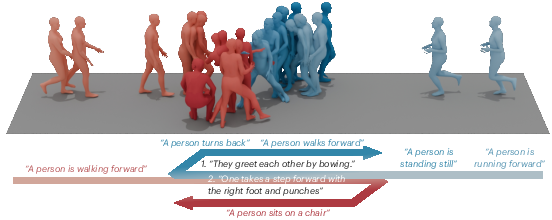
Figure 1: ARMS generates long-horizon motion streams from evolving textual instructions, enabling seamless transitions between solo behavior and human–human interaction within a single generative process.
Methodology
Anchor – Relational Motion Representation
The representation specifies two parallel per-agent state encodings: an Anchor stream with canonical incremental root-relative dynamics and a Relational stream encoding the displacement of the second agent with respect to the first. The partner-referenced relative-translation term is null during solo motion and assumes the aligned offset for interaction, ensuring unified encoding and decoding processes. This mitigates inter-agent drift and promotes stable spatial relationships, elegantly addressing the unnatural motion discontinuities present in prior approaches based either on global coordinates or static relational offsets.
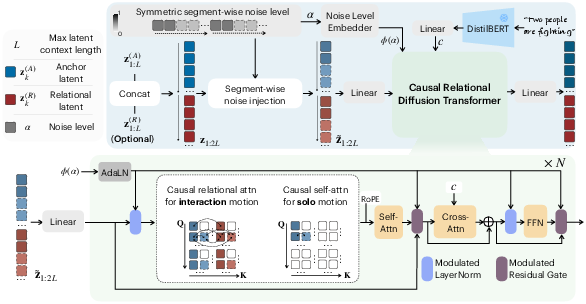
Figure 2: Motion is encoded as causal latent streams for both Anchor and Relational agents; symmetric segment-wise noising and a Causal Relational Diffusion Transformer enable mode-aware cross-agent attention for both solo and interactive phases.
Causal Temporal Autoencoder
To enable efficient long-horizon generation in high-dimensional motion space, ARMS utilizes a causal VAE, compressing observed sequences into temporally causal latents. Encoder and decoder modules are applied identically to each agent (with shared parameters), allowing any timeline to be represented with a consistent latent structure, regardless of social configuration.
Causal Relational Diffusion Model
A segment-wise diffusion process in the latent space is operated via a transformer with causal and cross-agent attention. A novel mode-aware relational gating mask controls the flow of relational information, activating cross-agent attention during interaction windows and reverting to strictly per-agent (solo) inference otherwise. The segment-wise noising schedule supports progressive denoising with temporal overlap, enforcing temporal smoothness and local consistency while allowing for incrementally generated streams.
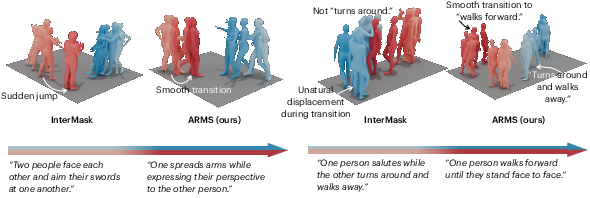
Figure 3: Qualitative comparison demonstrates ARMS’ superiority in transition smoothness and interaction coherence over InterMask in extended interaction scenarios.
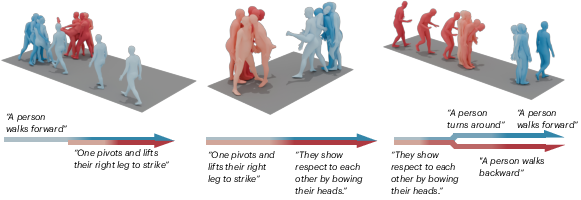
Figure 4: Streaming motion generation: (1) Solo-to-interaction, (2) interaction-to-interaction, (3) interaction-to-solo transitions—all executed continuously without latent state resets.
Experimental Evaluation
Quantitative Results
On InterHuman and InterX, ARMS achieves superior R-Precision, FID, MM Dist, and Diversity metrics compared to both prior clip-based and streaming models, including InterMask, TIMotion, InterGen, HINT, and Interact2Ar. Full-window generation achieves R-Precision (top-1) of 0.529 and FID of 4.436 on InterHuman, outperforming all baselines; streaming configuration maintains competitive scores (R-Precision 0.492, FID 4.444) despite the challenges of compounding temporal uncertainty across unbounded horizons.
On HumanML3D, ARMS yields R-Precision (top-1) of 0.769 and FID of 4.975, establishing a new performance state-of-the-art for single-agent streaming models.
Streaming ablation demonstrates that segment size, latent dimension, number of sampling steps, and inter-segment refinement offset are critical to balancing interaction fidelity and transition smoothness. Autoregressive streaming attenuates boundary discontinuities relative to inpainting-based or static approaches.
Smoothness and Relational Consistency
Jerk-based metrics (Peak Jerk, Area Under Jerk) and penetration analysis on close-contact interactions show that ARMS substantially reduces motion discontinuity at transition boundaries: e.g., solo–interaction transitions have PJ/AUJ of 0.077/1.07 (compared to InterMask >3.1/7.4). The method attains competitive penetration depth and frame-level collision rates despite not employing explicit physics-aware constraints.

Figure 5: Qualitative samples showcase dynamically varying agent configurations and social mode switches within a single generative stream.
Long-Horizon Robustness
A drift analysis on 5-minute walking sequences evidences dramatically improved Mean Lateral Deviation (3.35 m, vs. 22.39 m for MotionStreamer) and Forward Efficiency (0.985 vs. 0.363), illustrating that the proposed anchor-relational mechanism effectively eliminates cumulative global trajectory divergence—a major failure mode in autoregressive generation.
Inference Efficiency
Staggered denoising and segment-wise autoregression lead to competitive first-frame latency and reduced overall time-to-sequence compared to other streaming and interaction-centric models.
Implications and Future Directions
ARMS’ principal theoretical contribution is in demonstrating that asymmetric anchor-relational motion state design, in combination with unified causal latent modeling and mode-aware relational attention, overcomes the fundamental limitations of previous division between clip-based and autoregressive streaming frameworks for social motion generation. The approach admits configuration-agnostic training, seamless transitions among arbitrary sequences of solo/interaction modes, and supports strong zero-shot generalization across skeletons and interaction protocols.
In practice, this enables robust, flexible motion generation suitable for open-world agents, multi-modal avatars, continuous VR/AR characters, and physically embodied robots interacting in unconstrained, evolving environments.
Future extensions include: (i) incorporation of surrounding multi-agent, crowd, and environmental cues, (ii) generalization to arbitrary N-agent settings via hierarchical relational attention architectures, (iii) integrating continuous blending/gating of social attention to minimize abruptness, and (iv) augmenting with physics simulation or learned constraints for improved contact and collision realism. The anchor-relational paradigm remains compatible with all of these axes, and constitutes a generalized foundation for next-generation, text-driven social motion frameworks.
Conclusion
ARMS provides a technically rigorous, configuration-unified, and incrementally extensible solution for continuous, text-driven solo–social motion generation. By introducing asymmetric anchor-relational representation, causal latent diffusion, and mode-aware relational attention, ARMS demonstrates state-of-the-art performance across interaction realism, transition smoothness, and long-horizon stability, and establishes a scalable path for generalizable and controllable agent motion synthesis (2607.05733).