Vision as Unified Multimodal Generation
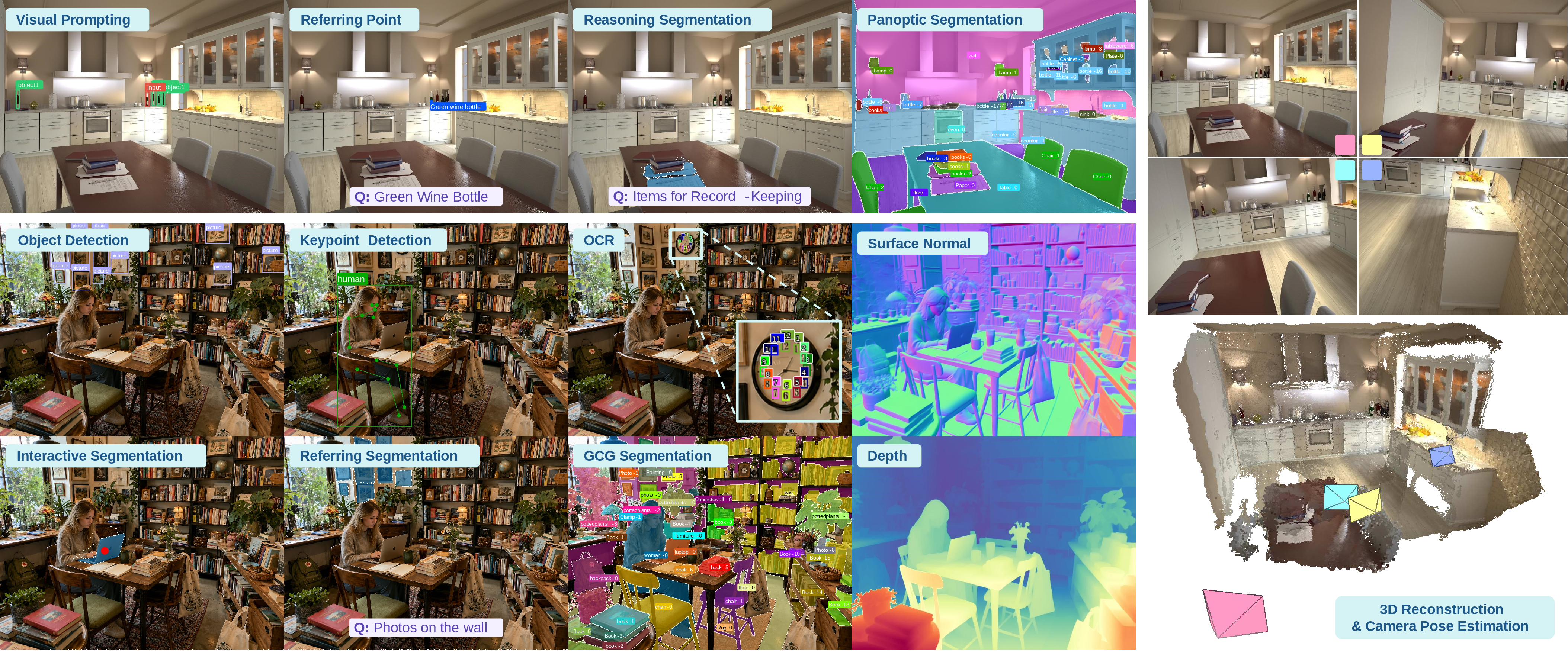
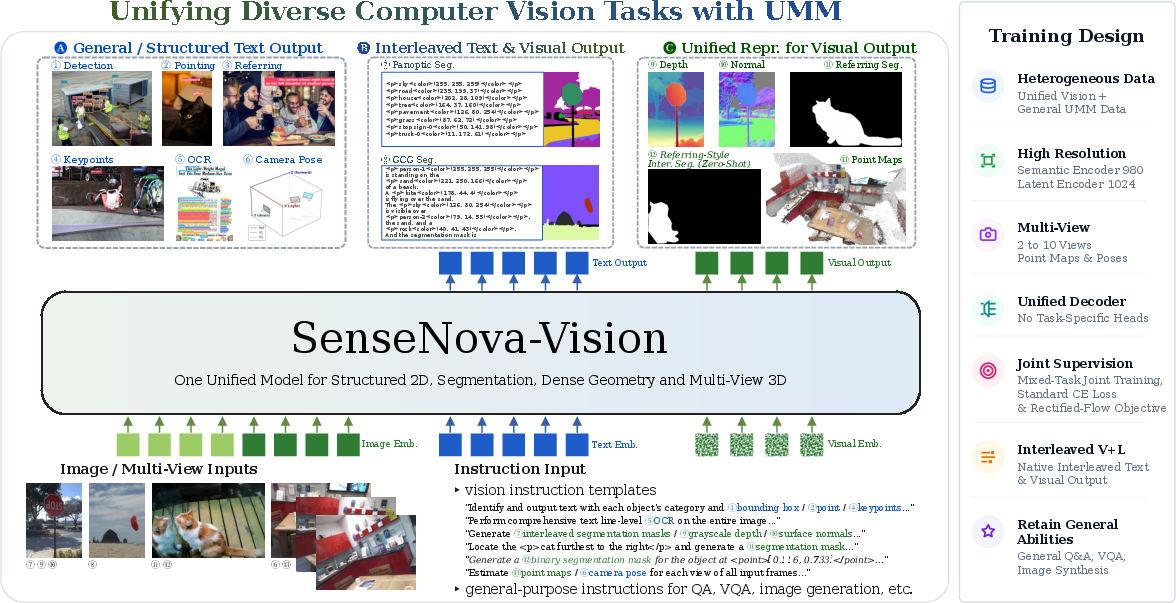
Abstract: We formulate computer vision as unified multimodal generation, where heterogeneous visual tasks are expressed in the native text and image generation spaces of a unified multimodal model, without task-specific architectures. Under this formulation, SenseNova-Vision uses natural-language instructions and optional visual prompts to specify tasks, target regions or views, and decoding conventions, and generates responses as text for symbolic outputs, images for dense spatial predictions, or mixed text-and-image outputs for compositional tasks. To support large-scale training, we convert diverse computer vision annotations into instruction-response examples compatible with these generation spaces, resulting in the SenseNova-Vision Corpus, a computer-vision instruction-response corpus spanning text, image, and mixed targets. Starting from an off-the-shelf pretrained unified multimodal model, SenseNova-Vision is trained primarily on this corpus, with auxiliary multimodal data used as a capability-preserving mixture, and requires no task-specific prediction heads or architectural modifications. The resulting model covers a broad range of vision tasks, including detection, OCR, keypoint estimation, segmentation, depth estimation, surface normal prediction, point maps, and camera pose estimation, while supporting language-defined variants that combine category, color, region, and other visual cues. Experiments show that a single unified model can match leading task-specialized systems across structured visual understanding, dense geometric prediction, segmentation, and multi-view visual geometry. These results suggest unified multimodal generation as a scalable route for integrating computer vision capabilities into general-purpose foundation models. The model and corpus are publicly available.
First 10 authors:
Paper Prompts
Sign up for free to create and run prompts on this paper using GPT-5.
Top Community Prompts
Explain it Like I'm 14
What is this paper about?
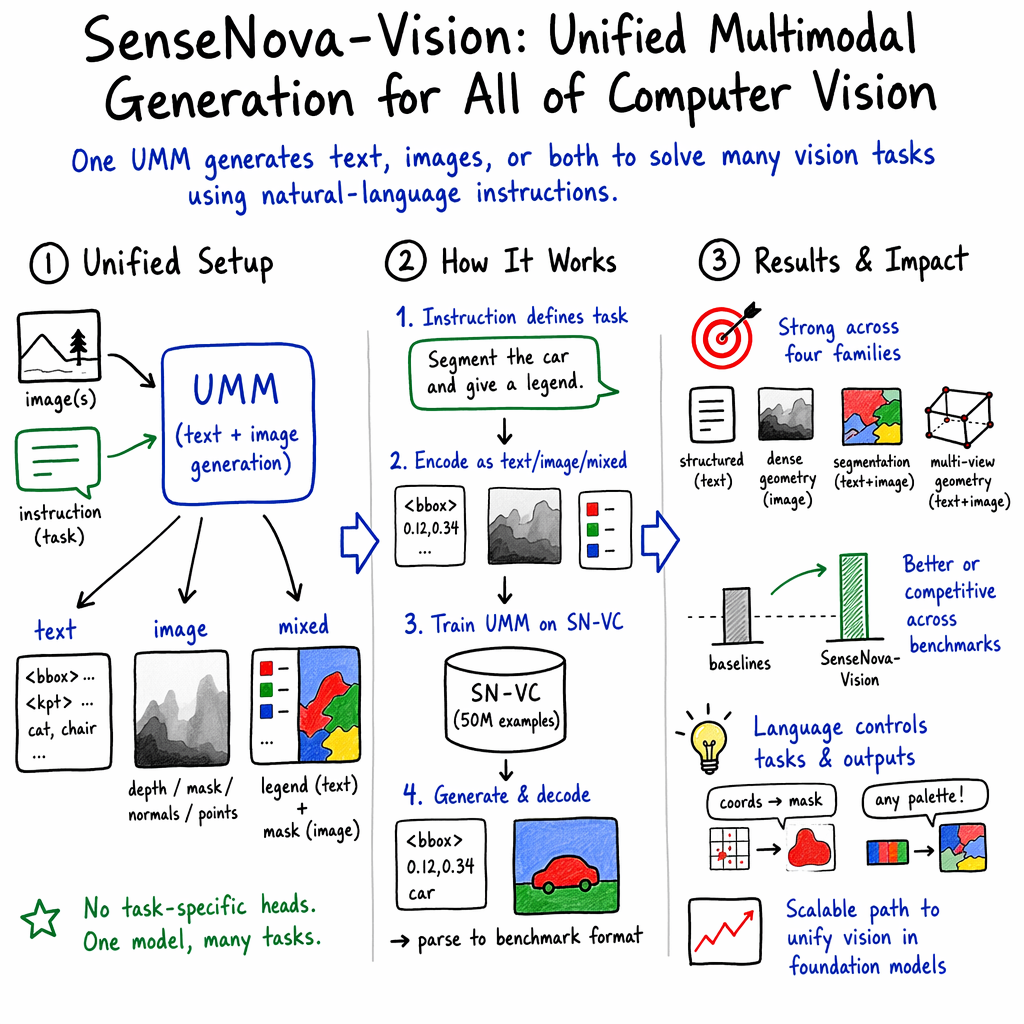
This paper shows how to teach a single AI model to do many different vision jobs—like finding objects, reading text in images, outlining objects, estimating depth, and even understanding 3D scenes—by treating everything as “generation.” In simple terms, the model can read an instruction in natural language and then “answer” by writing text, drawing an image, or doing both. The system is called SenseNova‑Vision.
What questions did the researchers ask?
The team focused on two big questions:
- Can one model handle many very different vision tasks if we let it answer in the way that feels most natural—text for facts and coordinates, images for pixel‑by‑pixel maps?
- If we turn lots of existing vision labels into “instruction → response” examples, can this one model learn to follow language instructions and produce good, benchmark‑quality results without building a different head or architecture for every task?
How did they do it?
One model that talks and draws
They start with a “unified multimodal model” (UMM). Think of it as one smart system that:
- Understands and writes text (like a chatbot)
- Generates images (like a drawing program)
Because it can do both, the model can:
- Output text for things like object names, coordinates, or camera settings
- Output images for things like masks, depth maps, or surface normals
- Mix both when needed (for example, write a legend in text and produce a color‑coded mask image)
Turning old datasets into instructions
Many vision datasets have labels like bounding boxes, masks, or 3D info. The researchers converted these labels into instruction‑response pairs that match the model’s “native” outputs:
- Text tasks: labels, coordinates, recognized words (OCR), and camera parameters become text responses
- Image tasks: dense maps like depth or surface normals become images the model draws
- Mixed tasks: for example, the model writes a region list and draws a corresponding mask colored exactly as described
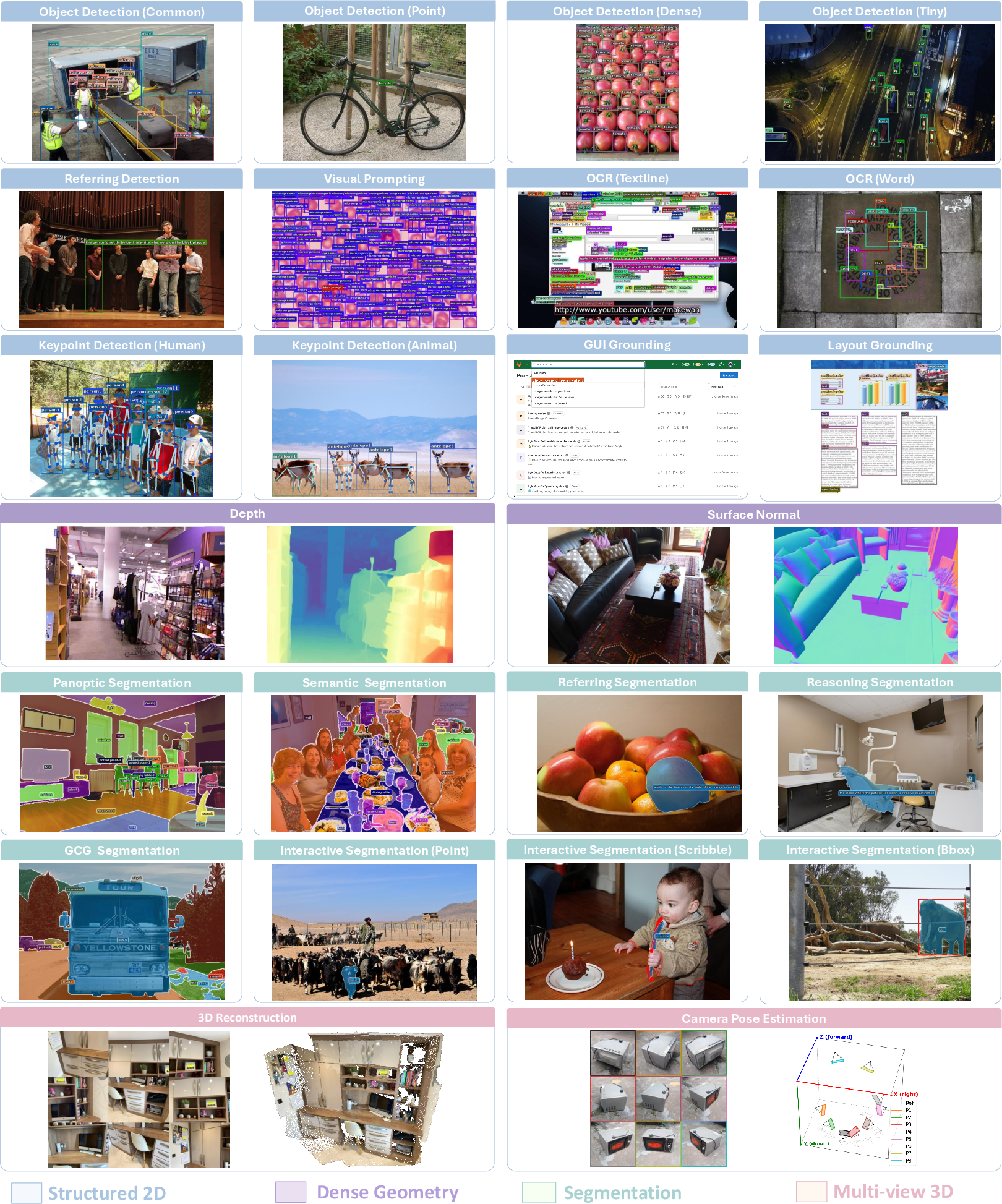
This huge converted collection is the SenseNova‑Vision Corpus (SN‑VC). It covers:
- Structured understanding (detection, OCR, keypoints, referring/pointing)
- Dense geometric prediction (depth and normals)
- Segmentation (single target, multi‑region, reasoning‑based)
- Multi‑view geometry (3D point maps and camera pose from multiple images)
Teaching the model
They fine‑tuned an existing UMM (called Bagel) mainly on this new corpus, plus some extra multimodal data to keep its general skills. Importantly:
- No task‑specific heads or special architectures were added
- The same text generator is used for structured outputs, and the same image generator is used for dense visual outputs
- Natural‑language instructions guide what to do and how to format the answer
What kinds of tasks can it handle?
With just language instructions (and optional visual prompts like points or boxes), the model can:
- Find objects, name them, and give their coordinates
- Read text in images
- Mark keypoints (like joints on a person)
- Segment objects (draw precise object masks)
- Predict depth and surface normals (how far things are and how they’re oriented)
- Reconstruct 3D point maps and estimate where the camera is pointing across multiple views
What did they find?
The researchers tested the model on many standard benchmarks and saw that:
- Structured visual understanding: It performs very strongly at tasks like detection, grounding, and OCR localization using only text outputs. This is impressive because scenes can be crowded and require long, precise lists of coordinates.
- Dense geometric prediction: It produces competitive depth and normal maps as images, often matching or beating other generation‑based methods and coming close to specialized geometry models.
- Segmentation: It’s competitive across different segmentation styles (referring, reasoning, grounded, interactive), especially strong on reasoning and grounded conversation segmentation. Specialized segmentation systems still lead on some generic and referring tasks, but the gap is small.
- Multi‑view geometry: It can reconstruct 3D point maps and estimate camera poses across multiple images. It’s close to strong specialist models on some metrics and ahead of other generalist approaches on several others.
Why this is important:
- All these results come from one model that uses one unified input‑output setup—no custom modules for each task. That means less engineering and easier scaling.
- The model can follow flexible, language‑defined variants like “segment the red car on the left” or “find small blue objects,” even if those exact requests weren’t listed during training.
What does this mean for the future?
This work suggests a practical path to making computer vision part of general‑purpose AI:
- Instead of building a different system for each vision task, we can teach one model to understand instructions and then “answer” as text, images, or both.
- This makes it easier to combine tasks (like “find all red cars and return their boxes and a mask”) and to control the output with plain language.
- It could speed up real‑world applications—like photo editing, robotics, AR/VR, or document analysis—because one adaptable model can be directed to many jobs with simple prompts.
The team has released both the SenseNova‑Vision model and the SenseNova‑Vision Corpus, which can help researchers and developers build on this unified approach and push toward AI systems that see, describe, and predict the world through a single, flexible interface.
Knowledge Gaps
Knowledge Gaps, Limitations, and Open Questions
Below is a single, concrete list of what remains missing, uncertain, or unexplored in the paper, crafted to guide actionable follow-up research.
- Lack of permutation-invariant decoding for structured outputs: serialized, ordered text lists for detection/grounding impose arbitrary ordering that can penalize scenes with many instances; investigate order-invariant set decoding, constrained grammars, or matching-based post-decoding to improve robustness and recall in dense scenes.
- No constrained decoding for structured schemas: free-form token generation can yield malformed or partially parseable outputs; explore grammar-constrained decoding, finite-state decoders, or structured tokenizers to boost validity and reduce parsing failures.
- Camera pose quantization via 2,001 special tokens may limit accuracy: the paper does not report bin sizes or quantization error; evaluate continuous/low-bit regression alternatives, mixed discrete–continuous decoding, or higher-resolution codebooks for rotations, translations, and scale.
- Single-shot mixed text–image responses lack consistency enforcement: the method assumes legends (text) and masks (image) match, but introduces no loss tying them together; add cross-modality consistency objectives or cycle checks (text→palette→mask→text) to reduce mismatches.
- Uncertainty and confidence calibration are absent: structured coordinates, masks, and geometric maps are produced without uncertainty estimates; integrate calibrated confidence/epistemic uncertainty to support downstream selection, thresholding, and active learning.
- Limited view count in multi-view training (≤10 views): scaling behavior with larger view sets, long-baseline setups, and variable intrinsics/extrinsics remains unexplored; assess memory-efficient architectural or curriculum strategies for 20–100+ view scenes.
- Absolute metric depth remains underexplored: evaluations emphasize affine-invariant metrics; test absolute-scale accuracy and camera-intrinsic-aware decoding to understand metric fidelity and cross-camera generalization.
- Depth/normal encodings may induce quantization/clipping artifacts: grayscale inverse-depth and RGB normals rely on deterministic visual encodings; benchmark precision losses vs. native continuous regressors and explore higher-fidelity latent decoders or learned codecs.
- Segmentation spatial fidelity likely bottlenecked by the VAE/generative path: the VAE is frozen and output resolution constraints are not detailed; quantify boundary quality and explore high-resolution latent grids, super-resolution heads, or diffusion backbones to close the gap with SAM/Mask2Former.
- Prompt robustness is not systematically quantified: multiple instruction variants are used in training, but sensitivity to prompt phrasing, verbosity, and adversarial wording remains unknown; design robustness benchmarks and training augmentations.
- Multilingual generalization is untested: instructions and datasets appear predominantly English; assess cross-lingual performance and extend corpus construction to multilingual instructions and labels.
- Compositional task generalization is only qualitatively demonstrated: no standardized evaluation for novel, language-defined compositions (e.g., “all red vehicles except buses, left of the crosswalk”); introduce compositional benchmarks and scoring protocols.
- Limited coverage of temporal tasks: optical flow, multi-object tracking, video segmentation, and video-depth/geometry are not included; extend unified generation to temporal inputs and investigate sequence consistency losses.
- Geometry beyond point maps is not studied: no mesh, TSDF, or neural field outputs, nor differentiable rendering consistency; explore richer 3D representations and cross-view consistency constraints.
- No analysis of camera intrinsics and lens models: handling of varying intrinsics, distortion, and fisheye cameras is unspecified; study intrinsics-aware conditioning and normalization in both single- and multi-view settings.
- Interactive segmentation limited to single-turn inference: multi-turn interaction, error recovery, and human-in-the-loop workflows are not evaluated; benchmark iterative refinement performance and memory of prior prompts.
- Inference efficiency and latency are unreported: joint text-and-image generation may be costly; profile runtime across tasks, evaluate decoding strategies (e.g., early-exit, partial decoding), and optimize for real-time or edge deployment.
- Scaling laws and mixture design are not ablated: the effects of corpus size/composition, auxiliary multimodal data ratios, and instruction diversity on each task family are not studied; perform controlled scaling experiments.
- Catastrophic forgetting prevention is not quantified: auxiliary data is included to “mitigate degradation,” but no before/after benchmarking on general multimodal tasks, captioning, or open-ended generation is shown; run standardized general capability suites pre-/post-training.
- Data quality and bias in SN-VC-50M curated/generative targets are not analyzed: densification (MoGe-2), depth completion (LingBot-Depth), and mask legend generation may inject systematic biases; perform error/bias audits and correlate target noise with downstream performance.
- Robustness to distribution shift and rare categories is only partially explored: while some long-tailed and small-object benchmarks are included, per-class/attribute breakdowns and domain shifts (e.g., medical, aerial, underwater, industrial) are missing; curate and test on diverse domains.
- Failure mode characterization is limited: no detailed analysis of typical structured (mislocalization, schema errors), dense (texture-copying, oversmoothing), segmentation (leakage, holes), or geometry (scale drift, pose flip) errors; build taxonomies and targeted mitigations.
- Parsing and recovery under generation errors are unspecified: how unparseable outputs or partially correct lists are handled (e.g., partial credit, lenient recovery) is unclear; define robust, consistent parsing rules and error-tolerant scoring.
- Lack of explicit set reasoning for variable cardinality outputs: counting and list-length inference for detection/segmentation is implicit; investigate auxiliary counting heads or consistency checks between counts and lists.
- Safety and privacy considerations for OCR/GUI tasks are not discussed: handling PII, sensitive screens, or content moderation in language-guided outputs is absent; define redaction policies and safe decoding protocols.
- Ablations on architectural choices are missing: impacts of freezing the VAE, SigLIP2 resolution (980 px cap), pose tokenization, and image/text loss balancing are not quantified; run systematic ablations.
- Cross-decoder interference is unexamined: how text and image generative heads interact (positive transfer vs. negative interference) is unclear; test decoupled vs. joint training, loss weighting, and adapter-based isolation.
- Post-processing-free pipeline lacks learned NMS or deduplication: deduplication/order invariance for detection is not addressed; explore learned non-maximum suppression or set matching within generation.
- Generalization to unseen output conventions is uncertain: the approach relies on fixed schemas, palettes, and token markers; assess the model’s ability to adapt to new schemas/palettes at inference via few-shot prompts or self-generated legends with verification.
- Evaluation alignment with standard metrics varies: use of F1@mIoU for boxes and other nonstandard metrics may complicate comparability to mAP/mAR; provide cross-metric evaluations and calibration to canonical benchmarks.
- Memory constraints limit very high-resolution inputs and outputs: only SigLIP2 input up to 980 px is noted; explore tiling, sliding-window conditioning, and memory-aware decoding for ultra-high-resolution imagery.
- Limited treatment of cross-view/global consistency: beyond center-normalization and sky-box handling, there is no explicit multi-view consistency constraint; incorporate view-consistency losses or 3D-aware priors.
- Limited exploration of training curricula: no staged curricula for moving from simple to complex tasks/schemas are reported; evaluate curriculum strategies for stability and convergence speed.
Practical Applications
Below is a concise analysis of real-world applications enabled by the paper’s unified multimodal generation approach (SenseNova-Vision), organized by deployment horizon. Each item notes likely sectors, possible tools/products/workflows, and key assumptions or dependencies that influence feasibility.
Immediate Applications
- Bold title — short description.
- Sectors: …
- Potential tools/products/workflows: …
- Assumptions/dependencies: …
- Unified multi-task vision API — A single service that performs detection, OCR, keypoints, segmentation, monocular depth/normals, and basic multi-view geometry from natural-language instructions and optional visual prompts.
- Sectors: Software, robotics (R&D), media, retail, logistics, geospatial.
- Potential tools/products/workflows: “Unified Vision Agent SDK” exposing promptable endpoints (text-only, image-only, mixed responses); one API replaces multiple task-specific models; easy A/B of decoding conventions via prompt.
- Assumptions/dependencies: Requires GPU inference and VAE decoding; some tasks may underperform state-of-the-art specialists (fallback or QA loops recommended); prompt templates and decoding rules must be standardized; latency not tuned for real-time.
- Document intelligence and OCR+layout parsing — End-to-end extraction of text and structure (forms, tables, layout zones) with spatial grounding and boxes/points serialized in text.
- Sectors: Finance, government, legal, enterprise back-office.
- Potential tools/products/workflows: “Docs2Data” pipeline that returns structured JSON from scans with OCR text, boxes, reading order; automatic redaction via segmentation masks.
- Assumptions/dependencies: Multilingual OCR quality may vary; complex layouts may require prompt specialization; human-in-the-loop validation advised for compliance-critical workflows.
- GUI grounding and screen automation — Locate buttons/fields by natural language on screenshots and return precise click points or boxes.
- Sectors: QA/testing, RPA, customer support tooling, accessibility.
- Potential tools/products/workflows: “Screen Agent” that identifies elements for automated UI tests or RPA; accessibility overlays that highlight targets by instruction.
- Assumptions/dependencies: Sensitive to UI theme/resolution variations; requires consistent screenshot capture; not yet guaranteed robust to dynamic/animated content.
- Interactive and referring segmentation for creative tools — Text- or prompt-guided masks for editing, object removal/recoloring, or compositing.
- Sectors: Creative software, advertising, e-commerce content ops.
- Potential tools/products/workflows: Photoshop/GIMP/Figma plug-ins for “segment by instruction” or “click+text to mask”; batch asset background removal.
- Assumptions/dependencies: Fine edge fidelity may trail specialist mask decoders; high-res conditioning supported up to ~980 px (tiling or upscaling may be needed for large assets).
- Retail shelf and catalog operations — Detect, localize, and segment products; read price tags/labels; combine color/category cues via language prompts.
- Sectors: Retail, CPG, e-commerce.
- Potential tools/products/workflows: “Shelf Auditor” mobile/backend service; rapid SKU onboarding with detection+OCR; automated planogram compliance checks.
- Assumptions/dependencies: Domain shift requires fine-tuning for store lighting/occlusions; OCR quality depends on font/print quality; periodic human spot checks recommended.
- Warehouse and inventory photo audits — Rapid identification and counting of boxes/items; location marking via points or boxes; simple depth cues for volume estimation.
- Sectors: Logistics, manufacturing.
- Potential tools/products/workflows: Photo-based cycle counts; exception reports with grounded evidence; rule-based workflows triggered by textual inventory policies.
- Assumptions/dependencies: Camera placement and image quality matter; dense geometry is monocular and affine-invariant—metric estimates need calibration or scale priors.
- Labeling acceleration and quality control — Bootstrapping annotations (boxes, masks, points, keypoints) as machine suggestions with unified schema; mask legend generation for multi-class tasks.
- Sectors: Data providers, ML teams (industry/academia).
- Potential tools/products/workflows: “Spec-to-Label” tool: define schema in text, auto-generate provisional labels, flag low-confidence items for review.
- Assumptions/dependencies: Output parsing must be robust to ordering and formatting; measure quality with task metrics and sampling; domain-specific fine-tuning boosts yield.
- Safety and compliance triage — Detect/locate sensitive text (PII), logos, prohibited items; mask at pixel level; log structured findings for audits.
- Sectors: Online platforms, ad tech, enterprise governance.
- Potential tools/products/workflows: Pre-publish image checks; PII redaction masks; brand usage verification using grounded detection+OCR.
- Assumptions/dependencies: Policy definitions must be encoded in prompts; false positives/negatives require human review thresholds; maintain updated sensitive-term lists.
- Photogrammetry bootstrap — Use multi-view point maps and camera pose estimates as a front-end to conventional SfM/MVS, improving initialization or recovering partial geometry rapidly.
- Sectors: Geospatial, VFX, construction.
- Potential tools/products/workflows: “3D-from-Photos (Lite)” microservice for quick previews; hybrid pipelines where SenseNova-Vision seeds or diagnoses classical reconstructions.
- Assumptions/dependencies: Current training samples restrict to ~≤10 views per scene due to memory; pose tokens are quantized; downstream refinement (Bundler/Colmap-like) recommended for metric accuracy.
- Education and research prototyping — One model to teach detection/segmentation/geometry; reproducible corpus (SN-VC) for instruction design and ablation studies.
- Sectors: Academia, EdTech.
- Potential tools/products/workflows: Coursework on instruction-to-label conversion; research on prompt robustness and schema design; comparison with specialist systems using unified metrics.
- Assumptions/dependencies: Compute for fine-tuning/evaluation; alignment with institutional dataset licenses and splits.
- Accessible computing and assistive tech — Describe and locate on-screen elements and regions in images; read signs/labels with OCR; provide grounded answers.
- Sectors: Accessibility, consumer apps.
- Potential tools/products/workflows: Mobile assistants that return “where” and “what” with visual pointers and masks; spoken instructions for target selection.
- Assumptions/dependencies: Must manage privacy and on-device/off-prem decisions; latency considerations for user experience.
- Field inspection triage (pilot) — Depth/normal cues to highlight surface anomalies; segmentation for corrosion/cracks/paint regions; localized reports.
- Sectors: Energy, utilities, infrastructure.
- Potential tools/products/workflows: Photo-based pre-inspections; visual overlays; structured findings exported to CMMS.
- Assumptions/dependencies: Not a substitute for calibrated metrology; requires domain fine-tuning and validation; environmental conditions impact performance.
- Smart home and personal photo organization — Locate and segment objects by instruction; tag and group photos using grounding, OCR, and color/attribute cues.
- Sectors: Consumer software, cloud photo services.
- Potential tools/products/workflows: “Find-and-mask” workflows; automatic album creation for receipts, documents, or items.
- Assumptions/dependencies: Privacy preferences and data processing constraints; variability across personal capture conditions.
Long-Term Applications
- Real-time unified perception for robots and AR — One instruction-driven model powering detection, segmentation, depth, and normals at interactive frame rates on-device.
- Sectors: Robotics, AR/VR, autonomous systems.
- Potential tools/products/workflows: Edge-optimized variants via distillation/quantization; unified memory-efficient decoding for masks and geometry.
- Assumptions/dependencies: Significant latency and memory optimization; hardware accelerators; robust prompt handling without cloud.
- Foundation-model 3D reconstruction at scale — Replace much of traditional SfM/MVS with instruction-driven multi-view geometry that scales to dozens/hundreds of views.
- Sectors: Geospatial, digital twins, construction, VFX.
- Potential tools/products/workflows: “UMM-Reconstruct” that outputs dense point maps and camera poses with uncertainty; integrates with mesh/texturing tools.
- Assumptions/dependencies: Extend training to long sequences and higher resolutions; improve pose precision beyond current quantization; incorporate metric scale.
- Universal UI agent for software control — Screen-grounded, language-driven agent that understands and manipulates arbitrary GUIs robustly across apps and platforms.
- Sectors: RPA, productivity suites, enterprise IT.
- Potential tools/products/workflows: Agent chains combining grounding, OCR, and action planning; self-healing locators defined in natural language.
- Assumptions/dependencies: Generalization across UI frameworks; temporal reasoning; handling dynamic DOM changes and security constraints.
- Domain-specialized medical imaging assistant — Unified segmentation, detection, geometry cues for non-invasive modalities (e.g., instrument tracking, organ/tumor masks).
- Sectors: Healthcare.
- Potential tools/products/workflows: Promptable mask generation for planning and training; structured outputs for PACS integration.
- Assumptions/dependencies: Requires extensive domain data and regulatory approvals; retraining for modality-specific signals; clinical validation.
- City-scale mapping and digital twins from drones — Instruction-driven pipelines that produce camera poses and dense maps for entire neighborhoods.
- Sectors: Urban planning, insurance, disaster response.
- Potential tools/products/workflows: “Drone-to-Twin” with automatic scene partitioning and merging; semantic overlays guided by prompts.
- Assumptions/dependencies: Scalability beyond current ~10-view training; rigorous geo-referencing and error bounds; robust to lighting/occlusions.
- Policy and compliance automation with multimodal rules — Declarative policies (in text) validated against images: signage requirements, warning labels, prohibited content.
- Sectors: Government, manufacturing, social platforms.
- Potential tools/products/workflows: “Policy-as-Prompt” that generates grounded evidence (boxes/masks) and structured audit trails.
- Assumptions/dependencies: High-precision OCR and detection; versioned policy libraries; human adjudication for edge cases.
- Video-centric unified perception — Temporal extension for tracking, motion, and instance persistence with language-defined targets across frames.
- Sectors: Surveillance, sports analytics, media.
- Potential tools/products/workflows: Instruction-driven trackers; “describe and follow” entities over time with mask propagation.
- Assumptions/dependencies: Temporal modeling and memory; efficient batching; stable identity assignment.
- Privacy-preserving on-device assistants — Local inference for OCR/segmentation on sensitive content (IDs, checks, forms), with no cloud upload.
- Sectors: Finance, government, consumer mobile.
- Potential tools/products/workflows: Compressed UMM variants; secure enclaves; ephemeral caches and on-device parsers.
- Assumptions/dependencies: Aggressive model compression; hardware NPUs; acceptable quality post-quantization.
- Automated schema induction for new labeling tasks — Define new annotation schemas in natural language and immediately generate/validate labels without writing parsers.
- Sectors: ML Ops, data-centric AI platforms.
- Potential tools/products/workflows: “Schema-from-Prompt” that yields both labels and decoding conventions; continuous feedback/retraining loops.
- Assumptions/dependencies: Robust instruction parsing and output serialization; governance for label taxonomies; monitoring drift.
- Multimodal scientific imaging assistants — Apply unified outputs (masks, keypoints, geometry surrogates) to microscopy, materials, and remote sensing with promptable tasks.
- Sectors: Academia, biotech, materials science.
- Potential tools/products/workflows: Rapid prototyping for novel tasks (e.g., “segment mitochondria with elongated morphology”); mixed text+mask outputs for lab notebooks.
- Assumptions/dependencies: Domain adaptation with curated datasets; validation against ground-truth; handling non-natural image statistics.
- Disaster assessment at scale — From aerial/street imagery, detect and segment damage types and estimate 3D context to prioritize response.
- Sectors: Public safety, insurance, NGOs.
- Potential tools/products/workflows: Rapid triage dashboards combining grounded detections with depth cues; policy-prioritized prompts.
- Assumptions/dependencies: Domain robustness under extreme conditions; calibration for metric measurements; operational oversight.
- Continual learning and evaluation frameworks — Use the SN-VC protocol to standardize instruction-response conversion across new tasks and track capability drift.
- Sectors: ML research, standards bodies.
- Potential tools/products/workflows: Benchmarks that accept mixed text-image outputs and enforce deterministic decoders; model cards emphasizing task coverage.
- Assumptions/dependencies: Community adoption of schemas; tooling for validator consistency; dataset governance.
Notes on cross-cutting dependencies and risks:
- Compute and latency: Current 7B-scale UMM with VAE decoding suits server-side or batch workflows; edge deployments require distillation and optimization.
- Output determinism and parsing: Production deployments should version prompt templates and decoding scripts; add consistency checks and fallback strategies.
- Domain shift: Many applications will benefit from task- or domain-specific fine-tuning using the released corpus protocol.
- Safety and privacy: OCR and screen-grounding can expose sensitive information; incorporate redaction, data minimization, and access controls.
- Multi-view limits: Present training covers up to ≈10 views per sample and uses quantized pose tokens; larger-scale, metric-accurate geometry requires additional development.
Glossary
- AdamW optimizer: An adaptive gradient-based optimizer with decoupled weight decay commonly used to train deep networks. "We use the AdamW optimizer with a learning rate of "
- affine-invariant depth metrics: Evaluation measures for depth that are insensitive to affine transformations (scale and shift). "Depth maps are decoded from generated depth images and evaluated using affine-invariant depth metrics"
- AUC (Area Under the Curve): A scalar summary of performance across thresholds; here computed under a 30-degree pose-error threshold. "and AUC under the 30-degree threshold."
- camera pose estimation: Predicting a camera’s orientation and position relative to a reference frame. "The resulting model covers detection, OCR, keypoints, segmentation, depth, surface normals, point maps, and camera pose estimation,"
- center-normalized: A normalization scheme that shifts and scales coordinates to be centered for numerical stability. "center-normalized, and invalid pixels are mapped to a distant sky box."
- cross-entropy (CE) loss: A standard loss for probabilistic classification and next-token prediction in LLMs. "optimized with the standard cross-entropy (CE) loss under the next-token-prediction paradigm."
- decodable targets: Training outputs encoded (as text and/or images) so they can be deterministically converted back to benchmark labels. "decodable text, image, and mixed targets that can be recovered as boxes, masks, depth maps, surface normals, point maps, or camera poses."
- dense geometric prediction: Estimating per-pixel geometric quantities like depth and surface normals. "SenseNova-Vision integrates diverse computer vision tasks into a single UMM, producing outputs for structured visual understanding, dense geometric prediction, segmentation, and multi-view visual geometry"
- diffusion: A class of generative models that learn to synthesize images by reversing a noise diffusion process. "diffusion and image-generation models provide visual generative priors for spatially aligned outputs,"
- EMA (Exponential Moving Average): Averaging model parameters over training steps to stabilize evaluation/performance. "an EMA ratio of 0.995; the EMA checkpoint is used for evaluation."
- F1@mIoU: F1-score computed using matches defined by a minimum Intersection-over-Union threshold. "Performance is assessed using F1@mIoU for box-based detection, referring, and OCR localization tasks"
- F1@mOKS: F1-score computed using matches defined by a minimum Object Keypoint Similarity threshold. "and F1@mOKS for keypoint localization."
- feed-forward visual geometry: A setup where geometric outputs (e.g., poses, point maps) are predicted in a single forward pass without iterative optimization. "This family follows feed-forward visual geometry settings such as VGGT"
- Grounded Conversation Generation (GCG): A segmentation setting where the model generates region descriptions and a legend and then renders masks accordingly. "Grounded conversation generation (GCG) segmentation further exercises this format:"
- inductive biases: Architectural or algorithmic assumptions that guide learning toward solutions consistent with domain structure. "This preserves useful inductive biases but keeps output spaces fragmented across task-specific components."
- instruction-response examples: Training samples consisting of inputs, a natural-language instruction, and a decodable target output. "converting heterogeneous computer vision annotations into instruction-response examples."
- inverse depth: Representing depth as its reciprocal to normalize dynamic range and stabilize learning. "For depth, valid metric values are converted to inverse depth and rendered as normalized grayscale images;"
- mIoU (mean Intersection over Union): The average overlap metric across classes or instances in segmentation. "we report PQ for panoptic segmentation (Pan.) and mIoU for semantic segmentation (Sem.)."
- multimodal LLMs (MLLMs): Foundation models that process and generate across text and vision modalities. "multimodal LLMs (MLLMs) bring language instructions and reasoning into visual perception."
- multi-view visual geometry: Estimating 3D structure and camera parameters from multiple images of a scene. "segmentation, and multi-view visual geometry."
- next-token-prediction paradigm: Autoregressive generation where the model predicts the next token given the previous context. "under the next-token-prediction paradigm."
- normalized image coordinates: Coordinates scaled to a consistent range (e.g., [0,1]) relative to image dimensions. "while spatial fields are written as normalized image coordinates."
- panoptic segmentation: A unified segmentation task that combines instance and semantic segmentation into a single labeling. "such as generic segmentation (semantic and panoptic segmentation), we use a mixed text-image response:"
- point map: An image-aligned 3D representation where each pixel stores an XYZ coordinate of the visible surface point. "per-view dense XYZ point maps; each point map stores aligned and normalized 3D coordinates in its RGB channels."
- PQ (Panoptic Quality): A metric for panoptic segmentation combining segmentation quality and recognition quality. "we report PQ for panoptic segmentation (Pan.) and mIoU for semantic segmentation (Sem.)."
- quaternion rotation: A 4D unit-vector representation of 3D rotation that avoids gimbal lock and enables smooth interpolation. "encoded relative to the reference frame as a quaternion rotation, a translation direction, and a scale,"
- rectified-flow training objective: A training objective for image generation that learns a transport map between data and noise distributions. "and optimized with the rectified-flow training objective inherited from Bagel."
- relative rotation accuracy (RRA): The fraction of camera-pair rotations estimated within a specified angular error. "we report relative rotation accuracy (RRA), relative translation accuracy (RTA), and AUC under the 30-degree threshold."
- relative translation accuracy (RTA): The fraction of camera-pair translations estimated within a specified angular error. "we report relative rotation accuracy (RRA), relative translation accuracy (RTA), and AUC under the 30-degree threshold."
- RGB palette: A color legend mapping labels or regions to specific RGB values for mask rendering. "uses the <color> marker to specify RGB palette values in prompts or generated legends,"
- semantic segmentation: Assigning a semantic class label to every pixel in an image. "we report PQ for panoptic segmentation (Pan.) and mIoU for semantic segmentation (Sem.)."
- SigLIP2: A vision-text encoder providing strong semantic conditioning for image inputs. "Compared with the VAE pathway, SigLIP2 provides stronger semantic conditioning over input images,"
- sky box: A distant background container used to handle invalid or out-of-range pixels in 3D mappings. "invalid pixels are mapped to a distant sky box."
- special tokens: Reserved symbols in the vocabulary used to structure or encode nonstandard information (e.g., pose fields). "we reserve the final 2,009 vocabulary entries of the base model and repurpose them as a dedicated set of special tokens."
- supervised fine-tuning (SFT): Further training a pretrained model on labeled data for target tasks. "We perform SFT with the VAE visual encoder frozen,"
- unified multimodal generation: Casting tasks so outputs are generated directly in a model’s native text and image spaces. "We formulate computer vision as unified multimodal generation,"
- unified multimodal model (UMM): A single model that natively supports both text and image understanding and generation. "a unified multimodal model (UMM), without task-specific architectures."
- variational autoencoder (VAE): A generative model that encodes inputs into a latent distribution and decodes back to the data space. "Visual outputs, including masks, depth maps, normal maps, and point maps, are encoded into a VAE latent space"
- ViT (Vision Transformer): A transformer-based architecture that processes images as sequences of patches. "The dropout rates for text, ViT and VAE input tokens are set to 0.05, 0.1 and 0.1, respectively."
- visual question answering (VQA): A multimodal task where a model answers textual questions about images. "spanning visual question answering (VQA), text-to-image, and image-to-image tasks."
- zero-shot: Generalizing to task variants or prompts not seen during training. "potentially improving its generalization to zero-shot task variants."
Collections
Sign up for free to add this paper to one or more collections.