- The paper demonstrates that selectively training super weights, despite their critical role, leads to a complete collapse in accuracy across various model scales.
- It reveals through extensive pruning and neighborhood experiments that individual weight importance does not translate to effective trainability due to high local curvature and optimizer dynamics.
- The study shows that coordinated full-layer updates, particularly via low-rank methods like LoRA, enable efficient adaptation, proving superior to sparse, isolated parameter updates.
Super Weights in LLMs and the Failure of Selective Training: An Expert Analysis
Overview and Motivation
This paper investigates the relationship between "Super Weights"—individual neural parameters in LLMs whose ablation results in catastrophic performance degradation—and the prospects for parameter-efficient fine-tuning via selective or sparse updates. The central thesis is that, despite the apparent functional criticality of Super Weights, training these parameters (and their local neighborhoods) in isolation fails entirely: accuracy drops to chance across a range of model scales and selection strategies. In stark contrast, low-rank, full-layer updating methods such as LoRA achieve effective adaptation using a comparably small parameter budget, strongly suggesting that structural coordination at the layer level—not the targeting of individual important weights—is the key to efficient LLM adaptation.
Super Weight Identification and Pruning Effects
The study begins by validating the existence and structural consistency of Super Weights in transformer-based LLMs. Extending the single-forward-pass analysis of prior works, the authors demonstrate via 1,000 diverse input samples that the set of coordinates producing activation outliers is highly stable, with a core of nine positions consistently manifesting across all runs. This confirms that Super Weights are not input-specific artifacts but encode global properties of the pretrained model.
A battery of pruning experiments follows, replicating and extending prior findings: zeroing just a handful of Super Weights in OLMo-1B and OLMo-7B collapses test-set perplexity by orders of magnitude, consistent with their structural role.
Selective Training Fails: Direct and Neighborhood Experiments
The core negative result is that selective training of Super Weights—the paradigmatic "most important parameters"—is empirically ineffective. Training only these positions (for k=100 up to k=8,192) or modestly expanding to their 3×3 neighborhoods yields no improvement over random guessing, regardless of the number of parameters updated. In contrast, training random coordinates in the same layer, or performing a low-rank update over the full layer, yields substantial gains.
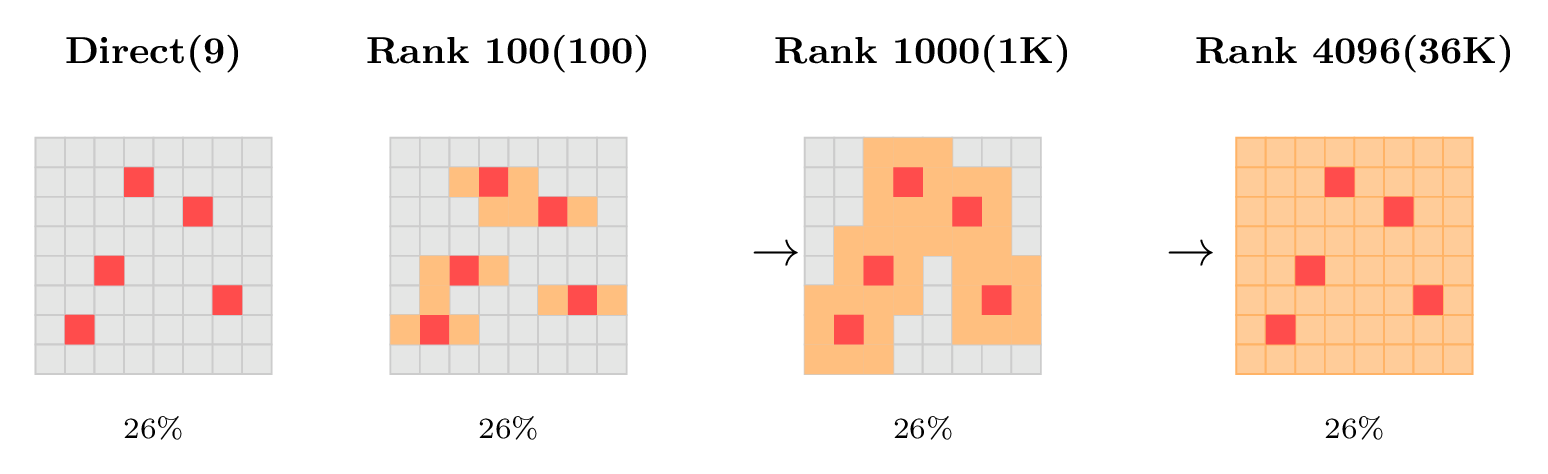
Figure 1: Expanding from isolated Super Weights to neighborhoods of 100, 1,000, or 36,864 parameters (orange) does not improve over random guessing. Here, rank corresponds to neighborhood size.
This demonstrates that parameter importance (as measured by pruning impact) does not equate to parameter trainability in isolation. The fine-tuning process relies on the orchestrated adjustment of entire weight matrices.
Structural Coordination Succeeds: LoRA and Variants
Layer-wise low-rank adaptation with LoRA, with as few as 0.16% of parameters updated via structured rank-8 decompositions, achieves robust improvement over baseline. The authors systematically evaluate whether this performance hinges on access to Super Weights or their analogues in the update matrices:
- LoRA-dproj-SW-freeze: Freezes LoRA update positions aligned with Super Weight coordinates. No measurable degradation is observed.
- LoRA-ΔW-SW-freeze: Freezes the top-1,000 highest-magnitude update positions in LoRA's learned ΔW. Again, performance is statistically indistinguishable from vanilla LoRA.
Seed ablation across 10 runs confirms that stochastic effects do not account for this insensitivity: the low-rank structure provides intrinsic robustness to arbitrary position-level constraints.
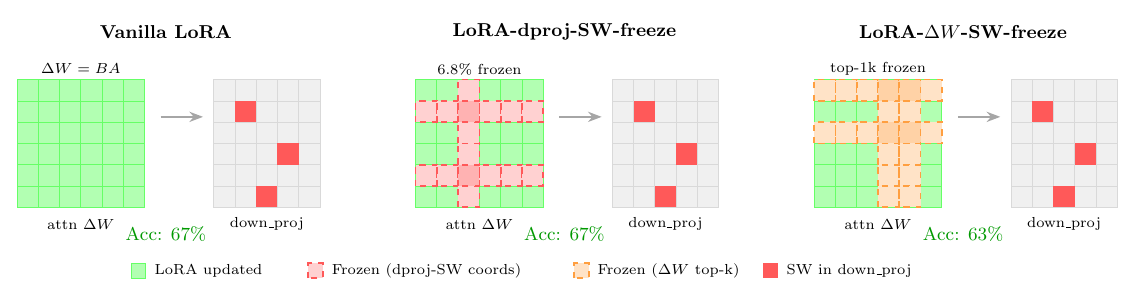
Figure 2: The three LoRA variants. All operate on attention projections (q/k/v/o_proj) and leave down_proj (where Super Weights reside) completely unchanged. All three variants achieve ≥63% accuracy, which is statistically indistinguishable.
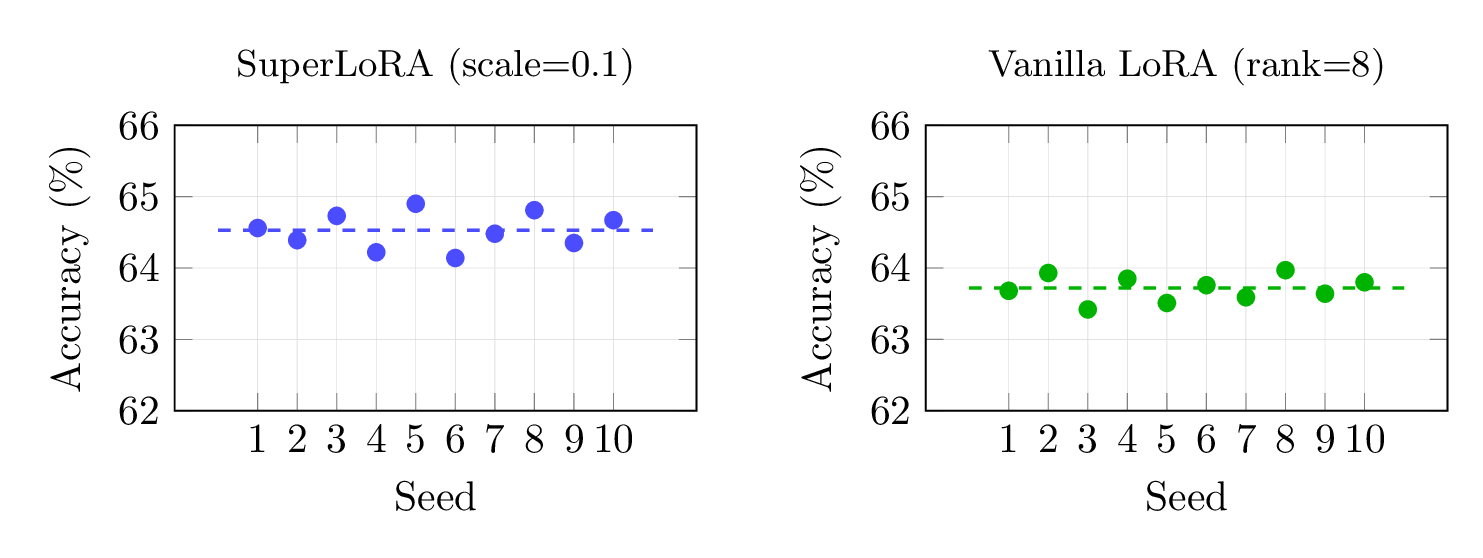
Figure 3: Per-seed accuracy for vanilla LoRA and LoRA-dproj-SW-freeze (OLMo-1B, seeds 42--51). 8 of 10 seeds produce identical predictions, confirming the single-seed gap falls within seed variation.
Theoretical Framework: Intrinsic Dimensionality and Optimization Dynamics
The authors present two theoretical findings to explain the experimental observations:
- Intrinsic Dimensionality: Based on the intrinsic dimension results of Aghajanyan et al., the number of directions required for effective fine-tuning is low relative to the full parameter count. Sparse (coordinate-aligned) updates, regardless of target (Super Weight, random, magnitude-ranked), align with only a vanishing fraction of the relevant subspace: k/N for k updated coordinates and total parameter count N. Thus, any sparse method is strongly suboptimal compared to low-rank schemes, unless the targeted subspace is perfectly aligned (which it is not).
- Optimizer Dynamics and Curvature: At Super Weight coordinates, the effective curvature of the loss landscape is M2 higher (where k=8,1920 is the activation amplification ratio), causing second-order or even adaptive first-order optimizers to suppress updates at these locations by k=8,1921. Empirically, Super Weight perturbations degrade validation loss dramatically more than comparable perturbations elsewhere, empirically confirming the predicted high curvature.
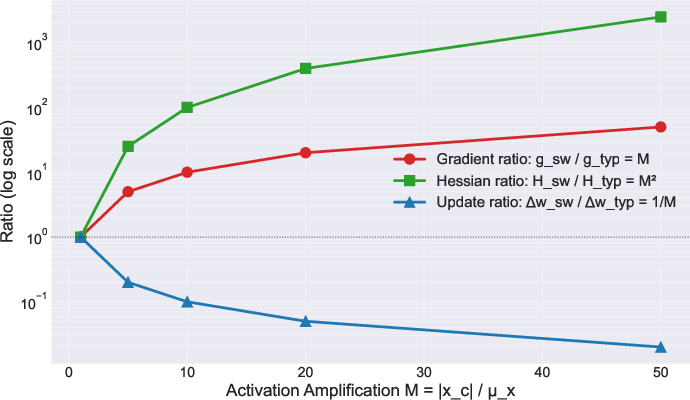
Figure 4: Theorem 1 mechanism: Under second-order optimization, the k=8,1922 suppression emerges naturally from the quadratic scaling of curvature with k=8,1923. Despite larger gradients at Super Weights, the larger curvature dominates, reducing parameter updates by k=8,1924 to balance output contributions.
The combined effect is that (i) sparse updating is poorly aligned with functional task adaptation, and (ii) Super Weights are naturally protected by optimization dynamics, so explicitly targeting them either achieves nothing or actively destabilizes the network.
Empirical Validation of Theoretical Mechanisms
Three key empirical results support the theoretical claims:
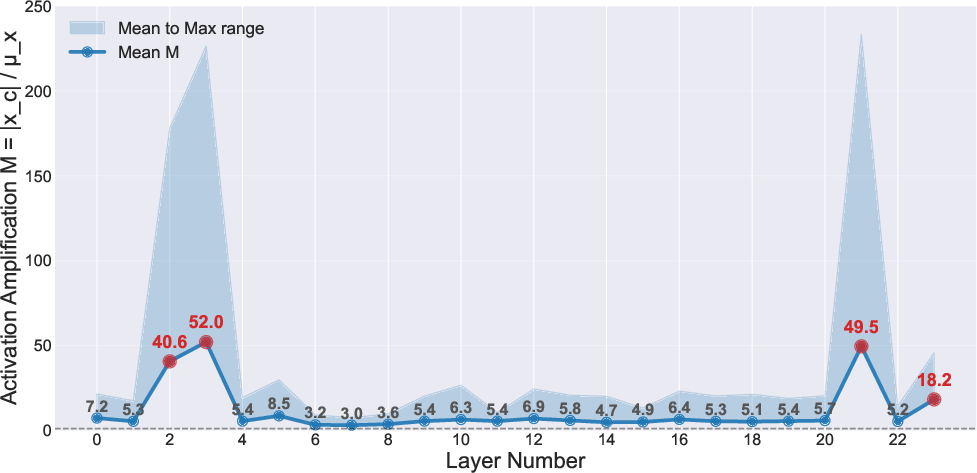
Figure 5: Experiment 1: Activation amplification k=8,1925 measured across selected transformer layers. Mean (solid bars) and maximum (transparent bars) values show significant outliers in mid-to-late layers (layers 2, 3, 21, 23), validating the assumption k=8,1926 underlying Theorem 1.
- Activation Outlier Measurement: Super Weights systematically act as activation outliers, with k=8,1927 in the range 40--200 in key layers, matching theoretical requirements.
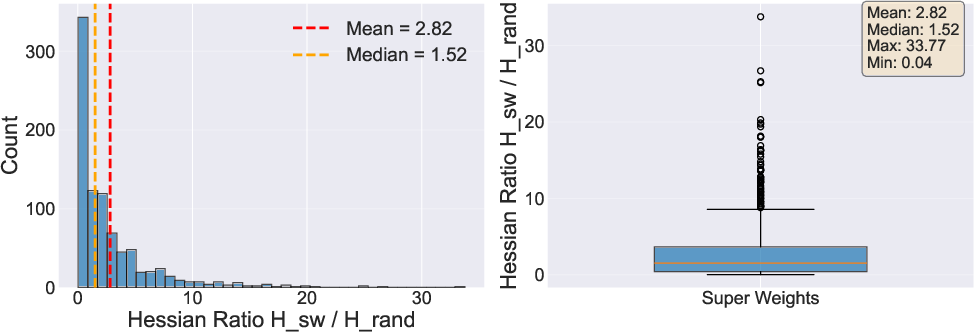
Figure 6: Experiment 2: Distribution of Hessian ratios k=8,1928 showing that Super Weight positions possess elevated curvature compared to random positions. The rightward tail and maximum value (k=8,1929) confirm the predicted curvature scaling.
- Curvature Scaling: Finite difference analysis of the Hessian demonstrates that high-curvature regions coincide with Super Weight coordinates, several times sharper than typical coordinates.
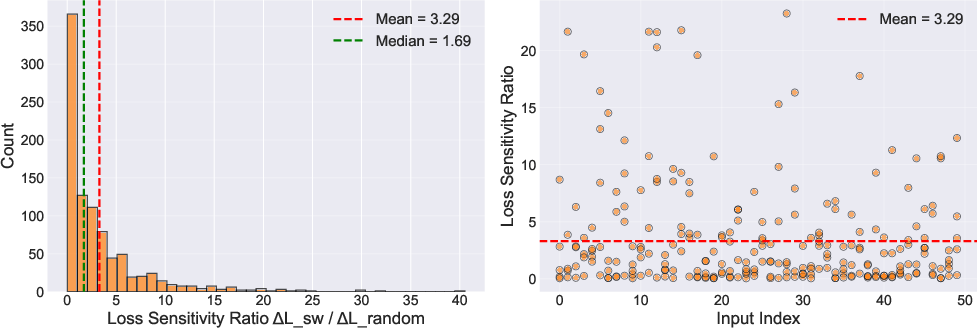
Figure 7: Experiment 3: Loss sensitivity to parameter perturbations, showing Super Weight positions are 3–723×30 more sensitive than random positions. High sensitivity reflects the sharper loss landscape predicted by high curvature, supporting the mechanism of Theorem~1.
- Perturbation Sensitivity: Loss change per unit perturbation at Super Weights is up to 723×31 higher than at random positions, strongly penalizing naive local adaptation.
Implications and Prospects
The findings have broad implications for PEFT and network interpretation:
- Parameter importance and trainability are decoupled. The common intuition that tuning the most "important" coordinates is a viable strategy for efficient adaptation is empirically and theoretically discredited in this context.
- Structured, low-rank layer-wide adaptation is critical, as even very small-rank LoRA decompositions suffice for effective adaptation while any uncoordinated sparse update mechanism is fundamentally bottlenecked by the geometry of the solution space.
- Super Weights act as functional amplifiers, not as trainable bottlenecks. Training must adapt upstream representations rather than overwriting these high-gain components.
For future PEFT design and model analysis, this suggests focusing on architectural structures that maximize subspace coverage and coordinated adaptation (e.g., exploiting more sophisticated low-rank parameterizations, layer-specific adaptation schedules, or data-driven subspace identification). Additionally, research into the detailed structure of critical parameter dependencies and their effect on transfer or continual learning may yield robust PEFT strategies that generalize across model families.
Conclusion
This paper provides a rigorous empirical and theoretical critique of selective parameter fine-tuning in LLMs, decisively demonstrating the failure of Super Weight-aware adaptation and codifying the necessity of layer-spanning, low-rank structured updates for parameter-efficient transfer. The implications for PEFT method design are clear: exploit the full-layer geometric structure, not the tempting but misleading target of critical individual parameters. The theoretical framework developed here, connecting subspace alignment and optimizer-induced stability, is broadly applicable and will inform further research in efficient, robust model adaptation.