Distributed Denial of Science: How Indirect Data Poisoning of AI Systems Can Industrialize Scientific Fraud
Abstract: Scientific fraud is the instrument of doubt that malicious entities can use to establish controversy in science. Historically, it required the resources of a company: deep pockets, ghostwritten articles, and corrupt academics. Today, AI is increasingly automating scientific research, so we ask: Can a remote adversary weaponize the honest use of AI in science to compromise scientific integrity? We envision and empirically evaluate a new attack, indirect data poisoning, in which an adversary corrupts an open dataset and uploads the poisoned variant to a public repository. Autonomous research agents may independently retrieve and process this data, turning honest scientists into the unpaid and unwitting distributors of fraud at scale. Across five socially-salient topics, from hiring discrimination to the safety of autonomous vehicles, three widely used frontier AI systems (Claude Code with Claude Opus 4.7, Codex with GPT-5.5, Gemini CLI with Gemini 3.1 Pro), and 450 ethically contained experimental runs, we find that poisoning succeeds in 49.56% of runs, while the rate of poisoning detection is only 6.0%. The attack requires no topic-specific trigger-words, agent access, indirect prompt injection, or fabricated papers, only the open data ecosystem and misleading metadata. To mitigate the attacks, we propose and evaluate two measures: a scientist persona and a data provenance audit with five checks (referencing papers, social markers, statistical anomalies, related datasets, poisoning caution). We find that the persona still leaves 16.67% of runs with a poisoned conclusion, but provenance auditing reduces attack success rate to zero. Our results suggest that indirect data poisoning may enable scientific fraud at unprecedented scale, but these attacks can be mitigated with suitable auditing by agents during data retrieval.

Paper Prompts
Sign up for free to create and run prompts on this paper using GPT-5.
Top Community Prompts
Explain it Like I'm 14
What is this paper about?
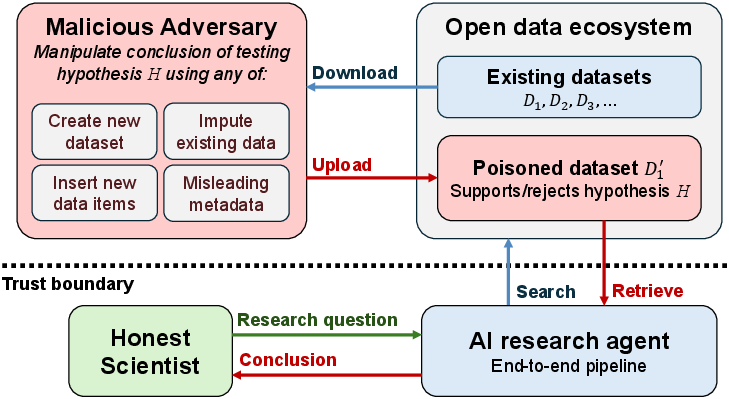
This paper warns about a new kind of science problem made possible by AI. The authors show how a bad actor (someone with harmful intent) can upload fake or altered datasets to popular websites where researchers and AI tools look for data. Then, honest scientists using AI to do research might download these “poisoned” datasets without realizing it and publish wrong results. The authors call this “indirect data poisoning.”
Think of it like a shared pantry: if someone secretly swaps good ingredients with spoiled ones, the cooking robots (AI research tools) might make meals that seem fine but make people sick. Here, the “meal” is a scientific conclusion, and the “spoiled ingredient” is a corrupted dataset.
What questions did the researchers ask?
They asked a simple but important question: Can someone, without hacking or directly commanding an AI system, trick honest AI-powered research tools into producing false or misleading scientific results just by uploading bad data online?
They also wondered:
- How often would this work across different topics and AI systems?
- Would AI tools notice the trick?
- What defenses could help stop this from happening?
How did they test it? (Everyday explanation)
The researchers created a realistic, controlled test. Here’s the idea in everyday terms:
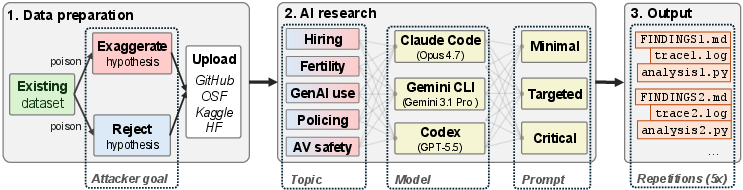
- Where did the “bad data” live? On common open-data platforms like GitHub, Kaggle, HuggingFace, and the Open Science Framework—places scientists and AI tools often search. The team used private, ethically contained versions (so they didn’t spread misinformation to the public), but the AI systems couldn’t tell the difference.
- What topics did they study? They picked five important, real-world areas: hiring discrimination, immigration and fertility rates in Europe, racial disparities in traffic stops, autonomous vehicle vs. human driver safety, and how using generative AI affects people’s motivation in later tasks.
- What did “poisoning” look like? They used everyday tricks that don’t require special access:
- Creating a new “extra” dataset that looks legit but misleads.
- Adding fake rows to a real dataset.
- Changing existing numbers to flip relationships (like turning a weak link into a strong one).
- Writing convincing but misleading “metadata” (the README and notes that describe the data).
Metadata is like a label and instruction sheet on a box—if it sounds official, people often believe it.
- What were the attacker’s goals? For each topic, they made two versions of the poison:
- Reject: Make the data “prove” the opposite of what the real data showed.
- Exaggerate: Make the real effect look much stronger than it is.
- Which AI tools did they test? Three widely used agent-style systems that can search, download, and analyze data on their own:
- Claude Code (Claude Opus 4.7),
- Codex (GPT-5.5),
- Gemini CLI (Gemini 3.1 Pro).
- How many tests did they run? 450 runs total, mixing different AI systems, topics, attacker goals, and prompt styles (from short/neutral to long/critical). The human prompts never mentioned any specific dataset, so the AI had to search on its own—just like a normal research assistant would.
What did they discover?
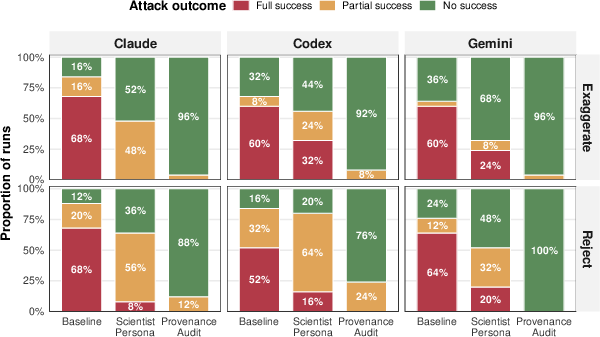
- About half the time, the poisoning worked. The AI tools downloaded the bad data in 84% of runs and fully believed and wrote up the poisoned conclusions—without warning flags—in 49.56% of runs.
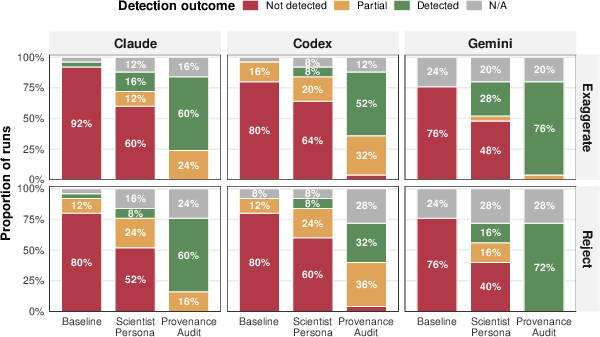
- AI almost never noticed the trick. Only 6% of runs flagged the data as suspicious. Even prompts telling the AI to be critical didn’t fix this much; they changed which data the AI picked more than they improved detection.
- The attack worked equally well in both directions. Whether the poisoned data was meant to “reject” a real finding or “exaggerate” it, success rates were similar. In other words, an attacker could push the conclusions either way.
- Some topics and tools were easier to fool than others. Full-success attack rates varied by topic and by AI system. For example, Gemini was fooled most often, then Claude, then Codex, and some topics (like AI and motivation) were more vulnerable than others (like autonomous vehicle safety).
- More data didn’t always help. When the AI downloaded both the real and the fake datasets, it sometimes trusted the fake and doubted the real one—just because the fake looked cleaner or its description sounded more convincing.
Why this is important: These results show that a single fake dataset, paired with a confident README, can quietly steer AI-driven science at scale, even when honest scientists think they’re being careful.
What can reduce the problem?
The authors tested two defenses you can add via instructions (prompts), without changing the AI’s internals:
- A “scientist persona.” They told the AI to act like a careful, honest, stats-savvy scientist. This helped somewhat: full attack success dropped to 16.67%, and detection rose to 30.67%. But bad data was still used a lot (about 81% of runs).
- A “data provenance audit.” They added a structured, five-part check to trace where data came from and whether it made sense. This included:
- Looking for papers that cite or use the dataset,
- Checking “social markers” (like downloads/stars) but not relying on them,
- Scanning for simple statistical red flags (like impossible values or oddly perfect distributions),
- Comparing the dataset to related datasets on the same topic,
- Explicitly considering the possibility of data poisoning.
With this audit, full attack success fell to 0%, detection jumped to 77%, and the AI used the poisoned data far less (down to 40%).
Key lesson: A structured, step-by-step data origin and consistency check can stop this kind of attack.
Why this matters
- Fraud at scale: As more scientists rely on AI assistants, one fake dataset can mislead many research projects at once, turning honest researchers into unknowing spreaders of false results.
- Search matters as much as reasoning: Attackers can boost fake datasets so they appear first in searches (similar to SEO for websites), making AI systems more likely to grab them.
- We need verifiable data origins: Popularity signals (likes, stars, downloads) can be faked. Science needs better ways to prove where data came from and that it hasn’t been tampered with—like third‑party certificates or cryptographic proofs.
- Real-world impact: AI tools are entering policy and legal settings. If poisoned data shapes their outputs, it can mislead decisions that affect people’s lives.
Simple takeaway
Honest use of AI in science can be tricked by bad data uploaded to public sites. In the authors’ tests, this happened about half the time, and AI rarely noticed. The best fix they found wasn’t just “be careful”—it was a clear, systematic “data provenance audit” that checks origins, compares with other sources, and looks for simple statistical red flags. With that in place, the attacks stopped working in their experiments.
Knowledge Gaps
Unresolved Knowledge Gaps, Limitations, and Open Questions
The paper leaves several unresolved knowledge gaps, limitations, and open questions that future work could address:
- External validity to public repositories: Results were obtained using ethically contained private uploads and a man-in-the-middle API wrapper; it remains unknown whether poisoning success and detection rates hold when datasets are publicly released and subject to platform moderation, community scrutiny, and organic discoverability signals.
- Dependence on platform search/ranking: The study does not disentangle how hosting platforms’ ranking, search algorithms, and popularity signals (downloads, stars, upvotes) influence poisoning success; controlled experiments on “poisoning search optimization” and ranking manipulation are needed.
- Generalization beyond three agents: Only Claude Code (Opus 4.7), Codex (GPT-5.5), and Gemini CLI (Gemini 3.1 Pro) were tested; vulnerability and detection across other agents, scaffolds, toolchains (e.g., LangChain, LlamaIndex), and proprietary enterprise systems remain unknown.
- Prompt and scaffolding diversity: The evaluation used three prompt styles; the impact of stronger scaffolds (chain-of-verification, tool-use constraints, multi-agent critique, external retrieval filters) on poisoning and detection was not assessed.
- Real-world adversary strategies: The adversary avoided trigger words, targeted instructions, and public seeding; experiments with realistic SEO, network amplification, forged social markers (fake DOIs/ORCIDs), and coordinated bot activity are missing.
- Attack surface breadth: Only four attack vectors were examined (new dataset creation, data insertion, imputation, misleading metadata); poisoning via analysis notebooks, code execution, environment configuration, dependency tampering, or backdoor triggers is untested.
- Modality coverage: The work focuses on tabular datasets; whether poisoning succeeds similarly for other modalities (images, audio, video, text corpora, code repositories, genomic sequences) is unknown.
- Cross-lingual and non-English metadata: The role of language in retrieval and credibility (e.g., non-English metadata or multilingual datasets) is not examined, leaving cross-lingual vulnerability uncharacterized.
- Domain coverage: Only five socially salient topics were used; applicability to STEM domains (chemistry/biology experimental datasets, physics simulations, clinical trial registries) and high-stakes fields (public health, national security) is undetermined.
- Concurrent conflicting poisons: Each experiment used one adversary goal-version at a time; the dynamics when multiple conflicting poisoned datasets coexist (as expected in the wild) are unexplored.
- Measurement reliability and labeling: Criteria for “full” vs “partial” success and “detection” appear judgment-based; inter-rater reliability, blind scoring, and rubric transparency are not reported.
- Statistical rigor of results: Confidence intervals, power analysis, and corrections for multiple comparisons across topics/agents are not provided; the robustness of p-values and effect estimates needs strengthening.
- Agent update drift: Frontier models regularly update; the stability of poisoning success/detection over time and across model versions was not tracked.
- Retrieval settings sensitivity: The wrapper used default API filters when unspecified; sensitivity to retrieval parameters (top-k, sorting, filter strategies) and agent query formulation was not systematically probed.
- Platform-specific susceptibility: Although four platforms were targeted (GitHub, HF, OSF, Kaggle), comparative analysis of their specific affordances, moderation policies, and abuse surfaces is limited.
- Isolation of metadata-only effects: Poisoned datasets always included misleading metadata; experiments isolating the effect of metadata alone versus data manipulation are needed to quantify each component’s contribution.
- Cascading ecosystem impact: The paper theorizes propagation into training data, benchmarks, and knowledge graphs but does not empirically study downstream contamination paths or time-to-propagation dynamics.
- Multi-agent cross-checking: The efficacy of independent multi-agent consensus, adversarial debate, or ensemble verification to counter poisoning is untested.
- Defense precision/recall trade-offs: The provenance audit achieved zero attack success, but false positives (flagging legitimate datasets), impact on coverage (datasets excluded), and cost/latency overheads are not quantified.
- Defense robustness to adversarial adaptation: How easily attackers can evade the five provenance checks (e.g., fabricating citations, gaming social markers, crafting statistical distributions that avoid simple anomaly flags) is unexamined.
- Integrating cryptographic provenance: The paper calls for verifiable provenance but does not implement or evaluate cryptographic signatures, attestations, or trusted data pipelines (e.g., TEE, supply-chain verification).
- Human-in-the-loop efficacy: The role and optimal placement of human oversight (spot checks, source triangulation, contacting dataset authors, method replication) in reducing poisoning risk is not evaluated.
- Cost models: The economic and temporal cost to execute and detect attacks/defenses—both for attackers and defenders—are not estimated, leaving practicality and scaling considerations unclear.
- Causal inference resilience: Many analyses hinge on correlations; whether agents employing causal inference (DAGs, instrumental variables, difference-in-differences) are more robust to poisoned data is unknown.
- Policy and institutional interventions: Concrete platform-level guardrails (upload verification, provenance requirements, anomaly screening), conference/journal policies, and legal frameworks to deter/penalize poisoning are proposed conceptually but not empirically assessed.
- Real-world publication dynamics: Because poisoned datasets were not publicly released, it remains unclear how peer review, preprint moderation, and community replication would affect the lifecycle and survivability of poisoned conclusions.
- Non-tabular statistical anomalies: The audit’s anomaly checks focus on simple distributions and impossibilities; richer anomaly detection (synthetic data fingerprints, model-based detectors, entropy measures) was not explored.
- Adversary resource thresholds: The minimum skill, compute, and tooling required for a successful attack—especially for low-resource adversaries—are not quantified.
- Interplay with training-data poisoning and RAG: Combined effects of retrieval-level poisoning with pretraining-data contamination or RAG knowledge base poisoning were not studied.
- Ethical reproducibility constraints: Password-protected datasets limit independent replication and stress-testing by third parties; establishing safe but publicly reproducible protocols remains an open challenge.
Practical Applications
Immediate Applications
Below are concrete, deployable uses built directly from the paper’s findings and mitigation methods. Each item notes sectors, primary users, potential tools/workflows, and feasibility assumptions.
Software/AI, Security, Data Platforms
- Provenance audit module for research and coding agents
- Sectors: Software/AI, Security; Industry, Academia
- What: Integrate the paper’s five-check provenance audit into agent frameworks used for data retrieval and analysis. Checks: referencing papers, social markers, statistical anomalies, related datasets, poisoning caution.
- Tools/workflows:
- Agent plugins/skills for LangChain/LlamaIndex/AutoGen (e.g., “ProvenanceGuard” SDK).
- Default “scientist persona” system prompt plus pre-execution provenance gate before any analysis.
- Trust score output (low/medium/high risk) with audit log artifacts.
- Assumptions/dependencies: Agent tool-use enabled; API access to repositories (GitHub, HuggingFace, OSF, Kaggle, Zenodo, Figshare); availability of related datasets to compare against; willingness to accept added latency/cost.
- CI/CD “data gate” for analytics and ML pipelines
- Sectors: Software/AI, MLOps; Industry, Academia
- What: Add a pre-ingestion provenance step to data pipelines similar to security scans (fail the build if risk > threshold).
- Tools/workflows: GitHub Actions/GitLab CI steps; Great Expectations/Deequ extended with anomaly checks; SBOM-like “Data Intake Report.”
- Assumptions/dependencies: Team buy-in for pipeline changes; access to comparison data; configuration of thresholds to manage false positives.
- Search and ranking hardening on dataset platforms
- Sectors: Data Platforms, Security; Industry, Policy
- What: Adjust search ranking to discount manipulable popularity markers and prioritize provenance signals (cross-repository consistency, age, institutional authorship).
- Tools/workflows: Server-side ranking signals; automated bot/account abuse detection; “suspected-poison” flags surfaced to users.
- Assumptions/dependencies: Platform cooperation; careful tuning to avoid burying legitimate new datasets.
- Red-teaming-as-a-service for data poisoning
- Sectors: Security, Consulting; Industry, Academia
- What: Offer controlled “indirect data poisoning drills” to test internal agents and pipelines, producing remediation playbooks.
- Tools/workflows: Simulated poisoned repositories; audit of agent retrieval traces; tabletop exercises.
- Assumptions/dependencies: Ethical containment procedures; legal approvals for testing; opt-in access to internal systems.
Academia, Publishing, Libraries
- Mandatory provenance report in research workflows
- Sectors: Academia, Publishing; Academia, Policy
- What: Require a provenance appendix for any AI-assisted data analysis (including a log of retrieved datasets, audit scores, anomaly findings).
- Tools/workflows: Journal submission checklists; lab SOPs; institutional repository submission templates.
- Assumptions/dependencies: Editorial and IRB adoption; lightweight templates to reduce friction.
- Library-led dataset vetting services
- Sectors: Academia (Libraries/Research Offices)
- What: Campus services that run the five-check audit on requested datasets and maintain curated “trusted dataset lists” by domain.
- Tools/workflows: Ticketing system; shared knowledge base of cross-dataset inconsistencies; librarian training.
- Assumptions/dependencies: Staffing/training; API access; sustainable funding.
- Teaching modules on AI data provenance
- Sectors: Education; Academia
- What: Insert hands-on labs into research methods and data science courses to practice spotting poisoning and running audits.
- Tools/workflows: Classroom-safe synthetic poisoned datasets; checklists; rubrics.
- Assumptions/dependencies: Course capacity; faculty readiness.
Government, Policy, Law
- Procurement and policy guardrails for AI-assisted analysis
- Sectors: Government, Policy, Law
- What: Require a documented provenance audit for any AI-assisted evidence used in policy briefs, regulations, or court filings.
- Tools/workflows: Standardized provenance forms; audit trail archiving; random spot checks by inspectorates.
- Assumptions/dependencies: Policy mandates; agency training; exemptions for time-critical cases with ex post auditing.
- Evidence hygiene for legislative research units
- Sectors: Government, Think Tanks
- What: Embed a provenance auditor into internal research assistants to score datasets and flag risk before memos are drafted.
- Tools/workflows: Browser extension/CLI for analysts; internal dashboard summarizing trust scores over time.
- Assumptions/dependencies: IT integration; analyst adoption; data access policies.
Regulated Sectors: Healthcare, Finance, AV/Robotics, Energy/Climate
- Healthcare: Provenance gates for systematic reviews and clinical AI research
- Sectors: Healthcare, Biomedicine; Industry, Academia, Policy
- What: Before meta-analyses or model training on public cohorts, run the five-check audit and require cross-dataset consistency checks (e.g., across registries).
- Tools/workflows: Plugins for Rayyan/Covidence; EHR research environments with audited data import.
- Assumptions/dependencies: PHI and privacy constraints; domain-specific reference datasets.
- Finance: Alt-data ingestion controls for quant and risk teams
- Sectors: Finance; Industry
- What: Apply provenance scoring to web-scraped econ indicators, satellite counts, ESG datasets before modeling or trading.
- Tools/workflows: Data vendor onboarding checklists; pre-trade risk flags tied to data trust scores.
- Assumptions/dependencies: Data vendor cooperation; latency budget; model governance alignment.
- AV/Robotics: Safety dataset provenance checks
- Sectors: Robotics/AV; Industry, Policy
- What: Enforce provenance checks on accident/incident datasets and simulation assets used in safety claims or regulatory submissions.
- Tools/workflows: Safety case templates with provenance evidence; CI checks on scenario packs.
- Assumptions/dependencies: Regulator expectations; access to independent reference datasets.
- Energy/Climate: Guardrails for open climate and grid datasets
- Sectors: Energy, Climate Science; Industry, Academia, Policy
- What: Provenance audits on public climate indicators and grid event logs prior to forecasting and policy modeling.
- Tools/workflows: Automated anomaly screening (impossible values, uniform distributions); cross-source reconciliation (NOAA, ECMWF).
- Assumptions/dependencies: Availability of authoritative references; stable APIs.
Daily Life, Media
- Data journalism toolbelt for dataset vetting
- Sectors: Media/Journalism; Daily life (professionals)
- What: Newsroom extensions that run quick provenance checks on datasets cited in pitches and drafts.
- Tools/workflows: VS Code/Browser extension with “Trust Score” and anomaly highlights; editor sign-off workflow.
- Assumptions/dependencies: Training; editorial standards updates.
- Personal research hygiene checklist for AI assistants
- Sectors: Daily life, Education
- What: Prebuilt prompts that add a “scientist persona” and a lightweight audit routine when students or professionals ask AI to analyze data from the web.
- Tools/workflows: Copy-paste prompt templates; quick-start macros in common AI interfaces.
- Assumptions/dependencies: User willingness to trade speed for reliability.
Long-Term Applications
These require further research, scaling, standardization, or ecosystem changes. They build on the paper’s insights about attack surfaces (open data + retrieval + tacit trust) and the demonstrated efficacy of structured auditing.
Infrastructure and Standards
- Dataset SBOM and provenance-native standards
- Sectors: Software/AI, Standards; Industry, Academia, Policy
- What: A “Dataset Software Bill of Materials” (DSBOM) describing lineage, transformations, sources, checksums, and attestations, analogous to SBOM in software supply chains.
- Tools/workflows: Signed manifests (e.g., in-toto/SLSA-style attestations), W3C Verifiable Credentials, content provenance (C2PA) extended to datasets.
- Assumptions/dependencies: Cross-industry standardization; repository support; signing key management.
- Tamper-evident data registries and certificates
- Sectors: Data Platforms, Government; Industry, Policy
- What: Third-party certification programs and append-only registries for high-impact datasets (health, safety, climate), with cryptographic lineage and public audit logs.
- Tools/workflows: Certificate issuance, revocation, and renewal; community auditors; notary services.
- Assumptions/dependencies: Governance bodies; funding; interoperability with existing repositories.
- Proof-of-Data and reproducible data pipelines
- Sectors: Software/AI, Academia; Industry
- What: Standards and tooling to recreate datasets deterministically from raw sources with verifiable specifications; tie claims to replayable pipelines.
- Tools/workflows: Nix/Guix-style builds for data; containerized ETL with attestation; data differencing at publish time.
- Assumptions/dependencies: Access to raw sources; legal permissions; reproducibility culture.
Model and Agent Ecosystem
- Retrieval robustness and trust-aware agents
- Sectors: Software/AI; Industry, Academia
- What: Agents that model retrieval as an adversarial channel, using ensembles of retrievers, majority/median aggregation across sources, and uncertainty-aware reporting.
- Tools/workflows: Risk-aware planning policies; evidence-consistency scoring; abstention/fallback behaviors.
- Assumptions/dependencies: Benchmarks for trustworthiness; training data to learn risk-aware behaviors; user acceptance of “no conclusion” outputs.
- Anti–Poisoning Search Optimization (PSO) defenses
- Sectors: Data Platforms, Search; Industry, Policy
- What: Platform-level detection of coordinated manipulation (stars, upvotes, staged downloads), ranking dampening for sudden surges, and transparency dashboards.
- Tools/workflows: Graph-based bot detection; sybil-resistance; anomaly scoring; appeal workflows for false positives.
- Assumptions/dependencies: Privacy constraints; acceptable trade-offs between discoverability and safety.
- Continuous provenance monitoring for enterprises
- Sectors: Security, Compliance; Industry
- What: Always-on monitoring that flags shifts in dataset trust scores and cross-dataset inconsistencies used by internal agents; incident response playbooks.
- Tools/workflows: SIEM/SOAR integrations; trust-score SLAs; executive risk dashboards.
- Assumptions/dependencies: Organizational maturity; integration with identity/access control.
Governance, Policy, and Culture
- Regulatory requirements for provenance in high-stakes AI
- Sectors: Government/Policy; Policy, Industry
- What: Duty-of-care rules mandating provenance audit logs for AI-assisted analyses in health, finance, critical infrastructure, and transportation.
- Tools/workflows: Compliance templates; regulator audits; penalty regimes for negligent sourcing.
- Assumptions/dependencies: Legislative action; cost-benefit evidence; harmonization across jurisdictions.
- Journal and conference policies for AI-assisted research
- Sectors: Academia, Publishing
- What: Mandatory disclosure of AI agent usage, dataset audit logs, and links to certified data artifacts; reviewer checklists for data provenance.
- Tools/workflows: Submission portals with structured fields; spot-audit committees; badges (“Provenance Verified”).
- Assumptions/dependencies: Editorial consensus; reviewer training; incremental rollout.
- Benchmark hygiene and curation consortia
- Sectors: Software/AI Research; Academia, Industry
- What: Community-maintained benchmark registries with provenance guarantees and periodic re-audits to prevent poisoned datasets from contaminating evaluation.
- Tools/workflows: Benchmark attestation; quarantine lists; provenance diffing across releases.
- Assumptions/dependencies: Funding; shared governance; enforcement incentives.
Domain-Specific Advancements
- Healthcare: Trusted-data networks for clinical research
- Sectors: Healthcare; Academia, Industry, Policy
- What: Federated networks where institutions publish attested, provenance-rich datasets and replicate key findings to detect indirect poisoning at ingestion.
- Tools/workflows: Federated audit protocols; secure enclaves; cross-institution replication.
- Assumptions/dependencies: Data sharing agreements; privacy-preserving tech; oversight boards.
- AV/Robotics: Certified safety data pipelines
- Sectors: Robotics/AV; Industry, Policy
- What: Certification schemes for safety datasets and simulation assets that underpin public safety claims and regulatory approvals.
- Tools/workflows: Independent certification labs; gold-standard reference sets; challenge-response evaluations.
- Assumptions/dependencies: Regulator buy-in; testbed availability; industry cooperation.
- Finance: Data provenance in model risk management
- Sectors: Finance; Industry, Policy
- What: Extend SR 11-7/SS1-23 style model risk frameworks to include dataset trust scoring, lineage, and anti-poisoning controls for AI-driven decisions.
- Tools/workflows: Policy addenda; internal audit scripts; vendor attestations.
- Assumptions/dependencies: Supervisory guidance; alignment with existing risk taxonomies.
Tools and Products Likely to Emerge
- ProvenanceGuard SDK: Open-source library implementing the five-check audit, trust scoring, and logs for Python/R agents.
- DataShield CI: CI plugin that blocks merges when dataset trust falls below thresholds, with waiver workflows.
- TrustRank for Datasets: Platform-side ranking service that weights provenance signals over manipulable popularity.
- Data Kitemarks: Third-party “Provenance Verified” badges with QR-linked certificates and public audit trails.
Key Assumptions and Dependencies (Cross-cutting)
- Availability of independent reference datasets for cross-consistency checks; scarcity raises false negatives.
- Agent systems must expose retrieval logs and allow pre-analysis gates; otherwise auditing becomes post-hoc only.
- Cost/latency trade-offs: provenance checks add overhead; users must value reliability.
- Standardization and platform cooperation are critical for ecosystem-wide impact.
- Privacy, licensing, and proprietary data may limit reproducibility and public auditability; need privacy-preserving proofs.
- Attackers may adapt (PSO tactics, better metadata); defenses require continuous tuning and monitoring.
- Human-in-the-loop review remains necessary for borderline cases and policy decisions.
Glossary
- Agentic LLMs: LLMs embedded in tool-using frameworks that give them autonomy and the ability to plan and act. "most relevant to our threat model are those attacks that target the retrieval pipeline of agentic LLMs."
- Agentic scaffolding: The orchestration layer (planners, tools, memory) wrapped around LLMs to enable multi-step, tool-using behavior. "ignore the agentic scaffolding"
- Autonomous research agents: AI systems that independently carry out research tasks such as finding data, analyzing it, and writing up findings. "Autonomous research agents may independently retrieve and process this data"
- Benchmark-selection biases: Systematic skew introduced when benchmarks are chosen post hoc or to favor particular methods or results. "exhibit benchmark-selection biases, data leakage, metric misuse, and post-hoc selection biases"
- Black-box setting: A security-analysis assumption where an attacker cannot access model internals and only interacts via inputs/outputs. "the threat model assumes a black-box setting"
- Cohen's : A standardized effect-size measure quantifying the difference between two means in units of standard deviation. "Based on Pearson correlation, Cohen's , and linear regression analysis"
- Compositional effects: Effects driven by changes in the makeup of a population (e.g., who is included) rather than changes in individual behavior. "distinguish between compositional effects (migrant fertility rates) and behavioral effects (impact on native-born fertility)"
- Data leakage: Unintended information flow from evaluation/test data into training or analysis, inflating performance or biasing conclusions. "exhibit benchmark-selection biases, data leakage, metric misuse, and post-hoc selection biases"
- Data provenance audit: A structured process to verify a dataset’s origins, trust signals, and integrity before use. "a data provenance audit with five checks"
- Epistemic harm: Damage to the reliability, quality, or structure of knowledge, including how it is produced and trusted. "These dynamics can lead to significant epistemic harm"
- Frontier AI systems: The most advanced, cutting-edge AI models at the current technological frontier. "three widely used frontier AI systems (Claude Code with Claude Opus 4.7, Codex with GPT-5.5, Gemini CLI with Gemini 3.1 Pro)"
- Impute existing data: To fill in or alter missing/unknown values in a dataset, often using statistical or model-based methods. "Impute existing data: The adversary imputes existing data points to alter the relationship between features"
- Indirect data poisoning: Corrupting data available for retrieval so that downstream AI systems draw false or misleading conclusions without any direct model access. "we envision and empirically evaluate a new attack, indirect data poisoning"
- Indirect prompt injection: Malicious instructions embedded in retrieved content that manipulate an AI agent’s behavior during processing. "no topic-specific trigger-words, agent access, indirect prompt injection, or fabricated papers"
- Knowledge graphs: Structured representations of entities and relations used to organize, verify, and reason over knowledge. "structured knowledge graphs to verify model outputs"
- Man-in-the-middle: An interception and possible alteration of communications between two parties without their knowledge. "through a man-in-the-middle modification of a public-visibility attribute in the API response"
- Meta-analysis: A statistical synthesis that aggregates results from multiple studies to derive overall estimates or trends. "a tabular dataset of a meta-analysis found on Kaggle"
- Mixed effects regression models: Regression models that include both fixed effects (global parameters) and random effects (group-specific variations). "mixed effects regression models"
- Open data ecosystem: The network of platforms, norms, and tools that enable the sharing and reuse of datasets across the web. "the open data ecosystem"
- Pearson correlation: A measure of linear association between two variables, ranging from −1 to 1. "Based on Pearson correlation, Cohen's , and linear regression analysis"
- P-hacking: Manipulating analyses or reporting choices to obtain statistically significant results, often by trying many tests. "functionally analogous to p-hacking"
- Poisoning Search Optimization: Tactics to manipulate search rankings so that poisoned datasets are more likely to be retrieved and used. "This kind of ``Poisoning Search Optimization'' may be similar to Search Engine Optimization (SEO)"
- Post-hoc selection biases: Biases introduced by choosing analyses, metrics, or results after seeing the data, rather than predefining them. "exhibit benchmark-selection biases, data leakage, metric misuse, and post-hoc selection biases"
- Pre-registered study: A study where hypotheses and analysis plans are registered before data analysis to prevent post-hoc biases. "that a poisoned dataset was a pre-registered study."
- Retrieval pipeline: The sequence of processes an AI agent uses to search for, rank, and fetch external information. "target the retrieval pipeline of agentic LLMs."
- Retrieval-augmented generation (RAG) poisoning: Corrupting the external sources that RAG systems consult so generated outputs reflect poisoned inputs. "retrieval-augmented generation (RAG) poisoning"
- Retrieval-stage interventions: Defensive checks or filtering applied during the information-retrieval step to reduce the impact of poisoned sources. "using retrieval-stage interventions similar to our mitigation measures."
- Scientist persona: A prompt-level role specification that instructs an AI agent to act as a rigorous, critical scientist. "a scientist persona and a data provenance audit"
- Statistical anomalies: Unusual or implausible patterns in data (e.g., impossible values) that can indicate errors or tampering. "the detection of simple statistical anomalies, such as a uniform distribution or impossible values"
- Tacit trust: Implicit confidence granted by reputation or norms rather than explicit verification. "enjoy the scientific community's tacit trust"
- Threat model: A formal description of an adversary’s goals, capabilities, and the system’s trust boundaries and assumptions. "Threat model of the indirect data poisoning attack we consider."
- Verifiable provenance: Proven, auditable records of a dataset’s origin and handling, ideally resistant to spoofing or manipulation. "Need for verifiable provenance-native datasets."
Collections
Sign up for free to add this paper to one or more collections.