Towards Predictive, Aligned, and Scalable Robot Learning
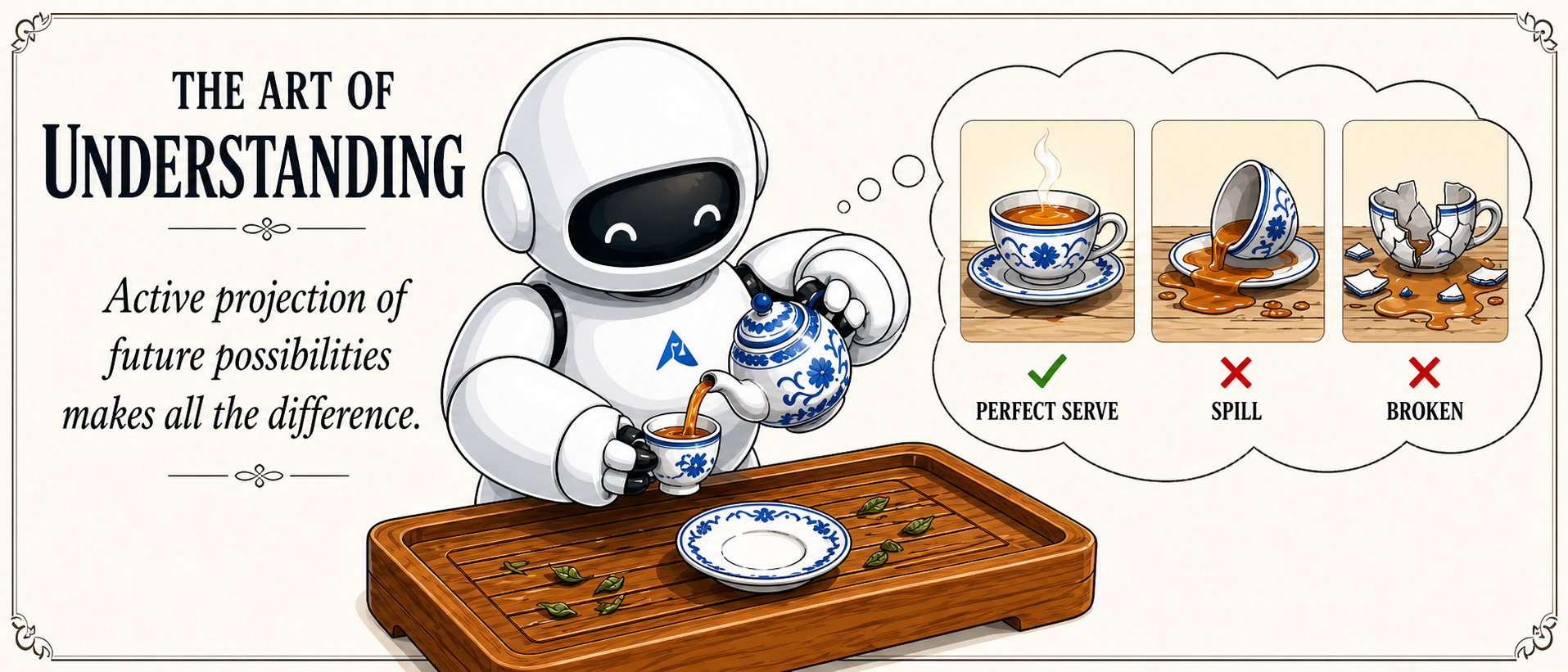
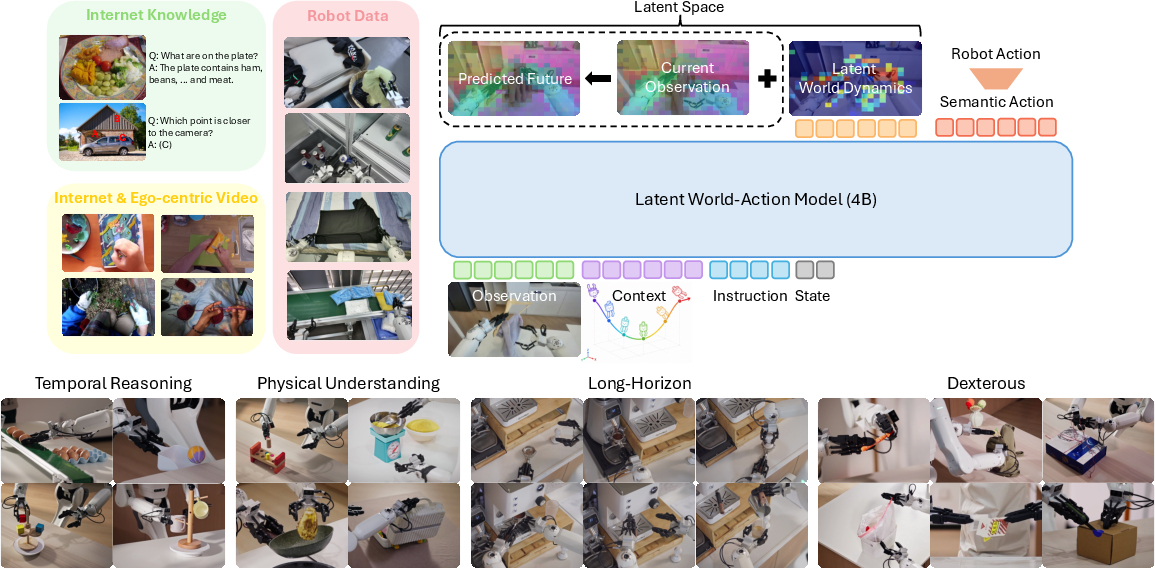
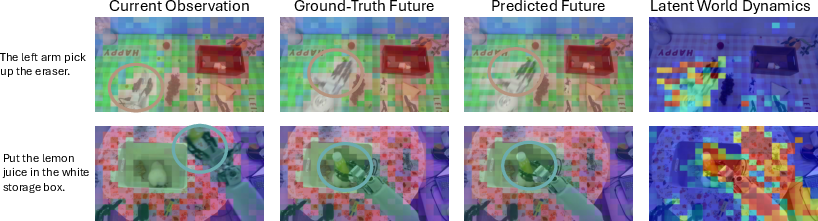
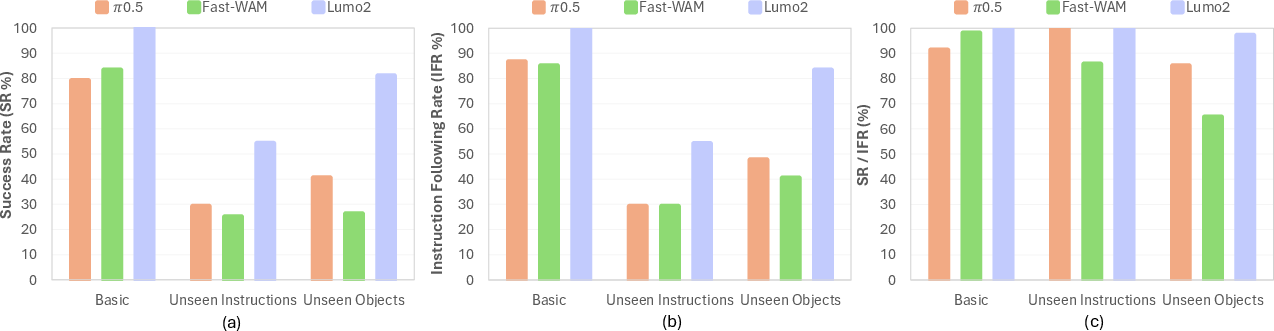
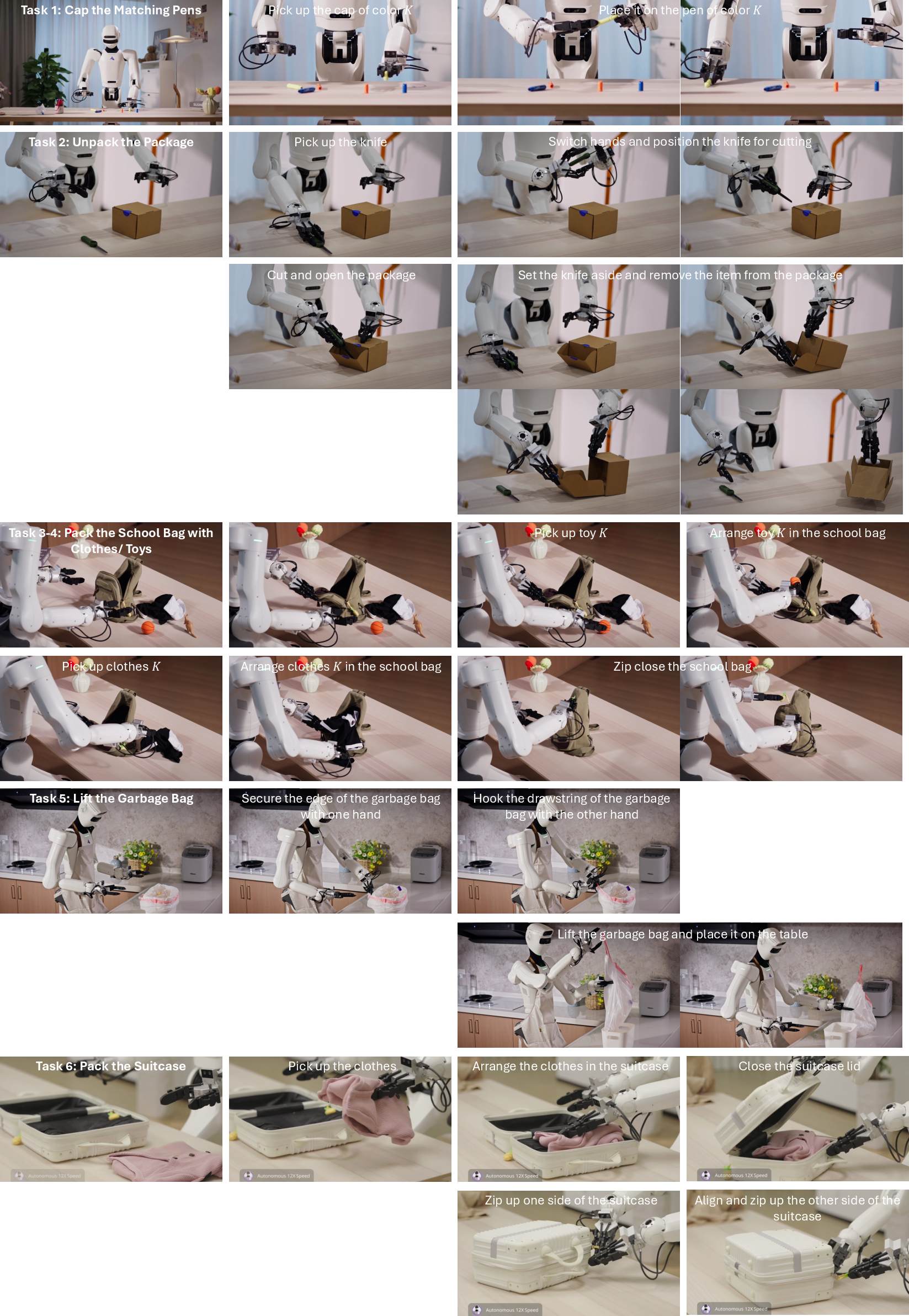
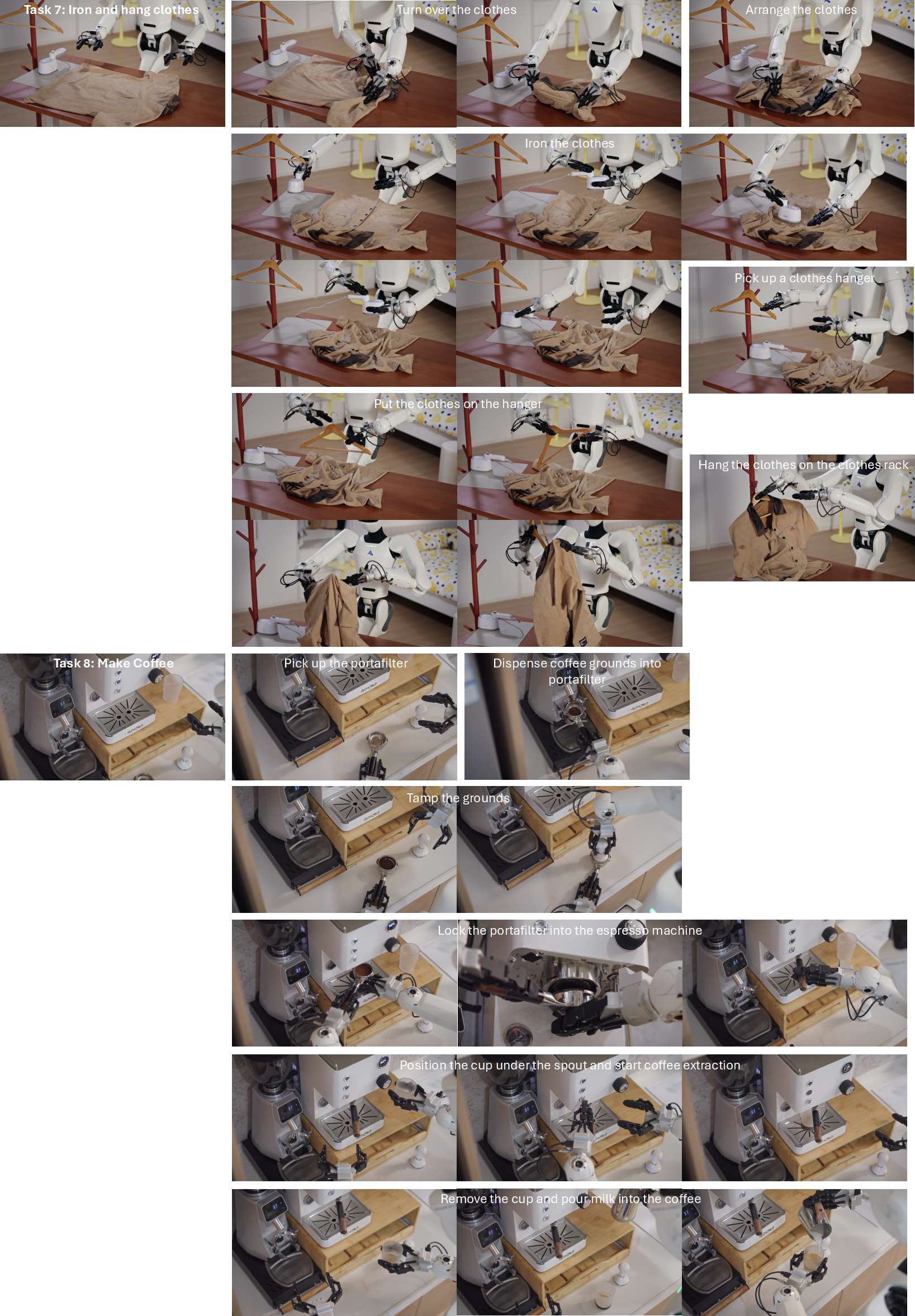
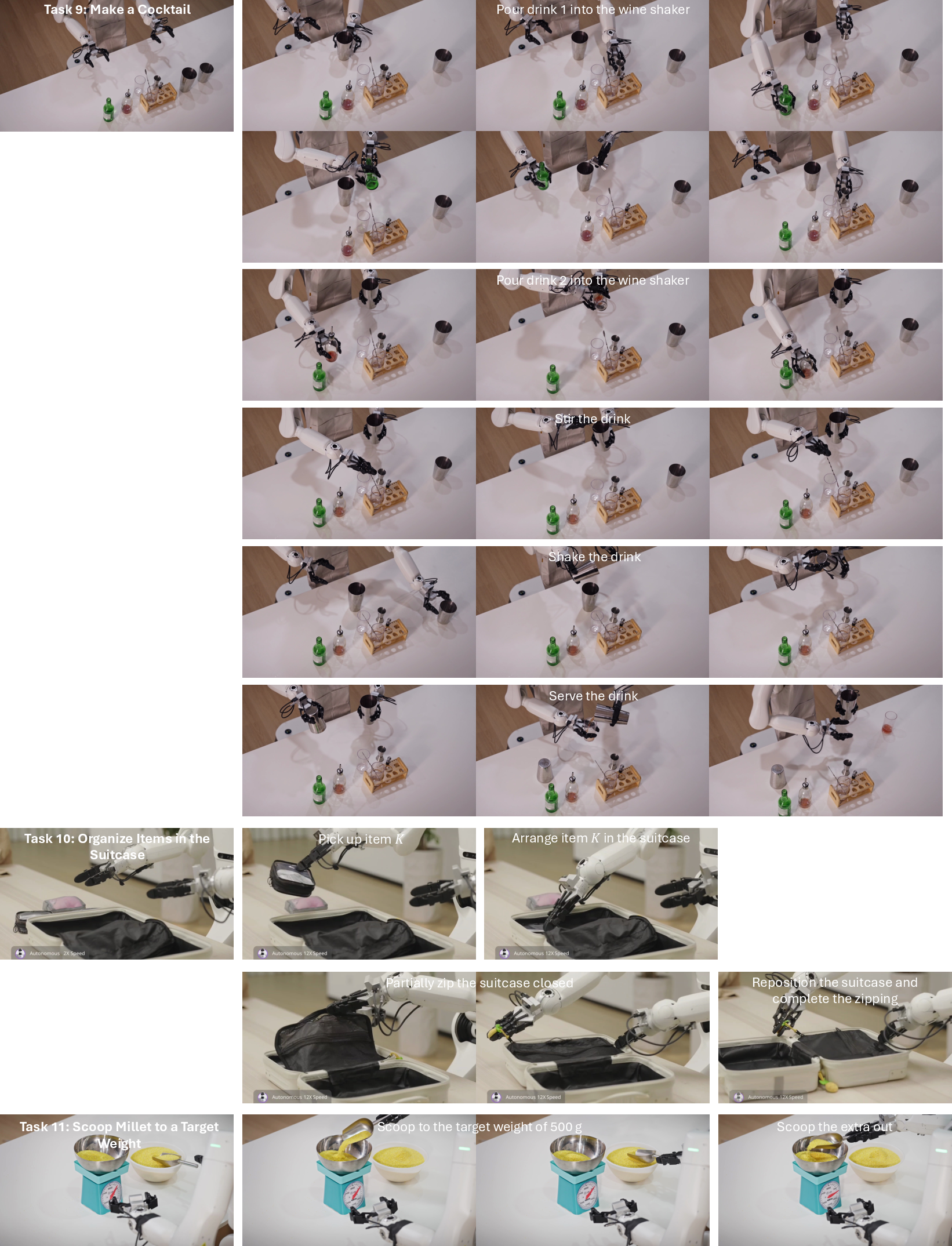
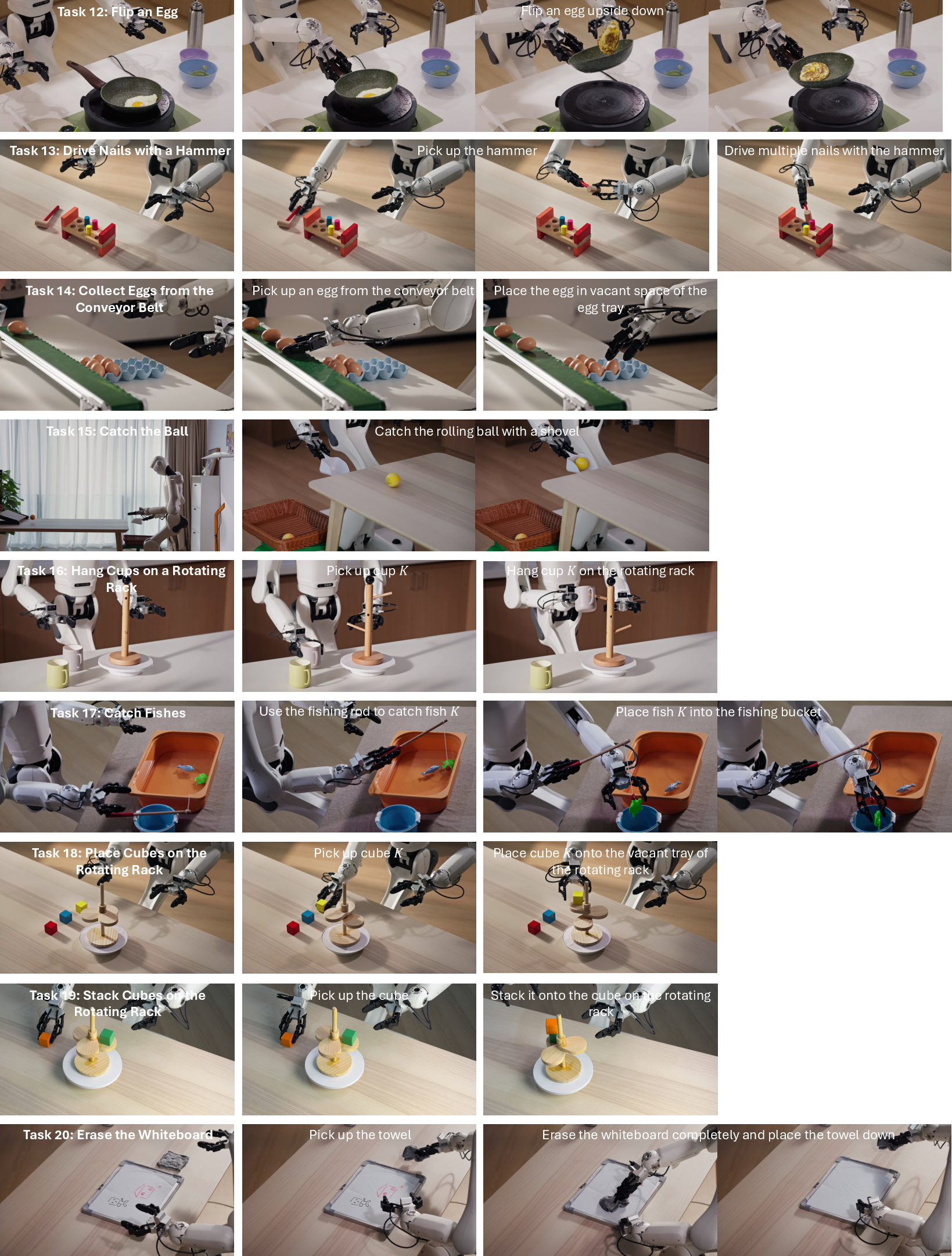
Abstract: Learning, at its core, extends beyond memorization to the ability to reason and solve novel problems by navigating a space of possibilities. We introduce Lumo-2, a latent world-action model that generates actions by reasoning over world dynamics in latent space. The learned latent world dynamics capture physically grounded visual transitions, naturally encoding future possibilities and providing a unified substrate for cross-modal alignment. This formulation enables predictive reasoning akin to world modelling while remaining lightweight and focused on physical dynamics relevant to control. Central to our approach is the hypothesis that action generation quality is governed by the geometry of the latent space. We observe that standard reconstruction-based action tokenization objectives induce representations biased toward low-level signal fidelity, leading to misalignment between reconstruction quality and downstream control performance. To address this limitation, we propose a multi-stage modality pre-alignment strategy in which action representations are progressively aligned with latent world dynamics, vision, and language. This process enforces cross-modal consistency, promotes abstraction, and induces a structured latent space for predictive reasoning. We provide a systematic empirical study of latent world modelling and modality alignment, analyzing their roles in scaling laws and out-of-distribution generalization. Results show that Lumo-2 consistently outperforms strong vision-language-action (VLA) and world-action model (WAM) baselines, with gains on challenging real-world tasks requiring temporal reasoning, physical understanding, or high control complexity, including long-horizon and dexterous manipulation. These findings suggest that structured multimodal alignment and predictive reasoning are fundamental principles for advancing embodied intelligence.


Paper Prompts
Sign up for free to create and run prompts on this paper using GPT-5.
Top Community Prompts
Explain it Like I'm 14
A simple guide to “Towards Predictive, Aligned, and Scalable Robot Learning (Lumo‑2)”
What is this paper about?
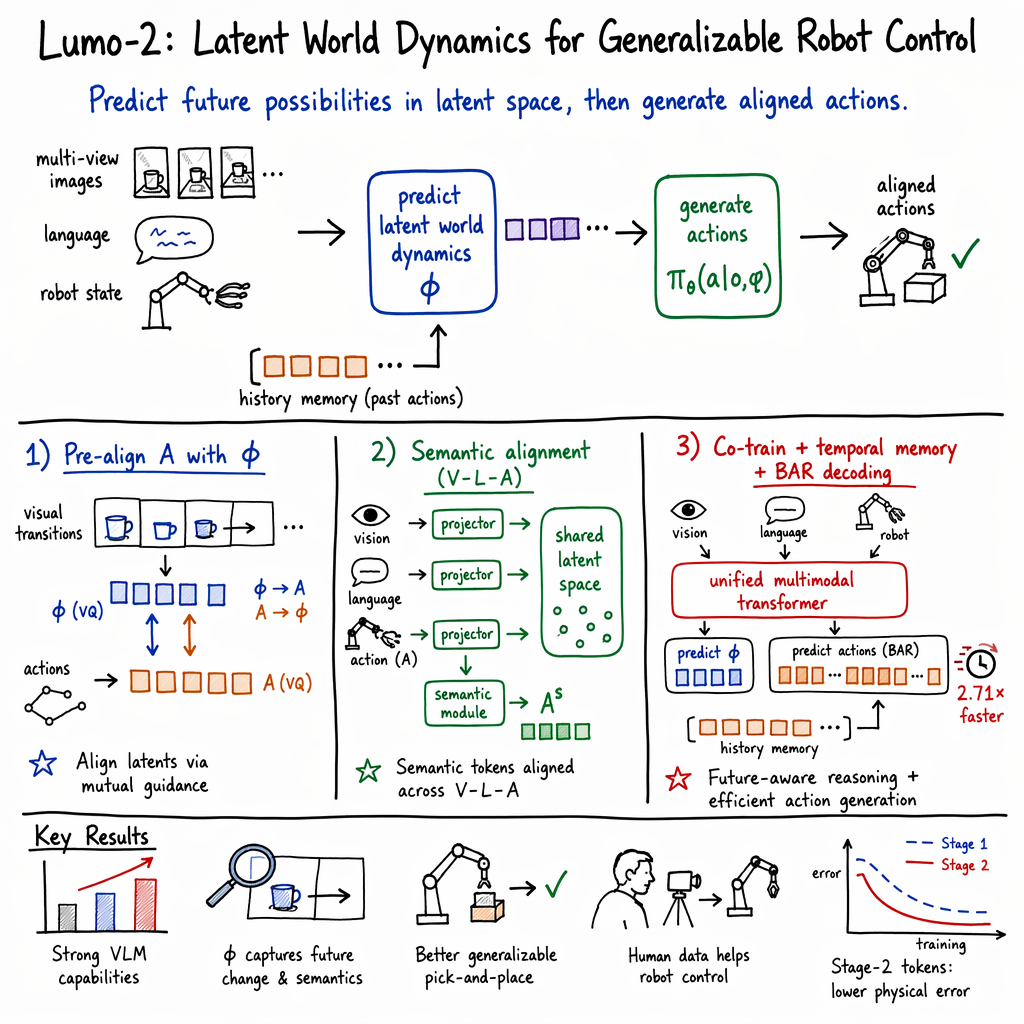
This paper introduces Lumo‑2, a new way to teach robots how to move and act in the real world. Instead of just copying what it has seen before, Lumo‑2 helps a robot “imagine” what might happen next and pick actions that make sense for its goal. It connects what the robot sees (vision), what it’s told to do (language), and how it moves (actions) so they all work together smoothly.
What questions are the researchers trying to answer?
The authors focus on a few simple but big questions:
- How can a robot plan its actions by predicting what the world will look like a moment later, without having to generate full videos in its head?
- How can we make a robot’s “seeing,” “understanding,” and “doing” speak the same “language,” so instructions, images, and actions line up?
- How can this approach keep working as we add more data and harder tasks, and still handle new situations the robot hasn’t seen before?
How does Lumo‑2 work? (Explained with everyday ideas)
Think of a robot with three abilities: eyes (vision), ears/brain for instructions (language), and muscles (actions). Training these three to cooperate is hard because they’re very different. Lumo‑2 solves this with three key ideas.
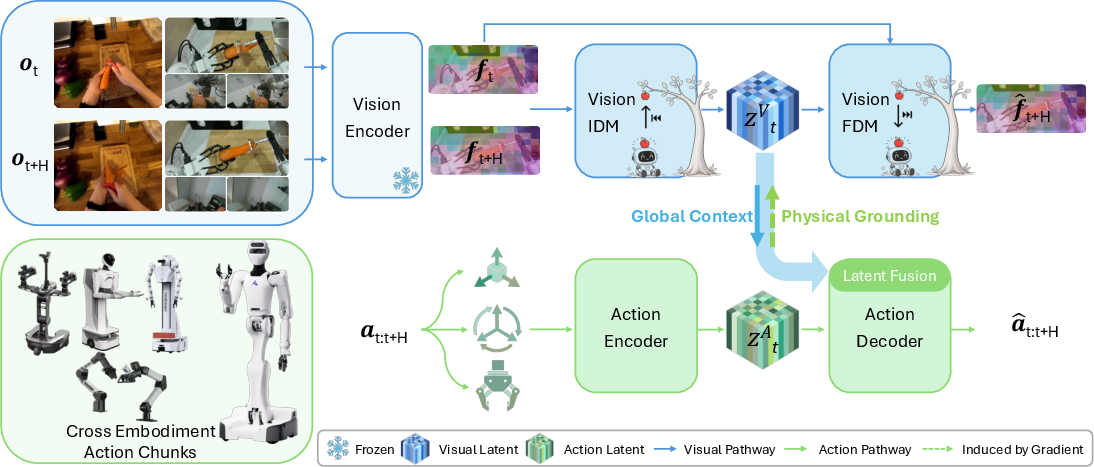
- A compact “imagination space” for the future Instead of predicting every pixel of the future, the robot builds a small, meaningful “mental sketch” of how the world might change next. The paper calls this a “latent world dynamics” space. You can think of it like a simple internal map of the next likely moves and outcomes. The robot uses this sketch to choose the next actions.
- Making all parts talk to each other clearly (modality alignment) Vision, language, and actions are different “modalities.” Lumo‑2 creates a shared representation so:
- vision captures what is happening,
- language says what should be done,
- actions carry it out, and all three match up. It’s like getting people who speak different languages to agree on the same plan using a shared set of symbols.
- Training in three stages, like leveling up in a game To make learning stable and effective, Lumo‑2 follows a step-by-step training plan:
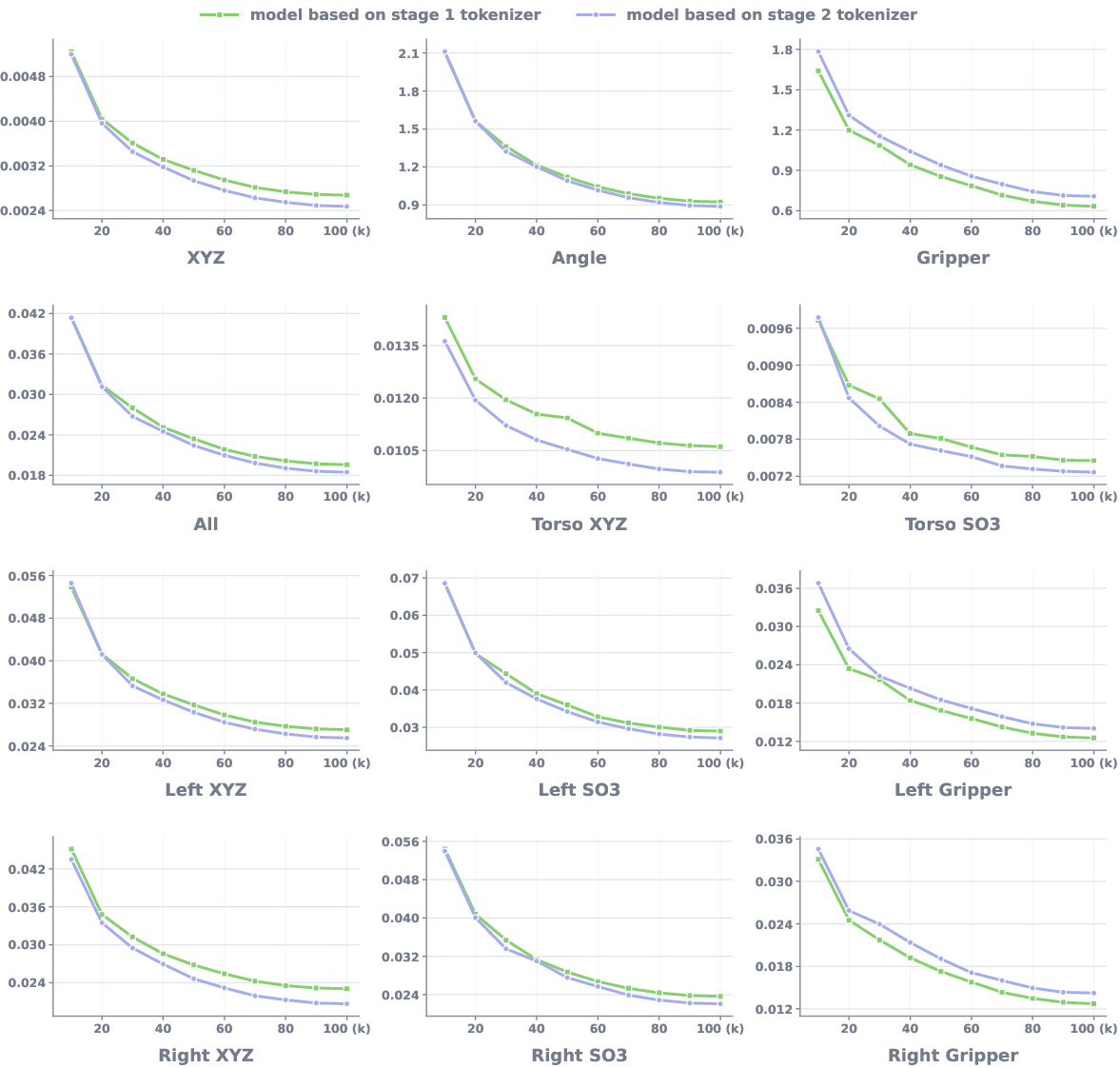
- Stage 1: Align actions with world changes. The robot looks at how images change from one moment to the next, learns what those changes mean physically, and links them to the actions that probably caused them. This cleans up the “imagination space” so it focuses on real motion, not camera noise like lighting or background clutter.
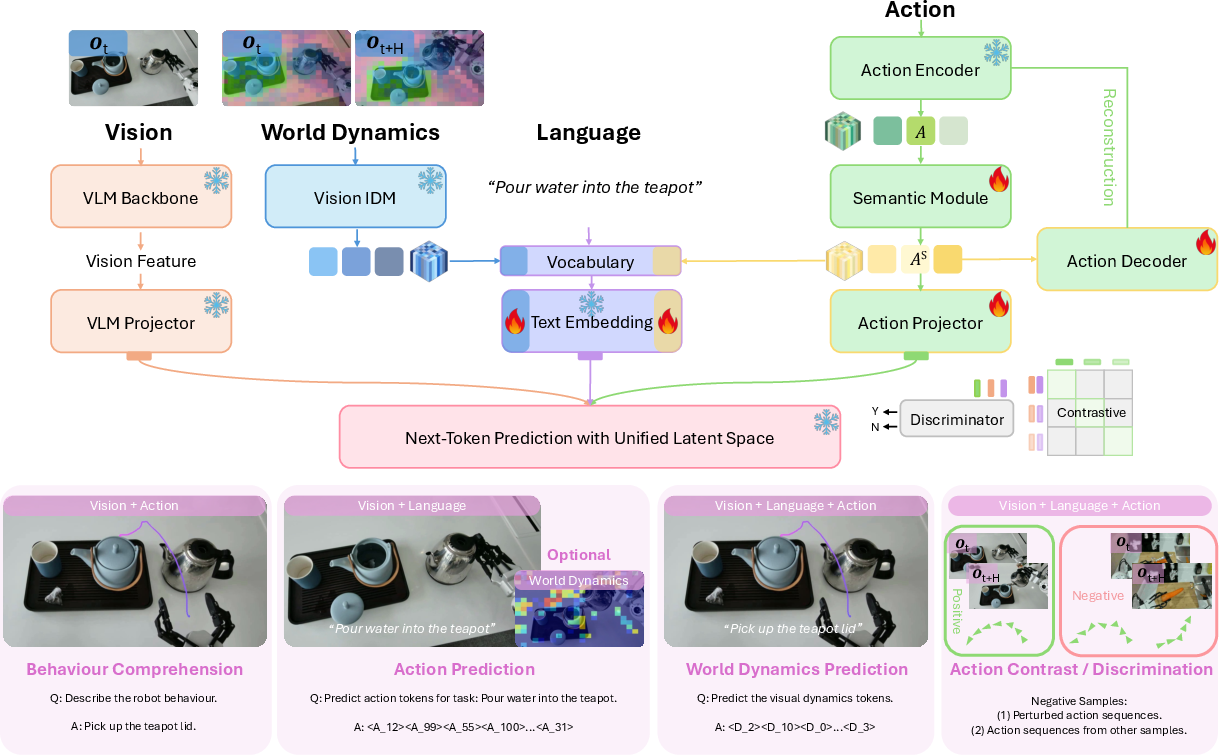
- Stage 2: Add meaning with vision and language. The robot turns its action codes into “semantic” action tokens—actions that don’t just store motion, but also carry meaning that lines up with what it sees and what it’s told in words.
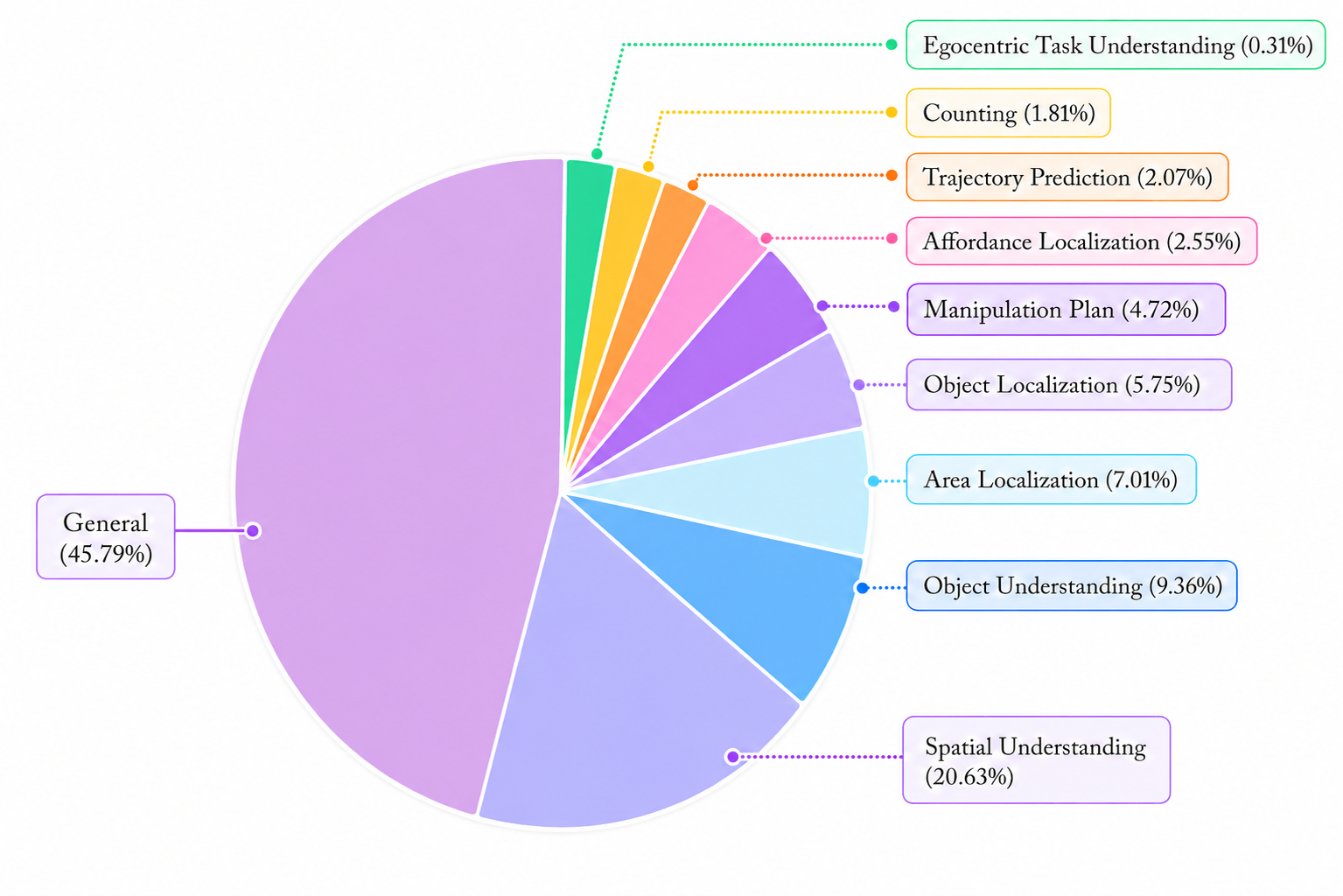
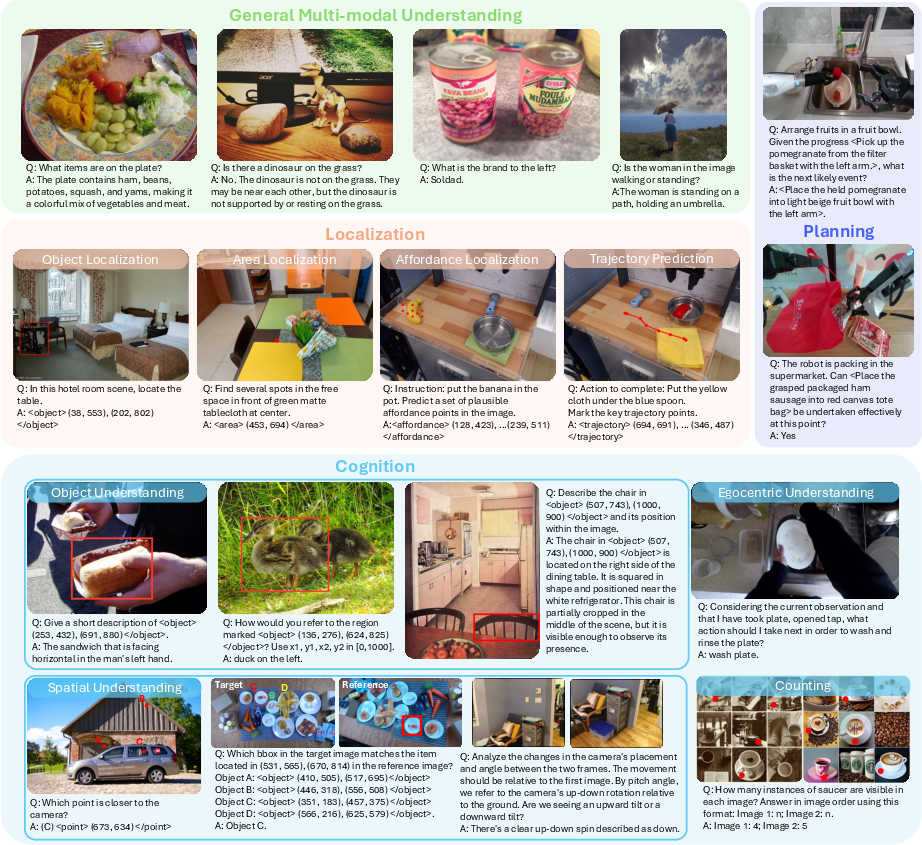
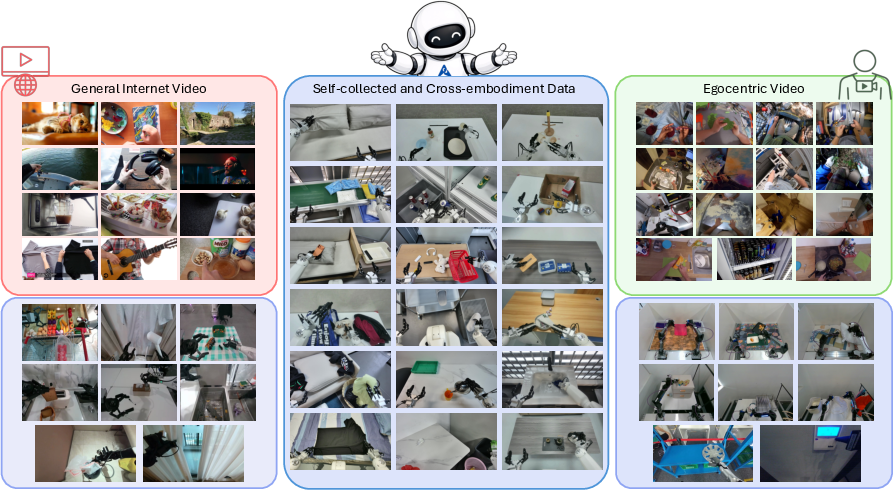
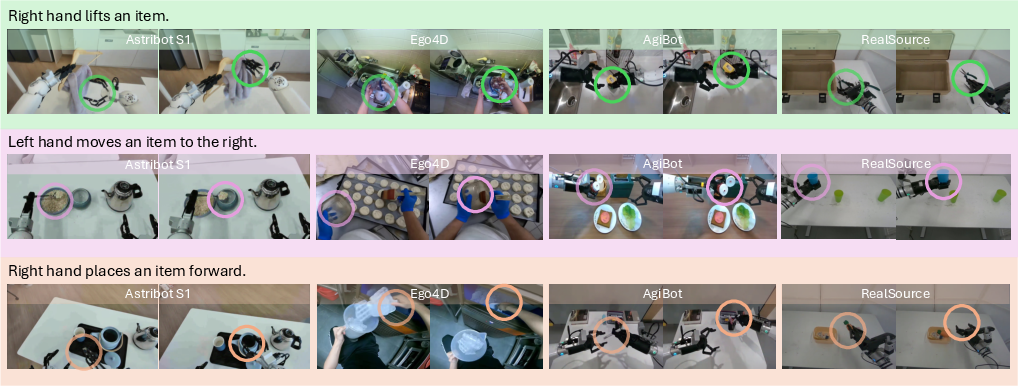
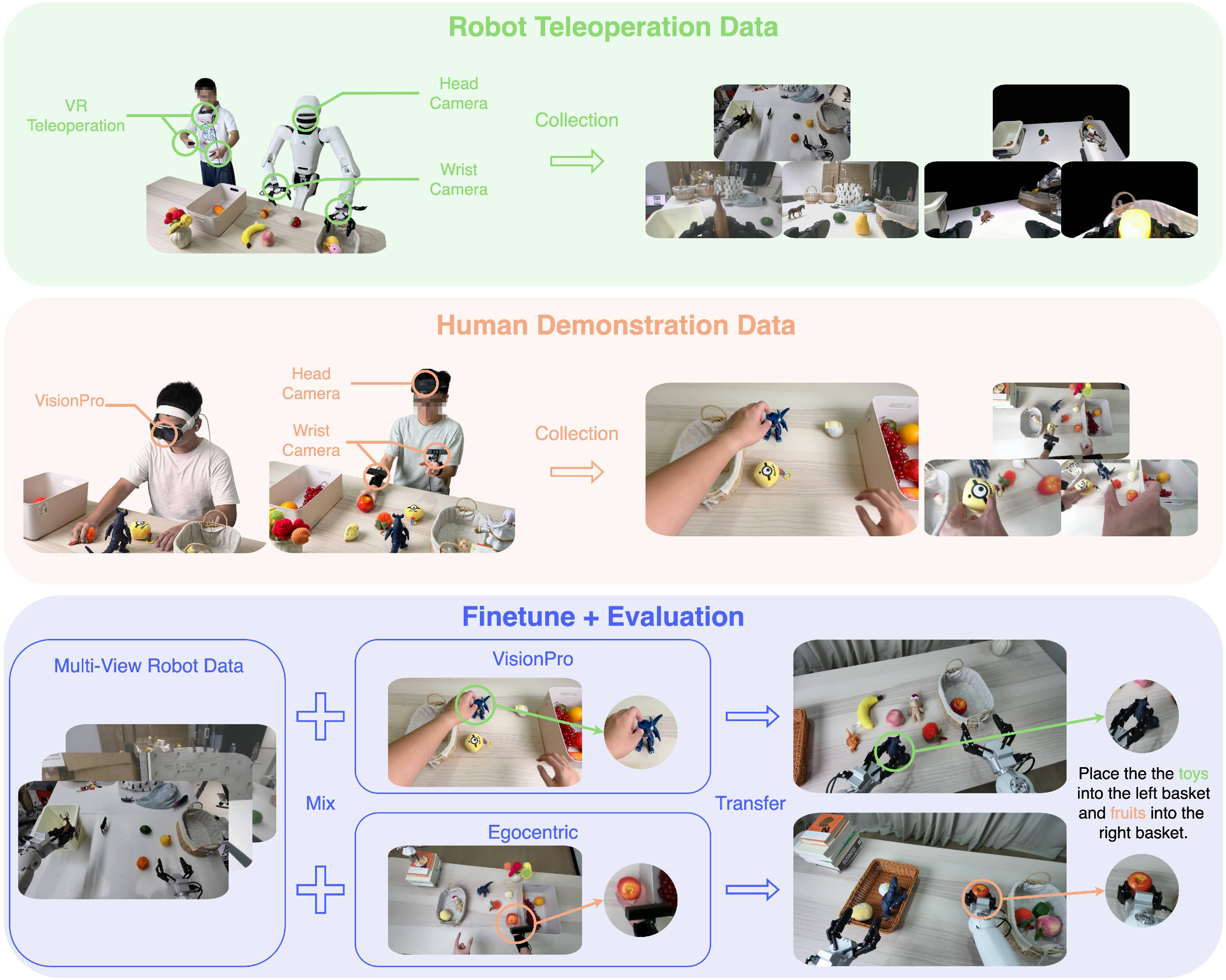
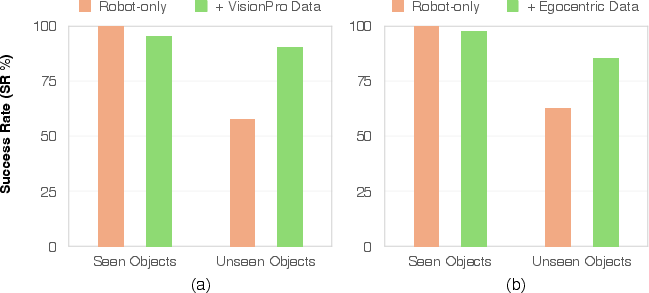
- Stage 3: Train everything together at scale. The model is then trained on lots of mixed data: pictures and videos from the internet, robot demonstrations, and egocentric videos (first-person views). Now the robot learns to first predict future dynamics in its imagination space and then generate actions that fit.
A few practical tricks make this work better:
- Short-term memory: The robot keeps a small window of recent history so it can tell which phase of a task it’s in (for example, “still pouring” vs. “done pouring” even if the image looks similar).
- Efficient action “words”: Actions are turned into compact tokens (like words for movement), grouped by meaning (e.g., left arm vs. right arm), so the model can generate them quickly and coherently.
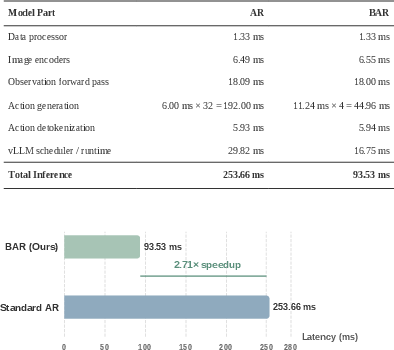
- Faster decoding: A “block-wise autoregression” method predicts multiple action tokens at once instead of one-by-one, giving about a 2.7× speedup in action generation—important for real-time control.
What did they find, and why is it important?
According to the paper’s experiments and analysis:
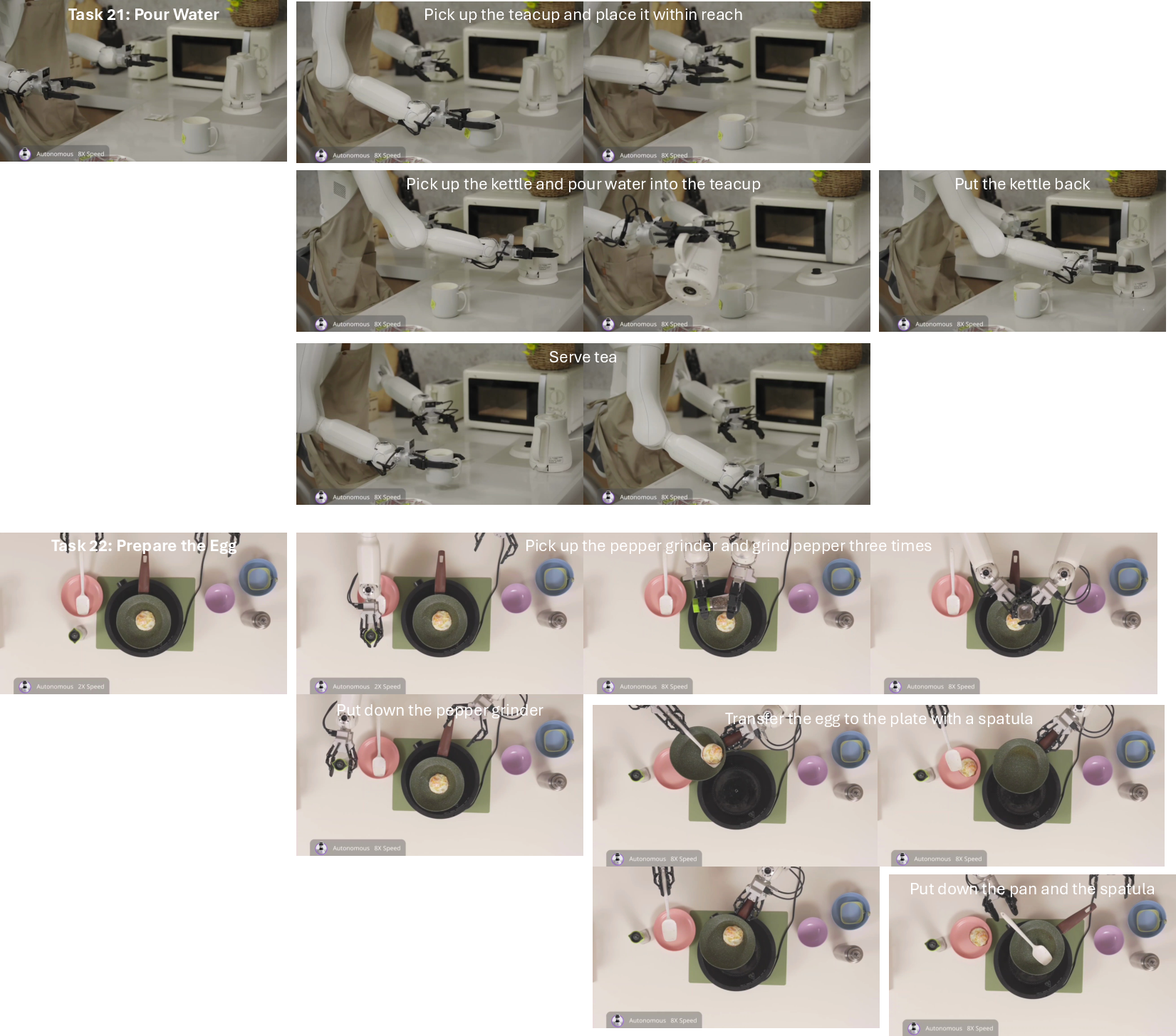
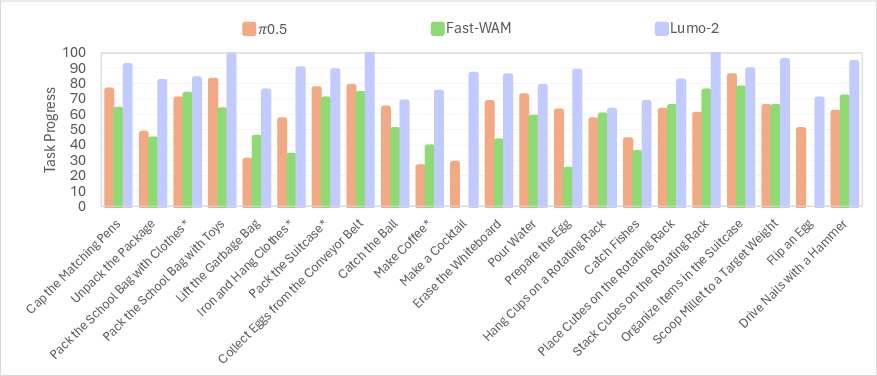
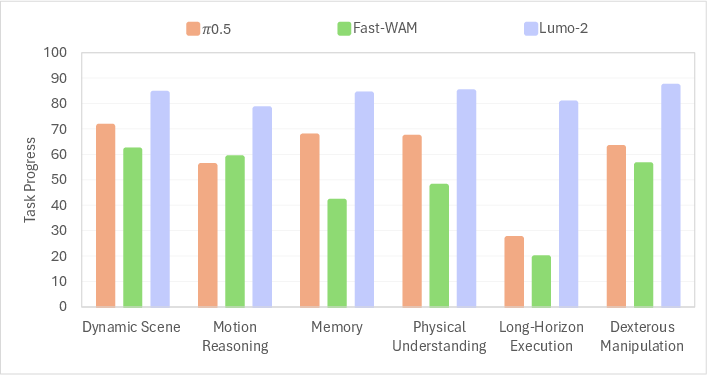
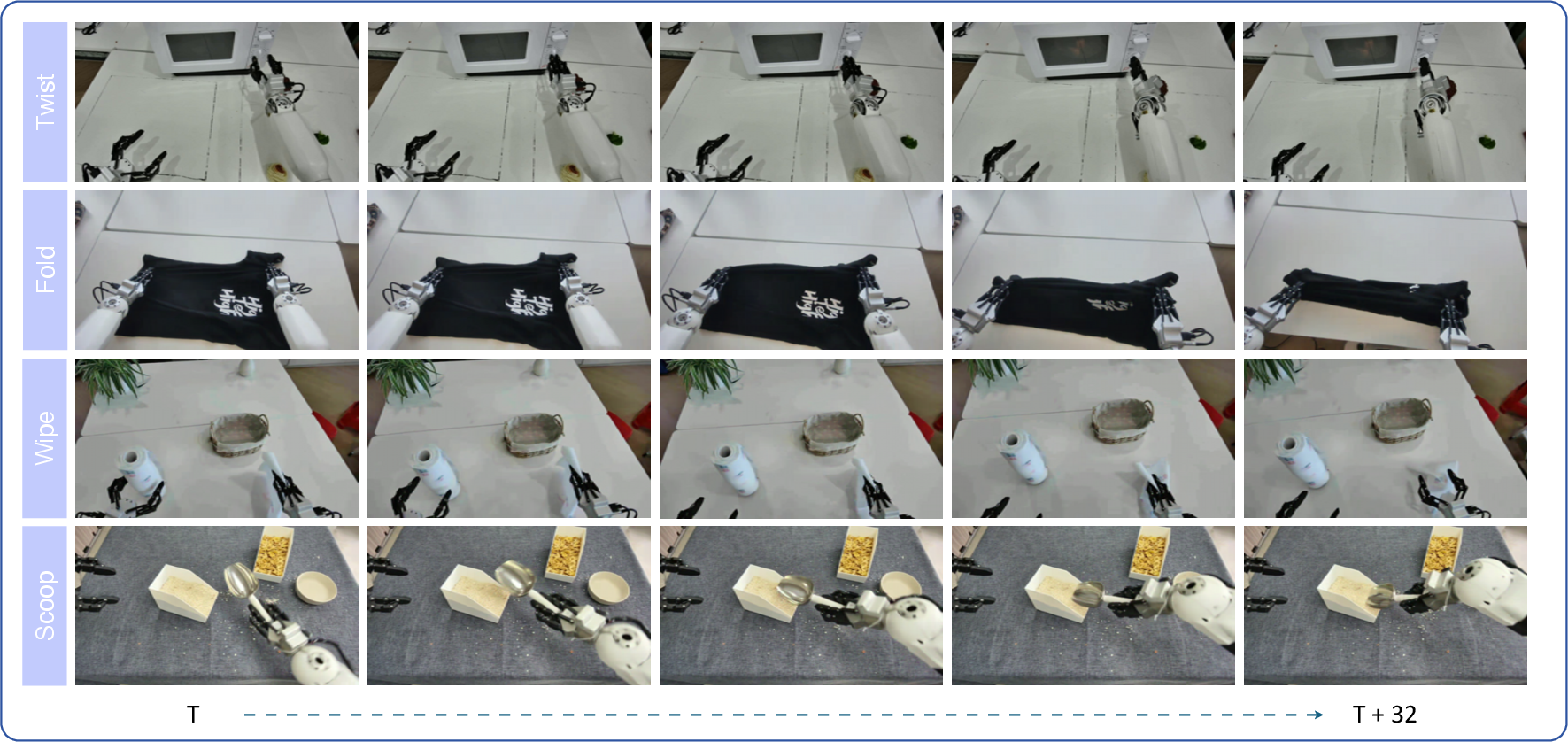
- Better performance on tough, real-world tasks: Lumo‑2 beats strong baseline models on tasks that need planning over time, understanding of physics, or precise control—like long, multi-step jobs and dexterous hand/arm movements.
- Stronger generalization: Because actions, vision, and language are aligned in a shared space, the model handles new or out-of-distribution situations more reliably.
- Scales well with more data: The structured design and the staged alignment help it learn from big, mixed datasets (web videos, robot data, human egocentric videos) without becoming unstable.
- Faster and more practical: The faster action decoding makes it more suitable for real robots that need to act quickly and smoothly.
What could this mean for the future?
If robots can “imagine” the near future in a compact way and keep their seeing, understanding, and doing tightly aligned, they can:
- follow instructions more reliably in messy, real environments,
- learn useful behavior from many kinds of data (not just carefully labeled robot demos),
- adapt to new tasks and tools without starting from scratch,
- and operate safely and efficiently in homes, factories, or hospitals.
In short, Lumo‑2 suggests a promising path toward more general, dependable robot intelligence by combining predictive thinking with a shared “language” across vision, language, and actions.
Knowledge Gaps
Unresolved knowledge gaps, limitations, and open questions
Below is a concise, actionable list of what remains missing, uncertain, or unexplored in the paper, organized to guide future research.
- Formalization of latent world dynamics: The paper does not precisely define the probabilistic structure of the latent variable φ (e.g., stochastic vs. deterministic, uncertainty modeling, identifiability), nor how its geometry quantitatively governs action generation quality.
- Latent geometry diagnostics: No metrics or analyses are provided to assess manifold properties of φ (e.g., smoothness, disentanglement, topology), or how these properties correlate with control performance across tasks.
- Predictive horizon and rollout policy: H and re-planning cadence for chunked action generation are unspecified; it remains unclear how far ahead φ predicts, how rollouts are stabilized, and how chunking interacts with closed-loop execution.
- Exposure bias and compounding errors: The training/inference mismatch for autoregressive chunking (teacher forcing vs. test-time rollouts) and its impact on long-horizon tasks are not analyzed.
- BAR trade-offs: Block-wise autoregression (BAR) is evaluated on latency only; its effect on action accuracy, stability, and cross-dimensional coupling (e.g., bimanual coordination) is not measured.
- Memory design limits: The short-term memory uses only past actions (no past images or latent φ); the required history length, robustness to long delays, and failure cases when visual aliasing spans longer than the buffer are unexamined.
- Proprioception integration: Although proprioceptive state is mentioned, its encoding, fusion with φ, and contribution to performance are not detailed or ablated.
- Force/impedance control: The action space appears kinematic (pose/velocity/gripper); there is no pathway for force/torque or impedance actions, limiting applicability to contact-rich or compliant manipulation.
- Tactile and non-visual sensing: The approach omits tactile/force sensors and other modalities (e.g., audio), leaving performance on tasks requiring contact feedback or non-visual cues unexplored.
- Cross-embodiment grounding: How action tokens and φ transfer across robots with different kinematics/dynamics is not specified beyond decomposition into groups; no calibration procedure or embodiment-aware normalization is described or evaluated.
- Rate debiasing method: The “distribution debiasing” for action-rate heterogeneity is referenced but not detailed; its algorithm, sensitivity, and impact on policy performance are unknown.
- Semantic action codebook interpretability: Stage 2 claims semantically enriched action tokens; no probing, clustering, or human-interpretability studies are provided to validate semantic content.
- Alignment stability across stages: Risks of catastrophic forgetting or representational drift when moving from Stage 1→2→3 (frozen vs. unfrozen components) are not analyzed; no alignment health metrics over training are reported.
- Cross-modal alignment ablations: The relative contributions of each Stage 2 objective (contrastive, discriminative, cross-modal prediction) to control success and generalization are not disentangled.
- Video-only learning to control: The pathway from unlabeled egocentric/general videos to improved action generation is unclear (no explicit action-label learning or inverse RL); how, and to what extent, video-only VLW supervision benefits control is not quantified.
- Two-frame vs. multi-frame dynamics: φ is described as learned from inter-frame changes but trained on 5-frame clips; the sensitivity of φ to clip length and its ability to capture longer-term dependencies is not studied.
- Uncertainty and multimodality: The model lacks explicit uncertainty estimation (e.g., probabilistic φ or action distributions); consequences for safety, risk-aware planning, or multimodal future prediction are unaddressed.
- Robustness and OOD generalization: Claims of improved OOD generalization are not backed by explicit benchmark definitions, stress tests (lighting/camera shifts, novel objects/materials, transparent/liquid objects), or quantitative robustness metrics.
- Dataset mixture sensitivity: The effect of data mixture ratios (VLM/video/robot) on downstream control and failure modes (negative transfer) is not ablated; mixing policies and sampling weights are not justified.
- Scaling laws: Although a “systematic empirical study” is claimed, there is no presented analysis of model/data/compute scaling (e.g., 2B→4B→7B), diminishing returns, or scaling breakpoints for control success.
- Hardware-in-the-loop latency: BAR speedups are measured on vLLM/desktop GPUs; end-to-end robot latency (sensing→inference→actuation), frequency limits, and control-loop stability on-device are not reported.
- Safety and constraint handling: There is no mechanism for constraint-aware action generation (e.g., collision avoidance, joint limits, human safety zones) or evaluation on safety-critical tasks.
- Failure mode taxonomy: The paper lacks systematic error analysis (e.g., per-task failure categories such as perception misgrounding, planning error, dynamics mismatch, control saturation).
- Long-horizon temporal structure: How φ and action tokens represent and transition between subgoals or phases (options/skills) is unspecified; no hierarchical or options-based structure is evaluated.
- Language grounding reliability: Sensitivity to instruction ambiguity, negation, or adversarial prompts is not studied; no calibration or detection of off-instruction actions is described.
- Camera and calibration dependence: Robustness to camera placement changes, calibration errors, occlusions, and multi-view synchronization issues is not evaluated; requirements for setup are unclear.
- Generalization to locomotion/multi-agent: The approach is tailored to manipulation; applicability to locomotion, navigation, or multi-agent coordination with shared φ is unexplored.
- Comparative baselines and metrics: Specific baselines, tasks, and evaluation metrics are not included; without standardized benchmarks, the claimed gains over VLA/WAM models are hard to interpret.
- Reproducibility and compute: Training requires large-scale compute (up to 160 H100s); there is no discussion of reproducibility, open-sourcing, or how results transfer under constrained compute.
- Ethical/data considerations: Dataset licensing, privacy, and potential biases in large web-scale corpora are not discussed; implications for downstream behavior and fairness are unexamined.
Practical Applications
Immediate Applications
The following applications can be deployed with current capabilities of Lumo-2 or with modest engineering effort, leveraging its latent world-dynamics reasoning, cross-modal alignment (vision–language–action), and faster block-wise autoregression (BAR) for ~10 Hz control.
- General-purpose industrial manipulation cells — Sector: Robotics, Manufacturing, Logistics
- Use case: Rapidly configure dual-arm or single-arm cells for kitting, bin picking, machine tending, fastening, and rework without per-task programming—fine-tune from a few demonstrations, including egocentric human videos captured by devices like Vision Pro.
- Tools/workflows:
- Demonstration-to-policy toolkit (egocentric capture → latent world dynamics → semantic action tokens → deployment).
- Skill libraries built around semantically enriched action tokens for reuse/transfer across lines and robots.
- Assumptions/dependencies: Multi-view RGB sensing or wrist cameras; safe cell setup; access to H100/A100/RTX-class inference or optimized distillation; availability of representative demonstrations in the new domain.
- Warehouse pick-and-place and restocking — Sector: Logistics, Retail
- Use case: Long-horizon picking, containerization, shelf restocking, and exception handling using predictive latent dynamics for phase-aware execution (regrasp, reorient, place).
- Tools/workflows:
- BAR-enabled low-latency action decoding integrated with existing WMS.
- Affordance-aware grasping via the model’s localization/trajectory prediction training.
- Assumptions/dependencies: Reliable grasp hardware; SKU variability within the training distribution; calibrated cameras; fallback policies for OOD items.
- Laboratory and small-batch automation — Sector: Healthcare (labs), Biotech, Pharma
- Use case: Pipette handling, tube capping, reagent transfers, and device interaction where dexterity and temporal reasoning are essential.
- Tools/workflows:
- Semantic action token “skills” for repeatable lab routines.
- Language-guided adjustments (e.g., “switch to 10 µL tips and repeat step 3”).
- Assumptions/dependencies: Sterility/contamination safeguards; compliance SOPs; fine-grained perception of transparent liquids may require extra sensing (e.g., weight scales, vision tuning).
- Intralogistics in hospitals and facilities — Sector: Healthcare, Facilities Management
- Use case: Transporting supplies/linens, door/button operation, cart docking, and station handoffs with consistent phase tracking via short-term action memory.
- Tools/workflows:
- Instruction-following user interface for staff; natural-language task assignment and monitoring (“deliver meds to Room 204, then dock”).
- Assumptions/dependencies: HRI safety compliance; role-based access; controlled corridors/traffic policies.
- Retail backroom and front-of-house support — Sector: Retail, Hospitality
- Use case: Product facing, shelf tidying, tray handling, simple food prep support (safe sub-tasks like placing/dispensing), and cleaning workflows.
- Tools/workflows:
- Pre-aligned affordance localization for “handle,” “button,” “spout,” etc., to robustly actuate common fixtures.
- Assumptions/dependencies: Food safety boundaries; safe tool use; consistent fixture geometry coverage in training.
- Household assistance for ADLs (non-safety-critical) — Sector: Consumer Robotics
- Use case: Tidying, organizing, laundry sorting/folding, dishwasher loading/unloading, pouring tasks the model explicitly handles.
- Tools/workflows:
- End-user teaching via wearables: record a short demonstration; auto-fine-tune to the home’s configuration.
- Assumptions/dependencies: Conservative safety constraints; child/pet-safe operation; reliable detection of fragile objects.
- Quality assurance and compliance logging — Sector: Manufacturing, Regulated Industries
- Use case: Automatic natural-language descriptions of executed behaviors (Stage 2 Behavior Comprehension) for traceability.
- Tools/workflows:
- Auto-generated execution logs: “Opened valve A, waited 3s, set knob to 2.3.”
- Assumptions/dependencies: Audit requirements accept ML-generated logs, potentially with human verification.
- Robotic education and rapid prototyping — Sector: Education, Academia
- Use case: Teaching robotics courses/labs with world-model-based reasoning; quick iteration on new manipulation tasks without bespoke motion code.
- Tools/workflows:
- Open curricula on latent world-action models, tokenization, and cross-modal alignment; benchmarking and ablation on scaling laws and OOD generalization.
- Assumptions/dependencies: Access to pre-trained checkpoints, reasonable GPU resources, and supported robot platforms.
- Cross-embodiment task transfer — Sector: Robotics Platforms/OEMs
- Use case: Port skills between different arms and bimanual platforms using semantic action tokens and learned world dynamics as a common substrate.
- Tools/workflows:
- “Adapter” modules that map platform-specific kinematics to a shared token space; reduced overhead in onboarding new hardware.
- Assumptions/dependencies: Calibration and embodiment metadata; adequate cross-embodiment data during pretraining.
- Predictive safety monitors and watchdogs — Sector: All robotics
- Use case: Use latent future dynamics to forecast near-term hazardous interactions (e.g., potential collisions or spills) and gate or slow action generation.
- Tools/workflows:
- Lightweight monitor service that runs φ-forecasting in parallel; policy gating layer integrated into controller.
- Assumptions/dependencies: Properly calibrated scene representation; conservative thresholds; fallbacks for uncertainty spikes.
Long-Term Applications
These applications require further research, scaling, validation in safety-critical contexts, or integration with additional sensing/hardware.
- Generalist home assistant with appliance/tool integration
- Use case: Whole-home autonomy spanning diverse appliances and tools beyond the training distribution; language and visual grounding for arbitrary tasks.
- Potential products/workflows:
- “Teach-by-watching” pipelines using egocentric videos from residents; robust reuse across households.
- Dependencies/assumptions: Robustness in cluttered, dynamic homes; safe tool use; tactile feedback integration; strong OOD generalization; long-term maintenance.
- Collaborative multi-robot manipulation with shared world models — Sector: Warehousing, Manufacturing, Field Robotics
- Use case: Coordinated bimanual/multi-robot tasks (assembly, lifting) via a shared latent world-dynamics space for joint planning.
- Tools/workflows:
- φ-synchronization across agents; multi-agent BAR decoding with collision-aware constraints.
- Dependencies/assumptions: Low-latency comms; consistent cross-robot calibration; new training regimes for cooperative dynamics.
- Surgical support and sterile field operations — Sector: Healthcare
- Use case: Instrument setup, sterile transfer, and device manipulation with predictive reasoning and semantic action tokens.
- Tools/workflows:
- Regulatory-grade intent logging and verification; constrained execution with strict safety gating.
- Dependencies/assumptions: Extensive validation and certification (e.g., FDA/CE); integration with vision/tactile sensors; liability frameworks.
- Hazardous environment manipulation — Sector: Energy (nuclear/offshore), Chemical, Utilities
- Use case: Valve turning, inspection, and tool operation in high-risk areas where predictive reasoning reduces operator exposure.
- Tools/workflows:
- Teleop-to-autonomy pipeline: collect human demos remotely, then fine-tune for supervised autonomy.
- Dependencies/assumptions: Ruggedized hardware; radiation/temperature tolerant sensors; rigorous fail-safes.
- Standards for semantic action tokens and cross-embodiment data — Sector: Policy, Standards Bodies, Robotics Industry
- Use case: Establish interoperable formats for action tokens, φ-embeddings, and datasets for cross-embodiment alignment and benchmarking.
- Tools/workflows:
- Open schemas and benchmarks (token vocabularies, φ-evaluation), similar to ONNX for models but for embodied control.
- Dependencies/assumptions: Industry consortium participation; IP/data-sharing agreements; long-term stewardship.
- Edge inference and model compression for mobile/embedded deployment — Sector: Robotics, Hardware/Software
- Use case: Run Lumo-2 derivatives on embedded GPUs/NPUs for mobile manipulators and drones.
- Tools/workflows:
- Distillation, quantization, and BAR-optimized decoders; streaming-friendly φ inference.
- Dependencies/assumptions: Accuracy–latency trade-off studies; new hardware kernels; robustness under lower precision.
- Continual learning and personalization at scale — Sector: Consumer/Enterprise Robotics
- Use case: On-device, privacy-preserving adaptation to users’ routines with automated drift detection and policy updating.
- Tools/workflows:
- Federated fine-tuning pipelines; consent and governance layers for egocentric data.
- Dependencies/assumptions: Differential privacy guarantees; regulation-compliant data handling; catastrophic forgetting mitigation.
- Cross-domain extension to mobile manipulation and navigation
- Use case: Unify locomotion and manipulation via shared latent world dynamics and action tokens for whole-body control.
- Tools/workflows:
- Expanded Stage 1–3 training with locomotion datasets; hierarchical BAR (planning + control blocks).
- Dependencies/assumptions: Broader datasets; robust perception in unstructured environments; safety validation for HRC (ISO/TS 15066).
- Regulatory frameworks for learning-based embodied AI — Sector: Policy/Regulation
- Use case: Certification and auditing procedures for latent world-model-driven robots, including interpretability via Behavior Comprehension logs.
- Tools/workflows:
- Model cards and audit trails tied to executed φ-trajectories and action tokens; scenario coverage and OOD tests.
- Dependencies/assumptions: Consensus on acceptable risk; standardized test suites; third-party certification bodies.
- Financial planning and ROI models for generalist retrofits — Sector: Finance, Operations
- Use case: Evaluate CAPEX/OPEX benefits of replacing task-specific automation with generalist Lumo-2-based systems across production mixes.
- Tools/workflows:
- Tooling to simulate productivity gains using φ-driven task complexity estimates; sensitivity analyses for data collection costs.
- Dependencies/assumptions: Transparent performance metrics; robust benchmarking; integration costs for legacy lines.
These applications hinge on several core assumptions common across deployments:
- Data availability and rights: sufficient, representative multimodal data (including egocentric videos) and clear consent/compliance processes.
- Hardware readiness: appropriate sensors (multi-view cameras/wrist cams; potentially tactile), calibrated kinematics, reliable end-effectors.
- Compute and latency: inference hardware and/or compressed models to meet control loop needs; BAR decoding integrated into control software.
- Safety and governance: gating layers for predictive safety, human-in-the-loop escalation for OOD cases, and auditable behavior descriptions.
- Ecosystem support: access to pre-trained checkpoints, adapters for different robot embodiments, and standardized interfaces for integration.
Glossary
- Action tokenization: Converting continuous control signals into discrete tokens for learning and generation. "optimize action tokenization via auto-encoding."
- AdamW: An optimizer that decouples weight decay from gradient updates to improve generalization. "optimized with AdamW~\citep{loshchilov2017decoupled}"
- bfloat16: A 16-bit floating-point format that preserves exponent range of float32 for efficient mixed-precision training. "bfloat16 mixed-precision training"
- Block-wise Autoregression (BAR): An inference/training scheme that predicts groups of tokens per step to speed up autoregressive generation. "Block-wise Autoregression (BAR) over discrete action codes enables efficient multi-token prediction while preserving autoregressive consistency"
- Causal linkage: A modeled directional dependency connecting predicted dynamics to action generation. "establishes a causal linkage between visual dynamics and action generation."
- Causal mask: An attention mask that restricts tokens to attend only to past (or allowed) positions to maintain autoregressive causality. "We replace the standard causal mask with a block-wise causal mask"
- Causal spatial-temporal transformer: A transformer that models time-ordered spatial and temporal dependencies with causal constraints. "encoded by a causal spatial-temporal transformer~\citep{bu2025univla}"
- Contrastive objectives: Learning objectives that pull matched cross-modal pairs together and push mismatched pairs apart in embedding space. "contrastive and discriminative objectives"
- Cross-embodiment: Spanning data or models across different agent bodies or platforms to improve generalization. "cross-embodiment robot datasets"
- Cross-modal alignment: Structuring and training to make different modalities (vision, language, action) share compatible representations. "providing a unified substrate for cross-modal alignment."
- Dead-code re-initialization: Resetting rarely used VQ codebook entries to prevent collapse and improve utilization. "all VQ codebooks use dead-code re-initialization."
- DINOv2: A self-supervised vision backbone used for robust feature extraction. "frozen DINOv2~\citep{Oquab2023DINOv2LR} backbone"
- Distribution debiasing: Adjusting training data distributions to mitigate biases (e.g., action-rate differences) across heterogeneous sources. "we apply a distribution debiasing method on cross-embodiment data."
- Egocentric video: First-person video capturing the visual stream from the actor’s viewpoint. "egocentric video data"
- FlashAttention-2: A fast, memory-efficient attention algorithm for transformer inference/training. "FlashAttention-2~\citep{dao2024flashattention} enabled"
- Imitation learning: Training policies to mimic expert demonstrations by maximizing likelihood of demonstrated actions. "optimized via imitation learning"
- Inverse Dynamics Model (IDM): A model that predicts actions causing observed state transitions, often from visual changes. "We train a vision-based Inverse Dynamics Model (IDM) to encode world dynamics"
- Latent chain-of-thought: Reasoning performed in a compact latent space rather than explicit textual steps. "latent chain-of-thought paradigm"
- Latent world dynamics: A compact representation of environment state transitions used to guide action generation. "latent world dynamics that capture physically grounded visual transitions."
- Latent world-action model: A model that jointly reasons in latent dynamics space and generates actions conditioned on that reasoning. "a latent world-action model"
- Partial observability: The condition where current observations do not fully specify the underlying system state. "leading to partial observability and ambiguity"
- Perceptual aliasing: Different underlying states appearing identical in observations, causing action ambiguity. "disambiguate perceptual aliasing."
- Projection module: The component that maps modality-specific features (e.g., vision) into the LLM’s embedding space. "the projection module plays a pivotal role as the interface between perception and reasoning."
- Proprioceptive state: Internal sensor readings of a robot (e.g., joint angles, velocities, gripper state). "the robot's proprioceptive state."
- Semantic action tokens: Discrete action codes enriched with semantic meaning beyond low-level kinematics. "Predict discrete semantic action tokens"
- Semantic augmentation: Adding semantically informative signals or tasks to improve representation alignment. "introduces semantic augmentation and multi-task learning"
- Sequence packing: Concatenating multiple samples into one sequence to improve training efficiency on long contexts. "we adopt sequence packing with a maximum sequence length of 8{,}192 tokens"
- Short-term memory mechanism: A learned or engineered memory of recent history to resolve ambiguity in sequential decision-making. "we incorporate a short-term memory mechanism"
- Teacher forcing: Training technique where the ground-truth previous token is fed to the model during next-token prediction. "under teacher forcing"
- Temporal context buffer: A fixed-length window of recent observations/actions used as additional input context. "a temporal context buffer, denoted by "
- Vector-quantized (VQ) codebook: A discrete set of learned embeddings used to quantize continuous features into token indices. "VQ codebook"
- vLLM: A high-throughput inference framework for LLMs with efficient scheduling. "using the vLLM~\citep{kwon2023efficient} inference framework"
- visionâlanguageâaction (VLA): Models that jointly process vision, language, and action modalities for robotic control. "visionâlanguageâaction (VLA)"
- visionâLLMs (VLMs): Models that integrate visual and textual inputs for multimodal understanding and reasoning. "In visionâLLMs (VLMs), the projection module plays a pivotal role"
- worldâaction model (WAM): Models that couple an internal world representation with action generation. "worldâaction model (WAM)"
- world modelling: Learning or using an internal model of environment dynamics to enable prediction and planning. "predictive reasoning akin to world modelling"
Collections
Sign up for free to add this paper to one or more collections.