Mixture of Frames Policy: Multi-Frame Action Denoising for Bimanual Mobile Manipulation
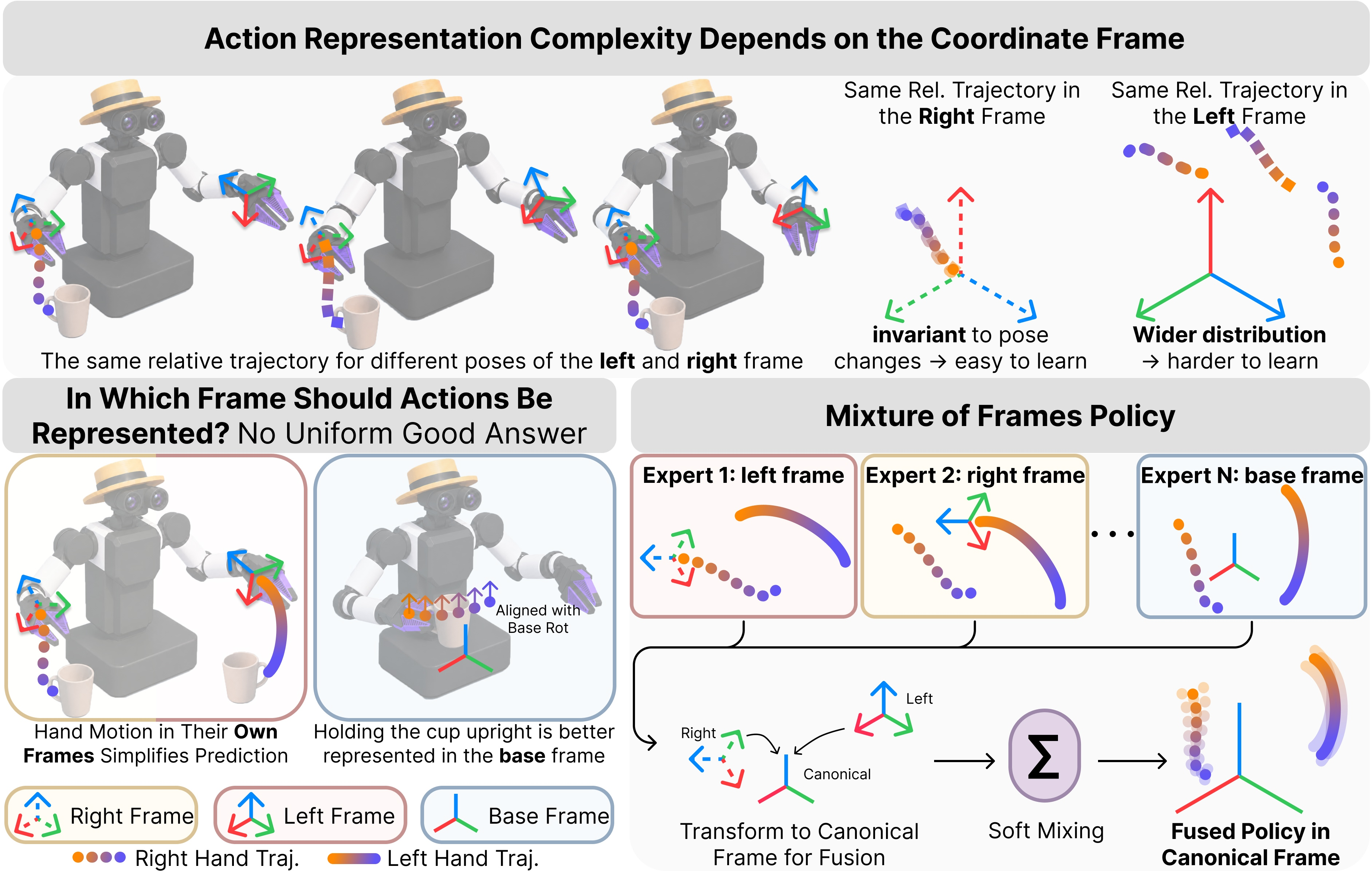
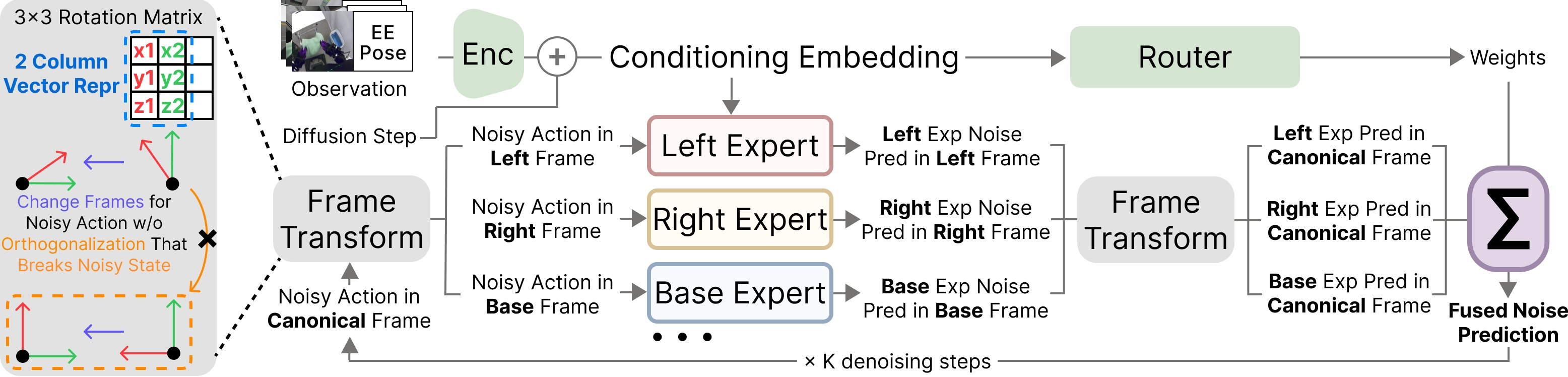
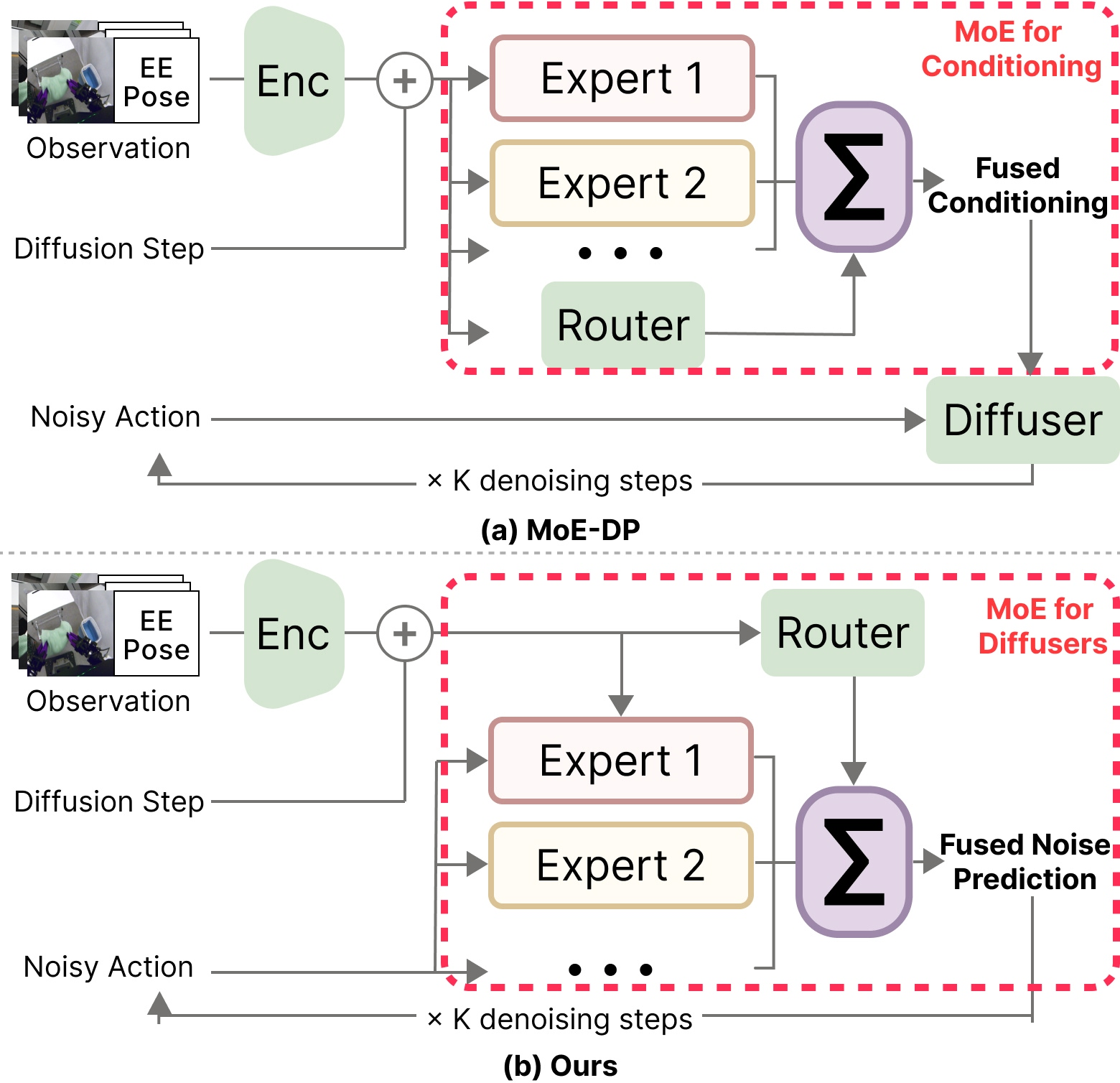
Abstract: Robotic manipulation is inherently multi-frame: local actions may be simple in an end-effector frame, while transport, upright-object handling, and whole-body coordination are better represented in a base-aligned frame. However, modern diffusion-based visuomotor policies typically commit to a single predefined action frame, forcing one denoiser to model action distributions that are often unnecessarily complex in that frame. We propose Mixture of Frames Policy (MoF), a diffusion policy that performs synchronized action denoising across multiple coordinate frames. MoF maintains a single canonical diffusion state, re-expresses it in several task-relevant frames, applies frame-specialized denoisers, and fuses their noise predictions back in the canonical frame. To make this possible for intermediate noisy diffusion states, we introduce a column-based 6D rotation representation within an SE(3) action parameterization that supports exact, differentiable frame transformations without requiring noisy rotations to lie on the SO(3) manifold. Across nine simulated bimanual manipulation tasks, we show that the best action frame is task-dependent and that MoF improves over oracle frame selection and standard Mixture-of-Experts (MoE) baselines. We further evaluate MoF on two real-world bimanual mobile manipulation tasks, demonstrating that it outperforms all constituent single-frame baselines. Project homepage: https://mofpo.github.io
Paper Prompts
Sign up for free to create and run prompts on this paper using GPT-5.
Top Community Prompts
Explain it Like I'm 14
Mixture of Frames Policy: A simple explanation
What is this paper about?
This paper is about teaching robots with two arms and wheels (bimanual mobile robots) to handle objects better. The big idea is that the way you describe a robot’s movement—its “coordinate frame,” like giving directions relative to the robot’s hand, its body, or the world—can make the task much easier or harder to learn. Since no single “frame” is best for every moment, the authors propose a method called Mixture of Frames (MoF) that lets a robot think in several frames at once and combine them smartly.
What questions are the researchers trying to answer?
- Does the choice of coordinate frame (like robot hand vs. robot base) change how well a robot can learn to act?
- Can a robot do better if it learns from multiple frames at the same time, rather than sticking to just one?
- How should we combine these different frames so the robot’s actions are smooth and consistent?
How did they approach the problem?
Think of giving directions in different ways:
- “Move your hand 10 cm forward” (hand frame)
- “Move north 10 cm” (world or base frame) Each way can make some tasks simpler. For example:
- Reaching toward a cup handle is easier to describe relative to the hand.
- Carrying a full cup while moving the base is easier to describe relative to the robot’s body.
The authors use a modern learning method called a diffusion policy, which works a bit like un-blurring a noisy photo: the robot starts with a rough, “noisy” guess of the actions and repeatedly “denoises” it into a good plan.
Here’s their key idea:
- Keep one “main” version of the robot’s planned movement (the canonical frame).
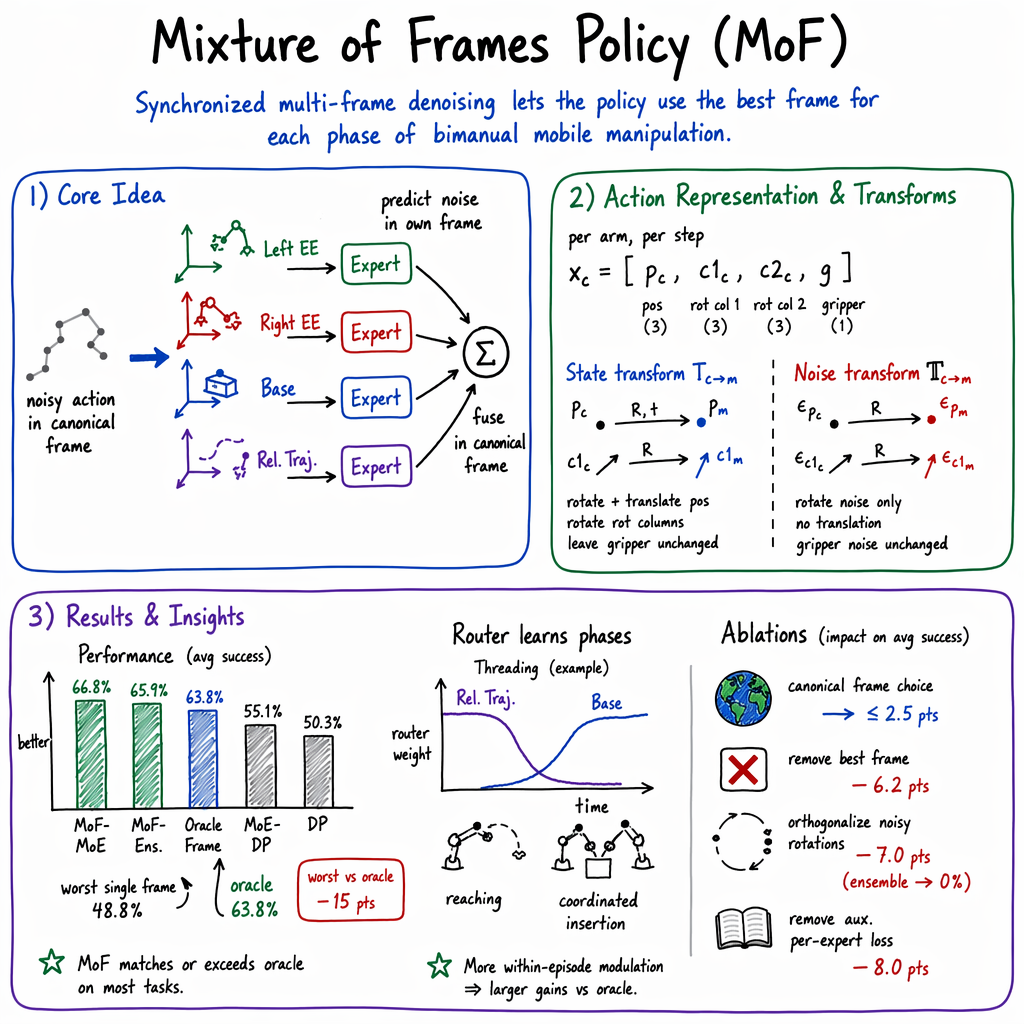
- At each denoising step: 1) Convert that plan into several frames (hand-left, hand-right, base, etc.). 2) Ask an “expert” specialized in each frame to predict how to clean up the plan in that frame. 3) Convert each expert’s suggestion back to the main frame. 4) Fuse (combine) the suggestions—either by averaging or using a small “router” network that learns how much to trust each expert at each moment.
Two extra details that make this work:
- Synchronization: All experts refine the same underlying plan at the same time, so their suggestions don’t clash.
- A math trick for rotations: During denoising, intermediate guesses can be “messy” and not perfectly valid orientations. The authors represent the robot hand’s orientation using two direction arrows (columns) instead of forcing a perfect rotation every step. That way, they can safely switch frames and combine suggestions without breaking the plan.
What did they find?
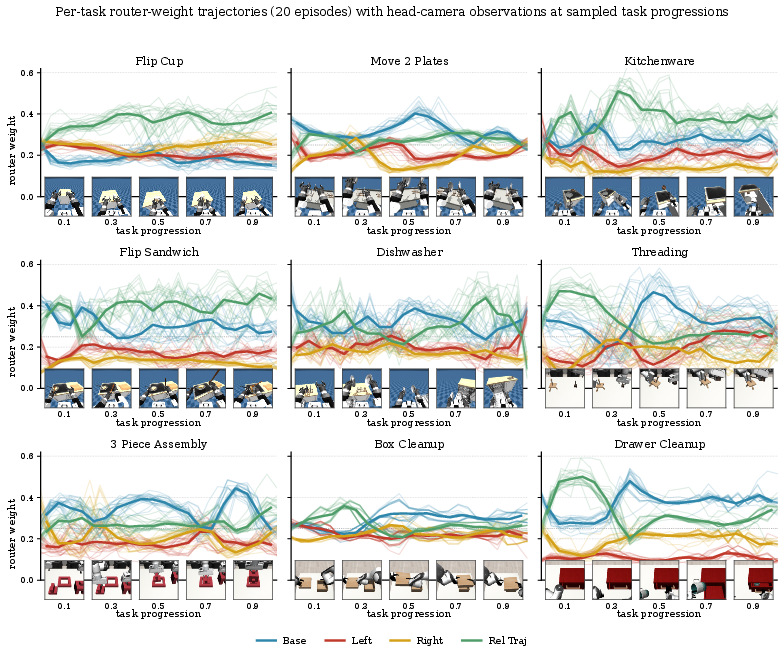
- Frame choice matters a lot. The “best” frame depends on the task and even on the phase within a task. For example, reaching might be easier in a hand frame, while transporting might be easier in a base frame.
- Their MoF method consistently did better than:
- Using a single fixed frame,
- Standard diffusion policies,
- A “mixture-of-experts” system that doesn’t switch action frames,
- And even a strong “oracle” baseline that picks the single best frame per task after seeing the results.
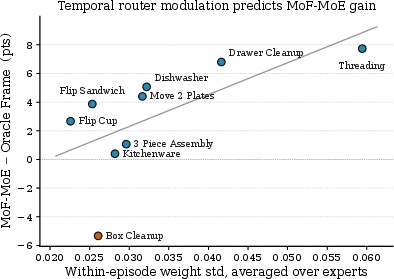
- In 9 simulated two-arm tasks, MoF had the highest average success rate and sometimes even beat the “oracle frame” because it could switch frames mid-task.
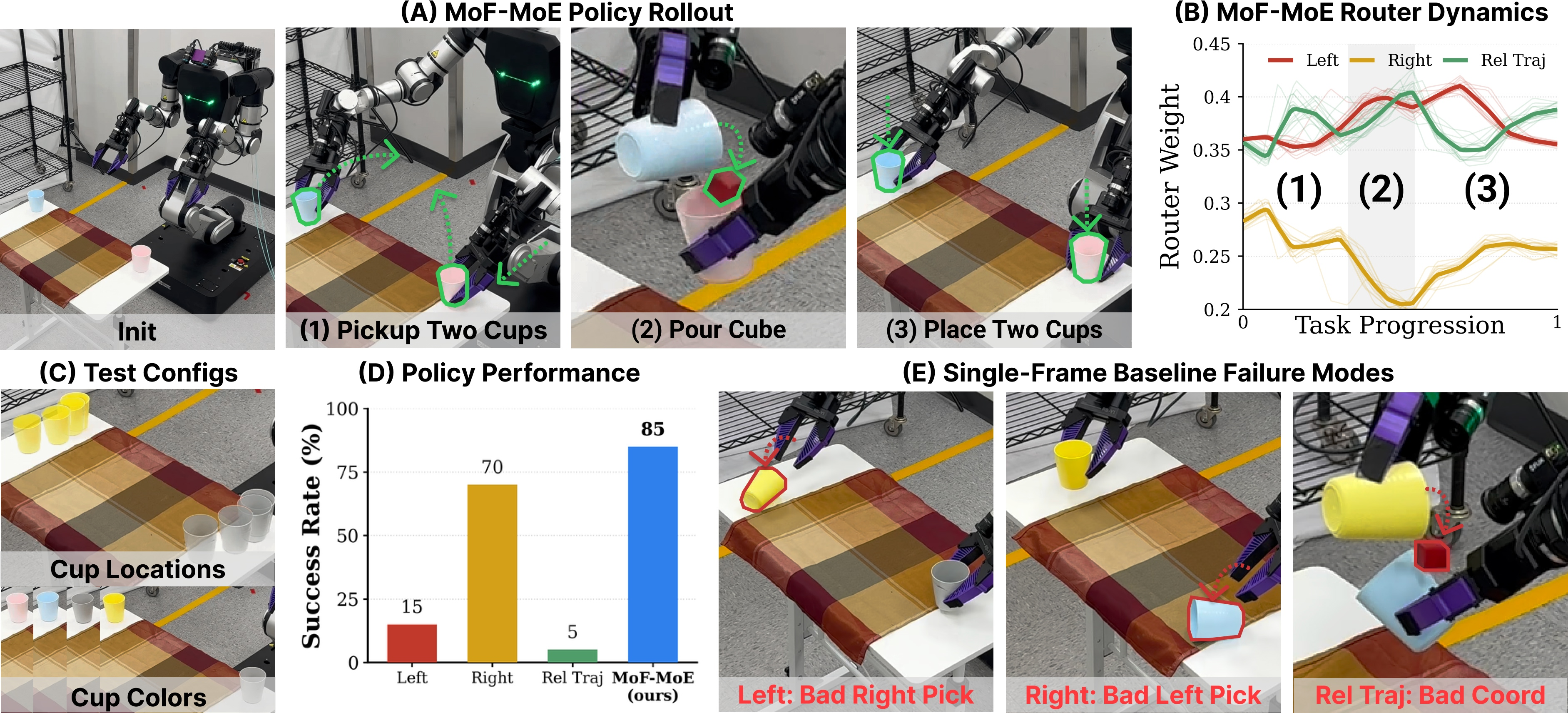
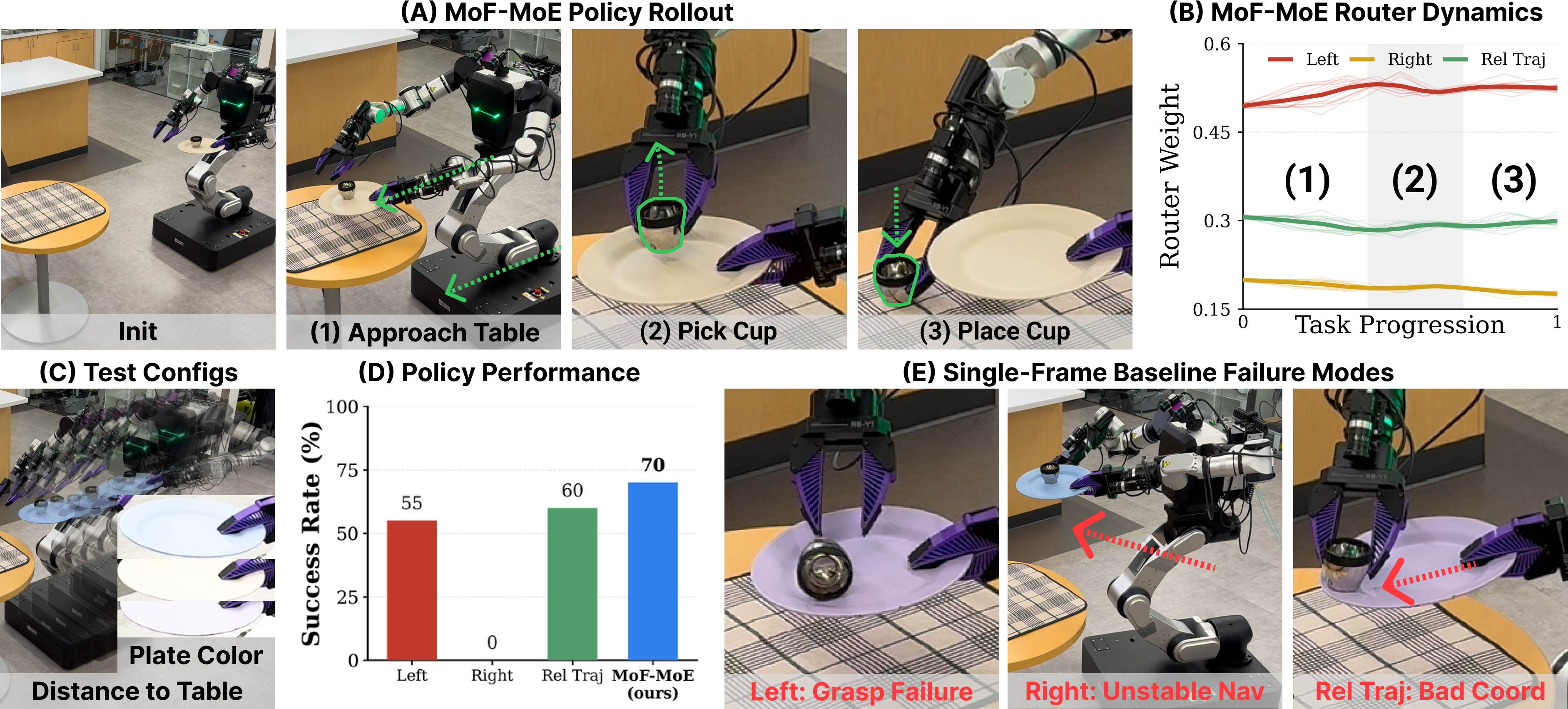
- In real-world tests (like pouring from one cup to another and serving a cup on a plate while navigating), MoF was more robust than any single-frame policy. The “router” learned to favor different frames at different times—exactly what you’d hope for.
Why this is important:
- Robots often have to do different kinds of movements within one job: precise grasps, careful transport, and coordinated two-arm moves. MoF lets the robot switch its “way of thinking” about motion so each part is easy to learn and execute.
What does this mean for the future?
- Robots could become more reliable in everyday tasks, like kitchen chores or organizing objects, because they can automatically choose the best “point of view” for each moment.
- This approach could be combined with bigger, more general robot models (like vision-language-action models) to make them even stronger.
- Future work may:
- Learn which frames to use automatically (instead of hand-picking them),
- Improve the router so it optimizes real-world success directly,
- Handle uncertain or noisy frame information from the robot’s sensors.
In short
The paper shows that “how you describe a robot’s motion” really matters. Instead of picking one way to describe actions, MoF lets the robot use several—and blend them—so it can perform complex, multi-step tasks more reliably.
Knowledge Gaps
Unresolved knowledge gaps, limitations, and open questions
Below is a concise, actionable list of what remains missing, uncertain, or unexplored in the paper, organized by theme to guide future research.
Theory and algorithmic design
- Lack of theoretical analysis of when synchronized multi-frame denoising with weighted noise fusion provably helps (e.g., convergence guarantees, bias/variance trade-offs, conditions that avoid inter-expert mode conflicts).
- No study of the optimality of linear noise fusion in canonical space versus alternatives (e.g., hard routing to a single expert per step, mixture in latent/action spaces, learned non-linear fusion).
- Router is trained only via denoising loss; no behavior-aware training (e.g., using policy rollouts, success-weighted or reinforcement signals) to align routing with downstream task performance.
- Absence of regularization or load-balancing for the router to prevent expert under/over-utilization; no analysis of expert collapse or redundancy across tasks.
- Unclear generality across samplers and schedules: the approach is demonstrated with DDIM; behavior with DDPM, higher-order solvers, stochastic samplers, or different noise schedules remains untested.
- No ablation of routing granularity (e.g., hard vs soft routing, temperature, per-diffusion-step vs per-time-index within the action chunk, or per-arm/per-dimension routing).
Action representation and transformations
- The column-vector 6D rotation representation avoids mid-process orthogonalization, but the final step requires a valid element for control; the paper does not quantify final rotation projection errors, stability, or impact on control accuracy.
- No comparison of the column-vector representation against other rotation parameterizations (e.g., quaternion, 5D, 9D, Lie algebra) in terms of numerical stability, sample quality, and learnability under multi-frame transforms.
- Impact of high noise levels on column-vector drift (loss of orthogonality) and the downstream controller’s sensitivity to such drift is not characterized.
- The transformation operators for noise vs action state are defined in the appendix, but their numerical stability and gradient properties through many diffusion steps are not empirically analyzed.
Frame set design and routing policies
- Frames are designer-specified; no mechanisms are proposed to automatically discover task-relevant frames (e.g., object-centric, contact-centric, or learned latent frames) or to prune unhelpful frames.
- Only four action frames are explored; scalability with more (or different) frames, and the point of diminishing returns, are not evaluated.
- Canonical frame invariance is only lightly probed; broader studies across tasks, robots, and horizons to confirm invariance (or identify edge cases) are missing.
- Routing is global across the action (both arms) and denoising step; per-arm or per-action-channel routing, which could better capture asymmetric subproblems, is not explored.
- Frame uncertainty (e.g., kinematic calibration errors, base odometry drift) is not modeled or tested; MoF’s sensitivity and potential robustifying strategies (e.g., Bayesian transforms, uncertainty-aware fusion) remain open.
Task scope and generalization
- Real-world validation excludes the base-frame expert (no base tracking in the data collection stack); benefits of base-frame reasoning on hardware are not demonstrated.
- Limited real-world diversity (two tasks, 20 rollouts each) constrains statistical power and external validity across environments, objects, and embodiments.
- No study of data efficiency: how MoF performs with fewer demonstrations or under data scarcity relative to single-frame baselines.
- MoF is trained per task; its behavior in multi-task or continual learning settings, where frames may transfer across tasks, is not investigated.
- No experiments on robots with different kinematics (e.g., single-arm, tri-manual, or different base types) to assess portability.
- Robustness to sensor noise (vision, proprioception), camera miscalibration, or partial observability is not evaluated.
Computational and systems considerations
- Training/inference overhead from multiple denoisers is not reported (latency, memory, compute), leaving real-time viability unclear.
- Interaction with whole-body controllers is under-specified: feasibility of fused commands under controller constraints, and rates of saturation or constraint violations, are not measured.
- Impact of action horizon length and chunking strategy on routing behavior and performance (especially for long-horizon tasks) is not analyzed.
Baselines and comparative analyses
- No baseline that performs dynamic single-frame switching (phase-aware or learned hard selection) for a direct comparison with multi-frame fusion.
- No comparison to visual multi-frame approaches (e.g., Frame Mining) adapted for action-space frames in diffusion policies.
- The router’s benefit over uniform ensembling is modest on average; design alternatives (e.g., Gumbel-softmax hard routing, auxiliary diversity losses, information bottlenecks) and their effects remain unexplored.
Task and failure-mode analysis
- Failure analyses are qualitative and limited; no systematic categorization linking failure modes to frame/routing choices, noise levels, or controller constraints.
- Effects of demonstration multimodality on MoF’s ability to represent multiple modes (mode coverage metrics, diversity in sampled trajectories) are not reported.
- Contact-rich control (forces/torques, impedance) is not addressed; extending frame-aware denoising to wrench space and contact frame transformations remains open.
Extensions beyond current scope
- Integration with vision-language-action (VLA) backbones is identified as future work but untested; how frame selection interacts with language grounding is unknown.
- Use of object-attached, contact, or task-parameterized frames that move during execution is not evaluated; mechanisms for robust dynamic frame selection are absent.
- Safety and deployment concerns (e.g., smoothness, energy usage, collision rates) are not quantified; no metrics beyond task success are reported.
Practical Applications
Immediate Applications
- Robust mobile bimanual manipulation for orientation‑sensitive transport (keep‑upright moves) [Robotics, Warehousing, Food & Beverage, Healthcare]
- What: Use MoF’s base‑aligned expert to maintain object uprightness during navigation (e.g., moving trays, liquids, medicines, or lab samples) while switching to gripper‑aligned frames for local placement.
- Tools/products/workflows: MoF module integrated into existing Diffusion Policy (DP) stacks; ROS2/MoveIt/whole‑body controllers that consume end‑effector pose targets; retrofit to ALOHA/UMI/HoMMI‑style teleop datasets.
- Assumptions/dependencies: Accurate base and arm kinematics; reliable frame transforms in proprioception; end‑effector pose tracking controller; adequate demonstrations covering transport and local placement.
- Food service tasks: pouring and serving [Hospitality, Food Service, Home Robotics]
- What: Deploy MoF to alternate between left/right gripper frames for precise grasps and relative/base frames for bimanual pouring/serving; demonstrated to outperform single‑frame baselines in real pouring and serving tasks.
- Tools/products/workflows: Perception pipeline for object detection; MoF router or uniform ensembling; tray/plate stabilization using base or “holding‑arm” frame.
- Assumptions/dependencies: Well‑calibrated cameras; liquid slosh tolerances; safe velocities; gripper reliability for containers.
- Household assistance: dishwasher loading, drawer opening, table setting [Home Robotics, Facilities]
- What: Use frame‑specialized experts for sub‑tasks (e.g., drawer opening in base frame; utensil placement in gripper frame; coordinated bimanual handling of large items).
- Tools/products/workflows: Plug‑in MoF policy for existing home assistants; task graphs invoking MoF policy at manipulation steps; safety monitors for collision and pinch points.
- Assumptions/dependencies: Sufficient demonstrations for each sub‑task; cabinet variability; tactile/force sensing optional but beneficial.
- Bimanual assembly and insertion (threading, multi‑part assembly) [Manufacturing, Electronics, Appliances]
- What: Exploit phase‑dependent frame selection—arm‑centric frames for separate approach, base/relative frames for coordinated insertion—yielding higher success in tight‑tolerance assembly.
- Tools/products/workflows: Cell deployment on mobile bases or fixed cells; integration with vision‑guided fixturing; router introspection to verify phase transitions.
- Assumptions/dependencies: Tight calibration; part variability control; grippers or end‑effectors matched to assembly tolerances.
- Warehouse tote and tray handling with coordinated bimanual moves [Logistics, E‑commerce]
- What: Use base frame for stable motion of large containers and end‑effector frames for local pick/place, improving stability during long traversals.
- Tools/products/workflows: MoF embedded in a warehouse mobile manipulator stack (navigation + manipulation); scheduling that triggers MoF for manipulation phases.
- Assumptions/dependencies: Nav stack and manipulation stack synchronization; slip detection or margin policies; robust container grasping.
- Rapid gains from retrofitting existing DP policies [Software]
- What: Swap single‑frame denoiser heads for frame‑specialized experts with fusion; minimal change to scheduler; gains without changing demonstrations or hardware.
- Tools/products/workflows: “MoF for DP” SDK: canonical‑frame buffer, expert heads, router/ensemble, column‑6D SE(3) action representation; ROS2 nodes for transform services.
- Assumptions/dependencies: Access to frame transforms; retraining experts; validation on held‑out tasks.
- Multi‑frame ensemble for single‑arm mobile manipulation [Robotics]
- What: Even for single‑arm tasks, alternating between base and end‑effector frames improves approach vs. placement stability.
- Tools/products/workflows: Two‑expert MoF (base + end‑effector) with uniform fusion; deployable as a light‑weight upgrade.
- Assumptions/dependencies: Same as above; modest compute overhead for second expert.
- Safety margining via frame choice [Safety, Compliance]
- What: Use base‑frame expert to bound accelerations, jerk, and tilt of carried items; fuse with grasp‑frame experts for accuracy.
- Tools/products/workflows: Safety monitors and constraints applied in base frame; router priors to bias weights when safety constraints activate.
- Assumptions/dependencies: Certified collision/tilt monitors; compliance with facility SOPs; conservative limits validated with QA.
- Benchmarking and reproducible research [Academia]
- What: Incorporate MoF into BiGym/DexMimicGen evaluation suites to quantify frame sensitivity and multi‑frame gains across tasks.
- Tools/products/workflows: Open‑source MoF code; scripts for expert ablations and router analytics; standard metrics for phase‑dependent performance.
- Assumptions/dependencies: Availability of benchmarks and compute; standardized logging of frames.
- Policy interpretability via router analytics [Academia, Industry QA]
- What: Use router weight trajectories to segment task phases and diagnose failure modes (e.g., mis‑weighting during insertion).
- Tools/products/workflows: Visualization dashboards plotting expert weights vs. progress; alerts for abnormal frame usage patterns.
- Assumptions/dependencies: Consistent task progress estimates (e.g., via success predicates or progress heuristics).
- Data collection guidelines for frame‑rich logs [Industry, Academia]
- What: Update teleop workflows to record accurate frame transforms (base, grippers, cameras) and time stamps for MoF training.
- Tools/products/workflows: ROS2 transforms (tf2), calibration routines, continuous time sync; dataset schemas to store transforms alongside actions.
- Assumptions/dependencies: Calibrated sensors; minimal added latency; training pipelines that consume transform logs.
- Library adoption of the column‑6D SE(3) action representation [Software, Academia]
- What: Replace row‑6D with column‑6D rotation channels to enable exact, differentiable frame transforms for noisy diffusion states.
- Tools/products/workflows: PRs to popular DP repos; unit tests comparing transform accuracy; tutorials for migration.
- Assumptions/dependencies: Backward compatibility for existing policies may require conversion scripts; minor retraining expected.
Long‑Term Applications
- Integration with vision‑language‑action (VLA) models for generalist robots [Software, Robotics, Consumer]
- What: Use language to condition router/expert choices and scale MoF to multimodal backbones (e.g., VLA), enabling instruction‑conditioned frame selection.
- Tools/products/workflows: VLA+MoF hybrid architectures; distillation from MoF experts into compact controllers; cloud training pipelines.
- Assumptions/dependencies: Larger datasets; efficient on‑robot inference; alignment/safety methods for language‑conditioned control.
- Automatic discovery of task‑relevant frames [Academia, Software]
- What: Learn object‑centric or task‑parameterized frames (e.g., via keypoints or latent frames) and spawn experts dynamically.
- Tools/products/workflows: Meta‑learning or differentiable frame discovery modules; priors from CAD/scene graphs; dynamic router training.
- Assumptions/dependencies: Reliable object pose or keypoint estimation; stability/identifiability of learned frames.
- Standardization of coordinate‑frame metadata [Policy, Industry Consortia]
- What: Define dataset and runtime standards for frame naming, transforms, and uncertainty, facilitating multi‑frame policies and certification.
- Tools/products/workflows: ROS REP updates, ISO/IEC recommendations for mobile manipulation; dataset documentation templates.
- Assumptions/dependencies: Stakeholder consensus; toolchain support (ROS2, simulators); backward compatibility pathways.
- Humanoid and legged mobile manipulation [Robotics, Logistics, Field Ops]
- What: Extend MoF to whole‑body humanoids where torso, hands, feet, and base frames all matter; leverage frame fusion for balance + manipulation.
- Tools/products/workflows: Whole‑body controllers that track multi‑end‑effector targets; contact‑aware routing; simulation‑to‑real protocols.
- Assumptions/dependencies: Reliable state estimation; contact modeling; higher compute budgets.
- Collaborative multi‑robot manipulation with shared canonical frames [Manufacturing, Construction, Warehousing]
- What: Synchronize multiple robots’ diffusion trajectories via shared canonical frames while each uses its own expert frames locally.
- Tools/products/workflows: Multi‑robot coordination middleware; shared router or consensus mechanism; latency‑robust fusion.
- Assumptions/dependencies: Low‑latency comms; shared world model; inter‑robot calibration.
- Cloud robotics and fleet‑level expert libraries [Software, Robotics]
- What: Centralize training of frame experts and dispatch light‑weight fused policies to a fleet; collect router telemetry for continual learning.
- Tools/products/workflows: CI/CD pipelines for expert updates; telemetry dashboards; A/B tests for expert sets per site.
- Assumptions/dependencies: Secure data pipelines; bandwidth constraints; versioning and rollback mechanisms.
- Cross‑domain control where frames simplify sub‑tasks [Aerospace, Medical, Inspection]
- What: Apply MoF to domains like UAVs with gimbals (body vs. inertial vs. camera frames), surgical robots (tool vs. patient frames), or inspection arms (base vs. surface frames).
- Tools/products/workflows: Domain‑specific frame sets and controllers; safety‑critical routers; certification test suites.
- Assumptions/dependencies: High‑precision calibration and strict safety/sterility requirements; regulatory approvals.
- Quality control and process monitoring via router signals [Manufacturing QA, Operations]
- What: Treat expert weights as latent process indicators; detect shifts in task phases or anomalies (e.g., excessive reliance on a suboptimal frame).
- Tools/products/workflows: SPC dashboards; alarms integrated with MES; automated triage/retraining triggers.
- Assumptions/dependencies: Stable mapping from router patterns to process states; thresholds tuned to avoid false alarms.
- Robust sim‑to‑real transfer through frame‑aware randomization [Academia, Robotics]
- What: Randomize environment in frame‑specific ways (e.g., base‑frame dynamics vs. gripper‑frame contacts) and fuse experts to bridge the gap.
- Tools/products/workflows: Simulator plugins (Isaac Sim, MuJoCo) with frame‑aware domain randomization; curriculum learning schedules.
- Assumptions/dependencies: High‑fidelity sim models for contact and sensing; careful selection of randomization ranges.
- Uncertainty‑aware frame fusion and calibration drift handling [Robotics, Safety]
- What: Extend router to weigh experts by transform uncertainty; maintain performance under calibration errors and sensor drift.
- Tools/products/workflows: Online transform uncertainty estimation; Bayesian or robust routers; auto‑calibration routines.
- Assumptions/dependencies: Observability of calibration errors; reliable uncertainty models; fallback behaviors.
- Hardware/firmware support for real‑time frame transforms [Robotics Hardware]
- What: Offload frame transforms and Jacobians to controllers/firmware to reduce latency in multi‑frame fusion.
- Tools/products/workflows: Controller APIs exposing low‑latency transforms; co‑processors for kinematics; standardized firmware interfaces.
- Assumptions/dependencies: Vendor collaboration; safety validation; maintainability across robot models.
Cross‑cutting assumptions and dependencies (impacting feasibility)
- Accurate, low‑latency coordinate transforms (base, end‑effectors, cameras) from robot proprioception; time‑synchronized sensing.
- A whole‑body controller capable of tracking end‑effector pose trajectories and coordinating base + arms.
- Sufficient task demonstrations that cover phase variations; data schemas that log frame transforms.
- Compute budget for training/inference with multiple expert denoisers; embedded inference optimizations if on‑robot.
- Safety frameworks for mobile manipulation (collision, tilt limits, speed governors), especially when transporting liquids or fragile items.
- Calibration quality and maintenance; strategies to detect and adapt to calibration drift over time.
Glossary
- Action chunk: A contiguous block of future actions predicted at once by the policy. "The policy predicts an action chunk over horizon ."
- Action parameterization: The specific numerical representation used to express actions (e.g., poses in a Lie group). "we introduce a column-based 6D rotation representation within an action parameterization"
- Action trajectory: A sequence of actions over time that the policy denoises or executes. "a diffusion policy that denoises a single action trajectory through multiple coordinate-frame parameterizations."
- Base frame: The coordinate frame attached to the robot’s mobile base, used as a reference for expressing motions. "the desired gripper frame action is invariant, even if the gripper-object pair is in different absolute poses relative to the base frame"
- Base-relative: An action representation expressed relative to the robot’s base frame. "left end-effector, right end-effector, base-relative, and per-arm relative-trajectory."
- Bimanual mobile manipulation: Robotic manipulation involving two arms and a mobile base acting together. "We consider visuomotor imitation learning for bimanual mobile manipulation with diffusion policies."
- Canonical diffusion state: The single shared noisy sample maintained during denoising and expressed in a canonical frame. "MoF maintains a single canonical diffusion state"
- Canonical frame: A designated reference frame in which the shared diffusion state is stored and fusion occurs. "let denote the canonical frame"
- Canonical noise space: The reference noise space (in the canonical frame) where expert predictions are fused. "because fusion occurs in the canonical noise space, the diffusion scheduler remains unchanged"
- Column-based 6D rotation representation: A rotation encoding that stores the first two columns of a rotation matrix (as vectors) to enable differentiable frame changes without projection. "we introduce a column-based 6D rotation representation within an action parameterization"
- Coordinate frame: A reference coordinate system used to express states and actions. "choose a single predefined coordinate frame to parameterize the action."
- DDIM sampler: A deterministic sampling procedure for diffusion models that accelerates generation. "MoF can be implemented on top of a standard DDIM sampler"
- Denoiser: The neural network component that predicts noise to iteratively refine noisy actions in diffusion policies. "the denoiser must still model the entire action distribution in one chosen frame."
- Denoising step: An iteration in the diffusion process where predicted noise is used to update the current sample. "and fuses their predictions at each denoising step"
- Diffusion policy: A visuomotor control policy that models and samples actions via a diffusion (denoising) process. "a diffusion policy that performs synchronized action denoising across multiple coordinate frames."
- Diffusion scheduler: The schedule (e.g., noise levels) that governs the forward and reverse diffusion processes. "the diffusion scheduler remains unchanged"
- End-effector frame: The coordinate frame attached to a robot’s tool or hand, often used for local action representations. "including but not limited to the left and right end-effector frames and "
- Ensembling: Averaging or combining predictions from multiple models to improve robustness or accuracy. "or simple ensembling."
- Frame-change rotation: The rotation matrix that maps vectors from one coordinate frame to another. "uses the known frame-change rotation "
- Frame-specialized expert: A denoiser trained to operate in a specific coordinate frame to simplify action distributions. "MoF trains frame-specialized experts"
- Mixture of Frames Policy (MoF): The proposed method that performs synchronized multi-frame action denoising and fuses predictions in a canonical frame. "We propose Mixture of Frames Policy (MoF)"
- Mixture-of-Experts (MoE): An architecture where multiple expert models are combined via learned weights (routing) to handle diverse inputs. "standard Mixture-of-Experts (MoE) baselines."
- Multimodal action distributions: Action distributions with multiple distinct modes, reflecting different valid behaviors or strategies. "problematic with multimodal action distributions"
- Orthogonalization: The process of projecting vectors onto an orthonormal basis, used here to reconstruct valid rotations—often undesirable for noisy states. "requires reconstructing a valid rotation matrix via orthogonalization"
- Per-arm relative-trajectory (rel traj): An action representation that encodes each arm’s motion relative to its own recent trajectory. "per-arm relative-trajectory."
- Point-cloud policies: Manipulation policies that consume 3D point cloud observations as inputs. "point-cloud policies"
- Proprioception: Internal sensor measurements (e.g., joint states) used to compute frame transforms and robot state. "Given proprioception, the rigid transforms from any frame to another frame , , are known."
- Rigid transform: A transformation (rotation and translation) that preserves distances, mapping poses between frames. "the rigid transforms from any frame to another frame , , are known."
- Router: The gating network that assigns weights to experts in a Mixture-of-Experts system. "uses a router conditioned on the diffuser-conditioning embedding to predict the expert weights ."
- SE(3): The Lie group of 3D rigid-body transformations (rotation and translation). ""
- SO(3) manifold: The manifold of 3D rotation matrices representing pure rotations. "without requiring noisy rotations to lie on the SO(3) manifold."
- Task-parameterized: A framework where skills or models are expressed relative to task-specific frames or parameters. "task-parameterized methods"
- Visuomotor imitation learning: Learning control policies from demonstrations using visual inputs and motor outputs. "We consider visuomotor imitation learning for bimanual mobile manipulation with diffusion policies."
- Visuomotor policy: A control policy that maps visual observations to motor commands. "modern diffusion-based visuomotor policies"
- Whole-body controller: A control module that coordinates all robot joints (arms and base) to track target end-effector poses. "These end-effector targets are tracked by a whole-body controller for execution."
- World frame: A global, fixed coordinate frame used to express absolute poses and motions. "prior works have used the world frame"
Collections
Sign up for free to add this paper to one or more collections.