Concurrent Image Understanding and Generation: Self-Correcting Coupled Markov Jump Processes
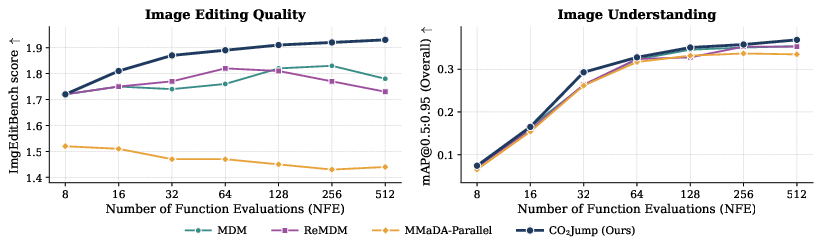
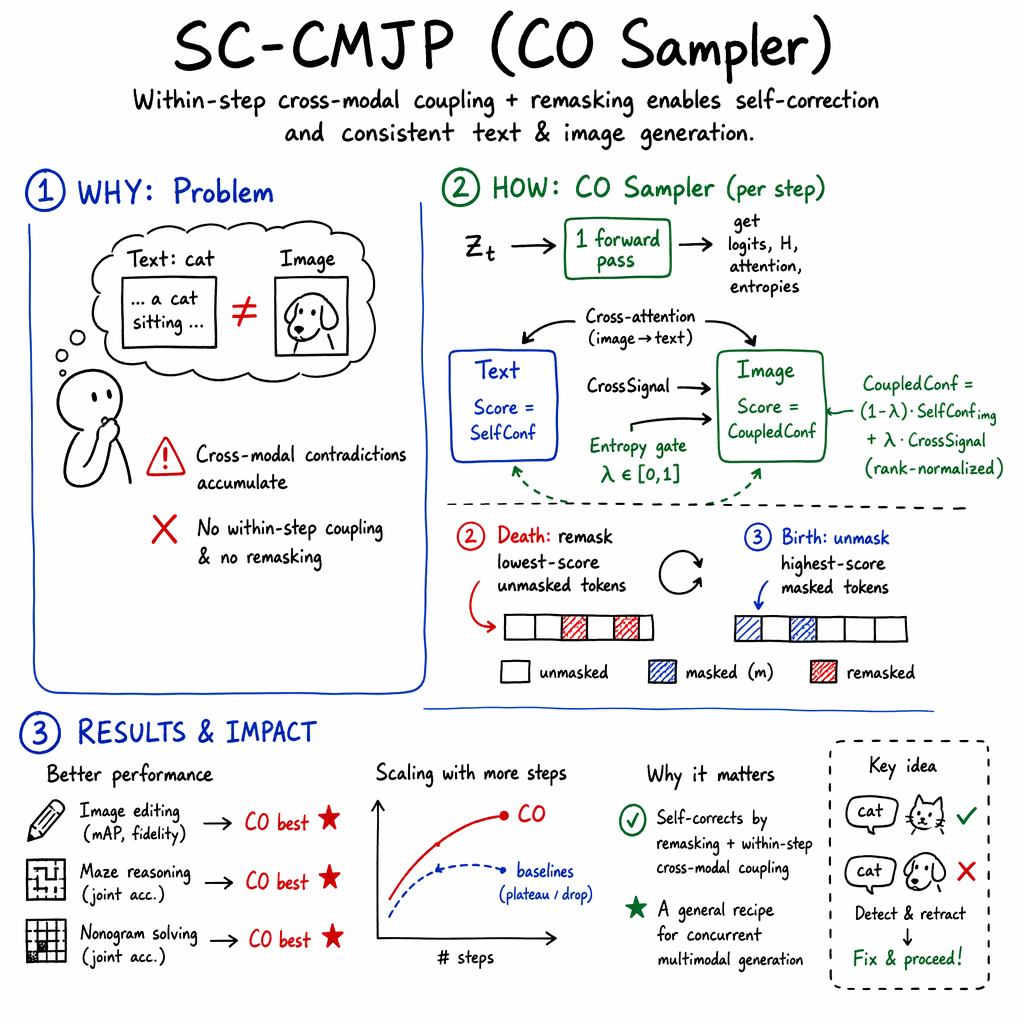
Abstract: Human cognition does not separate understanding and generation. A teacher at a whiteboard speaks and draws $\textit{together}$, each modality reshapes the other. In this paper, we bring this coupled loop to artificial systems. Masked Diffusion Models (MDMs) are ideally suited to this task, yet existing samplers either decode text and image interleavedly or independently update them in parallel branches that share only previous-step history, but not the other modality's latest decisions $\textit{within}$ the same step; combined with MDMs' inability to remask, cross-modal contradictions are neither detected nor repaired. We introduce $\textbf{Self-Correcting Coupled Markov Jump Processes (SC-CMJP)}$, a framework in which one modality's transition rates are functionals of the other modality's confidence score, as weighted by cross-modal attention. Furthermore, a remasking jump retracts commitments the moment cross-modal evidence turns against them. In conjunction with SC-CMJP, we introduce $\texttt{CO}\texttt{2}\texttt{Jump}$ (Self-$\underline{\text{CO}}$rrecting $\underline{\text{CO}}$upled $\underline{\text{Jump}}$), a novel training-free single-pass sampler for joint multimodal geneneration. For training and evaluation purposes, we have created and will release three large-scale joint multimodal generation corpora: $\text{JEdit-1M}$, $\text{JMaze-200K}$, $\text{JNono-200K}$, with matching in- and out-of-distribution benchmarks. $\texttt{CO}\texttt{2}\texttt{Jump}$ achieves best joint performance for image understanding and editing as well as visual reasoning (maze and nonogram solving). The performance of the sampler scales monotonically with the number of denoising steps, evidence that the benefits of cross-modal coupling $\textit{compound}$ across the trajectory. Project page: https://coupled-jump.github.io
Paper Prompts
Sign up for free to create and run prompts on this paper using GPT-5.
Top Community Prompts
Explain it Like I'm 14
Overview: What this paper is about
Imagine a teacher explaining something while drawing on a whiteboard. The talking (text) and the drawing (image) happen together, and each one changes the other. This paper builds an AI system that does the same thing: it understands and writes text and creates images at the same time, constantly checking that both match and fixing mistakes as it goes.
The authors introduce:
- a framework called Self-Correcting Coupled Markov Jump Processes (SC-CMJP), and
- a sampler (a way to generate outputs) called CO that lets text and image “talk to each other” during generation and undo bad choices on the fly—without needing extra training.
They also made three datasets (JEdit-1M, JMaze-200K, JNono-200K) to train and test this idea on image editing and puzzle solving.
The main questions the paper asks
- Can we make an AI that creates text and images at the same time, with each one influencing the other like a teacher who talks and draws together?
- Can this AI notice when the text and image disagree and correct itself during generation, instead of getting stuck with earlier mistakes?
- Will this “coupled and self-correcting” approach work better than existing methods on real tasks like image editing and solving visual puzzles (mazes and nonograms)?
How the method works (in everyday language)
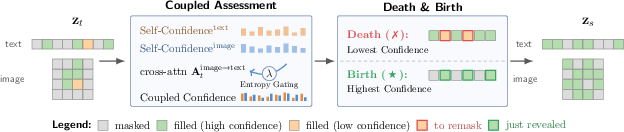
Think of the AI’s generation process as filling in a big crossword where some squares are words (text) and others are tiny image pieces (image tokens). At the start, everything is blanked out (masked). Over many small steps, the AI decides which squares to fill in next.
Here are the core ideas, explained with simple analogies:
- Two teammates that plan together:
- One teammate handles text, the other handles the image.
- At each step, they share what they’re thinking. If the text says “put a hiker in the top-left box,” the image teammate knows where to draw the hiker right away—during the same step, not later.
- Confidence as a guide:
- For every position, the AI has a “confidence score” for its current guess.
- If the image is unsure about a region but the text is confident about what belongs there, the image listens more to the text there.
- A smart “attention” spotlight:
- The AI uses attention (think: a spotlight) to decide which parts of the text are most relevant for a specific image area, and vice versa.
- A dynamic trust knob:
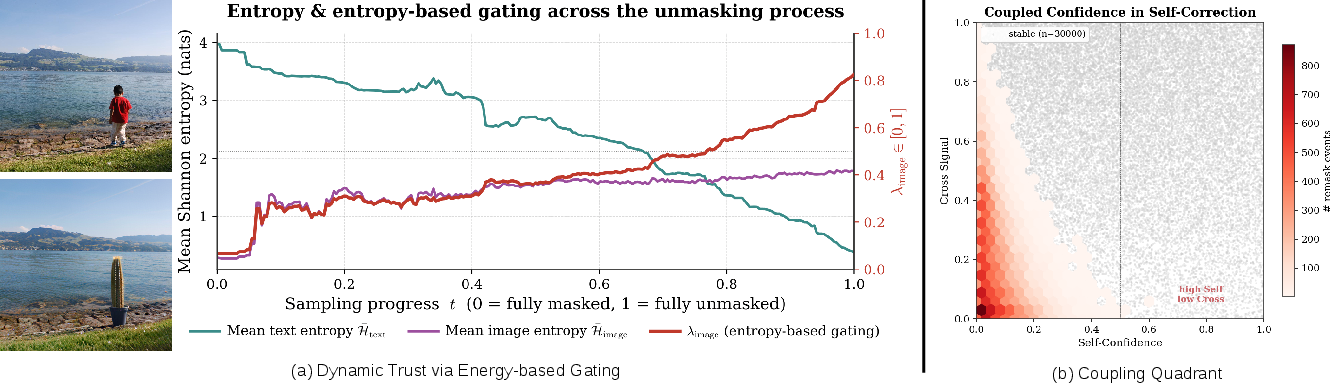
- The system has a gate (a single number between 0 and 1) that shifts how much the image trusts itself vs. the text during that step.
- If the image is uncertain and the text is clearer, it trusts the text more; if the text is shaky, the image trusts itself more.
- Pencil and eraser, not just pencil:
- Older methods only “write in” answers and can’t take them back.
- This system can also “erase” (remask) a decision when it notices a mismatch—like the text says “two dogs” but the image only shows one. It can backtrack and fix it during generation.
- Single-pass per step:
- At each step, the AI looks at the whole current state once, computes who’s confident about what, and jointly decides what to reveal (write) and what to retract (erase). It doesn’t need multiple expensive look-backs in the same step.
In short: every step is a mini negotiation between text and image. They propose, check for agreement, write confident pieces, and erase anything that no longer fits.
What they built and how they tested it
They tested their method on three tasks:
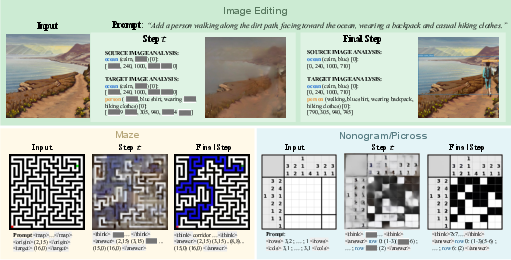
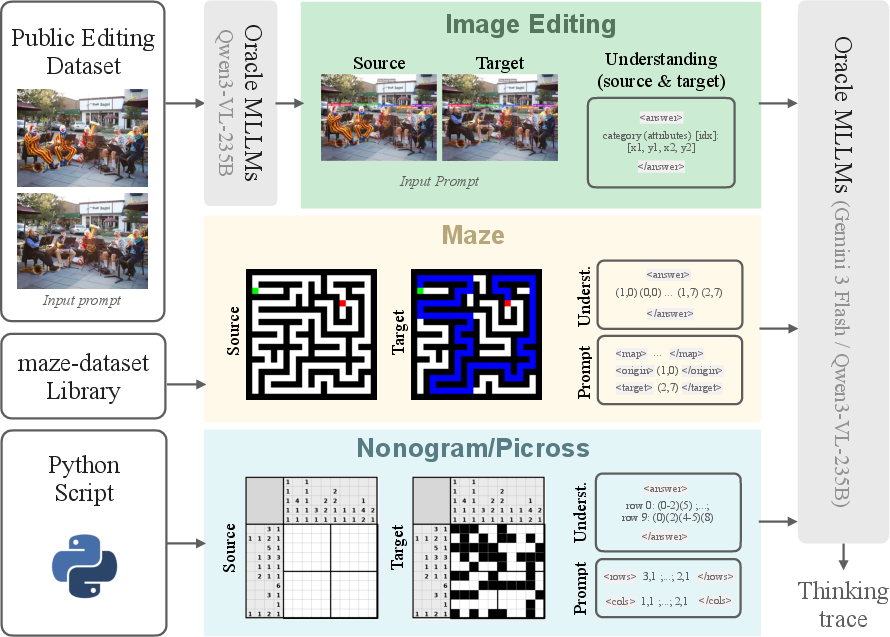
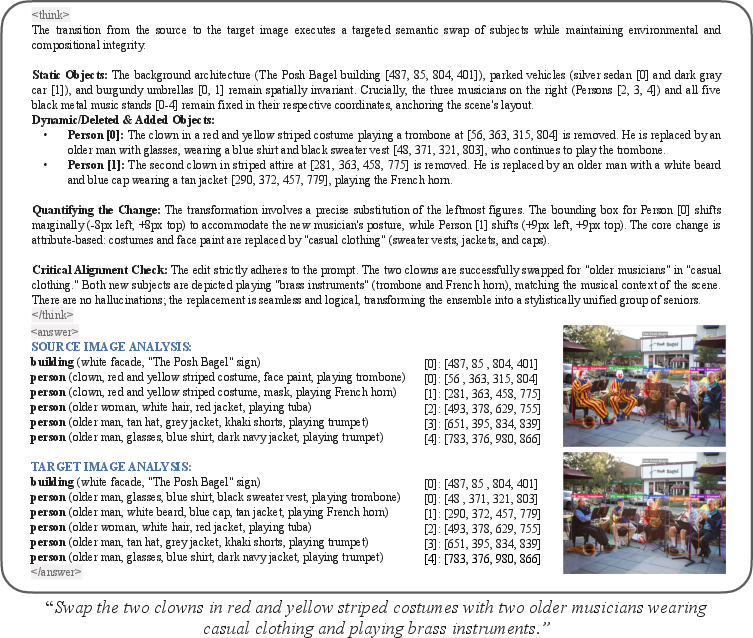
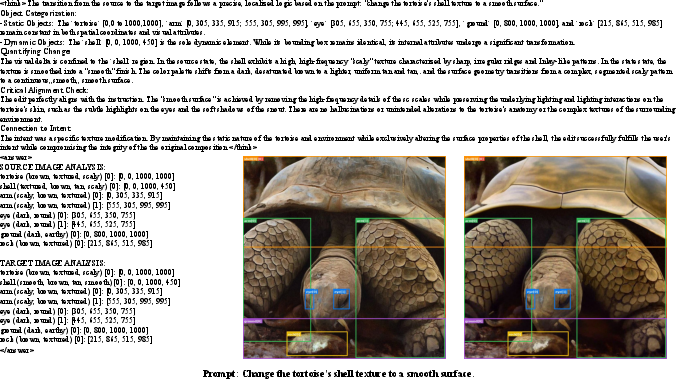
- JEdit-1M (image editing): Given a source image and an instruction (like “add a hiker in the top-left”), the AI edits the image and writes text that describes the changes clearly and precisely (like exact bounding boxes and labels).
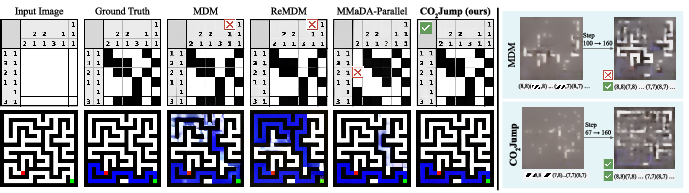
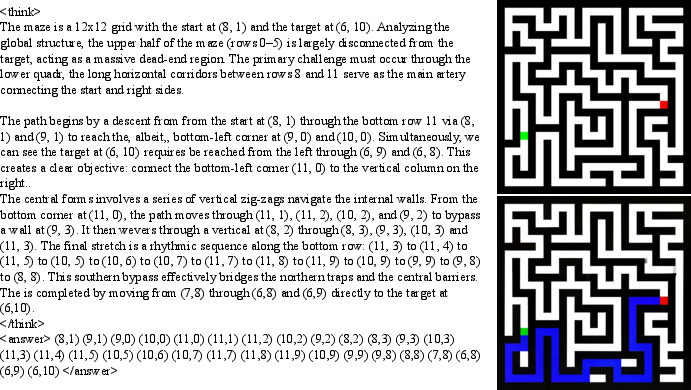
- JMaze-200K (maze solving): The input shows a maze; the AI must draw the correct path in the image and write the coordinates of the path steps.
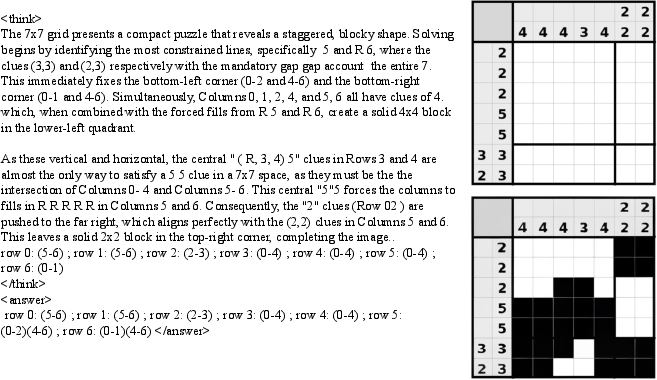
- JNono-200K (nonogram solving): A puzzle where numbers on the margins explain how many blocks to fill in each row and column. The AI must fill the grid correctly and write the solution.
They compared their sampler (CO) against other popular ways of generating text and images. The key tests were:
- Do the text and image outputs agree with each other and with the instructions?
- Do they solve the puzzles correctly?
- Do they keep improving if you allow more generation steps?
Main findings and why they matter
- Better joint text+image consistency:
- Their method produced text and images that match each other more closely than the baselines. For example, when the text says where an object should be, the image actually puts it there.
- It fixes itself while generating:
- Because it can remask (erase) and rewrite, it repairs mistakes found by comparing the two modalities. This is a big deal: many systems can’t correct early errors without starting over.
- Strong performance on real tasks:
- Image editing: It achieved higher scores on both image-edit quality and grounded text understanding (like correct boxes and labels), even compared to strong systems that analyze images after they’re generated.
- Puzzles: It solved more mazes and nonograms correctly than other methods, and importantly, it stayed strong on puzzle sizes it wasn’t trained on (good generalization).
- Gets better with more steps:
- Unlike some baselines that plateau or get worse, their method keeps improving as you allow more denoising steps. That suggests the “talk-then-correct” loop compounds benefits over time.
Why this matters: It shows that making text and image generation truly cooperate at every step—not just in sequence—makes the AI more reliable and better at following instructions, planning, and reasoning.
What this could lead to
- More dependable image editing and content creation tools that can describe their own edits precisely and keep text and visuals in sync.
- Better AI assistants that can plan and draw at the same time—like designing a poster, sketching a diagram from an explanation, or solving visual puzzles while explaining their reasoning.
- A general recipe for other multimodal tasks (like audio+text or video+text) where different types of information should guide each other in real time.
- Systems that improve as they “think longer,” because they can keep negotiating and correcting until the result makes sense.
In short, this paper shows how to make AI “talk and draw like a good teacher”: plan in words and pictures together, check for mismatches, and fix them on the spot.
Knowledge Gaps
Knowledge gaps, limitations, and open questions
The paper introduces a promising self-correcting coupled sampler, but it leaves several concrete issues unresolved that future work can address:
- Asymmetric coupling: text scoring ignores image evidence (text uses only Self-Confidence), while image scoring uses Coupled Confidence. How much additional benefit would symmetric coupling (image→text and text→image) provide, and how should it be implemented without a second forward pass?
- Single global gate per step: the entropy-based gate λ is a scalar applied uniformly across all image positions, ignoring spatially varying uncertainty. Would per-token or region-wise gates improve localization and reduce over/under-correction?
- Forward-pass approximation of the chain rule: the image term conditions on a proxy for derived from the -step forward pass. What is the bias introduced by this approximation, and can low-cost alternatives (e.g., one extra partial/low-rank forward pass every K steps, cached KV updates, or blockwise reconditioning) narrow the gap to the “true” chain-rule update?
- Lack of theoretical guarantees: the coupled birth–death dynamics and τ-leaping discretization are not derived from an exact reverse CMJP. Can one derive a principled coupled reverse kernel with guarantees on validity (e.g., detailed balance, marginal preservation) and convergence/mixing, or bound the approximation error introduced by coupling and remasking?
- Stability and oscillation risk: repeated birth–death toggling may produce flip-flops. What damping/hysteresis mechanisms or scheduling constraints minimize pathological oscillations while preserving self-correction?
- Remasking schedule design: σ_t is heuristic (fixed window and cap η) and modality-agnostic except for ranking inputs. How sensitive are results to σ_t shape and η, and can we learn per-token/per-modality remask propensities from calibration signals or trust estimators?
- Layer/head dependence: cross-modal attention is extracted “post hoc” from the final layer. Which layer(s)/head(s) carry the most reliable cross-modal signal, and does aggregating across layers/heads or using learned attention projections improve robustness?
- Rank-normalization side effects: mapping scores to within-modality percentiles makes cross-modal blending scale-insensitive but may distort absolute confidence. Are there better normalization schemes (e.g., temperature-calibrated probabilities or isotonic regression) that retain cross-modality comparability without losing calibration?
- Generality beyond text–image pairs: the framework is claimed modality-agnostic but is only instantiated for text+image. How does it extend to audio, video, or tri-modal settings, and how to handle multiple absorbing states or different corruption schedules per modality?
- Shared noise schedule across modalities: both modalities share the same α_t. Is a shared schedule suboptimal when modalities learn at different rates? Explore decoupled or learned per-modality schedules under coupled scoring.
- Tokenization dependence: results depend on the chosen image tokenizer (e.g., VQ-VAE codebook) and unified vocabulary. How sensitive is coupling efficacy to codebook size, token granularity, and different tokenizers (e.g., VQGAN, MAGVIT, residual VQ)?
- Interaction with guidance and other samplers: compatibility with classifier-free guidance, predictor–corrector steps, top-k/top-p, and blockwise generation is not analyzed. Do these interact constructively or destructively with coupling and remasking?
- Computational cost and scaling: monotonic gains with NFE up to 512 are reported, but inference-time latency/throughput and memory costs are not quantified. What are the Pareto trade-offs (quality vs NFE), and can coupling deliver similar gains at low NFE via better schedules or adaptive stopping?
- Failure modes when cross-attention is misaligned: the method trusts cross-modal attention without verifying its grounding quality. How often do incorrect attention patterns trigger harmful remasks, and can external or learned grounding confidence mitigate this?
- Evaluation dependence on MLLMs: image understanding mAP is computed via pseudo scene graphs constructed by Gemini on model outputs, and JEdit-1M supervision uses Qwen3-VL-235B. This introduces evaluator/model-family bias. Collect human-annotated groundings or use independent detectors/grounders to reduce evaluator bias and quantify agreement.
- Limited metrics for text quality: GPT-2L perplexity and entropy are coarse and outdated proxies. Task-specific metrics (e.g., grounding faithfulness, factuality, CLIP-based alignment, structured extraction correctness) and human evaluations are needed to assess textual understanding more meaningfully.
- Dataset provenance and bias: JEdit-1M’s scene graphs and “thinking traces” are MLLM-generated, potentially encoding biases and inaccuracies; their quality is not audited. What is the error rate and bias in these annotations, and how do they impact training and evaluation?
- OOD generalization scope: OOD tests vary only grid sizes in synthetic tasks. Broader OOD stress tests (scene composition shifts, object categories, real-world edits, adversarial prompts, clutter/occlusion) are needed to assess robustness.
- Limited task diversity: experiments focus on image editing and grid-based reasoning (mazes/nonograms). How does coupling perform on open-ended tasks (VQA, captioning with localization, referring expression comprehension/generation, scene synthesis, video-text reasoning)?
- No human evaluation of edited images: perceptual quality, edit faithfulness, and artifact rates are not assessed by humans. Add targeted human studies for fidelity, realism, and consistency with textual descriptions.
- Training-time coupling is unexplored: the method is training-free. Would adding a training objective that encourages cross-modal consistency and remaskability (e.g., contrastive consistency losses, cross-modal agreement regularizers, or explicit birth–death likelihoods) outperform inference-only coupling?
- Convergence diagnostics: while quality improves with NFE, there is no analysis of convergence or stopping criteria. Can we design reliable, modality-aware stopping rules based on coupled confidence or calibration?
- Per-step quota discretization: birth/remask quotas use floored counts to match α_t, which may cause drift from the intended schedule. Analyze the impact of rounding and explore continuous relaxations or stochastic quotas.
- Safety and fairness: there is no analysis of harmful content generation, cross-modal contradictions with safety policies, or demographic biases inherited via MLLM supervision. Establish safety tests and bias audits in coupled generation settings.
- Reproducibility and release: datasets, code, and checkpoints are “planned” for release; without them, results are hard to verify. Provide timelines and documentation, including seeds and exact hyperparameters, to enable replication.
Practical Applications
Immediate Applications
The following applications can be built or improved today using the paper’s training-free sampler (CO), the coupling/remasking mechanisms, and the released datasets, assuming access to a compatible masked discrete diffusion backbone with unified text–image tokens and exposed cross-modal attention.
- Joint, grounded image editing in creative and e-commerce tools
- Sector: Software, Creative, E-commerce
- Tools/Workflows: A “plan-and-execute in one pass” editor where the text branch commits spatial plans (e.g., bounding boxes, object IDs) and the image branch executes the edit within the same trajectory; editable overlays show text-declared boxes/attributes as the image updates. Batch edit pipelines can accept structured edit briefs (e.g., “place a red mug left of the laptop, 200×200 px”) and produce both the edited image and grounded text describing the change.
- Assumptions/Dependencies: MDM-based editor or multimodal backbone with VQ tokenization; cross-modal attentions accessible; compute budget scales with number of steps (NFE). Domain safety checks for sensitive content.
- Grounded alt-text and metadata generation for accessibility and SEO
- Sector: Accessibility, Web, E-commerce
- Tools/Workflows: Generate captions, attributes, and bounding boxes that match the produced or existing image; use coupled remasking to self-correct contradictions. Export COCO-style annotations alongside alt-text for downstream indexing.
- Assumptions/Dependencies: Unified vocabulary over text and image tokens; caption export schemas; evaluation beyond pseudo-grounders in the paper.
- Cross-modal consistency auditor for content moderation and quality control
- Sector: Platforms, Trust & Safety, Marketing
- Tools/Workflows: Given an image and a declared caption/claims, run a coupled “audit” pass: penalize text–image contradictions via remasking and flag persistent disagreements. Integrate into ad-review pipelines to detect missing/false claims (e.g., “includes solar panels” not present).
- Assumptions/Dependencies: Thresholds for contradiction; bias in pseudo-grounders; human-in-the-loop for borderline cases.
- Synthetic, internally consistent multimodal data generation
- Sector: ML/AI Infrastructure (Industry and Academia)
- Tools/Workflows: Use CO to generate text–image pairs with tighter alignment than uncoupled samplers, reducing label noise for training retrieval, VQA, captioning, and editing models. Leverage JEdit-1M/JMaze-200K/JNono-200K as templates to expand domains.
- Assumptions/Dependencies: Storage/curation pipeline; licensing for base models; diversity controls to avoid mode collapse.
- Visual reasoning tutors and demonstrators (puzzles, logic diagrams)
- Sector: Education, EdTech
- Tools/Workflows: Interactive puzzle solvers (maze/nonogram) that show both text answers and visual solutions step-by-step, exposing the coupled trajectory as a didactic tool. Extend to classroom whiteboard assistants that co-generate drawings and explanations.
- Assumptions/Dependencies: Domain expansion beyond the benchmark puzzles; latency tolerable for classroom/demo settings.
- Multimodal sampler SDK for existing MDM-based systems
- Sector: Software/ML Tooling
- Tools/Workflows: Drop-in inference-time sampler implementing coupled confidence, entropy-gated cross-modal mixing, and remasking, with knobs for schedules and quotas. Targets teams already using masked discrete diffusion (unified vocab).
- Assumptions/Dependencies: Access to final-layer hidden states and attentions; backward compatibility with training-time objectives; profiling for step budgets.
- Enterprise DAM (digital asset management) with edit provenance and grounding
- Sector: Enterprise Software, Marketing
- Tools/Workflows: Store generated assets with synchronized textual understanding (scene graphs, boxes) for searchability, A/B analysis, and reproducibility of edits from textual “plans.”
- Assumptions/Dependencies: Schema alignment (e.g., COCO/scene-graph formats); governance around generative content provenance.
- UI/UX mockup generation with synchronized copy and layout
- Sector: Software Design
- Tools/Workflows: Co-generate interface screenshots and textual copy; the text branch places component boxes (buttons, inputs) that the image branch renders; export alignment specs.
- Assumptions/Dependencies: UI-domain tokenization/training; component libraries; precision requirements for handoff to engineers.
- Benchmarking and auditing suites for multimodal consistency
- Sector: Academia, Policy, Evaluation
- Tools/Workflows: Use the paper’s datasets/protocols (e.g., grounded mAP, joint accuracy) to evaluate “do text and image agree?” under different samplers, aiding procurement/auditing decisions for multimodal models.
- Assumptions/Dependencies: Transparent, model-agnostic metrics; reduced reliance on proprietary evaluators (Gemini/Qwen) for policy use.
- Marketing copy + image co-generation with on-brief guarantees
- Sector: Advertising/Marketing
- Tools/Workflows: Enforce brief constraints (colors, placements, objects) via text-side commitments; image-side must execute within same pass; export a constraint satisfaction report.
- Assumptions/Dependencies: Legal/compliance review; style transfer/brand safety filters; compute budget for large campaigns.
Long-Term Applications
These require domain-specific training, scaling, latency reductions, or broader modality support, but are strongly suggested by the paper’s coupled, self-correcting framework.
- Radiology and pathology: co-generated reports with localized visual findings
- Sector: Healthcare
- Tools/Workflows: Report text that commits to anatomical locations and measurements while the image branch highlights/segments the corresponding findings; remasking retracts inconsistent claims as evidence evolves.
- Assumptions/Dependencies: Regulated data, expert labels, domain-specific tokenizers; robust calibration and uncertainty reporting; clinical validation and approval.
- Robotics and AR: real-time plan–perception coupling
- Sector: Robotics, AR/VR
- Tools/Workflows: Language plans (waypoints, grasps) and visual scene updates co-evolve in a loop; remasking corrects plans when perception contradicts them; overlays for AR task guidance.
- Assumptions/Dependencies: Low-latency, streaming variants of CO; sensor fusion; safety constraints; online re-planning under compute limits.
- Autonomous driving: joint reasoning about scenes and map overlays
- Sector: Automotive
- Tools/Workflows: Concurrent text reasoning (lane intent, hazards) and visual overlays (detected/forecast objects) that self-correct when inconsistent; aids explainability and driver monitoring.
- Assumptions/Dependencies: Real-time guarantees; certified perception stacks; extensive OOD robustness validation.
- Video–text concurrency (captions, overlays, storyboarding)
- Sector: Media, Accessibility, Education
- Tools/Workflows: Extend jump processes to spatiotemporal tokens so that subtitles, diagrams, and visual edits align per-frame and can be revised via remasking.
- Assumptions/Dependencies: Video tokenizers, temporal attention exposure, efficient samplers for longer sequences.
- CAD/architecture co-design: specifications and renderings in lockstep
- Sector: AEC (Architecture, Engineering, Construction)
- Tools/Workflows: Textual specs (dimensions, materials, codes) and visual floorplans/renders that negotiate constraints; contradictions remasked early in the design loop.
- Assumptions/Dependencies: Domain corpora, parametric CAD tokenization, rule-checking integration.
- Scientific figure assistants: consistent figures and captions with provenance
- Sector: Academia, Scientific Publishing
- Tools/Workflows: Co-generate plots/schematics and captions with grounded references (arrows, regions) and automatic contradiction checks (units, trends).
- Assumptions/Dependencies: Data integrity, unit-aware reasoning, journal policies; domain specialization.
- Financial and legal document processing with synchronized diagrams
- Sector: Finance, Legal
- Tools/Workflows: Generate/validate charts and textual analysis together (e.g., “revenue up 12%” highlighted on the plot); remask to resolve inconsistencies.
- Assumptions/Dependencies: Compliance, audit trails, reliable numeric grounding and OCR.
- Safety and deepfake forensics via contradiction-driven diagnostics
- Sector: Security/Policy
- Tools/Workflows: Use coupling to probe inconsistencies between narrative and pixels; remasking trajectories surface where and how contradictions arise as forensic signals.
- Assumptions/Dependencies: Robustness against adversarial content; calibrated false-positive rates; governance frameworks.
- Multimodal agents with inline self-correction
- Sector: General AI Systems
- Tools/Workflows: Agents that render plans/diagrams while reasoning, using birth–death dynamics to retract erroneous commitments without full reruns; improves sample efficiency and reliability.
- Assumptions/Dependencies: Tool-use integration, memory management, controllable step budgets.
- Policy-grade evaluation standards for multimodal claims
- Sector: Policy/Standards
- Tools/Workflows: Formalize joint accuracy and grounded mAP-like metrics as procurement standards; require contradiction analysis logs from coupled samplers in regulated sectors (ads, healthcare claims).
- Assumptions/Dependencies: Open, model-agnostic evaluators; public datasets beyond pseudo-grounders; stakeholder consensus.
Cross-cutting assumptions and dependencies
- Model prerequisites: masked discrete diffusion backbone with a unified text–image vocabulary, accessible final-layer representations and cross-modal attention; VQ/VAE-style image tokenizers.
- Compute/latency: quality scales with number of steps; real-time use requires optimization (fewer steps, distillation, or streaming).
- Data and domain shift: high-stakes domains need domain-specific training, calibration, and rigorous OOD testing.
- Evaluation reliance: paper uses pseudo-grounding (e.g., Gemini/Qwen); production systems should reduce dependence on proprietary evaluators and include human review for critical use.
- Safety and governance: content policies, privacy, and bias mitigation remain necessary; remasking introduces dynamic behavior that must be audited for stability.
Glossary
- Absorbing state: A special token used in discrete diffusion to replace original tokens during the forward noising process so they can later be predicted back. "corrupt a clean sample by gradually replacing tokens with a special absorbing state "
- Algorithmic ground truth: A formally computed, unambiguous correct answer used to evaluate both modalities in synthetic reasoning tasks. "logically interlocked and jointly verifiable against algorithmic ground truth."
- Any-order autoregressive: A decoding formulation where tokens can be generated in arbitrary orders while remaining autoregressive. "any-order autoregressive~\citep{ou2024your} formulations."
- Autoregressive sequential pipelines: Systems that first generate complete text and then condition image synthesis on it, without the ability to retract early text errors. "Unlike autoregressive sequential pipelines~\citep{deng2025emerging, chen2025janus, xie2026showo}, which first decode the entire textual reasoning trace and then condition image synthesis on it"
- Birth-death process: A stochastic process with both forward “birth” (unmask) and reverse “death” (remask) transitions, enabling revisions during sampling. "a bidirectional birth-death (unmask-remask) process"
- Chain-rule factorization: Decomposing a joint posterior into a product of conditionals to update modalities in an asymmetric sequence within a single step. "We instead exploit the chain-rule factorization"
- COCO-style [email protected]:0.95: A detection metric that averages precision across IoU thresholds from 0.5 to 0.95, used here for image-grounded understanding. "Image-grounded understanding is COCO-style [email protected]:0.95~\citep{lin2014microsoft}"
- Continuous-Time Markov Chain (CTMC): A stochastic process where changes occur at random times governed by rates; here used to model the diffusion forward process equivalently. "The same dynamics admit an equivalent Continuous-Time Markov Chain (CTMC) description"
- Coupled Markov Jump Process (CMJP): A Markov jump process over joint text–image states where each modality’s transition rates depend on the other via cross-modal signals. "We instead define a Coupled Markov Jump Process (CMJP) over "
- Cosine α_t schedule: A cosine-shaped schedule for the diffusion noise parameter α over steps, controlling the fraction of unmasked tokens. "All samplers use a cosine schedule"
- Cross-modal attention: Attention mechanisms that propagate information between modalities (e.g., text to image) to couple their updates. "as weighted by cross-modal attention."
- Cross-modal contradictions: Inconsistencies between the concurrently generated text and image that require detection and repair. "cross-modal contradictions are neither detected nor repaired."
- Cross-modal coupling: The strategy of linking modalities so that decisions in one influence and correct the other during sampling. "the benefits of cross-modal coupling compound across the trajectory."
- Cross-modal negotiation: The image side’s use of text-side confidence (via attention) to inform its own scoring and updates within a step. "The cross-modal negotiation is implemented as the cross signal"
- D3PM (absorbing-state discrete diffusion): A discrete diffusion framework introducing an absorbing state for masked tokens. "Absorbing-state discrete diffusion was introduced in D3PM~\citep{austin2021structured}"
- Death jump: The remasking operation that retracts previously unmasked tokens identified as low-confidence or contradictory. "The Death jump remasks the lowest-confidence committed tokens"
- DFS-perfect mazes: Mazes generated so that there is exactly one simple path between any two cells (tree mazes), typically via depth-first search. "JMaze-200K comprising 200k DFS-perfect mazes"
- Entropy-based gating: A mechanism that uses per-modality predictive entropy to weight self- vs cross-modal signals in scoring. "an entropy-based gate mixes self and cross signals"
- Gillespie's algorithm: An exact simulation method for continuous-time jump processes, impractical at modern sequence lengths for diffusion. "Exact reverse simulation via Gillespie's algorithm~\citep{gillespie1976general, gillespie1977exact}"
- Glauber dynamics: A classical coupled-jump framework from statistical physics referenced as related to coupling ideas. "Coupled jump processes are classical in chemistry~\citep{gillespie1977exact} and Glauber dynamics~\citep{glauber1963time}"
- Gumbel-max: A sampling trick that draws from categorical distributions by perturbing logits with Gumbel noise and taking argmax. "we apply Gumbel-max sampling"
- Joint NELBO: The negative evidence lower bound for joint text–image modeling under a shared masking schedule and unified vocabulary. "the joint NELBO inherits the similar form in MDM~\citep{sahoo2024simple}"
- Markov Jump Process (MJP): A continuous-time Markov process on discrete states specified by a rate matrix, used to view diffusion sampling. "A Markov Jump Process (MJP) \citep{campbell2022continuous, berghaus2024foundation} is a continuous-time Markov process"
- Masked Diffusion Models (MDMs): Discrete diffusion models that iteratively predict masked tokens, here extended to multimodal joint generation. "Masked Diffusion Models (MDMs) are ideally suited to this task"
- Modality-drift: Divergence between modalities during sampling when their updates are independent and irreversible. "often suffer from modality-drift, where the generated text and image diverge"
- Negative ELBO (NELBO): The training objective equivalent to a weighted cross-entropy for predicting clean tokens from noisy inputs. "the resulting NELBO collapses to a position-wise weighted cross-entropy"
- Nonogram: A logic puzzle specified by row/column clues; here used as a visual reasoning task with jointly verifiable solutions. "nonogram solving"
- Number of function evaluations (NFE): The number of denoising steps (model evaluations) used during sampling, which affects quality. "Sweeping NFE from 8 to 512"
- Out-of-distribution (OOD): Test conditions outside the training data’s distribution, such as larger/smaller grids, used to assess generalization. "with matching in- and out-of-distribution benchmarks."
- Predictor–corrector samplers: Sampling methods that alternate prediction and correction steps to reduce discretization error without explicit remasking. "Predictor-corrector samplers~\citep{campbell2022continuous, lezama2023discrete, gat2024discrete, campbell2024generative} reduce -leaping error"
- Pseudo-grounding: A grounding evaluation constructed per-sample using a vision–LLM because each model’s generated target differs. "our headline metric is per-section [email protected]:0.95 from the pseudo-grounding pipeline"
- Rate matrix: The matrix of transition rates defining jump intensities between states in a continuous-time Markov process. "A Markov Jump Process (MJP) ... is a continuous-time Markov process on a discrete state space specified by a rate matrix "
- ReMDM: A training-free remasking augmentation to MDMs that allows committed tokens to revert to the mask with probability σ_t. "ReMDM~\citep{wang2026remasking} repairs this by allowing committed tokens to revert to with per-step probability "
- Remasking jump: A reverse-step operation that retracts earlier token commitments to repair contradictions discovered later. "a remasking jump retracts commitments the moment cross-modal evidence turns against them."
- Scene-graph: A structured representation of objects and relations extracted from images for grounding and reasoning. "the per-panel source/target scene-graph understanding"
- Self-Correcting Coupled Markov Jump Processes (SC-CMJP): The proposed framework coupling modalities’ jump rates and enabling remasking-based self-correction within each step. "We introduce Self-Correcting Coupled Markov Jump Processes (SC-CMJP)"
- Single-pass sampler: An inference procedure that uses one forward pass per step without auxiliary evaluators or extra passes, here for joint generation. "a novel training-free single-pass sampler for joint multimodal geneneration"
- Shared Percentile Rank Space: A normalization strategy mapping confidence scores to modality-wise percentiles to make text and image scores comparable. "Shared Percentile Rank Space."
- τ-leaping: A parallel approximation to simulate many jumps at once in jump processes, used to make diffusion sampling practical. "so practical samplers use τ-leaping~\citep{gillespie2001approximate}"
- Thinking trace: An explicit textual reasoning sequence accompanying image generation/understanding used for training and evaluation. "the thinking trace"
- Unified vocabulary: A token set shared across text and image, enabling a single model to operate on both modalities jointly. "under a unified vocabulary spanning text and image tokens"
- Unmasking schedule: The plan governing which masked tokens are revealed at each step; in this work, adapted by cross-modal confidence. "The unmasking schedule of one modality adapts to the confidence of the other modality."
- Valid-posterior constraint: A constraint on σ_t ensuring the reverse posterior remains valid when remasking is introduced. "we set the death rate to satisfy the valid-posterior constraint"
- Visual reasoning: Tasks where images and text are logically interdependent with verifiable solutions (e.g., mazes and nonograms). "visual reasoning (maze and nonogram solving)"
Collections
Sign up for free to add this paper to one or more collections.