- The paper presents DeepLoop, a new analytic scaling rule for looped transformers that stabilizes training by adjusting residual and initialization parameters.
- It details a theoretical framework incorporating the visit-alignment coefficient to account for gradient sharing across recurrent layers, ensuring robust optimization.
- Empirical results on language modeling and downstream tasks validate that DeepLoop outperforms standard parameterizations, especially at increased recurrent depths.
Looped Transformers extend standard architectures by decoupling depth from parameter count, repeatedly applying a compact set of K physical blocks for R rounds and achieving an effective depth of N=KR. This paradigm enables parameter-efficient scaling through sequential computation, relating closely to ideas in Universal Transformers, ALBERT, and recent recurrent-depth or test-time-compute models. However, scaling recurrent depth in this manner necessitates a reconsideration of residual-scaling mechanisms, as parameter sharing introduces novel coupling between forward and backward passes that are inapplicable to traditional untied depth analyses.
Standard residual-scaling theory (e.g., DeepNorm) ensures optimization stability in deep Transformers by selecting skip connection and residual-branch initialization scales (α,β), given M=2N residual sublayer applications. The untied assumption, however, presumes mutually independent updates across all depthwise sublayers. In looped models, each parameter is shared across R visits, aggregating gradients and being read multiple times in subsequent forward passes. Consequently, the first-order effect of parameter updates is governed not simply by nominal layer count, but by both the structure of parameter sharing and the degree of alignment between per-visit gradient directions.
The paper formalizes this with a visit-alignment coefficient κR, refining the first-order stability condition from M(β/α)2=O(1) to MκR(β/α)2=O(1). In the aligned regime (κR=O(R)), the exponent in the scaling rule must increase from R0 (DeepNorm) to R1 as R2 increases at fixed R3. The resulting prescription, DeepLoop, proposes a universal, analytic scaling for looped Transformers: R4, R5.
(Figure 1)
Figure 1: Overview of the DeepLoop framework. (a) The model shares R6 physical blocks, (b) which are unrolled for R7 rounds, giving an effective depth of R8, (c) with each residual sublayer applying RMSNorm and scaled skip/branch paths, (d) and DeepLoop specifying loop-aware analytic scaling.
Let R9 and N=KR0 represent, respectively, the per-visit gradient and linearized output sensitivity for visit N=KR1 to physical sublayer N=KR2. For untied architectures, the cumulative effect sums over N=KR3 independent terms, yielding stability when N=KR4 under local N=KR5 sensitivities [wang2024deepnet].
When parameters are tied across looped visits, each parameter accumulates gradients from all visits, and all N=KR6 visits in subsequent steps are influenced by the same shared update. The perturbation therefore scales with N=KR7 (capturing alignment across visits): fully decorrelated visits recover the original untied scaling (N=KR8), while fully aligned visits, the conservative regime considered here, require N=KR9, amplifying the effect of shared updates.
This yields a loop-aware stability threshold that, for the scaling family (α,β)0, (α,β)1, is satisfied when (α,β)2, where (α,β)3 controls cross-round correlation ((α,β)4: decorrelated; (α,β)5: fully aligned). DeepLoop sets (α,β)6, ensuring stability in the worst-case aligned regime at any practical loop count.
Empirical Validation
Language Modeling: Validation Loss
DeepLoop and a baseline (tied-only, (α,β)7, (α,β)8) are tested on GPT-2 small and medium variants, trained on FineWeb-Edu for 50B tokens. At (α,β)9, both configurations perform identically—demonstrating parameterization neutrality when no sharing occurs. For all M=2N0, DeepLoop consistently outperforms baseline in final validation loss, with the gap increasing with M=2N1, confirming theoretical predictions.
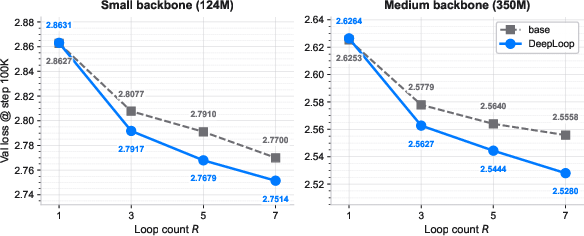
Figure 2: Final validation loss at step 100,000 on FineWeb-Edu 50BT (GPT-2 small/medium) for various loop counts. DeepLoop's advantage increases with recurrent depth.
Downstream Generalization: LM Evaluation Suite
On the lm-evaluation-harness suite (arc_challenge, arc_easy, hellaswag, etc.), DeepLoop achieves superior or equal average zero- and one-shot accuracies at M=2N2, with per-task improvements on seven out of eight tasks at M=2N3. These results, robust across scales, demonstrate that loop-aware scaling not only boosts language modeling but robustly transfers to downstream tasks.
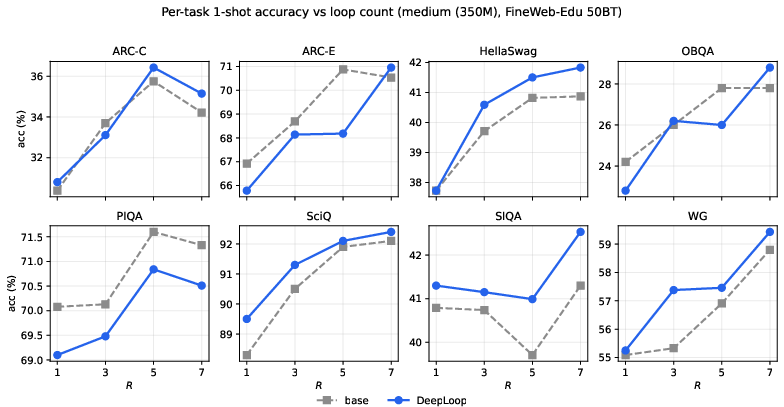
Figure 3: Per-task 1-shot accuracy versus loop count M=2N4 for base vs DeepLoop (GPT-2 medium). DeepLoop achieves consistently higher accuracy at high M=2N5 on most tasks.
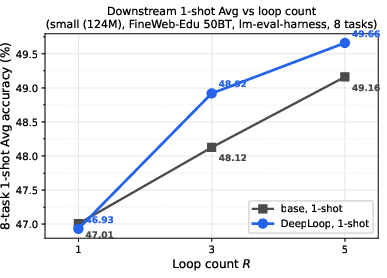
Figure 4: Eight-task 1-shot average accuracy versus M=2N6 (GPT-2 small), confirming DeepLoop's monotonic performance gains with increased recurrent depth.
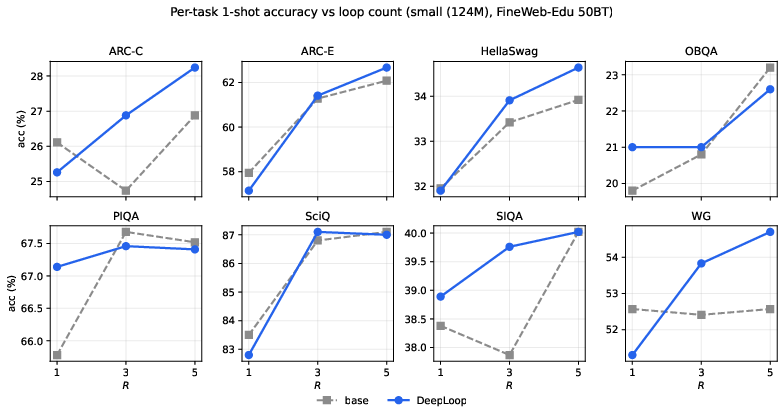
Figure 5: Per-task 1-shot accuracy vs M=2N7 for base and DeepLoop (GPT-2 small); DeepLoop outperforms or matches across tasks as depth increases.
M=2N8-Sweep: Empirical Stability Threshold
A direct grid search over exponent M=2N9 in the DeepLoop scaling rule (at fixed R0) confirms a sharp training-stability phase transition near R1. All seeds diverge for R2; training is reliable only for R3. Thus, R4 is the empirically minimal stable exponent, matching the theoretical bound.
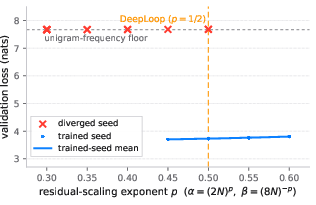
Figure 6: Validation loss snapshot at step 2000 on FineWeb-Edu 50BT (GPT-2 small, R5), sweeping exponent R6. Training is consistently stable for R7.
Extending the analysis, DeepLoop is successfully applied to hierarchical recurrent architectures such as the Hierarchical Reasoning Model (HRM) on ARC-AGI-1. Here, the same loop-aware scaling improves the headline two-vote accuracy by R8 points over vanilla HRM, with gains spanning all vote budgets. This supports the claim that R9 is required for aligned inner modules operating at fixed physical depth, even with truncated training gradients.
Practical and Theoretical Implications
DeepLoop demonstrates that correct residual and initialization scaling is essential when parameter sharing is employed across circuitous or recurrent depth in Transformers. The analytic scaling rule
κR0
is plug-and-play for any Post-LN looped backbone and robustly stabilizes very deep unrolled computation without architectural modification or new hyperparameters.
Theoretically, the visit-alignment coefficient κR1 elegantly captures the risk of over-aggressive parameterization in the presence of parameter tying. Empirically, the conservative choice κR2 is safe for a wide range of architectures, loop depths, and downstream evaluations, supporting its adoption as a default, loop-aware parameterization. The analysis exposes the importance of not only counting nominal layers but critically modeling how effective depth is realized.
Future Directions
- Measuring Alignment: Directly monitoring κR3 or empirically quantifying inter-visit gradient alignment would provide further guidance for adaptive or less conservative scaling.
- Optimizing for Decorrelation: If visit decorrelation can be induced or detected, it may be possible to interpolate exponents κR4 between the DeepNorm (κR5) and DeepLoop (κR6) regimes, trading off stability and learning signal.
- Scale and Architecture Extensions: Investigation into the behavior at larger κR7, scale, varying normalization strategies, and implications for hyperparameter transfer (as in κR8P/Depth-κR9P) would further elucidate the universality of the approach.
Conclusion
DeepLoop offers a principled and empirically validated residual parameterization for looped Transformers, ensuring robust training and improved generalization wherever residual-branch weight sharing is employed. The loop-aware analysis and its sharp stability boundary exemplify how careful theoretical modeling of parameter interactions is critical to advancing efficient and scalable deep sequence models (2607.13491).

