- The paper demonstrates that regression-aware optimization (RELAI-VCL) consistently compounds improvements while mitigating catastrophic forgetting.
- It employs a two-phase evaluation on Terminal-Bench 2.0, comparing GEPA, Meta Harness, and RELAI-VCL across static, transfer, and re-optimization scenarios.
- The study outlines practical implications for robust agent deployment and underscores the need for benchmarks that capture realistic task correlations.
Expert Summary: Do Agent Optimizers Compound? A Continual-Learning Evaluation on Terminal-Bench 2.0
Introduction and Motivation
The paper "Do Agent Optimizers Compound? A Continual-Learning Evaluation on Terminal-Bench 2.0" (2607.14004) interrogates the behavior of agent optimizers under a continual-learning regime, specifically whether gains from agent harness optimization persist and can be recursively compounded as new tasks are introduced. Conventional evaluations report improvements post one-shot optimization on static benchmarks, but the operational reality is staged or continual adaptation, often as new failure modes or task types emerge. The principal question addressed is whether agent harness optimizers—methods for automated prompt, tool, memory, and control code refinement—can compound improvements without regressions on previously solved tasks.
Protocol Design and Methodology
The paper introduces a two-phase evaluation protocol utilizing Terminal-Bench 2.0, a cohort of verifiable, hard terminal-based tasks. Phase 1 involves optimizing a baseline agent (GPT-5.5 based, Harbor/Ternimus2 framework) on an initial task set (T1) with a fixed rollout budget. Agents are then evaluated both on T1 (static) and an expanded set T1∪T2 (transfer) without further optimization. Phase 2 grants an additional budget for harness optimization on the union, assessing final pass rates. Four metrics are reported: Phase 1, Transfer, Final, and Lifelong Average pass rate (unweighted mean across the three preceding metrics). This protocol allows deconvolution of static optimization strength, transfer/generalization, and continued improvement upon task expansion.
Agent Harness Optimization Methods Compared
Three agent harness optimizers are evaluated:
- GEPA: Reflective prompt evolutionary search, mutating agent prompts based on language feedback while retaining improvements. Tends to encode per-task specifics within prompts.
- Meta Harness: Outer-loop harness code search via an agentic proposer (Codex/GPT-5.5), accepts candidates based on task-set evaluation feedback. Fixes are generic, targeting robustness.
- RELAI-VCL: Regression-aware continual-learning optimizer, enforcing a no-regression constraint inside the search loop. Candidates improving new tasks but regressing on prior tasks are rejected. Harness edits are intended to be broadly generalizable.
All optimizers operate from an identical baseline agent and receive equal rollout budgets in each phase. GEPA's code-mutation variant is omitted from Phase 2 due to failure to produce valid candidates.
Results: Static, Transfer, and Continued Improvement
Static Optimization (Phase 1)
All methods improve the baseline in the static regime. GEPA achieves 70.8%, Meta Harness 66.6%, and RELAI-VCL achieves 79.2% pass rate on T1 versus 62.5% for baseline, with RELAI-VCL showing the most substantial gains and the most generic harness modifications.

Figure 1: RELAI-VCL achieves the highest static optimization pass rate at 79.2% on Phase 1 tasks, outperforming GEPA and Meta Harness.
Transfer to Unseen Tasks
Evaluating Phase-1-optimized agents on the expanded set reveals sharp divergence:
Phase 2 Re-optimization
Upon re-optimization, GEPA recovers to 72.7% by direct optimization against expanded tasks, Meta Harness stalls and regresses to 59.1%, while RELAI-VCL continues to improve, reaching 77.3%. Only RELAI-VCL demonstrates both positive transfer and further gains after task set expansion, supporting compounding optimization.
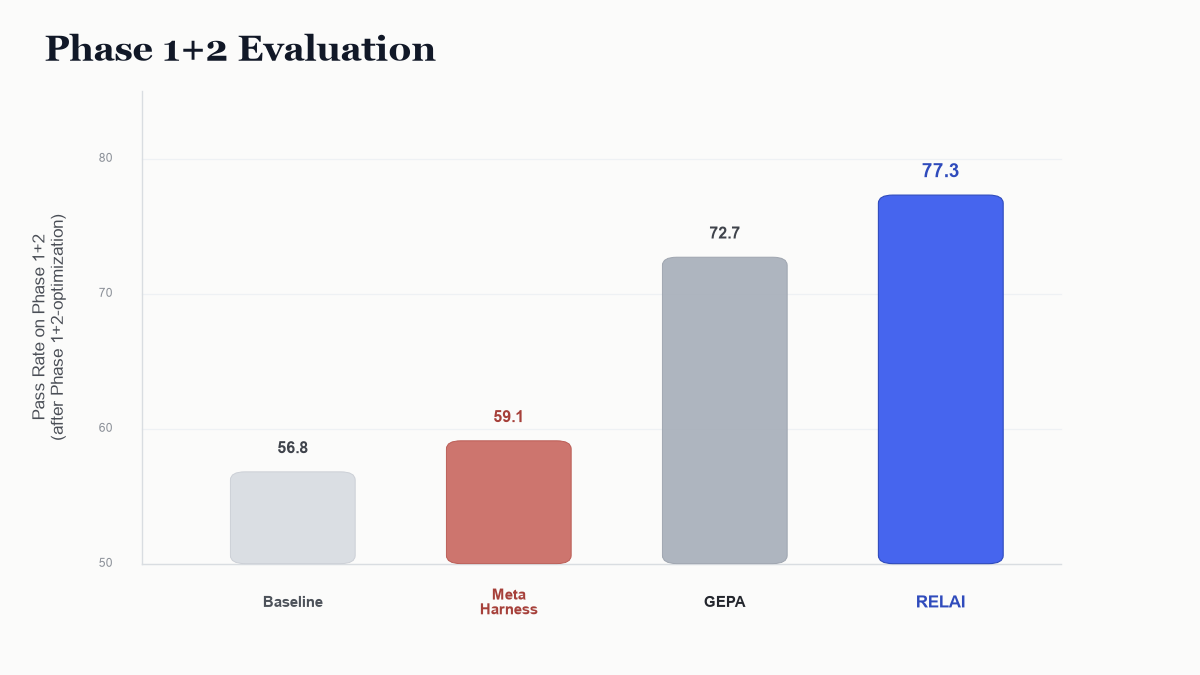
Figure 3: RELAI-VCL maintains continued improvement after phase 2 re-optimization, avoiding the stagnation or regression observed in alternative methods.
RELAI-VCL achieves the highest lifelong average pass rate (76.4%), substantially ahead of GEPA (66.0%), Meta Harness (64.6%), and baseline (58.7%).

Figure 4: Summary of lifelong average pass rates highlights RELAI-VCL's superior compounding and generalization properties.
Interpretation and Practical Implications
The evaluation illustrates that regression-aware search, as enforced by RELAI-VCL, is critical for compounding harness optimization gains. Enforcing this constraint within the search loop curbs catastrophic forgetting and biases the optimization toward genuinely generalizable interventions over narrow, task-specific shortcuts. Static benchmark performance cannot adequately diagnose overfitting or stagnation; compounding requires both robust transfer and sustained improvement under task arrival.
From a practical perspective, optimizers intended for deployment must internalize regression constraints to achieve durable agent improvements, especially as real-world task distributions shift continuously. Regression-avoidance as a search-time constraint—rather than post-hoc check—enables reliable agent escalation in production settings, relevant for continuous integration pipelines, auto-diagnosis loops, and broader agentic workflows.
Limitations and Future Directions
Terminal-Bench 2.0 tasks are loosely correlated, limiting the realism of cross-task dependency exploitation and shortcut generalization failures. Practical settings often feature highly correlated, domain-specific tasks, where exploiting shared structure or reciprocal failure modes is common. Repeatability and verifier availability are assumed, but are rarely guaranteed in operational deployments. More realistic benchmarks should address task correlation, limited observability, imperfect verifiers, and long-horizon iterative optimization beyond two phases.
Anticipated future developments include:
- Benchmarks and protocols capturing correlated failure modes and domain drift
- Agent harness optimizers integrating explicit memory, skill accumulation, and trace-driven harness adaptation with in-loop regression constraints
- Adaptive optimization strategies for partial, noisy, or single-instance feedback
- Scaling the compounding evaluation to meta-optimization of the optimizer itself (hyperagents)
Conclusion
The paper establishes, through controlled continual-learning evaluation on Terminal-Bench 2.0, that regression-aware agent harness optimization (RELAI-VCL) is uniquely capable of compounding improvements across task arrivals, retaining prior gains and facilitating further progress. Optimization gains compound only when regression control is built directly into the search loop. These findings suggest that agentic continual-learning protocols and regression-aware harness optimizers are prerequisites for robust, production-scale agent deployment, with future benchmarks needing to reflect the true complexity and correlation structures of deployed agent workloads.
Figure 5: RELAI-VCL consistently leads across all stages and achieves the highest lifelong average pass rate, demonstrating compounding optimization capabilities under continual learning.
