EvolvingWorld: An Open-Schema Framework for Co-Evolving Role-Play Agents and World Model in Interactive Literary World
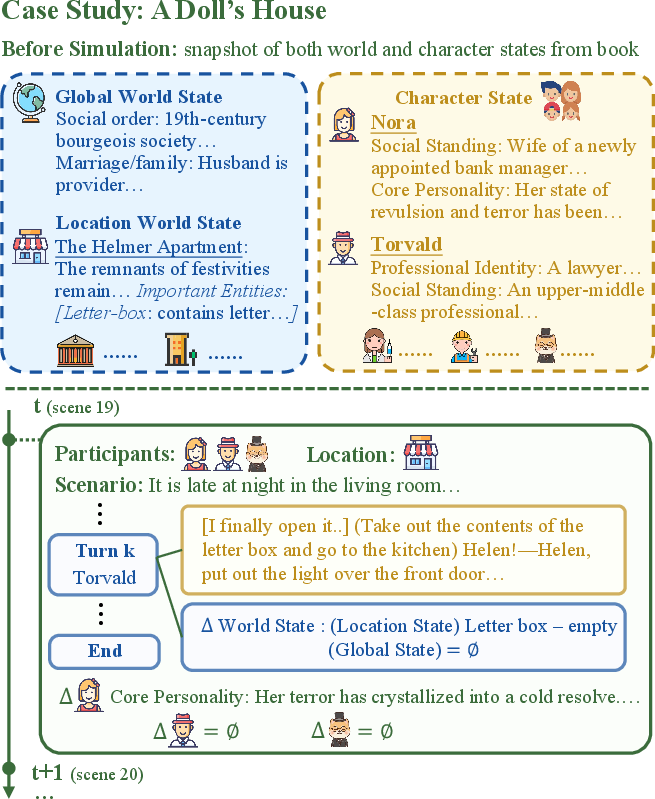
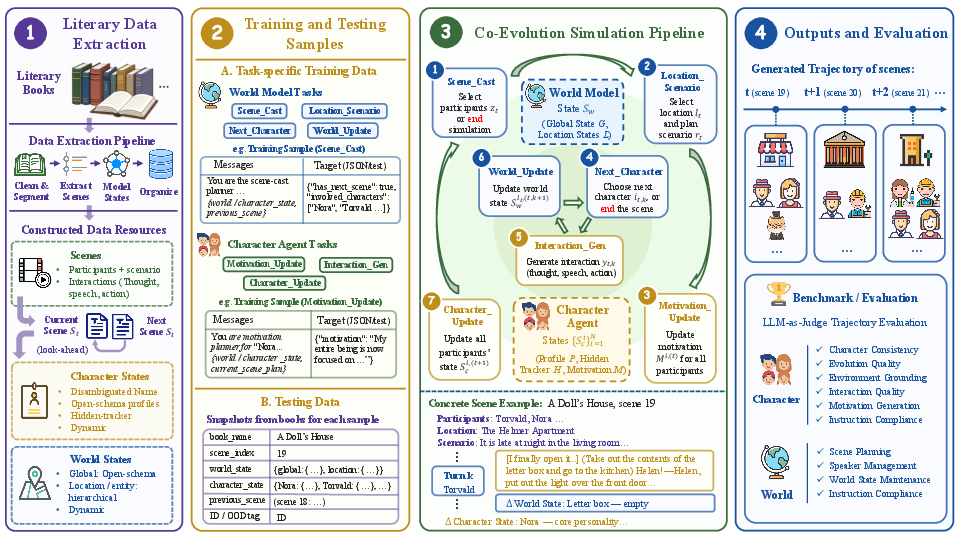
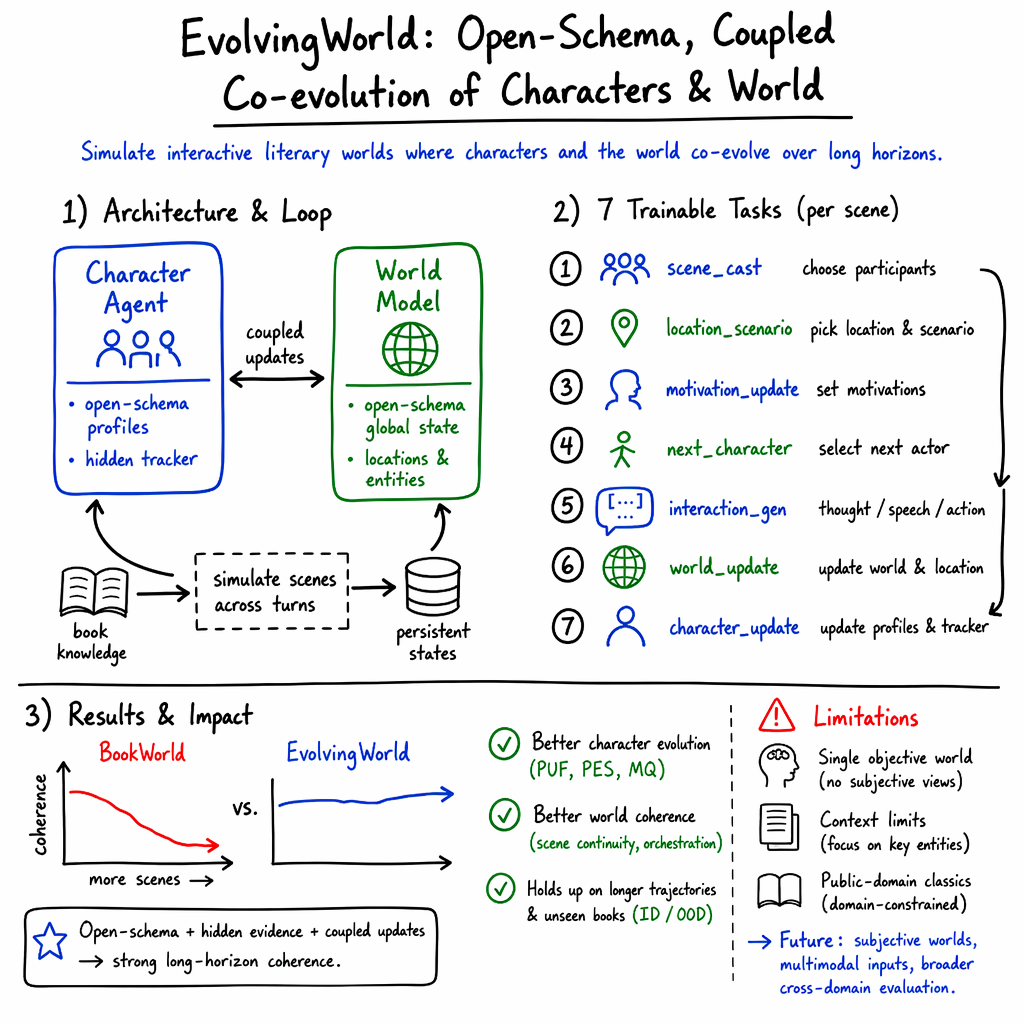
Abstract: This paper introduces EvolvingWorld, a framework and benchmark for character and world co-evolution in interactive literary worlds. Existing systems either treat interactive literary simulation as static persona imitation or isolated scene generation, failing to capture how characters and worlds evolve together over time. To address this, EvolvingWorld models literary simulation as a long-horizon process where characters interact, scenes progress, and character and world states are persistently updated. Unlike prior systems relying on fixed schemas, EvolvingWorld adopts an open-schema framework to support simulation across diverse literary worlds. The framework consists of two coupled modules: a Character Agent for multi-character role-play and persistent profile evolution, and an LLM-based World Model for global and location/entity-level state maintenance and scene progression. Based on this architecture, we formulate 7 trainable tasks for scene initialization, interaction generation, and state update. We construct a dataset from 57 books, producing 138,596 supervised training samples and 222 snapshots for testing. Furthermore, we introduce a trajectory-level LLM-as-Judge evaluation protocol spanning 10 dimensions and 20 metrics. Experiments show that EvolvingWorld can improve long-horizon simulation by effectively maintaining persistent, coherent character and world development.
Paper Prompts
Sign up for free to create and run prompts on this paper using GPT-5.
Top Community Prompts
Explain it Like I'm 14
What this paper is about
The paper introduces EvolvingWorld, a new way to make AI characters and their fictional worlds grow and change together over time—like in a real story. Instead of only making characters talk in character for one scene, EvolvingWorld keeps track of how people, places, objects, and rules change as the story moves forward.
What questions the paper tries to answer
The authors asked, in simple terms:
- How can we build AI characters who don’t just repeat a fixed personality, but actually change in believable ways as the story goes on?
- How can we keep track of the whole world—its locations, items, rules, and events—so it changes realistically as characters act?
- Can we do this for lots of different kinds of stories (mystery, fantasy, school life, etc.) without forcing everything into one rigid format?
- How do we measure whether the characters and the world stay consistent and make sense in the long run?
How the system works (in everyday language)
Think of telling a long story as running a small theater:
- The Character Agent is like the actors. Each actor has a profile (personality, goals, habits) that can evolve. Some things (like mood) change quickly; others (like deep values) change slowly.
- The World Model is like the stage manager. It keeps track of the whole set: the world’s big rules (like “magic exists” or “strict school rules”), the locations (like “the library,” “the forest”), and what’s in them (like “a broken lamp,” “a hidden letter”).
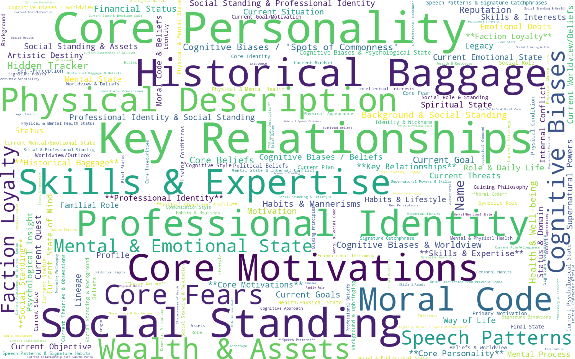
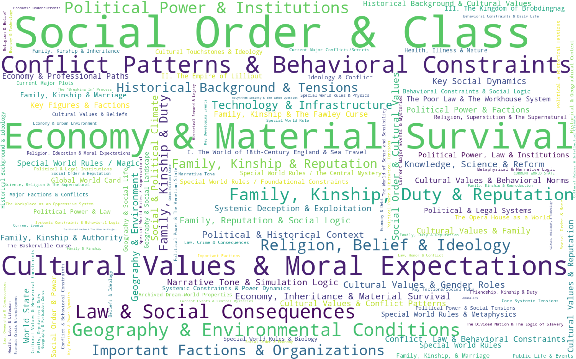
A key idea is “open-schema.” Instead of using the same fixed boxes for every story (e.g., always tracking “strength,” “speed,” “alignment”), the system figures out what actually matters for that book’s world. A detective might need “investigation style,” while a Victorian orphan might need “social status.” It’s like using a blank notebook (flexible) instead of a pre-printed form (rigid).
Another idea is the “hidden tracker” for each character. Imagine a private notebook where small hints (like repeated acts of bravery) are collected before deciding, “Okay, this character has truly become brave now.” This prevents sudden, unrealistic personality flips.
Each scene follows a simple loop, a bit like running a play:
- Choose who’s in the scene.
- Pick the location and scenario.
- Give each character a short-term motivation for that scene.
- Decide who acts next.
- Generate what they say/think/do.
- Update the world right away (did a door break? did the crowd react?).
- After the scene, update the characters (did their goals shift? did they learn something?).
To train and test this, the authors:
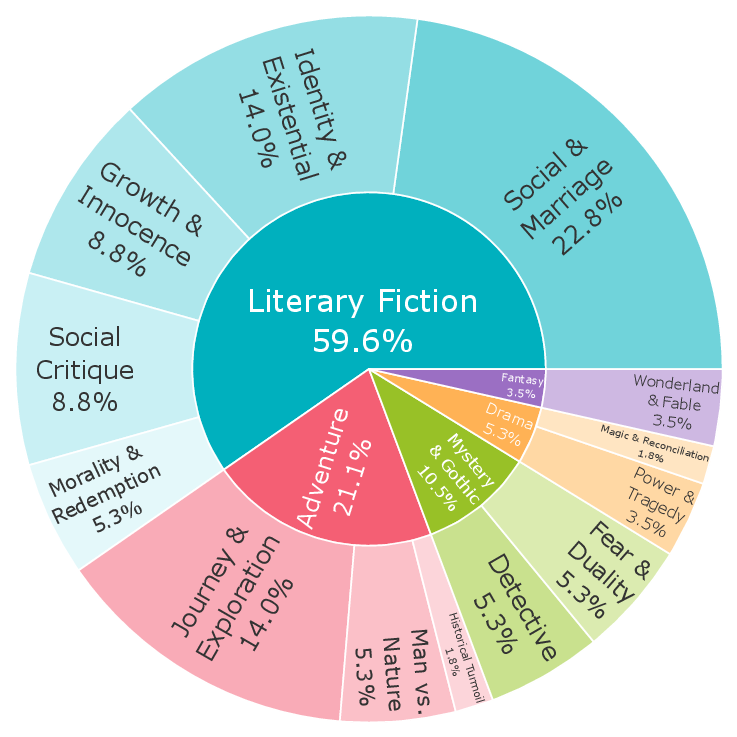
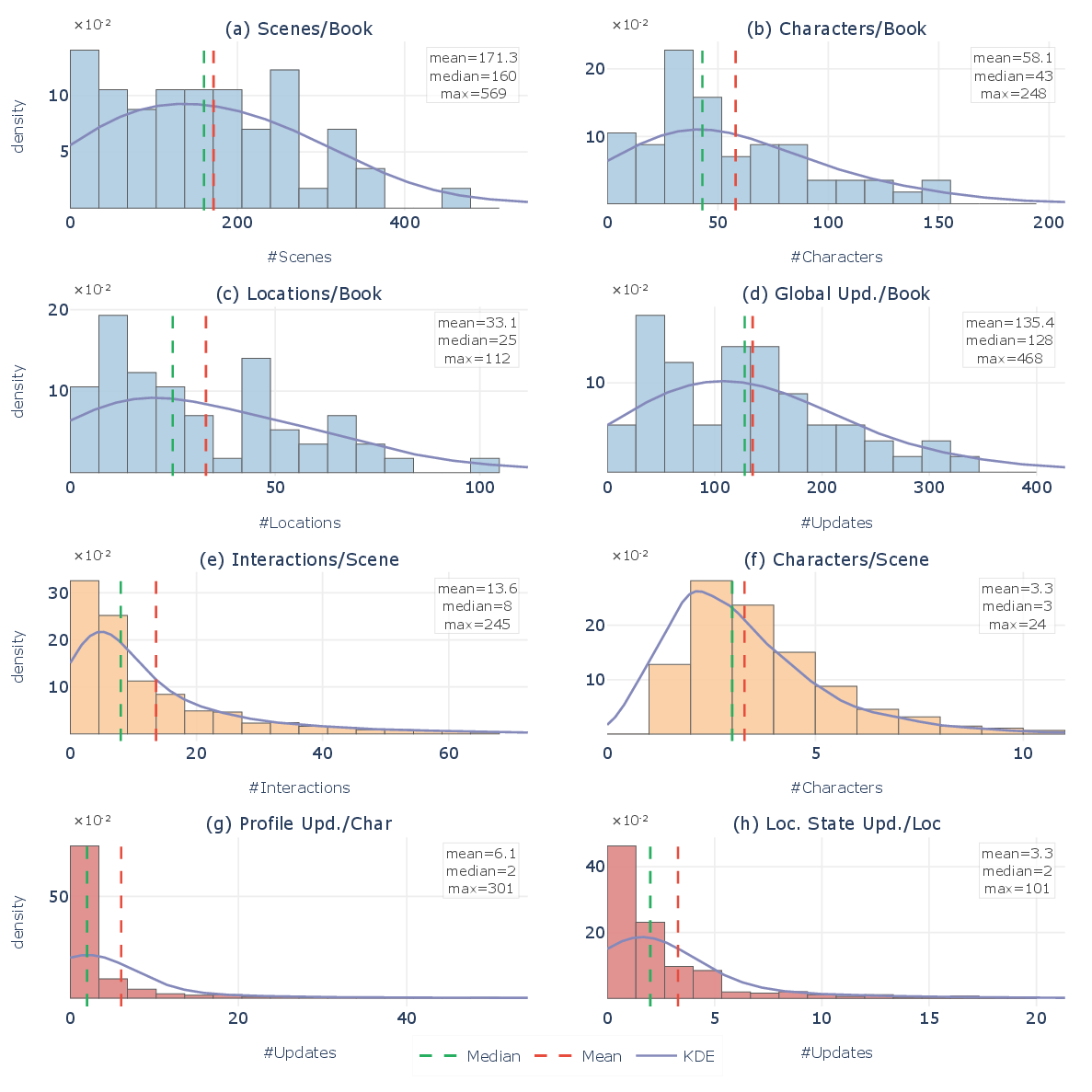
- Built a dataset from 57 books (different genres), with 138,596 training examples and 222 test “snapshots,” each snapshot being a point in the story where the simulation can continue.
- Broke the process into seven trainable tasks (like casting, planning the scene, picking the next speaker, and updating character/world states).
- Designed an “LLM-as-Judge” evaluation—basically, a smart AI reviewer reads whole story trajectories and scores them on 10 dimensions (20 detailed metrics), like character consistency, smooth evolution, and world accuracy.
What they found and why it matters
Main findings:
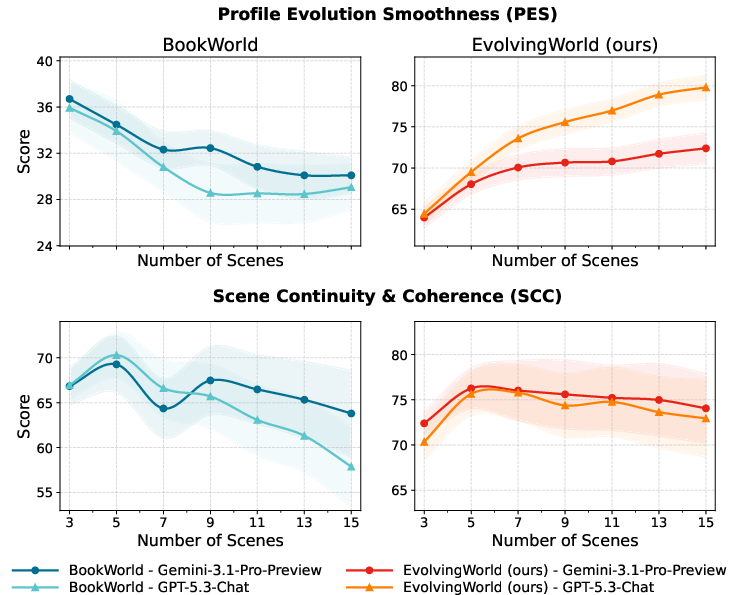
- EvolvingWorld keeps stories more coherent over time. Characters stay true to who they are, but can grow in believable ways. The world also updates consistently (locations change, items move, global rules stay sensible).
- It reduces the usual “long-horizon” problems—where AI gets worse the longer the story runs—by keeping careful track of states and changes.
- Because of the open-schema design, it works across many different kinds of fictional worlds instead of being stuck with one rigid setup.
- Their evaluation (the AI judge) shows improvements on many long-term measures (like character consistency, motivation-driven behavior, environmental awareness, and world state maintenance) compared to previous systems that focused on single scenes or fixed schemas.
Why it matters:
- Stories feel more like real stories—characters grow, relationships evolve, and the world responds to actions.
- It’s a step beyond “chatting in character”—it’s about living in a world that develops over time.
What this could lead to
This work can help:
- Better story-driven games and simulations, where non-player characters change and the world reacts realistically.
- Interactive learning tools that teach history, literature, or ethics by letting students explore evolving story worlds.
- Writing assistants that help authors test how characters and settings might change as the plot unfolds.
- Research on long-term AI behavior, showing how to keep AI consistent and grounded across many scenes, not just one conversation.
In short, EvolvingWorld helps AI tell stories that grow—where both the people and the places change together in believable, trackable ways.
Knowledge Gaps
Knowledge gaps, limitations, and open questions
Based on the provided paper, the following specific omissions and unresolved issues remain, which future work could concretely address:
- Open-schema stability and reproducibility: How consistent are the auto-inferred character/world dimensions across runs and books, and how can schema drift be detected and controlled (e.g., canonicalization, ontology alignment, schema versioning)?
- Conflict resolution and provenance: What mechanisms adjudicate conflicting updates between Character Agent and World Model, and how is evidence provenance tracked (e.g., citing interaction turns or source text) to justify state changes?
- Promotion thresholds in hidden trackers: How are thresholds calibrated for promoting “weak evidence” to stable profile updates across different dimensions and genres; can thresholds be learned and adapted online?
- Salience criteria for non-character entities: How are “important” entities selected and updated at locations; what is the recall/precision of the salience filter, and can a principled salience model be learned?
- Long-horizon scalability: What are the memory and compute costs as trajectories grow (e.g., 100+ scenes, 1,000+ turns, many locations/entities), and which memory pruning/summarization policies retain fidelity without degrading long-term coherence?
- Nonlocal/global effect propagation: The protocol leaves non-participating locations unchanged; how should remote or asynchronous global events (e.g., wars, policy changes, disasters) propagate across locations and timelines?
- Temporal modeling and asynchrony: How to represent time, duration, and asynchronous processes so scenes and state changes reflect overlapping timelines rather than only scene-local progression?
- Non-chronological and complex narratives: The dataset is restricted to chronologically narrated books; how does the framework adapt to nonlinear timelines, flashbacks/flashforwards, unreliable narrators, or multiple simultaneous POVs?
- Cross-genre coverage: The 57-book corpus’s genre balance is unclear; do results hold across fantasy, science fiction, mystery, historical, and romance worlds with different “physics” and institutions?
- Multilingual and cross-cultural generalization: The pipeline appears English-centric; how does open-schema induction fare in other languages and cultural narrative norms?
- LLM-as-Judge reliability: What is inter-judge agreement, bias across judge models, and robustness to prompt framing; how do LLM judgments correlate with expert human ratings at the trajectory level?
- Ground truth for open-schema evaluation: Without fixed slots, how is “accuracy” measured; can partially human-validated gold states or canonical references be created to reduce circularity in LLM-judged metrics?
- Potential train–test contamination: Labels use look-ahead evidence from later text; how is leakage or stylistic overfitting mitigated, and does training on future-confirmed states create unrealistic supervision for online prediction?
- Human-in-the-loop assessment: How do human players/authors assess controllability, enjoyment, and acceptability of emergent deviations from canon; what feedback mechanisms guide co-evolution during live interaction?
- Component ablations: What is the quantitative impact of key design choices (hidden tracker on/off, open-schema vs fixed schema, alternative world update policies, different speaker schedulers) on long-horizon metrics?
- Baseline comparability: There is no apples-to-apples comparison with prior frameworks on identical tasks and data; can baselines be adapted to open-schema tasks to isolate EvolvingWorld’s gains?
- Dataset noise and auditability: LLM-based name unification and location standardization can introduce errors; what are measured error rates and how much do they affect training targets and evaluation?
- Computational cost and efficiency: What are token budgets and wall-clock costs per scene/trajectory across model sizes; how do cost–quality trade-offs play out in practical deployments?
- Group/environment actor design: How often does treating groups/environment as actors improve or harm narrative coherence; are there controls to prevent group voices from collapsing into single-character style?
- Turn selection policy effects: The World Model selects the next speaker; how does this influence speaker balance, engagement, and narrative pacing, and are alternative global planning or RL-based schedulers better?
- Consistency under contradiction: How to maintain coherent world state under conflicting evidence, unreliable narration, or rumor; is a truth-maintenance or belief-state layer needed to separate belief from reality?
- Memory decay and forgetting: What policies remove or down-weight stale hidden-evidence trails, and how do different decay functions affect personality stability and relapse phenomena?
- Integration with symbolic structures: Can open-schema states be grounded to symbolic knowledge graphs or simulators (e.g., social networks, inventories, physics) to improve traceability and reduce hallucination?
- External user goals and controllability: How can users specify high-level arcs or constraints that steer co-evolution without micromanaging scenes; what interfaces and constraints are effective?
- Domain transfer beyond books: Does the framework generalize to games or social simulators with action affordances, resource constraints, and external feedback loops?
- Safety and ethics: How are harmful content, sensitive character portrayals, and bias amplification monitored and controlled in open-ended co-evolution?
- Data licensing and copyright: Are the 57 books public domain; what are the legal/ethical implications of training/evaluating on copyrighted materials, and how is dataset redistribution handled?
- Pretraining knowledge leakage: To what extent do base LLMs’ prior knowledge of the books influence extraction, training, and evaluation; can debiasing tests quantify this effect?
- Reproducibility under nondeterminism: How sensitive are results to LLM versions, seeds, and prompt variations; are prompts and seeds sufficient to reproduce reported scores?
- Open-schema drift across episodes: Do dimension names and meanings shift subtly over time (schema creep); can constraints or ontology anchoring reduce drift while retaining openness?
- Belief vs knowledge access: Characters only see their own thoughts; how are private beliefs, public information, and hidden world facts separated and evaluated for alignment and theory-of-mind consistency?
- Remote updates of non-current characters/locations: Current protocol freezes non-participants; can periodic global sweeps or event queues update off-screen states to avoid stasis?
- Robustness to adversarial prompts: How does the system handle contradictory or maliciously crafted scene prompts that induce incoherent updates?
- Transfer and continual learning: Can learned schemas or policies transfer across books and genres without catastrophic interference; what mechanisms support continual adaptation?
Practical Applications
Immediate Applications
Below are deployable use cases that draw directly on EvolvingWorld’s open-schema character/world state modeling, seven-task simulation pipeline, hidden evidence tracker, and trajectory-level LLM-as-judge evaluation.
- Entertainment and Game Development (software, gaming)
- Dynamic NPCs and AI Dungeon Masters that sustain long-form, coherent narratives and react to evolving world states.
- Leveraged components: scene_cast, location_scenario, interaction_gen, world_update; open-schema world and character profiles; hidden tracker for gradual trait shifts.
- Potential tools/products/workflows: Unity/Unreal plugin for “World State Memory”; writers’ tool to auto-generate “character/world bibles”; episodic quest orchestrator using the seven-task pipeline.
- Assumptions/dependencies: access to capable LLMs; content and IP licensing for book-like worlds; guardrails for safety and tone; compute budget for long-horizon simulation.
- Conversational AI with Evolving Personas (software, consumer apps, CX)
- Customer-facing chatbots or virtual companions that maintain consistent style, beliefs, and motives across sessions while evolving appropriately with interactions.
- Leveraged components: open-schema profiles; hidden tracker to accumulate evidence before persona updates; character_update.
- Potential tools/products/workflows: “Persona Memory Layer” SDK; CRM-integrated agent that updates motivations/goals over time; session-aware consistency checks using LLM-as-judge.
- Assumptions/dependencies: privacy/compliance (GDPR/CCPA); explicit user consent for long-term memory; robust prompt safety; latency constraints.
- Writers’ Room and Continuity Assistance (media, publishing, transmedia)
- Co-writing assistants that suggest scene plans, maintain continuity across episodes, and surface plausible character/world evolutions.
- Leveraged components: location_scenario, world_update, character_update; open-schema profiles and global/location states.
- Potential tools/products/workflows: script continuity tracker; “what-if” scene simulator; auto-updating character/world bible.
- Assumptions/dependencies: editorial oversight; domain adaptation to house style/franchise canon; IP rights.
- Scenario-Based Learning and Instructional Design (education, corporate L&D)
- Interactive case studies for literature, history, ethics, negotiation, and leadership with persisting world constraints and evolving roles.
- Leveraged components: scene planning and multi-character role-play; evaluation metrics (e.g., Narrative Progression, Consistency) for auto-grading.
- Potential tools/products/workflows: learning modules that branch on student choices; instructor dashboards with trajectory metrics; rubrics mapped to LLM-as-judge scores.
- Assumptions/dependencies: alignment to curriculum outcomes; safety filters for sensitive content; accessibility and age-appropriate design.
- Healthcare Communication Training (healthcare, medical education)
- Role-play simulations for clinician–patient conversations where patient states/motivations evolve with prior encounters.
- Leveraged components: hidden tracker for gradual change (e.g., adherence, trust), character_update for profile evolution; multi-agent scenes.
- Potential tools/products/workflows: OSCE-style practice with longitudinal patient histories; automated feedback via trajectory metrics (e.g., Motivation-Driven Behavior).
- Assumptions/dependencies: medical content validation by SMEs; bias and safety controls; de-identification and privacy.
- Customer Journey and UX Simulation (marketing, product)
- Synthetic personas that evolve attitudes and behaviors across touchpoints to test product features, messaging, and support flows.
- Leveraged components: open-schema persona dimensions tailored to product context; world model as “ecosystem” (policies, constraints).
- Potential tools/products/workflows: A/B testing in narrative sandboxes; funnel stress-tests where global policies (pricing, returns) change and propagate.
- Assumptions/dependencies: careful calibration to real user data; governance to avoid overfitting to synthetic behavior.
- Agentic App QA and Long-Horizon Benchmarking (MLOps, software)
- End-to-end tests of multi-turn agent systems using the seven-task orchestration and trajectory-level LLM-as-judge.
- Leveraged components: the 10 dimensions/20 metrics for trajectory evaluation; scene orchestration to create standardized stress-tests.
- Potential tools/products/workflows: CI pipelines that run long-horizon regressions; dashboards tracking consistency, motivation quality, world-state maintenance.
- Assumptions/dependencies: cost management for LLM-in-the-loop evaluation; reproducibility strategies (seeded prompts, versioning).
- Open-Schema Knowledge Extraction and Summarization (enterprise knowledge, legal, journalism)
- Dynamic “open-schema” extraction from long documents to maintain evolving actor profiles and environment states (e.g., case files, incident timelines).
- Leveraged components: data extraction pipeline from books adapted to enterprise text; global vs. location/entity state maintenance.
- Potential tools/products/workflows: living dossiers for cases/projects; timeline builders; meeting/state changelogs with justification trails.
- Assumptions/dependencies: domain fine-tuning; handling of factual accuracy and hallucination; human-in-the-loop review.
Long-Term Applications
These use cases are promising but require further research, domain adaptation, or scaling beyond literary domains.
- Policy Sandboxes and Urban Planning Simulations (public policy, urban analytics)
- Co-evolving agent societies modeling how rules, infrastructure, or subsidies reshape behaviors and local/global states over time.
- Leveraged components: open-schema world dimensions (institutions, social norms), global and location-level updates, multi-agent interactions.
- Potential tools/products/workflows: municipal “narrative digital twins” for community meetings, zoning, transit changes; policy A/Bs with outcome narratives.
- Assumptions/dependencies: grounding in real data; validation against historical outcomes; ethical oversight to avoid spurious inference and bias.
- Organizational Digital Twins for Strategy and Change Management (enterprise, HR)
- Longitudinal simulations of departments/teams where incentives, policies, and culture co-evolve with staff behaviors.
- Leveraged components: hidden tracker for slow-changing traits (trust, morale); global policies as world constraints; group/environment actors.
- Potential tools/products/workflows: leadership intervention simulators; change-impact scenario planning; risk assessment under cultural evolutions.
- Assumptions/dependencies: secure integration with HRIS/OKR data; privacy; rigorous calibration to avoid false precision.
- Healthcare Pathway and Population Simulations (healthcare systems, public health)
- Patient and care-team behavior models that capture adherence, access, and resource constraints across settings over months/years.
- Leveraged components: location/entity modeling for clinics/hospitals; character evolution for patients/providers; world updates for policy/payer rules.
- Potential tools/products/workflows: care-pathway planners; policy impact testing (e.g., formulary changes); narrative explanations for outcomes.
- Assumptions/dependencies: strong clinical datasets; safety and fairness audits; transparent uncertainty quantification.
- Market Microstructure and Strategy Evolution (finance, econ research)
- Synthetic markets where agents adapt strategies, sentiment, and risk over long horizons, coupled with regulatory or macro-world changes.
- Leveraged components: global state for macro/regulatory conditions; hidden tracker for gradual strategy shifts; trajectory evaluation for stability/consistency.
- Potential tools/products/workflows: stress-test harnesses; narrative backtesting with explainable agent decisions; training grounds for RL/evolutionary strategies.
- Assumptions/dependencies: alignment to empirical data; risk of overfitting to narrative dynamics; strict compliance oversight.
- Human–Robot Interaction and Social Navigation (robotics, HRI)
- Text-first social-world models that later integrate with embodied agents to anticipate evolving human intentions and environmental constraints.
- Leveraged components: scene orchestration and world updates as a social context layer; open-schema state dimensions mapped to sensors.
- Potential tools/products/workflows: HRI scenario generators; pre-deployment training of social policies; mixed-reality rehearsal of crowd interactions.
- Assumptions/dependencies: multimodal grounding (vision, audio, sensors); real-time constraints; safety and predictability guarantees.
- Legal and Governance Training with Evolving Cases (legal tech, compliance)
- Long-running case simulations where evidence, statutes, and stakeholder strategies co-evolve, supporting advocacy and compliance practice.
- Leveraged components: open-schema evidence profiles; world changes for precedent/regulatory updates; LLM-as-judge to score case strategy coherence.
- Potential tools/products/workflows: mock-trial platforms; compliance scenario sandboxes (e.g., AML, privacy incidents).
- Assumptions/dependencies: jurisdiction-specific knowledge; fact-checking and provenance tracking; human oversight.
- Multimodal Narrative Worlds and Cross-Media Production (media, XR)
- Persistent worlds linking text, images, and audio/video with consistent state evolution across platforms (games, series, VR).
- Leveraged components: world and character state APIs feeding downstream generative models (TTS, image/video); scene planning as orchestration.
- Potential tools/products/workflows: transmedia continuity engine; cross-episode asset planners; consistency validators across modalities.
- Assumptions/dependencies: robust cross-modal alignment; asset rights; tooling for state-to-asset synchronization.
- Standardized “World Memory Layer” for General-Purpose Agents (AI infra)
- A reusable, open-schema memory and orchestration layer enabling any agent to maintain and evolve internal and external states over long tasks.
- Leveraged components: seven-task loop abstracted as an API; open-schema profiles; trajectory-level evaluation for continual tasks.
- Potential tools/products/workflows: agent frameworks with plug-in world-state stores; MLOps observability for long-horizon behavior.
- Assumptions/dependencies: interoperability standards; cost control for long-running agents; governance for memory retention and redaction.
- Scientific and Social-Behavior Research at Scale (academia)
- Controlled studies of emergent social phenomena in co-evolving narrative environments (e.g., norm formation, cooperation, misinformation).
- Leveraged components: parameterizable world schemas; group/environment actors; measurable trajectory metrics.
- Potential tools/products/workflows: experiment platforms with reproducible seeds; metric suites aligned to research hypotheses.
- Assumptions/dependencies: careful experimental design; cross-validation with human studies; ethical review and transparency.
In all cases, feasibility depends on LLM capability (reasoning and memory), domain adaptation (fine-tuning or prompting on target corpora), safety/ethics (especially for sensitive domains), IP and privacy constraints, and the cost/latency profile of long-horizon simulations.
Glossary
- book-grounded: Systems that are trained on or constrained by specific books so their behavior is grounded in the source narratives. "Third, prior book-grounded systems focus on single-scene role-play~\citep{CoSER, AdaMARP} or partial long-horizon updates."
- Character Agent: The module that represents and role-plays characters while maintaining and evolving their profiles. "The framework consists of two coupled modules: a Character Agent for multi-character role-play and persistent profile evolution, and an LLM-based World Model for global and location/entity-level state maintenance and scene progression."
- co-evolution: Joint, coupled evolution of character states and world states over time. "This paper introduces EvolvingWorld, a framework and benchmark for character and world co-evolution in interactive literary worlds."
- entity-level state modeling: Tracking and updating the states of individual non-character entities in the world. "World columns cover support for diverse worlds, global world settings, global world state evolution, open-schema world representations, and location/entity-level state modeling."
- global world state: The high-level, system-wide settings and conditions of the simulated world. "The World Model maintains both a global world state and location-level physical states."
- hidden tracker: An internal record that accumulates weak or emerging evidence before committing profile updates. "We therefore use a hidden tracker to store weak or emerging evidence separately before they justify profile updates."
- in-domain (ID): Test data drawn from the same distribution or partially seen books used during training. "We then split them into training data, in-domain (ID) test data from partially seen books, and out-of-domain (OOD) test data from books excluded from training."
- interactive literary world: A simulated narrative environment where characters interact and the story evolves. "This paper introduces EvolvingWorld, a framework and benchmark for character and world co-evolution in interactive literary worlds."
- LLM-as-Judge: An evaluation approach where a LLM serves as the judge of outputs along defined metrics. "Furthermore, we introduce a trajectory-level LLM-as-Judge evaluation protocol spanning 10 dimensions and 20 metrics."
- LLM-based World Model: A world model implemented with a LLM to maintain and update states and guide scenes. "The framework consists of two coupled modules: a Character Agent for multi-character role-play and persistent profile evolution, and an LLM-based World Model for global and location/entity-level state maintenance and scene progression."
- location-level physical state: The detailed physical conditions and entity statuses for a specific location. "The World Model maintains both a global world state and location-level physical states."
- long-horizon: Spanning many steps or scenes, requiring persistent memory and consistency over time. "EvolvingWorld models literary simulation as a long-horizon process where characters interact, scenes progress, and character and world states are persistently updated."
- look-ahead references: Using later narrative events to validate and ground earlier state changes during data construction. "Chronological narratives allow later scenes to serve as look-ahead references, so character and world-state changes are grounded in textual evidence rather than LLM's knowledge."
- multi-agent: Involving multiple autonomous agents that interact within the environment. "Together, these evolving character and world states enable long-horizon, cross-scene simulation in interactive multi-agent literary worlds"
- multi-timescale: Evolving at different rates across dimensions (e.g., moods change quickly, traits slowly). "A simulation framework that couples an open-schema Character Agent with hidden trackers for multi-timescale profile evolution"
- open-schema: Not restricted to a fixed set of predefined fields; schema is inferred per domain or book. "Unlike prior systems relying on fixed schemas, EvolvingWorld adopts an open-schema framework to support simulation across diverse literary worlds."
- open-schema profile: A character profile whose dimensions are selected or created based on the specific story rather than a fixed template. "The Character Agent represents each character with an open-schema profile"
- out-of-domain (OOD): Test data drawn from books or distributions not used during training. "We then split them into training data, in-domain (ID) test data from partially seen books, and out-of-domain (OOD) test data from books excluded from training."
- persona-grounded dialogue: Dialogue generation constrained by a character’s persona traits and background. "LLMs have enabled fluent role-playing agents that imitate fictional characters and sustain persona-grounded dialogue~\citep{CharacterLLM, RoleLLM, CoSER, CharacterGLM, xu2026improvinggeneralroleplayingagents, AdaMARP}."
- profile evolution: The ongoing update of character profile dimensions as evidence accumulates over scenes. "The Character Agent further supports persistent profile evolution."
- sandbox: A manually specified, fixed environment used for simulations that may limit generality. "Second, multi-agent environments often use manually specified sandboxes, making them hard to scale to diverse literary worlds~\citep{GenerativeAgents, LARP, GenLARP}."
- scene initialization: The setup process that selects participants and plans the scene before interactions. "We formulate 7 trainable tasks for scene initialization, interaction generation, and state update."
- scene progression: The forward unfolding of a scene as determined by world and character states. "An LLM-based World Model for global and location/entity-level state maintenance and scene progression."
- snapshot: A structured state capture at a particular narrative point from which simulation can continue. "Starting from a snapshot derived from a book, multiple characters interact as both character and world states evolve."
- trajectory-level evaluation: Assessing performance across full simulated trajectories instead of isolated turns. "We also introduce a trajectory-level LLM-as-Judge evaluation framework covering 20 metrics"
- World Model: The module that maintains global and location states and orchestrates scene planning and updates. "An LLM-based World Model for global and location/entity-level state maintenance and scene progression."
Collections
Sign up for free to add this paper to one or more collections.