Position: Agentic Evolution is the Path to Evolving LLMs
This presentation explores a fundamental challenge in deploying large language models: the train-deploy gap that emerges when static systems meet dynamic, non-stationary environments. The authors introduce agentic evolution as a third axis of scaling beyond training-time and inference-time compute, operationalized through autonomous evolver agents that systematically refine persistent artifacts—tools, workflows, and knowledge—based on deployment evidence. Through empirical validation on the AppWorld benchmark and theoretical characterization of the evolution-scaling hypothesis, this work demonstrates that adaptive intelligence can be engineered as a scalable, goal-oriented process that converts interaction failures into durable, verifiable capabilities while maintaining privacy, interpretability, and governance.Script
What happens when a language model deployed in the real world encounters problems its training never anticipated? Static systems face an unbridgeable gap between their fixed capabilities and the constantly shifting demands of dynamic environments.
Building on that challenge, the authors identify why traditional approaches fall short. Neither larger models nor deeper reasoning chains systematically address the fundamental problem: models remain frozen after deployment, unable to learn from the failures they encounter in production.
The paper proposes a fundamentally different approach to this problem.
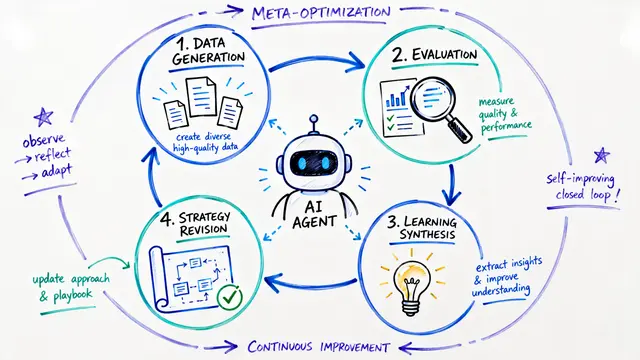
Here's the core insight: the authors introduce evolution as a third dimension of scaling, distinct from training-time and inference-time compute. An autonomous evolver agent systematically diagnoses failures, localizes structural gaps, and updates persistent artifacts that the system can reuse across episodes.
These principles distinguish agentic evolution from prior approaches. The system is goal-oriented, actively pursuing improvements rather than passively accumulating context. It's autonomous, deciding when and how to evolve through validation gates. And crucially, it's compositional, building verified, modular capabilities rather than monolithic adaptations that risk catastrophic forgetting.
The authors tested this framework rigorously on a demanding benchmark.
The empirical results validate the framework convincingly. Across multiple solver backbones, agentic evolution reliably converted deployment evidence into durable capability gains. Notably, smaller models enhanced through evolution matched or surpassed the performance of much larger static models, demonstrating efficient capability multiplication.
Perhaps most significantly, the authors demonstrate an evolution-scaling hypothesis: unlike heuristic memory accumulation that saturates quickly, allocating more compute to the evolver agent yields sustained improvements. This suggests adaptation isn't just opportunistic patching but a governed, convergent process that scales predictably with resources.
Comparing agentic evolution to alternatives clarifies its distinct value. Extended reasoning chains help on novel problems but don't capture recurring patterns. Direct weight updates lack interpretability and safety guarantees. Heuristic approaches are lightweight but strategically blind, leading to diminishing returns as context accumulates.
The practical implications extend beyond performance gains. Agentic evolution enables privacy-preserving adaptation by refining artifacts locally rather than shipping data for retraining. It promotes computational sustainability by converting one-shot inference costs into persistent, amortized capabilities. The framework includes governance mechanisms to ensure changes remain interpretable and aligned.
The authors make a compelling case that bridging the train-deploy gap requires more than static scaling or deeper reasoning: it demands systems that autonomously, systematically, and safely evolve through deployment experience. To explore how agentic evolution might reshape adaptive intelligence, visit EmergentMind.com to learn more.