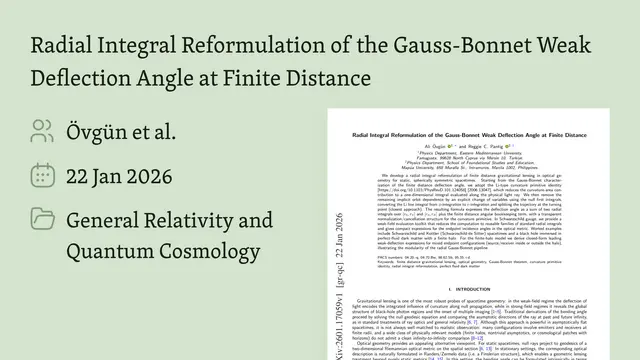
Boundary-only weak deflection angles from isothermal optical geometry
This presentation explains a novel computational approach to gravitational lensing that sidesteps traditional curvature area integrals. By exploiting isothermal coordinates and conformal geometry, the authors reduce the problem of computing weak deflection angles to boundary integrals alone. The method is validated on canonical spacetimes including Schwarzschild, Reissner-Nordström, and Kottler geometries, demonstrating both computational efficiency and broader applicability beyond standard asymptotically flat cases.Script
Gravitational lensing calculations traditionally require integrating curvature over entire regions of spacetime, a computationally expensive process. This paper presents a breakthrough: computing deflection angles using only boundary data, never touching the interior curvature at all.
Standard Gauss-Bonnet lensing requires computing curvature integrals across the entire optical manifold. When sources and receivers sit at finite distances, these calculations grow unwieldy. The key insight is that isothermal coordinates transform the optical metric into a conformally flat form, where area integrals collapse into boundary terms.
How does this boundary-only approach actually work?
The contrast is striking. Traditional methods march across the entire optical manifold, computing curvature at every point. The isothermal method exploits conformal geometry to rewrite everything in terms of a single function and its normal derivative, evaluated only where the light ray enters and exits the lensing region.
The authors validate their framework on three canonical spacetimes. For Schwarzschild, they recover established finite distance lensing formulas. Reissner-Nordström tests the method with electric charge, while Kottler spacetime with its cosmological constant term demonstrates the approach handles corrections of order Lambda without difficulty.
This is not just an algorithmic trick for known cases. The boundary-only framework applies to spacetimes that are not asymptotically flat, expanding the scope of Gauss-Bonnet lensing. By eliminating interior integrals, the method makes previously intractable multi-lens configurations computationally feasible.
When geometry lets you skip the middle and jump straight to the answer, lensing calculations become boundary data lookups. Visit EmergentMind.com to explore more research and create your own video presentations.