Computing Diffusion Geometry
This presentation explores a groundbreaking computational framework that reconstructs calculus, geometry, and topology purely from data—without requiring smooth manifolds or classical differentiability. By leveraging diffusion processes and the carré du champ operator, the authors demonstrate how to compute gradients, curvature, cohomology, and other geometric invariants on arbitrary point clouds, achieving remarkable robustness and efficiency that outperforms traditional methods by orders of magnitude.Script
What if you could compute curvature, gradients, and topology on data that isn't even a smooth manifold? The researchers behind this work show that diffusion statistics alone can reconstruct the entire machinery of calculus and geometry, no smoothness required.
Let's start with the problem they set out to solve.
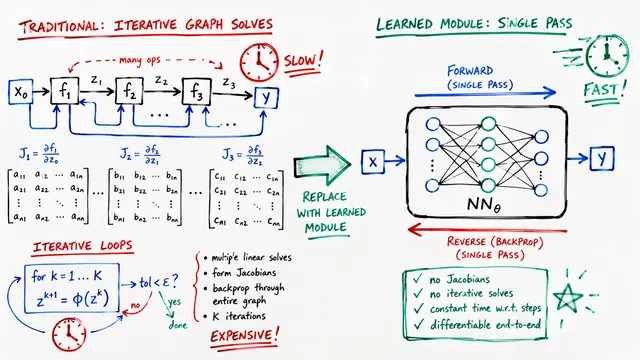
Building on that challenge, traditional geometric methods depend on smooth manifolds and infinitesimal calculus. But real data is finite, noisy, and often fails to satisfy manifold assumptions, leaving a huge gap between theory and practice.
The authors bridge this gap with a radically different approach.
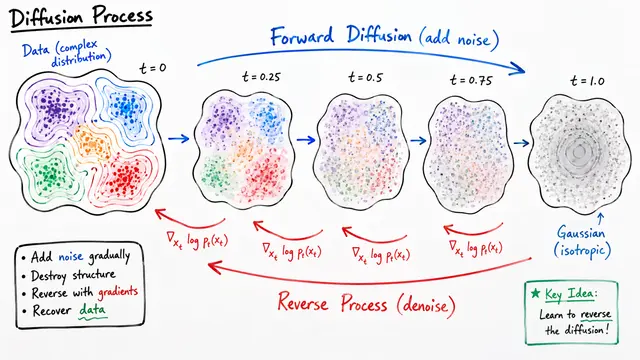
Their breakthrough is using diffusion processes to define geometry. The carré du champ operator captures how functions covary under infinitesimal heat flow, turning statistics into calculus without requiring differentiability.
Now here's how it works mechanically. They represent functions and tensors using spectral bases and frame theory, then compute all operators through weak formulations backed by sparse kernels, ensuring both numerical stability and scalability.
The empirical results are striking.
The results include the first-ever computation of sectional curvature on non-manifold data and topology extraction that's orders of magnitude faster than persistent homology, all while handling noise and irregularity gracefully.
Compared to traditional methods, this framework scales where others break down. It's meshless, doesn't assume smoothness, and achieves practical computation on data that would defeat classical techniques.
Of course, open questions remain, particularly around convergence guarantees beyond manifolds and optimal strategies for very high dimensions.
This work fundamentally changes what's computationally accessible in geometric data analysis. It connects statistical learning with classical geometry, enabling entirely new applications in science and machine learning where data defies traditional assumptions.
Diffusion geometry shows us that smoothness isn't a prerequisite for calculus—just a special case. Visit EmergentMind.com to explore more cutting-edge research like this.