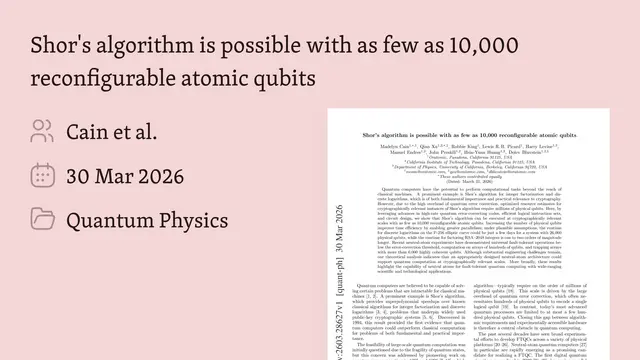
Breaking RSA-2048 with 100,000 Qubits Using Quantum LDPC Codes
This lightning talk unveils the Pinnacle Architecture, a revolutionary quantum computing framework that slashes the physical qubit requirements for breaking RSA-2048 encryption by an order of magnitude. By leveraging quantum low-density parity check codes, modular processing units, and novel magic state distillation engines, this architecture demonstrates that utility-scale quantum factoring is achievable with fewer than 100,000 physical qubits—a breakthrough that fundamentally challenges prevailing assumptions about the resource requirements for cryptographically relevant quantum computation and accelerates the timeline toward practical quantum advantage.Script
What if breaking the encryption that secures the internet required 10 times fewer quantum computers than we thought? This paper introduces the Pinnacle Architecture, a breakthrough that reduces RSA-2048 factoring to under 100,000 physical qubits using quantum low-density parity check codes.
To understand why this matters, we first need to examine the resource bottleneck that has kept utility-scale quantum computing out of reach.
Building on that challenge, conventional surface code architectures have demanded millions of physical qubits to factor RSA-2048, creating an insurmountable scalability barrier. The massive spacetime overhead of surface codes has kept cryptographically relevant quantum computation firmly in the theoretical realm.
The Pinnacle Architecture takes a fundamentally different approach by replacing surface codes with quantum low-density parity check codes.
Following from this new foundation, the architecture introduces three key components working in concert. Processing units built from bridged QLDPC blocks handle quantum operations, while magic engines simultaneously distill and inject high-fidelity magic states at constant throughput, and Clifford frame cleaning decouples units to enable flexible parallelism without prohibitive time costs.
This comparison reveals the magnitude of improvement: where surface codes demanded millions of qubits and years of runtime, Pinnacle achieves RSA-2048 factoring with fewer than 100,000 physical qubits in as little as one month.
These aren't just theoretical claims—the authors provide concrete numerical simulations and benchmark results.
Turning to the evidence, simulations demonstrate that the architecture factors RSA-2048 with 100,000 physical qubits at 0.001 physical error rate and microsecond cycle times. For the Fermi-Hubbard benchmark, only 22,000 qubits suffice at the lower error rate of 0.0001, representing order-of-magnitude improvements across both applications.
The architecture's flexibility extends across quantum hardware platforms. Superconducting systems can factor RSA-2048 with 100,000 qubits, while trapped ion systems achieve the same result with 3.1 million qubits but millisecond cycle times, still completing the computation in one month.
Despite these advances, challenges remain: scalable real-time decoding for QLDPC codes requires further development, and practical implementations must achieve robust quasi-local connectivity. The authors note that emerging higher-rate LDPC codes could push requirements below even the 100,000 qubit threshold.
The Pinnacle Architecture fundamentally redefines what's achievable in near-term quantum computing by proving that cryptographically relevant factoring is within reach of devices containing fewer than 100,000 physical qubits. Visit EmergentMind.com to explore the full technical details and implications for the future of quantum advantage.