- The paper presents a novel method for designing and fabricating superconducting CPW resonators that achieve quality factors up to several hundred thousand at 20 mK.
- It employs transmission measurements with Lorentzian fitting to precisely characterize resonator properties and assess the impact of capacitive coupling.
- The findings indicate strong photon-qubit coupling potential, advancing applications in quantum computing and high-speed quantum state detection.
Coplanar Waveguide Resonators for Circuit Quantum Electrodynamics
Introduction
The paper "Coplanar Waveguide Resonators for Circuit Quantum Electrodynamics" discusses the design, fabrication, and characterization of superconducting coplanar waveguide (CPW) resonators with applications in quantum optics and information processing. These resonators exhibit fundamental frequencies from 2 to 9 GHz and loaded quality factors ranging substantially, depending on input/output capacitor design, achieving several hundred thousands at temperatures of 20 mK.
Device Geometry and Fabrication
CPW resonators are constructed using optical lithography with aluminum deposited on a silicon substrate. The resonator designs comprise a center conductor flanked by lateral ground planes. The coupling design includes gap and finger capacitors for varying strengths. The geometry is crucial, as illustrated in the following figure.
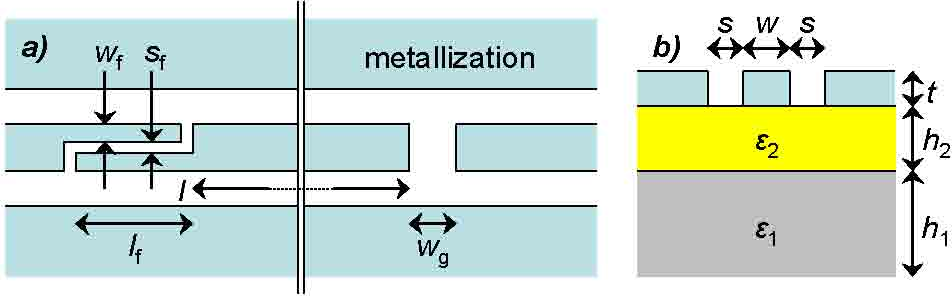
Figure 1: Top view and cross section of a CPW resonator design, highlighting capacitor configurations.
Measurement Techniques
Transmission measurements were performed in a dilution refrigerator at 20 mK, using a vector network analyzer and HEMT amplifiers for high-quality factor characterization. Typical transmission spectra display Lorentzian lineshapes, with significant internal quality dependence on the driving power due to nonlinear effects and dielectric losses.
Resonator Properties
The study details resonator design dependent frequency and quality factors measurable with a model of a parallel lumped element LCR oscillator. The effective permittivity and geometric considerations facilitate the high resonance frequencies suitable for quantum circuit applications.
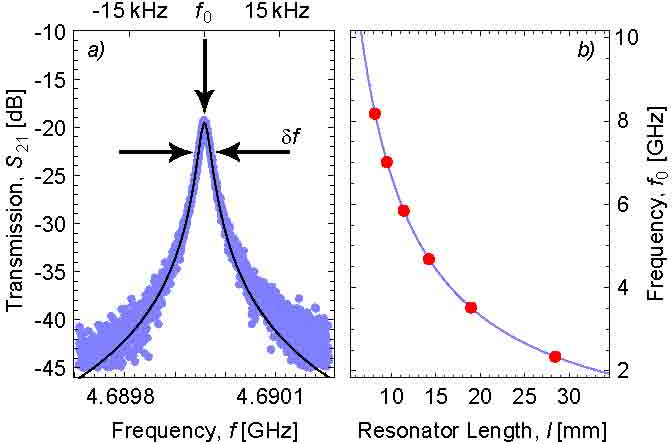
Figure 2: Transmission spectrum indicating resonance characterization through Lorentzian fitting.
Coupling affects both quality factor and resonance frequency, adjustable through capacitive loading. Figures below demonstrate the influence of coupling capacitors on insertion loss and loaded quality factor, highlighting the transition between over and under-coupled regimes.

Figure 3: Representation and equivalent circuit models of symmetrically coupled TL resonator depicting parameters affecting quality factors.
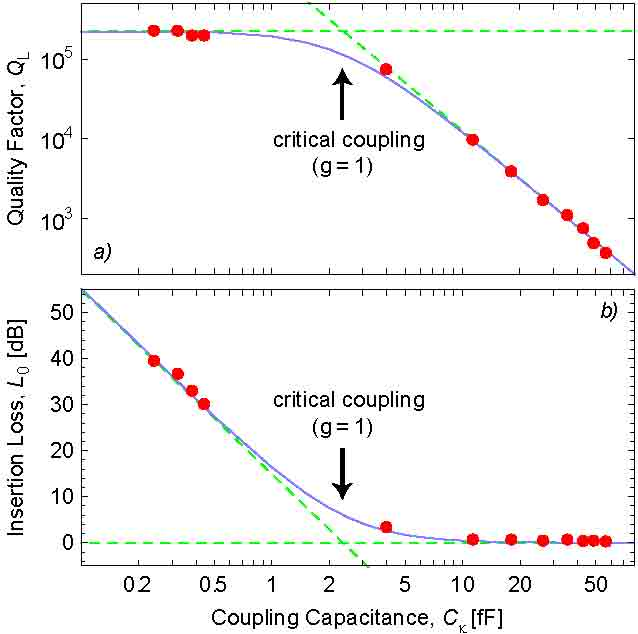
Figure 4: Variation of loaded quality factor contingent on coupling capacitor properties.
Harmonic Modes and Transmission Spectrum
Higher harmonic modes were consistently characterized, indicating a systematic decrease in quality factor with increasing mode number. Experimental transmission spectra corroborate model predictions regarding these harmonics.
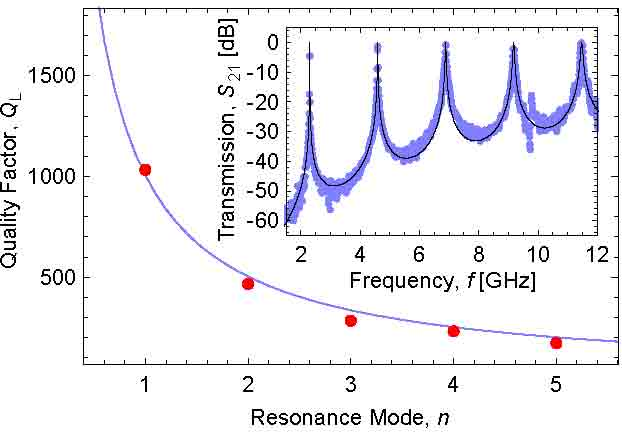
Figure 5: Correlation between measured and predicted quality factors across harmonic modes for resonator D.
Conclusion
The paper establishes that CPWs provide advantageous properties for circuit quantum electrodynamics, such as high electromagnetic field strengths and customizable impedance at micro-scale dimensions conducive to strong photon-qubit coupling. Analytical understanding of CPW properties will promote further explorations and applications in quantum detectors, circuit QED, and quantum information systems. The parallels between experimental data and theoretical models offer robust methods for analyzing various substrate and material compositions.
This comprehensive characterization enhances the potential of CPW resonators in advancing quantum computing and information processes, potentially serving as quantum memory or rapid state measurement devices.