- The paper demonstrates that active Brownian particle phase separation can be effectively mapped onto a Cahn-Hilliard equation using a coarse-grained hydrodynamic approach.
- It employs linear stability analysis and Brownian dynamics simulations to quantitatively determine instability thresholds and phase coexistence conditions.
- The study reveals a transition from continuous spinodal to discontinuous nucleation-driven kinetics, providing actionable insights for equilibrium analogies in active matter.
Effective Cahn-Hilliard Mapping of Phase Separation in Active Brownian Suspensions
Introduction
This paper presents a systematic theoretical and numerical investigation of phase separation in ensembles of repulsive active Brownian particles (ABPs), focusing on the mapping of their nonequilibrium kinetics onto an effective equilibrium description. Starting from a microscopic model, the authors derive a coarse-grained hydrodynamic description culminating in an equation of motion matching the Cahn-Hilliard form. This central result establishes a formal analogy between active phase separation and equilibrium phenomena driven by attractive forces, facilitating the application of equilibrium concepts such as free-energy functionals and spinodal decomposition to inherently driven active systems.
Microscopic Model and Hydrodynamic Coarse-Graining
The study considers a standard 2D ABP model: disks with self-propulsion at speed v0 along their orientation, which diffuses rotationally, interacting repulsively (modeled with WCA). The underlying equations are overdamped Langevin equations including propulsion, interparticle forces, and stochastic noise.
Through a moment expansion of the N-body Smoluchowski equation, the authors obtain coupled hydrodynamic equations for the density ρ(r,t) and polarisation p(r,t) fields. Crucially, the effective particle speed v(ρ) emerges as a decreasing function of density due to self-trapping—a mechanism whereby persistent motion and steric hindrance cause collisional slowing and clustering. Near the linear stability threshold, v(ρ)≈v0−ρζ where ζ quantifies the reduction of mobility.
Linear Stability and Instability Line
Linearization reveals an instability condition for homogeneous density: at fixed area fraction ϕ and propulsion speed v0, long-wavelength density fluctuations can become unstable when persistence and propulsion overcome diffusive relaxation. This boundary, analytically determined, defines an “instability line” in the (ϕ,v0) phase plane.
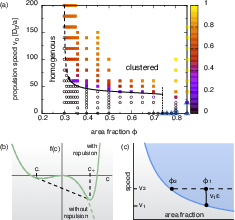
Figure 1: Instability diagram for repulsive self-propelled disks, showing phase regions, simulation results, and the analytically predicted instability line.
Brownian dynamics simulations for N=4900 particles corroborate the analytical results, showing excellent agreement for the onset of clustering and phase separation. The phase boundary exhibits both a minimal density threshold and a minimal propulsion speed for active clustering.
Emergence of the Cahn-Hilliard Equation
A weakly nonlinear analysis near the instability line yields a coarse-grained evolution equation for the density fluctuation field c(r,t). This equation takes the form:
∂tc=σ1∇2c−∇4c−2g∇⋅(c∇c)
which can be written as a conservation law with a chemical potential functionally derived from an effective free energy:
F[c]=∫[21∣∇c∣2+f(c)]dr,f(c)=21σ1c2−31gc3
This reveals that, at large scales and on long times, the phase separation kinetics of ABPs are governed by the same equation as passive systems with attractive interactions—the Cahn-Hilliard equation—with suitable effective parameters inherited from active dynamics.
Kinetics: Spinodal, Nucleation, and Hysteresis
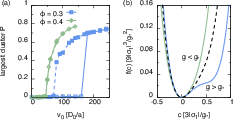
Simulation data reveal both continuous (spinodal) and discontinuous (nucleation-driven) phase separation regimes, depending on (ϕ,v0):
This crossover is also given a mean-field interpretation via the bulk free energy: the cubic term in f(c) yields a nonlinear instability whose bifurcation structure changes from supercritical to subcritical at a threshold g∗, set by the model parameters.
Quantitative Agreement and Nonlinear Effects
The phase boundary obtained from the hydrodynamic theory quantitatively matches simulation experiments, including the location of hysteresis and coexistence regions. The nonlinear coefficients, including the cubic nonlinearity g, are explicitly expressed in terms of microscopic parameters.
Additionally, the paper discusses the absence of "non-integrable" (non-variational) terms in the effective free energy for this minimal repulsive ABP model, contrasting with more complex active matter field equations that include fundamentally nonequilibrium terms.
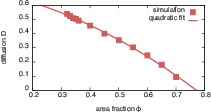
Figure 3: Passive suspension long-time diffusion coefficients versus area fraction, fit by a quadratic and used in analytic threshold calculations.
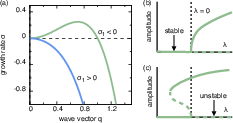
Figure 4: (a) Growth rates as a function of wave vector q for (un)stable regimes; (b,c) Bifurcation diagrams for continuous and discontinuous transitions, respectively.
Implications and Outlook
This mapping of ABP phase separation onto the Cahn-Hilliard framework carries significant theoretical and practical consequences. First, it validates the use of equilibrium statistical tools—free energy landscapes, double-tangent constructions, common tangent methods—for interpreting and predicting active suspension behavior near the motility-induced phase separation (MIPS) threshold. It also provides a firm theoretical ground for using coarse-grained continuum active matter models without recourse to nonequilibrium noise or non-Hamiltonian terms in this regime.
Practically, the framework predicts precise conditions for phase coexistence and cluster formation, facilitating design and control of synthetic or biological active materials. The prediction of a switch from spinodal to nucleation-driven kinetics may guide experimental investigations into the nonequilibrium analogs of classical nucleation theory in active matter.
Future research should resolve the discrepancy in domain coarsening dynamics, where computed exponents for growing cluster size in simulations deviate from the equilibrium Cahn-Hilliard $1/3$ law, potentially due to long transients or dimensional crossover effects.
Conclusion
By formally reducing the nonequilibrium dynamics of repulsive ABPs to an effective Cahn-Hilliard equation, this work establishes a rigorous connection between active and passive phase separation mechanisms, elucidates the kinetics of motility-induced phase separation, and predicts a density-dependent change in the character of the phase transition. These findings solidify the theoretical foundations of MIPS and provide a quantitative link between microscopic dynamics and macroscopic phase behavior in active matter systems (1312.7242).