Partial restoration of chiral symmetry in the color flux tube
Published 17 Feb 2015 in hep-lat | (1502.04845v2)
Abstract: Using the quark eigenmodes computed on the lattice with the overlap-Dirac operator, we investigate the spatial distribution of the chiral condensate around static color sources corresponding to quark-antiquark and three-quark systems. A flux structure of chromo fields appears in the presence of such color charges. The magnitude of the chiral condensate is reduced inside the color flux, which implies partial restoration of chiral symmetry inside hadrons. Taking a static baryon source in a periodic box as a toy model of nuclear matter, we estimate the magnitude of the chiral symmetry restoration as a function of baryon matter density.
The paper demonstrates that chiral symmetry is partially restored in flux tubes, with up to 20–25% suppression of the chiral condensate between static color charges.
It employs an overlap-Dirac operator and low-mode truncation to filter UV fluctuations, revealing long-range, infrared-dominated effects in the QCD vacuum.
The study extends its findings to baryonic systems and finite density, offering insights for effective string models and in-medium chiral dynamics.
Partial Restoration of Chiral Symmetry in the Color Flux Tube
Introduction and Motivation
This work provides a quantitative lattice QCD investigation of the spatial inhomogeneities of the chiral condensate, focusing on its modification in the vicinity of static color sources. Confinement and spontaneous chiral symmetry breaking are the defining low-energy, nonperturbative phenomena of QCD. While confinement manifests as color flux-tube formation between static charges, the chiral condensate ⟨qˉq⟩ quantifies chiral symmetry breaking. The interplay between these two properties, especially inside hadrons, remains central in hadronic physics. This study aims to connect the formation of confining flux tubes with local partial restoration of chiral symmetry, using the overlap-Dirac operator formalism to robustly define and measure the local chiral condensate.
Lattice QCD Setup and Methodology
The analysis employs $2+1$ flavor dynamical overlap fermion gauge configurations, ensuring exact lattice chiral symmetry. The low-lying eigenmodes of the overlap-Dirac operator are computed to reconstruct the local chiral condensate, leveraging the eigenmode expansion:
qˉq(x)=−λ∑mq+(1−2m0mq)λψλ†(x)ψλ(x)
Truncating the sum at a fixed number N of low-lying modes effectively filters UV fluctuations and regulates divergences. This non-perturbative probe allows reliable extraction of the local condensate even in the presence of static external sources.
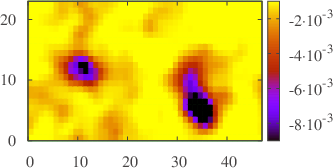
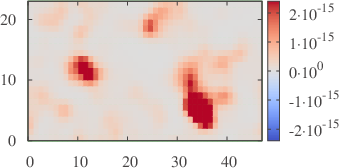
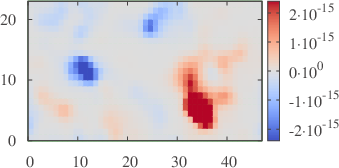
Snapshots of the vacuum structure using low-mode truncation reveal a clustered profile for qˉq(x), tightly correlated with the locations of topological charge and action density clusters. This provides a direct visualization of the QCD vacuum's nonperturbative structure.
Figure 1: Tomographies of the low-mode truncated local chiral condensate (left), action density (center), and topological charge density (right) demonstrate their strong spatial correlation.
Chiral Condensate Modification in the QQˉ Flux Tube
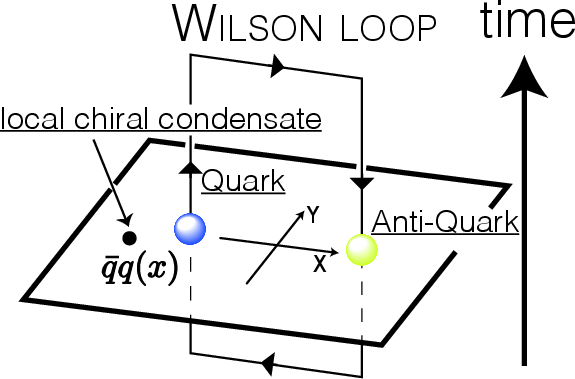
The spatial distribution of the chiral condensate is extracted in the presence of static quark-antiquark pairs, represented by Wilson loops. The observable of interest is the excess condensate at position x, ⟨qˉq(x)⟩W, defined as the difference between the local condensate in the presence of the Wilson loop and the vacuum expectation value.
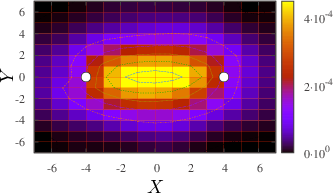
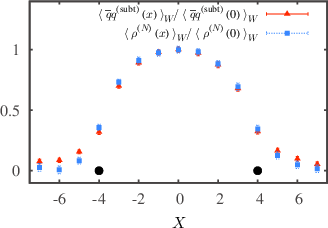
The primary result is the emergence of a tube-like suppression of the chiral condensate between static sources—the magnitude of ⟨qˉq(x)⟩ is reduced within the flux tube, indicating partial restoration of chiral symmetry in this region. The depleted region corresponds precisely to the confining chromoelectric flux tube, as supported by a close spatial correlation with the UV-filtered action density.
Figure 2: Schematic geometry of the QˉQ flux tube measurement using the Wilson loop and the probing of the local chiral condensate.
Figure 3: Spatial map of the local chiral condensate in the QˉQ system; the suppression forms a tube-like structure between sources.
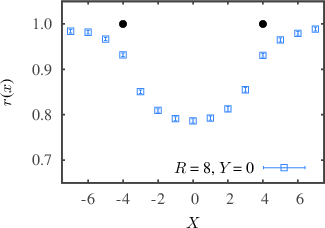
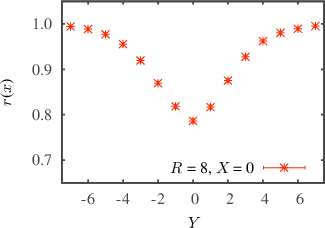
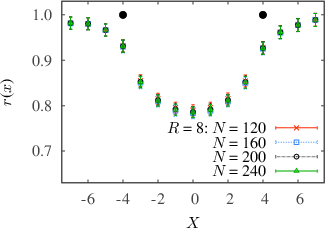
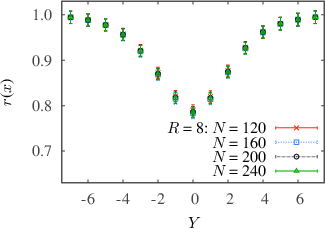
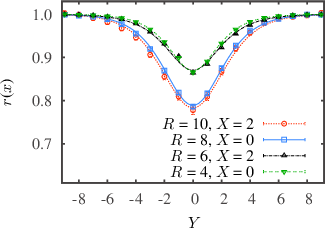
Figure 4: Cross-sections of the chiral condensate suppression ratio r(x) along X and Y axes, quantifying up to 20--25% reduction at the flux tube center.
The fractional suppression, robustly defined by the UV-finite ratio r(x), achieves values as low as 0.75 near the flux tube midpoint for R=8 lattice units (about 1fm). The suppression deepens for increasing source separation and broadens transversely, compatible with string-inspired models of the flux tube profile.
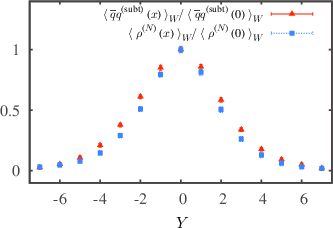
Figure 5: The spatial profiles of the local chiral condensate and the UV Dirac-mode truncated action density show strong agreement, reinforcing the physical connection between chiral symmetry restoration and confining field structure.
The results exhibit full saturation with respect to the low-mode truncation parameter N for N≳160, confirming that the observed effect is governed by long-distance, infrared physics rather than UV artifacts.
Figure 6: The suppression profile r(x) is insensitive to the number of included eigenmodes N, confirming IR dominance and mode saturation.
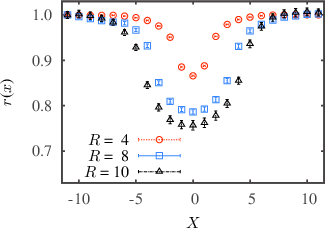
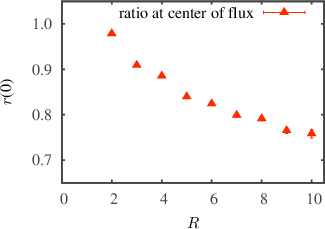
The spatial dependence for varying R demonstrates a monotonic increase in both the magnitude and spatial extent of the chiral condensate depletion as the source separation grows, consistent with the physical expectation that the flux tube becomes longer and thicker.
Figure 7: Cross-section along the flux tube displays increasing suppression with source separation R, consistent with the expected broadening.
Figure 8: Suppression ratio at the flux tube center versus R; the trend supports monotonic increase of restoration with separation.
Model fits to the transverse profiles support a flux-tube with a well-defined penetration length and core thickness, in qualitative agreement with string-inspired theoretical expectations.
Figure 9: Transverse cross-sections at different positions and separations exhibit scaling consistent with effective string model predictions.
Chiral Symmetry Restoration in Three-Quark Systems
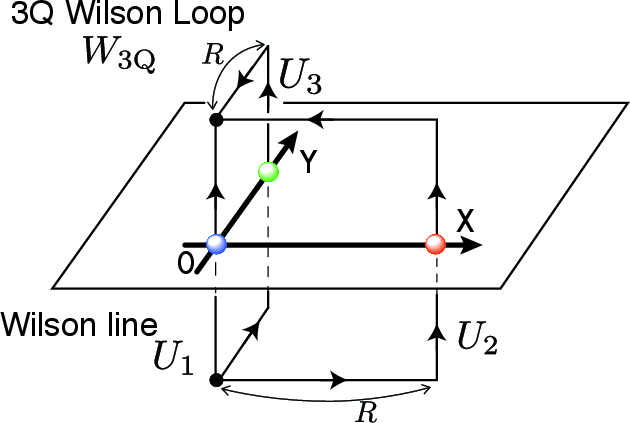
The analysis extends to static three-quark (3Q) configurations, representing idealized baryonic systems. The gauge-invariant 3Q Wilson loop is constructed and the local condensate is evaluated analogously to the QˉQ case.
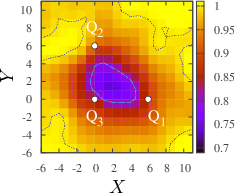
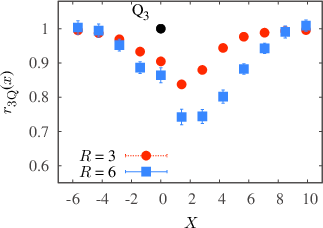
A clear region of suppressed condensate is observed inside the region spanned by the three color sources, with a reduction magnitude and spatial profile comparable to that of the QˉQ system. The effect is enhanced with increasing distance between the sources, often reaching 30% suppression at the geometric center.
Figure 10: Schematic visualization of the 3Q Wilson loop geometry for the isosceles triangle configuration.
Figure 11: Spatial map of r3Q(x) displays pronounced chiral condensate suppression among the three color sources.
The dependence on the interquark separation further corroborates the flux-tube picture and indicates similarly partial restoration in baryonic systems.
Figure 12: Chiral suppression profile along the diagonal X=Y for two different 3Q source sizes; larger R yields stronger suppression at the system center.
Implications for Finite Density QCD
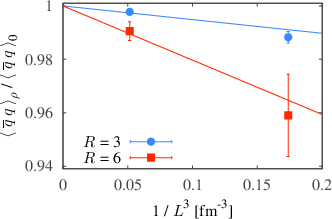
By spatially averaging the chiral suppression ratio in static multi-baryon configurations, the study provides a first-principles estimate for partial chiral restoration in baryonic matter at finite density. Although the toy model of “one baryon in a box” does not capture the full quantum nature of dense matter, the estimated chiral suppression at normal nuclear density is ∼5%. This is substantially less than phenomenological estimates, but the modeling of baryon size is a limiting factor. Considering that suppression increases with baryon spatial extent, the results suggest that realistic nuclear matter may exhibit substantially larger reductions in the chiral condensate.
Figure 13: The ratio of the averaged chiral condensate at finite baryon density to vacuum versus 1/L3 reveals a clear linear decrease due to local symmetry restoration.
Conclusion
This study implements an eigenmode-filtered, UV-finite lattice approach to quantify the local chiral condensate in the presence of static color sources. In both QˉQ and 3Q systems, a clear and significant partial restoration of chiral symmetry is observed, spatially coincident with the confining chromoelectric flux tubes. The suppression magnitude grows with interquark distance and is consistent with string-inspired phenomenology. Extension to baryonic systems and finite density offers insight into chiral restoration in nuclear matter, with practical and theoretical implications for interpreting hadron structure and in-medium QCD dynamics. The overlap-Dirac operator eigenmode framework is poised for straightforward extension to finite temperature and more complex static or dynamical source configurations, opening avenues for systematic investigation of chiral dynamics under extreme conditions.