- The paper demonstrates that time-periodic, orbital-dependent modulation can dynamically induce and control superconductivity in alkali-doped fullerides.
- It employs a time-dependent Gutzwiller variational method on a three-band Hubbard-Kanamori model to capture resonant pair-breaking effects and transient superconducting order.
- Results reveal that driving frequency and modulation amplitude critically determine whether superconductivity is enhanced above or suppressed below the equilibrium critical temperature.
Non-equilibrium Superconductivity in Driven Alkali-Doped Fullerides
Introduction and Motivation
This work presents an in-depth study of non-equilibrium superconductivity in alkali-doped fullerides, focusing on A3C60 compounds subjected to periodic modulation of orbital-dependent electronic interactions. The context stems from experimental observations of light-induced superconducting-like responses in K3C60 above the equilibrium critical temperature (Tc), which cannot be fully reconciled with traditional theories relying on simple enhancement of the effective SC coupling.
By employing a time-dependent Gutzwiller variational approach applied to a three-band Hubbard-Kanamori model with negative Hund's coupling, the paper investigates how transient SC can be dynamically stabilized by optical excitation of specific phonon modes, most notably the T1u intramolecular vibrations.
Model and Theoretical Approach
The physical model comprises three half-filled t1u orbitals on the C60 molecule, with on-site interactions exhibiting an inversion of Hund’s coupling due to Jahn-Teller effects. At equilibrium, all orbitals experience the same Coulomb repulsion U. Upon excitation of odd-parity vibrational modes (specifically T1u), the electron-phonon coupling induces both a reduction and differentiation of the interactions, leading to a time- and orbital-dependent modulation:
Ux,y(t)=U−r(t)2δU(1−cos2Ωt),Uz(t)=U
where Ω is the driving frequency, and r(t) parameterizes the onset of the modulation.
Non-equilibrium dynamics are treated with the time-dependent Gutzwiller approximation (tdGA), generalized to handle multi-band superconducting correlations at finite temperature. This variational technique is crucial for capturing the feedback between local correlations and the macroscopic SC order parameter out of equilibrium, substantially beyond what static mean-field or Hartree-Fock schemes can describe.
Dynamics of the Superconducting State
Simulations track the evolution of the SC order parameter following the introduction of the driving, for initial states both below and above Tc.
At select frequencies—specifically Ω=0.1875 eV—the periodic modulation not only enhances the SC order below Tc but also induces a finite SC order above Tc. This is consistent with a scenario where the average interaction imbalance raises the effective Tc (Figure 1).
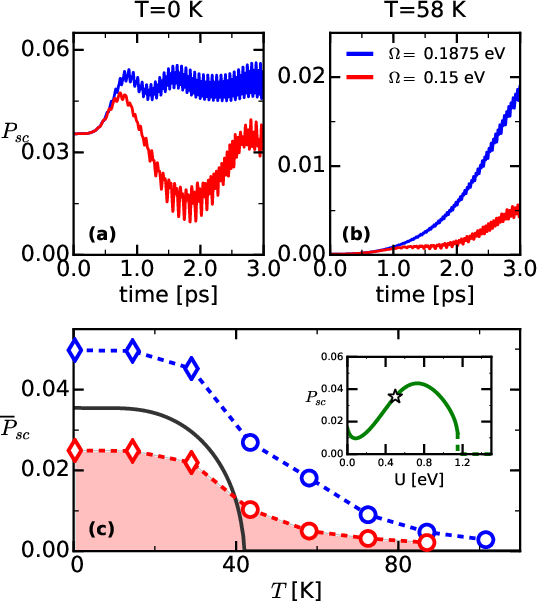
Figure 1: Dynamics and temperature dependence of the global SC order parameter for different driving frequencies, highlighting regimes where SC is suppressed below Tc but induced above Tc.
However, this behavior is strongly non-monotonic with respect to the driving frequency. Lowering the modulation to Ω=0.15 eV leads to a suppression of SC below Tc while still enabling a transient SC above Tc. The order parameter dynamics for distinct orbitals and frequencies further elucidate that at intermediate driving frequencies, the modulation can induce resonant pair-breaking, rapidly suppressing the SC order (Figure 2).
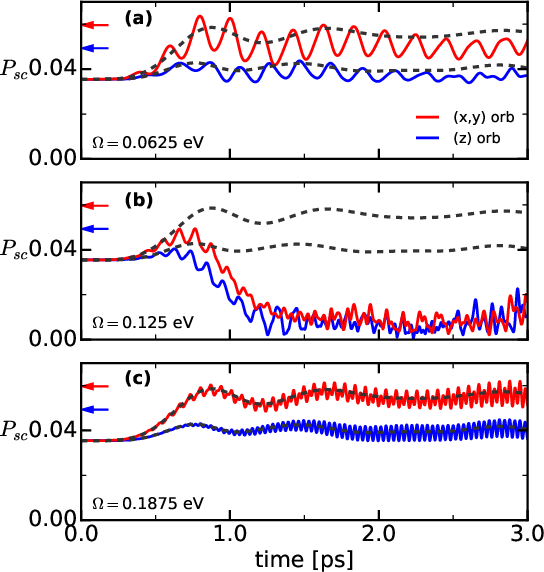
Figure 2: Zero-temperature evolution of individual orbital SC order parameters under various driving frequencies, compared to the dynamics with a sudden, constant interaction imbalance.
Frequency and Resonance Effects
A key finding is the existence of a frequency window (0.09 eV≲Ω≲0.16 eV) where dynamic energy absorption via resonant excitation of intra-orbital doublons leads to significant suppression of the SC state, even when the static (unmodulated) interaction imbalance would otherwise enhance SC (Figure 3).
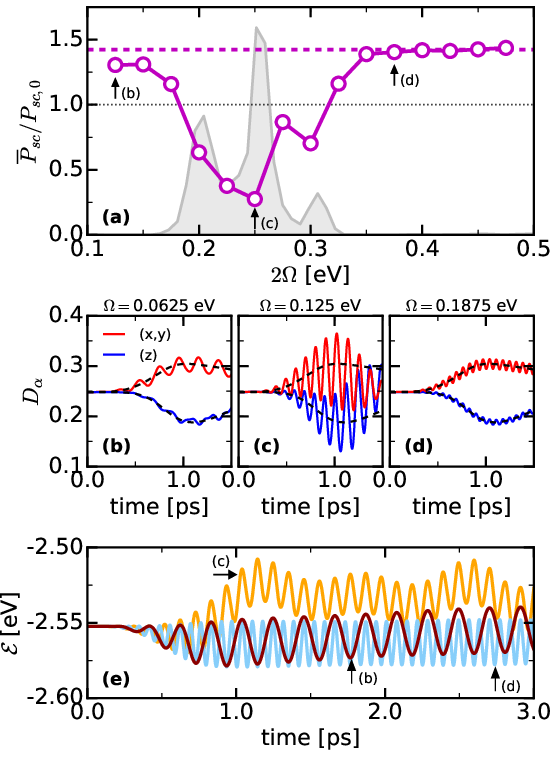
Figure 3: (a) Stationary zero-temperature SC order parameter versus driving frequency; (b)-(d) dynamics of orbital double occupancies and (e) internal energy, establishing the link between resonant excitations and SC suppression.
The analysis reveals that the suppression correlates with the resonance between the driving frequency 2Ω and the spectrum of electronic excitations associated with non-equilibrium doublon dynamics. The energy absorption at resonance results in robust pair-breaking, overwhelming the beneficial effect of the averaged interaction imbalance.
Outside this resonant energy absorption window, at both low and high frequencies, the SC order follows the expectations from equilibrium considerations: enhancement for high-frequency driving, and modest enhancement (or reduced suppression) for slow ramps, with minimal energy absorption.
Amplitude Dependence and Experimental Relevance
The amplitude δU of the induced interaction imbalance directly controls the enhancement of the SC order. Larger δU results in more pronounced effects, mirroring experimental trends where high incident laser fluence (which drives larger phonon displacements) is required to observe robust transient SC signals (Figure 4).
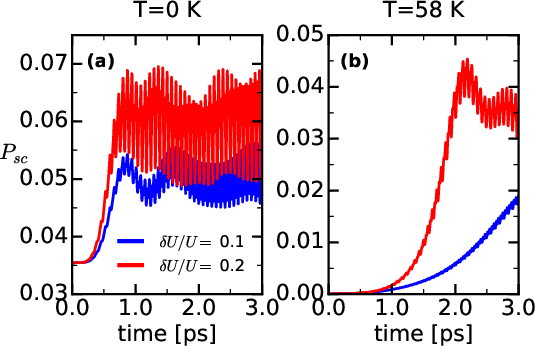
Figure 4: Dependence of the SC enhancement effect on the amplitude of the interaction imbalance for fixed driving frequency, in correspondence with fluence-dependent experimental observations.
The theoretical framework is consistent with scenarios where the primary effect of light is the excitation of T1u phonons, whose coupling naturally breaks orbital degeneracy in the local Coulomb interaction. Notably, the model reproduces the lack of enhancement or even suppression of SC below Tc and the existence of transient SC above Tc, both seen experimentally but not explained by models based solely on uniform pairing enhancement.
Implications and Outlook
The results demonstrate that the interplay between light-induced interaction imbalance and the resonant excitation of non-equilibrium doublons fundamentally governs the observed non-equilibrium superconducting response in alkali-doped fullerides. The findings bridge the gap between transient light-induced SC and intrinsic multi-orbital correlation effects, revealing regimes where SC can be transiently stabilized well above equilibrium Tc, and others where energy absorption quenches the order even for states initially below Tc.
Future experimental work—such as alkali substitution (e.g., Cs3C60 for a broader phase diagram exploration) and detailed pump-frequency dependence studies—could further validate the theory. Additional microscopic mechanisms, possibly involving direct electronic excitations, merit scrutiny but the presented framework establishes the orbital-selective interaction imbalance mechanism as a leading explanation.
Conclusion
This study establishes that time-periodic, orbital-asymmetric interaction modulation—realizable through selective optical phonon excitation—can generate non-equilibrium superconductivity in alkali-doped fullerides. The interplay between enhanced pairing and resonant energy absorption via doublon dynamics creates rich, non-trivial SC responses that match salient experimental observations: SC can both be induced above equilibrium Tc and suppressed below it, contingent on driving parameters. These insights advance the theoretical understanding of photoinduced SC states and identify new dynamical regimes accessible in strongly correlated molecular superconductors.
(1702.04675)

