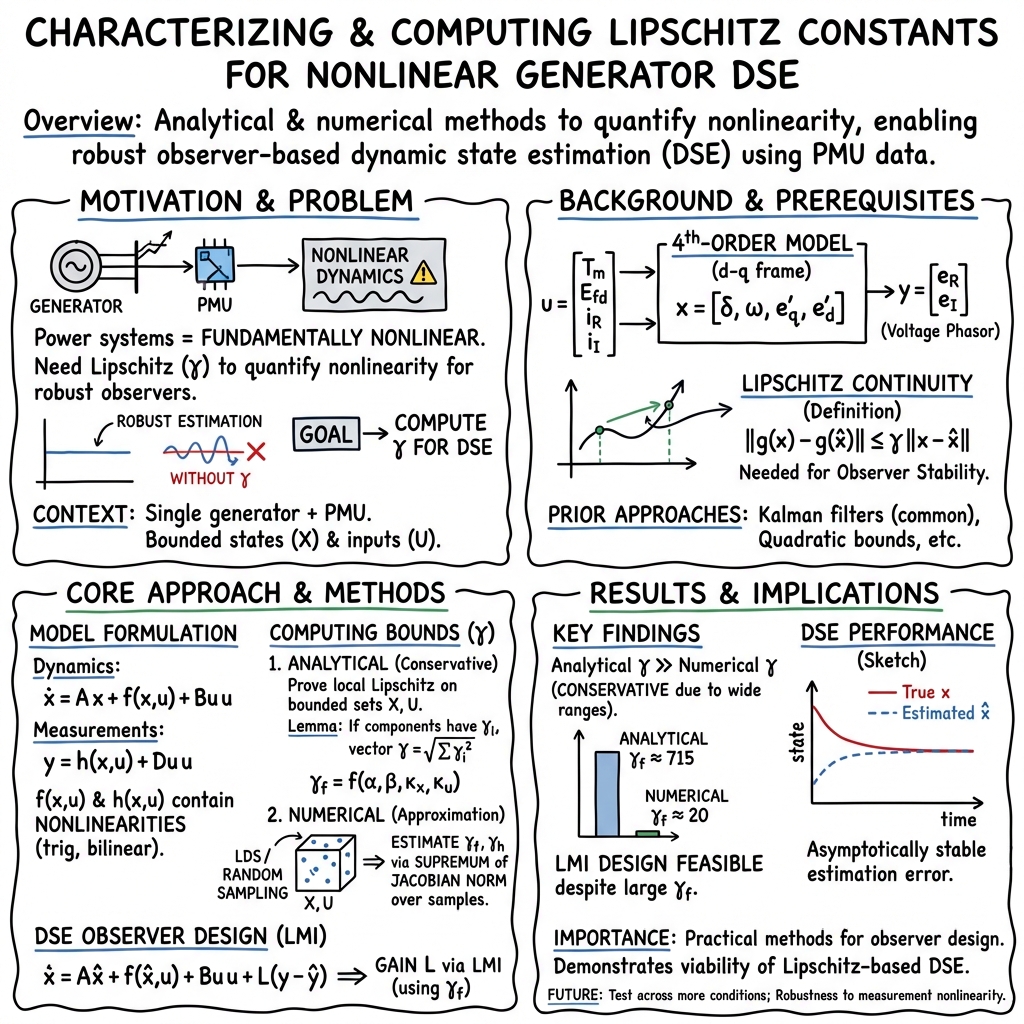
- The paper presents analytical and numerical approaches to compute Lipschitz constants, aiding dynamic state estimation in synchronous generator models.
- It validates the use of Lipschitz-based observers via simulations on multi-machine systems to achieve robust state-feedback control.
- The study demonstrates that numerical methods yield less conservative Lipschitz estimates, enhancing performance evaluation across wide operational ranges.
Characterizing the Nonlinearity of Power System Generator Models
Introduction
The nonlinear dynamics of power system generators are critical for designing advanced control and estimation strategies that enhance system stability and situational awareness. The paper "Characterizing the Nonlinearity of Power System Generator Models" (1902.06025) addresses this by focusing on synchronous generator models equipped with phasor measurement units (PMUs). This study provides essential insights into the dynamics characterized by Lipschitz continuity, a property instrumental for dynamic state estimation (DSE) and state-feedback control.
Synchronous Generator Model
The study begins by revisiting well-established models of single- and multi-machine power systems, specifically those capturing the dynamics of synchronous generators. Utilizing PMUs allows capturing voltage and current phasors, which aid in estimating the generator's internal states. The model considered includes fourth-order differential equations in the d-q reference frame. These models encapsulate rotor angles, rotor speed, transient voltages, and stator currents. Through these equations, the paper lays down a state-space model that reflects generator dynamics influenced by mechanical torque, field voltages, and stator currents.
Lipschitz Nonlinearity Analysis
One of the paper's focal points is the characterization of Lipschitz nonlinearity in dynamical models. Establishing local Lipschitz continuity ensures boundedness in the rate of change of the system states. This property is particularly beneficial as it simplifies the design of DSE routines and observer-based feedback controls using Lyapunov theory. The authors compute Lipschitz constants both analytically and numerically, providing a crucial tool for evaluating system stability.
Analytical and Numerical Methods
The authors propose analytical formulations to derive Lipschitz constants for both process and measurement models. These constants provide upper bounds on the rate of divergence of trajectories and are pivotal for observer design. Moreover, they introduce a numerical algorithm, employing low discrepancy sequences, to compute approximations of these constants. Results showcase that numerical methods can yield less conservative estimates than analytical approaches, particularly for systems with wide operational ranges.
Dynamic State Estimation
The paper applies the derived Lipschitz constants to the design of a Lipschitz-based observer. This observer is integral to DSE, estimating generator dynamics in real-time. The observer dynamics are governed by an LMI-based approach for gain matrix computation, enabling robust state estimation amidst nonlinearities. Simulations on a 16-machine system validate the observer's efficacy, affirming that both analytical and numerical Lipschitz constants facilitate effective DSE even with conservative values.
Conclusion
The analytical and numerical methodologies proposed for computing Lipschitz constants pave the way for advanced DSE in nonlinear power systems. Although the analytical constants tend to be conservative, they still enable the successful implementation of Lipschitz-based observers. The study encourages further exploration of robust observers and controllers leveraging these Lipschitz properties, especially under varying system conditions. Future research could extend this work to more comprehensive models and control scenarios, including the impact of external disturbances and the integration of renewable energy sources.