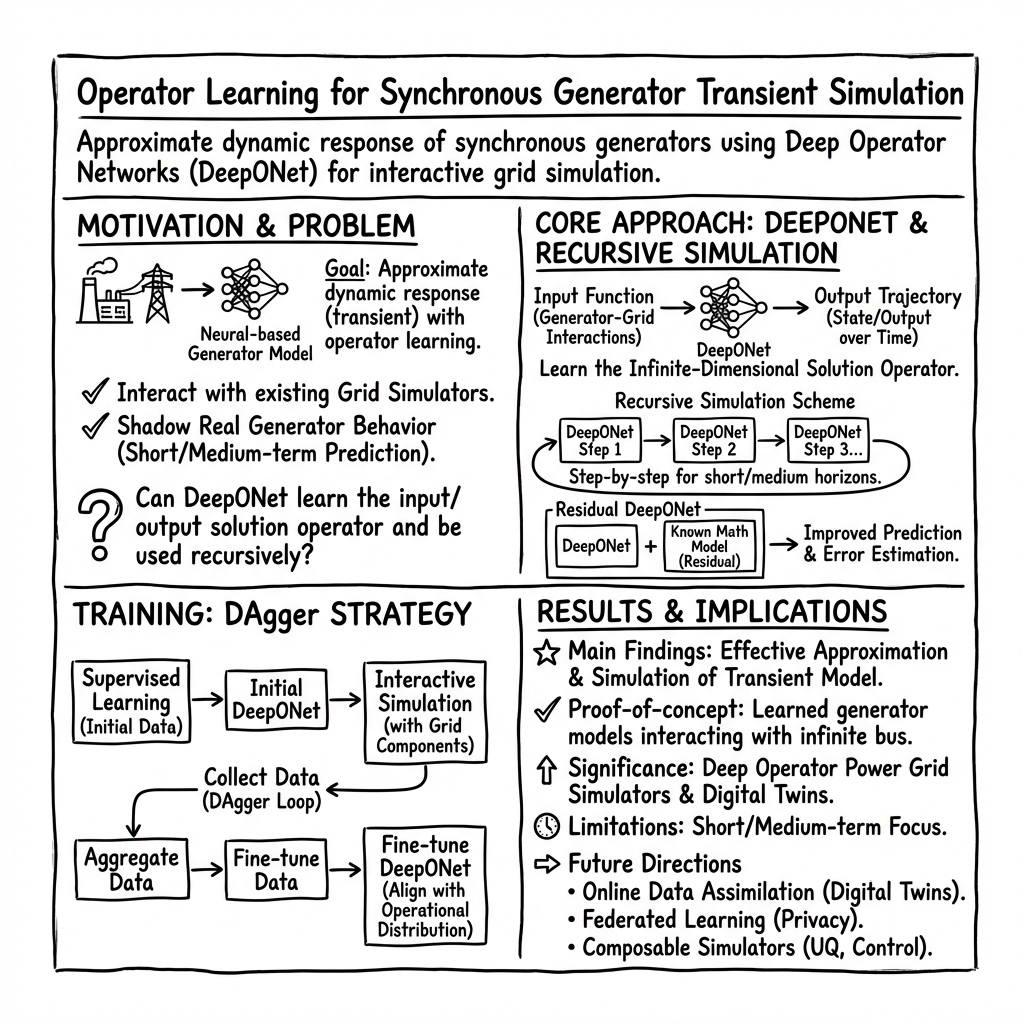
- The paper presents a novel DeepONet framework that approximates synchronous generators' dynamic responses using operator learning.
- It integrates a residual DeepONet scheme with DAgger-based data aggregation to enhance accuracy and recast established mathematical models.
- Numerical experiments validate its potential for creating digital twins and improving power grid simulation and optimization.
Operator Learning for Dynamic Response of Synchronous Generators
Introduction
This research addresses the challenge of simulating the dynamic behavior of synchronous generators within power grids by leveraging a novel Operator Learning framework. The focus is on the development of a Deep Operator Network (DeepONet) capable of approximating the infinite-dimensional solution operator of synchronous generators. This DeepONet framework can be utilized for designing neural network-based generator models that interact seamlessly with both numerical simulators and the actual components of the power grid.
Methodology
The core contribution lies in the design and implementation of a data-driven DeepONet that approximates the transient response of synchronous generators. The research proposes a numerical scheme based on DeepONet, which recursively simulates the generator’s dynamic behavior over short to medium time horizons using a multi-dimensional input detailing the interaction with other grid components. Importantly, the framework incorporates a residual DeepONet scheme that synthesizes information from established mathematical models of synchronous generators, accompanied by an analytical estimate of the prediction's cumulative error.
The study also introduces a data aggregation strategy known as DAgger to enhance supervised learning and fine-tune the DeepONet frameworks. This approach involves tailoring the training data to match scenarios likely to be encountered during interactive simulations, ensuring robustness in diverse operational conditions.
Numerical Experiments and Results
The framework’s capability was validated through numerical experiments that demonstrated its efficacy in simulating the transient models of synchronous generators. The DeepONet methodologies exhibit precise emulation of the established generator dynamics, as evidenced by comprehensive simulation results revealing the framework's potential to operate within complex power grid environments.
Implications and Future Work
The implications of this research are manifold. Practically, it provides a pathway to develop efficient, operator-based digital twins for power grid components, with applications extending to grid optimization and dynamic response prediction. Theoretically, it presents an innovative application of operator based learning in power system dynamics, contributing to ongoing discourse on the integration of machine learning within engineering fields.
Future research directions will explore the extension of the DeepONet framework towards the development of digital twins for power grids. Additionally, considerations for data privacy and secure implementation using federated learning protocols will be investigated to address practical deployment concerns. For large-scale grid simulations, the study plans to integrate reduced-order models, handle partially observable systems, and embrace stochastic differential equations. These advancements seek to facilitate comprehensive, composable simulations and optimizations of modern power grids with substantial renewable energy integration.
Conclusion
This paper presents a sophisticated DeepONet-based framework to approximate and simulate the dynamic responses of synchronous generators in power grids, providing a critical foundation for enhancing simulation capabilities in complex electrical systems. Through rigorous design and validation, the proposed methodologies promise substantial advancements in both the practical and theoretical aspects of power grid simulations, paving the way for future innovations in digital power grid modeling and smart grid management.