The LUX-ZEPLIN (LZ) Experiment
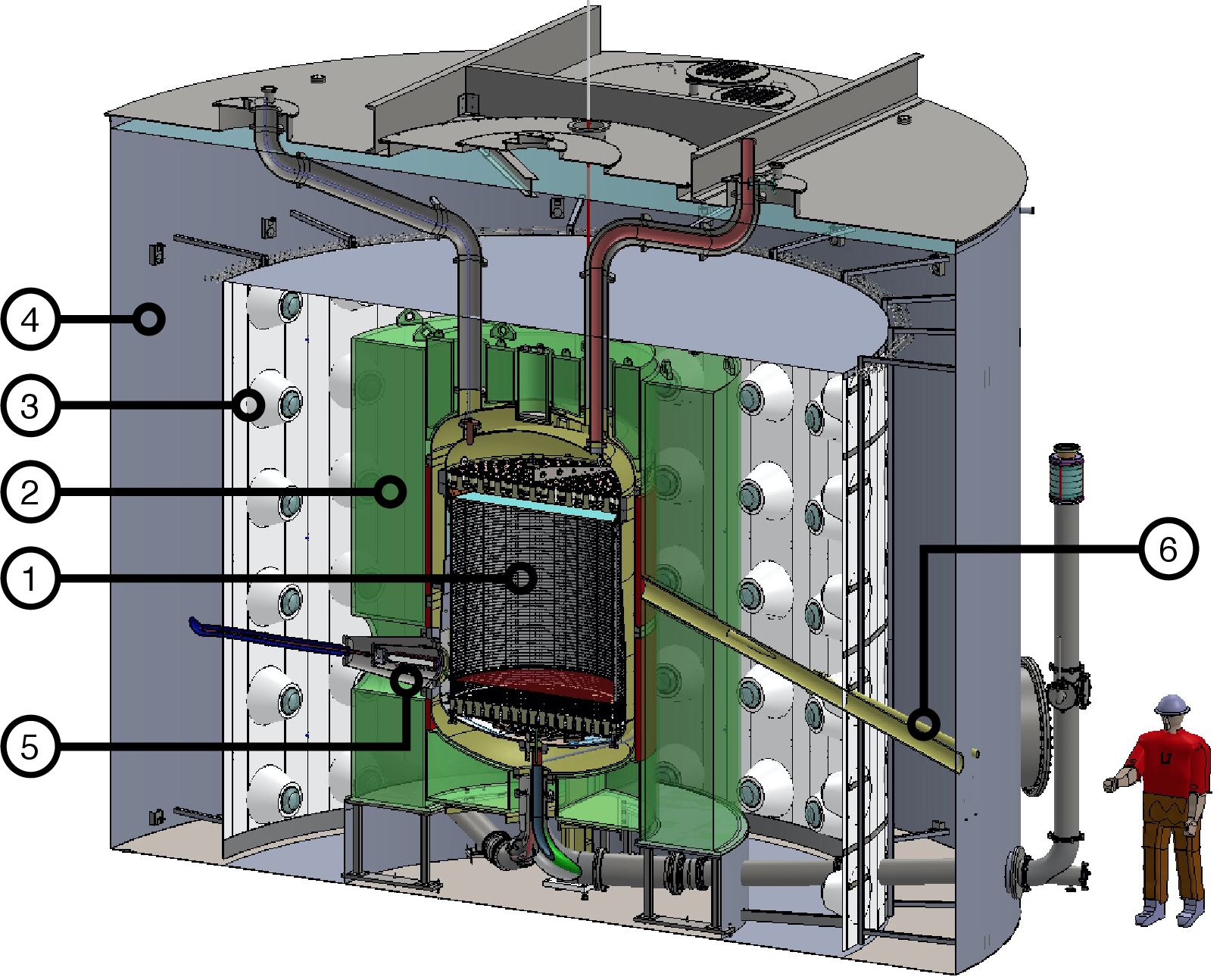
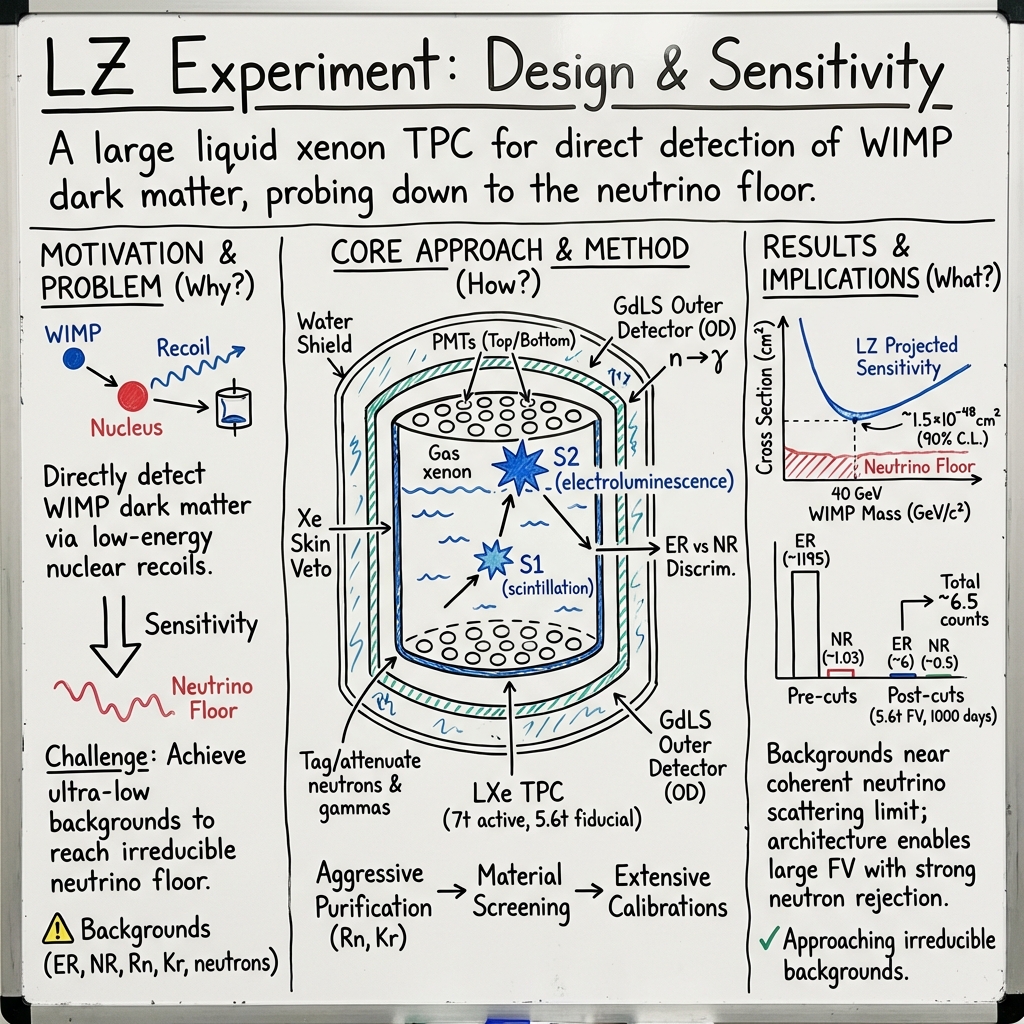
Abstract: We describe the design and assembly of the LUX-ZEPLIN experiment, a direct detection search for cosmic WIMP dark matter particles. The centerpiece of the experiment is a large liquid xenon time projection chamber sensitive to low energy nuclear recoils. Rejection of backgrounds is enhanced by a Xe skin veto detector and by a liquid scintillator Outer Detector loaded with gadolinium for efficient neutron capture and tagging. LZ is located in the Davis Cavern at the 4850' level of the Sanford Underground Research Facility in Lead, South Dakota, USA. We describe the major subsystems of the experiment and its key design features and requirements.
Paper Prompts
Sign up for free to create and run prompts on this paper using GPT-5.
Top Community Prompts
Explain it Like I'm 14
What is this paper about?
This paper explains how scientists designed and built LUX-ZEPLIN (LZ), one of the world’s most sensitive experiments to look for dark matter. It sits deep underground in South Dakota and uses a giant “camera” filled with ultra-pure liquid xenon to try to catch rare, tiny bumps that invisible dark matter particles might make when passing through.
What questions are they trying to answer?
- Does dark matter consist of particles called WIMPs (Weakly Interacting Massive Particles)?
- If WIMPs exist, how often do they hit ordinary matter, and how hard do they hit?
- If LZ doesn’t see anything, how small can those hits be before they’re too rare to detect with this kind of experiment?
In simple terms: they’re trying to catch a whisper-quiet knock from dark matter and either hear it or show that it must be even quieter than we thought.
How does the detector work? (Explained with simple ideas)
Think of LZ as a very quiet, very dark room packed with special sensors, built to notice even the faintest sparkle.
- The “room”: a large tank (about 1.5 meters tall and wide) of liquid xenon kept very cold. Xenon is a noble gas that gives off tiny flashes of light when something hits an atom inside it.
- The “sparkles”: when a particle bumps a xenon atom, two things happen:
- S1: a tiny, instant flash of light.
- S2: the bump also knocks loose some electrons. An electric field gently pulls those electrons upward. When they pop into a thin layer of gas at the top, they make a second, brighter flash.
- The “cameras”: hundreds of super-sensitive light sensors (called photomultiplier tubes, or PMTs) above and below watch for those flashes.
- How they tell where and what happened:
- The time between S1 and S2 tells how deep the hit was (like timing how long it takes a bubble to reach the surface).
- The pattern of light in the top sensors shows where it happened side-to-side.
- The ratio of the two flashes (S2 compared to S1) tells what kind of hit it was—like telling the difference between a bowling ball bump (a nucleus “recoil”) and a ping-pong ball bump (an electron “recoil”). Dark matter should look like the “bowling ball” kind.
Keeping out “noise” is the hardest part. LZ does this like a layered onion:
- Deep underground: rock shields out most cosmic rays from space.
- Water tank: the whole detector sits inside a big tank of water to block stray particles.
- Outer Detector: surrounding the xenon tank is a special liquid that lights up when neutrons pass through. It contains gadolinium, a material that loves to capture neutrons and make a clear light signal. If a neutron sneaks in and hits xenon, this layer helps tag it so it doesn’t fool us.
- Xenon “skin”: a thin layer of xenon around the main tank also watches for unwanted hits from the sides.
- Ultra-clean materials and gas: parts are made from very low-radioactivity metals and plastics. The xenon gas is purified to remove tiny amounts of krypton and radon, which could fake signals. The team even controls dust because dust can carry radioactive bits.
Other clever engineering:
- Electric fields: thin wire “grids” at the top and bottom make uniform electric fields to guide electrons upward and create the second flash.
- High voltage: special cables and designs safely bring in high voltage to move electrons without causing sparks or extra light.
- Optical design: reflective white plastic (PTFE) lines the walls to bounce light to the sensors, so even weak flashes are seen.
- Careful assembly: much of the detector was built in clean rooms on the surface, then lowered underground in pieces, so there’s less cutting, gluing, or welding in the mine.
- Sensors and controls: precise liquid level sensors, temperature monitors, and even acoustic sensors help keep the xenon calm and stable and the detector well-tuned.
What did they build, and why is it important?
- A 7‑ton active liquid xenon detector (about 5.6 tons used for the cleanest “inner” region) watched by two large arrays of PMTs.
- A “two-flash” (S1/S2) system that can pinpoint the location of a hit and identify what kind of particle caused it.
- Multiple veto systems (the xenon skin and the gadolinium-loaded liquid outside) to catch and reject background particles like neutrons and gammas.
- Ultra-clean, low‑radioactivity titanium containers and highly reflective PTFE surfaces to maximize sensitivity.
- A purification and cooling system to keep the xenon exceptionally pure and stable.
While this paper doesn’t claim a dark matter discovery, it shows that the LZ detector was carefully designed and assembled to be extraordinarily sensitive. Based on the design, LZ aimed to be able to detect or rule out WIMPs down to interaction rates far smaller than previous experiments.
Why does this matter?
If LZ detects a dark matter signal, it would be one of the biggest discoveries in physics—finally revealing the particle that makes up most of the matter in the universe. If LZ doesn’t see anything, that’s also powerful: it tells scientists that dark matter either interacts even more weakly than we thought or behaves differently than WIMPs, guiding future experiments and theories.
In short, LZ is like building the world’s quietest microphone in the deepest basement to listen for the faintest sound. Whether it hears the whisper or not, it will teach us a lot about the hidden side of the universe.
Knowledge Gaps
Knowledge Gaps, Limitations, and Open Questions in the LUX-ZEPLIN (LZ) Experiment Paper
The following list outlines the specific knowledge gaps, limitations, and open questions identified in the provided research paper on the LUX-ZEPLIN (LZ) experiment:
- Background Rejection: The paper describes methods for neutron and gamma-ray background suppression. However, it does not detail potential issues with the stability and long-term efficiency of these methods over the experiment's lifetime.
- Radon and Krypton Mitigation: Although the paper mentions off-site purification of xenon to reduce krypton levels, there is limited discussion on the on-site mitigation strategies specific to radon, which could lead to significant background noise.
- Detector Calibration and Systematic Uncertainties: The methods for calibrating the TPC and measuring systematics are not fully explored. Detailed procedures and potential challenges in calibration precision and accuracy remain open for exploration.
- Performance under Extreme Conditions: The implications of seismic events or extreme environmental changes on the cryostat’s structural integrity and the detector's operational stability are not extensively addressed.
- Material Radiopurity Assurance: While the use of ultra-radiopure titanium is mentioned, there is insufficient detail about the quality control processes ensuring that all materials used, especially those of the PMTs and electronics, meet the required levels of radiopurity.
- Software and Analysis Pipeline: There is a lack of discussion on the data analysis software pipeline, specifically algorithms used for event reconstruction and discrimination, and how they will be tested or validated.
- Optimizing S2 Photon Collection: Although efforts are made to maximize photon collection, the efficiency of photon transport, particularly in the S2 region, is not quantified or discussed in sufficient detail.
Future research can address these points to help refine the LUX-ZEPLIN experiment and other similar dark matter detection projects.
Practical Applications
Immediate Applications
Below are specific, deployable uses that leverage LZ’s engineering, materials, and operational innovations.
- Low-background materials procurement and QA for contamination-sensitive builds
- Sectors: research infrastructure, semiconductor/quantum devices, medical/HPGe radiometric labs
- Tools/products/workflows: supplier qualification and radioassay pipelines; low-radioactivity Grade-1 titanium selection; cleaning/etching and surface passivation workflows; hermetic handling to prevent dust/radon daughter plate-out
- Assumptions/dependencies: access to gamma-spectrometry/assay facilities; supplier willingness to share melt histories and process controls; cost and availability of ultra-pure alloys
- Radon and krypton removal and clean gas handling
- Sectors: noble-gas supply chain, low-background labs, archives/museums (air quality), semiconductor tools
- Tools/products/workflows: off-site charcoal chromatography for Kr removal from Xe; inline radon-removal traps for purge streams; cleanroom-compatible gas transfer with vacuum-insulated lines
- Assumptions/dependencies: media optimized for xenon may need re-engineering for air; throughput scaling and regeneration schedules; monitoring (e.g., RGA) for leak/contamination control
- High-reliability cryogenics in constrained environments
- Sectors: research facilities, quantum computing cryogenics, LNG/cryogenic test stands
- Tools/products/workflows: nitrogen thermosyphon heat pipes; stand-alone cryocooler integration to minimize liquid nitrogen logistics; externalized heat exchangers with vacuum-insulated transfer lines
- Assumptions/dependencies: heat loads and geometries comparable to LZ; on-site power and vibration isolation for cryocoolers
- Gadolinium-loaded liquid scintillator (GdLS) neutron tagging systems
- Sectors: nuclear safeguards, reactor monitoring, homeland security, oil-well logging
- Tools/products/workflows: segmented acrylic-vessel scintillator tanks surrounding target volumes; water shielding plus PMT arrays; neutron capture tagging with gadolinium
- Assumptions/dependencies: stable Gd loading chemistry and optical quality; regulatory approvals for scintillator deployment; PMT or SiPM infrastructure
- Cryogenic high-voltage delivery in dielectrics
- Sectors: superconducting systems, HV instrumentation in cryogens, accelerators
- Tools/products/workflows: all-polyethylene HV cable with conductive sheath; in-cryogen voltage grading structures; single-span, metal-free feedthrough design to reduce differential contraction and partial discharges
- Assumptions/dependencies: dielectric behavior validated for alternate cryogens and field strengths; standards compliance and lifetime testing for industrial adoption
- Precision two-phase level control and monitoring
- Sectors: cryogenic storage/process control, LNG tanks, industrial distillation columns
- Tools/products/workflows: micrometer-precision weir-based level setting; Weir Precision Sensors (WPS), long level sensors (LLS); acoustic and RF loop sensors for surface/bubble/electrostatic disturbance detection
- Assumptions/dependencies: sensor materials compatibility with process fluids; calibration/maintenance in industrial settings; EMI environment management
- Clean cabling and radon-barrier harnesses
- Sectors: cleanrooms, low-background detectors, precision metrology
- Tools/products/workflows: FEP-jacketed coax bundles with radon-barrier jackets; factory cleanliness enhancements; conduit purge with radon-scrubbed gas
- Assumptions/dependencies: vendor process controls for braid cleanliness; purge gas quality and monitoring; routing length/attenuation trade-offs
- Optical design for VUV/UV detection in large volumes
- Sectors: scientific detectors (noble liquid TPCs, Cherenkov/UV systems), UV-based sterilization/instrumentation
- Tools/products/workflows: high-reflectance PTFE paneling (≥97% in LXe); high-QE VUV PMTs; optical isolation to suppress stray light and cross-talk; LED-based gain and timing calibration
- Assumptions/dependencies: VUV materials availability; environmental compatibility (e.g., PTFE behavior in other media); safety and lifetime of VUV sensors
- Woven mesh electrode fabrication and QA
- Sectors: gaseous/noble-liquid detectors, electrostatic sensors
- Tools/products/workflows: robotic epoxy dispensing with bead spacers for stress isolation; tight-tolerance woven meshes for uniform fields; high-voltage screening and citric acid passivation to reduce field emission
- Assumptions/dependencies: wire finish quality and consistent mesh pitch; passivation efficacy across different alloys and environments
- Modular, segmented cryostat and detector assembly for difficult-to-access sites
- Sectors: underground/subsea installations, confined industrial retrofits
- Tools/products/workflows: segmentation to avoid on-site welding/bonding; suspension and leveling systems; seismic restraints for vessels
- Assumptions/dependencies: transport constraints comparable to LZ; structural analysis for new loads and regulations
- Event reconstruction and background-rejection workflows for edge/topology systematics
- Sectors: high-energy/nuclear detectors, security scanners
- Tools/products/workflows: sensor layout optimization to suppress “wall events”; correction pipelines for spatial non-uniformities (e.g., S2 yield vs position)
- Assumptions/dependencies: detector geometries offering similar optical/electric field control; availability of calibration sources and data volumes
- Comprehensive contamination control from design to operation
- Sectors: pharma/biotech cleanrooms, precision optics, EUV lithography
- Tools/products/workflows: dust minimization on wetted parts; radon daughter plate-out avoidance via hermetic enclosures; controlled assembly and transport; purge and bake workflows
- Assumptions/dependencies: cost/benefit vs existing cleanroom SOPs; training and QA bandwidth
Long-Term Applications
These opportunities require further R&D, scaling, or adaptation beyond current deployments.
- Two-phase noble-liquid detectors for medical imaging and security
- Sectors: healthcare (LXe PET, Compton cameras), cargo/portal security
- Potential products/workflows: compact LXe TPCs leveraging high QE VUV detection, uniform S2 electroluminescence, and refined edge-reconstruction; integrated vetoes for background suppression
- Assumptions/dependencies: clinical/regulatory validation; reliability and cost reductions; radiation safety and patient workflow integration
- Ultra-low-radon building air systems for heritage archives and high-sensitivity labs
- Sectors: cultural heritage, semiconductor fabs, ultra-low-background facilities
- Potential products/workflows: scaled radon-removal modules inspired by LZ’s inline traps; monitoring and bypass architectures; filtration/regeneration cycles
- Assumptions/dependencies: media performance with air vs xenon; energy and maintenance costs; building HVAC integration and standards
- Low-radioactivity material supply chains for space/astrophysics instrumentation
- Sectors: space-based X-ray/gamma-ray detectors, high-Z shielding-sensitive payloads
- Potential products/workflows: certified low-activity Ti and other alloys to reduce sensor noise and activation; cradle-to-gate radioassay documentation
- Assumptions/dependencies: supplier capacity and cost; launch/machining constraints; actual performance gains for specific sensor stacks
- Distributed antineutrino/neutron monitoring networks using GdLS-inspired modules
- Sectors: nonproliferation, reactor operations, environmental monitoring
- Potential products/workflows: modular, water-shielded GdLS detectors with automated calibration and ML-based tagging; remote/harsh-environment deployment kits
- Assumptions/dependencies: long-term scintillator stability; regulatory approvals; cyber-physical security and data pipelines
- Advanced cryogenic HV components for HTS power systems and magnetics
- Sectors: grid HTS cables, MRI/NMR magnets, fusion prototypes
- Potential products/workflows: polymeric HV feedthroughs with graded dielectrics; non-metallic stress-managed cables for cryogenic expansion/contraction; in-situ HV health monitoring
- Assumptions/dependencies: standards certification; lifetime and partial-discharge testing; integration with existing cryo-electric codes
- Predictive health monitoring for HV and two-phase systems using acoustic/RF signatures
- Sectors: power utilities, chemical process industries, cryogenics
- Potential products/workflows: sensor suites and analytics to detect bubbling, micro-discharges, and surface disturbances; real-time alarms and maintenance scheduling
- Assumptions/dependencies: robust signal models across fluids/equipment; sensor survivability; integration with SCADA/plant control
- Rare-gas purification at sub-ppb–ppq scale for quantum sensing and spin-polarized gases
- Sectors: quantum devices (e.g., Xe-based NMR/MRI, magnetometry), specialty gases
- Potential products/workflows: scalable charcoal chromatography/distillation hybrids; contamination monitoring and certification
- Assumptions/dependencies: demand volume; cost per liter; impurity spec confirmation for target quantum coherence times
- VUV photonics components (reflectors, sensors) for compact UV systems
- Sectors: sterilization, spectroscopy, analytical instruments
- Potential products/workflows: PTFE-based high-reflectance VUV chambers; VUV-compatible sensor arrays with calibration LEDs; ruggedized optical isolation designs
- Assumptions/dependencies: materials durability under UV flux and ambient exposure; safety and ozone byproducts; market need vs deep-UV LEDs/lasers
- Scalable, segmented-vessel architectures for hard-to-access deployments
- Sectors: underground labs, subsea energy, mining
- Potential products/workflows: modular cryostat/process-vessel kits with bolt-up seals; prequalified segment interfaces; minimal on-site bonding/welding
- Assumptions/dependencies: sealing reliability under pressure/temperature cycles; site-specific transport constraints; code compliance (ASME/EN/etc.)
- Field-emission mitigation via tailored passivation and surface finishing for HV metals
- Sectors: accelerators, vacuum electronics, high-voltage vacuum interrupters
- Potential products/workflows: passivation chemistries (e.g., citric acid) and microfinish QA workflows that reduce electron emission; acceptance testing using sensitive electroluminescent probes
- Assumptions/dependencies: reproducibility across alloys/geometries; compatibility with vacuum/cryogenic environments; longevity under stress cycles
- Transition to cryogenic SiPM arrays using LZ-derived optical/electrical design lessons
- Sectors: neutrino and dark matter detectors, cryogenic PET
- Potential products/workflows: VUV-compatible SiPM tiles with similar optical isolation, reflectors, and calibration schemes; reduced radioactivity packaging
- Assumptions/dependencies: SiPM dark noise and afterpulsing at cryo; VUV sensitivity and packaging; cost and channel count readout
Each application above stems from concrete LZ subsystems or workflows (e.g., radon/Kr purification, cryogenic HV delivery, GdLS neutron vetoes, precision two-phase sensing, low-background materials and cleanliness). Feasibility hinges on material availability, regulatory pathways, environment-specific validation, and scaling economics.
Glossary
Electroluminescence: A process in which a material emits light in response to an electric current or a strong electric field. "The nominal operating pressure of the detector is 1.8~bara. At nominal fields, each electron emitted into the gas generates 820 electroluminescence photons."
Fiducial Volume: The region within a detector wherein the data is considered to be of known and acceptable quality, excluding regions near boundaries that may have poor resolution or increased noise. "The optical design of the S2 signal is optimized for robust reconstruction of low energy events at the edge of the TPC, in particular from the decay of Rn daughters deposited on the field cage wall, termed 'wall events'. These events may suffer charge loss, thus mimicking nuclear recoils."
Photomultiplier Tube (PMT): A device that amplifies a signal generated by incoming photons, commonly used in detectors to measure light intensity. "The TPC PMTs are 3–inch diameter Hamamatsu R11410–22, developed for operation in the cold liquid xenon and detection of the VUV luminescence."
Radon Emanation: The process by which radon gas escapes into the surroundings, often presenting as a background problem in low-radioactivity experiments. "An additional consideration is the potential for radon emanation. This is especially important for the fraction of the cabling located near room temperature."
Spontaneous Fission: A form of radioactive decay in which an atomic nucleus splits into two smaller nuclei, releasing neutrons and energy. "Neutrons from spontaneous fission and alpha capture on light nuclei are efficiently tagged and vetoed by the OD and skin."
Time Projection Chamber (TPC): A type of particle detector that allows for three-dimensional reconstruction of particle trajectories by collecting electrons and ions released in ionization events. "LZ features a large liquid xenon (LXe) time projection chamber (TPC), a well-established technology for the direct detection of WIMP dark matter for masses greater than a few GeV."
WIMP (Weakly Interacting Massive Particle): A hypothetical particle that is a candidate for dark matter, notable for interacting only via weak nuclear and gravitational forces. "The LUX-ZEPLIN experiment, a direct detection search for cosmic WIMP dark matter particles."
Xe Skin Veto Detector: A component of the TPC that uses liquid xenon as a scintillator to detect and veto unwanted signals, enhancing background rejection. "Rejection of backgrounds is enhanced by a Xe skin veto detector."
Collections
Sign up for free to add this paper to one or more collections.