Propulsion of Spacecrafts to Relativistic Speeds Using Natural Astrophysical Sources
Published 8 Feb 2020 in astro-ph.IM, astro-ph.EP, astro-ph.HE, and physics.space-ph | (2002.03247v3)
Abstract: In this paper, we explore from a conceptual standpoint the possibility of using natural astrophysical sources to accelerate spacecrafts to relativistic speeds. We focus on light sails and electric sails, which are reliant on momentum transfer from photons and protons, respectively, because these two classes of spacecrafts are not required to carry fuel on board. The payload is assumed to be stationed near the astrophysical source, and the sail is subsequently unfolded and activated when the source is functional. By considering a number of astrophysical objects such as massive stars, microquasars, supernovae, pulsar wind nebulae, and active galactic nuclei, we show that terminal speeds approaching the speed of light might be realizable under idealized circumstances provided that sufficiently advanced sail materials and control techniques exist. We also investigate the constraints arising from the sail's material properties, the voyage through the ambient source environment, and the passage through the interstellar medium. While all of these considerations pose significant challenges to spacecrafts, our analysis indicates that they are not insurmountable in optimal conditions. Finally, we sketch the implications for carrying out future technosignature searches.
The paper presents a theoretical framework showing that light and electric sails can harness natural astrophysical sources to achieve relativistic speeds.
The paper employs detailed relativistic equations and astrophysical models to quantify acceleration profiles and address material and environmental limitations.
The paper highlights that sail material properties and interstellar medium effects pose critical constraints on achievable terminal speeds and mission range.
Relativistic Spacecraft Propulsion via Astrophysical Sources
This paper (2002.03247) examines the theoretical feasibility of employing naturally occurring astrophysical sources to propel spacecraft to relativistic speeds. It focuses on light sails and electric sails, which harness momentum transfer from photons and protons, respectively, to avoid the need for onboard fuel. By considering a range of astrophysical objects, the study assesses the potential for achieving terminal speeds approaching the speed of light, while also exploring the limitations imposed by material properties, the source environment, and the interstellar medium (ISM).
Light Sails and Relativistic Speeds
The paper explores the use of light sails accelerated by astrophysical sources.
Relativistic Light Sail Dynamics
The relativistic equation of motion for a light sail propelled by an isotropic astrophysical source of constant luminosity L⋆ and reflectance R≈1 is given by:
γ3dtdβ≈2πr2Σsc2L⋆(1+β1−β),
where β=v/c, γ=1/1−β2, and Σs is the sail's areal mass density.
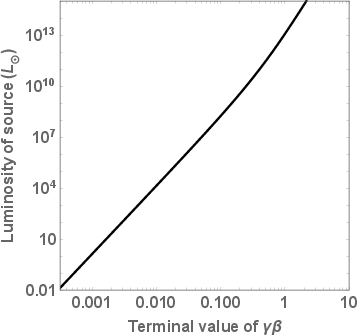
Figure 1: The luminosity of the source (units of L⊙) as a function of the terminal value of γβ, with the other free parameters held fixed at their fiducial values.
This leads to a terminal spatial component of the 4-velocity UT=βTγT, where βT is the terminal velocity. The initial launch distance d0 from the source is constrained by thermal properties:
where ε is the absorptance and Ts is the sail temperature.
Astrophysical Source Candidates
The study considers various astrophysical sources, including:
Massive stars: With luminosities up to 7.6×10⁶L⊙, potentially achieving βT≈0.05.
Low-mass X-ray binaries and microquasars: Luminosities ≲106L⊙, resulting in βT∼0.01.
Active Galactic Nuclei (AGNs): With black hole masses up to 1011M⊙, potentially reaching γT≈2.9.
Supernovae (SNe): Typical peak luminosities of 109L⊙ yield βT≈0.15, while superluminous supernovae (SLSNe) could achieve βT≈0.66.
Gamma-ray bursts (GRBs): Although potentially capable of achieving UT≫1, the short duration of GRBs limits their effectiveness.
Acceleration Time and Distance
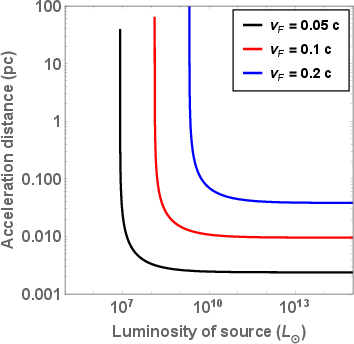
The acceleration time Δt to reach a desired final velocity vF and the corresponding distance Δr are crucial considerations. The non-relativistic approximation of the equation of motion leads to:
Δr≈d0[πd0c3βF2ΣsL⋆−1]−1,
where βF=vF/c.
Figure 2: Distance travelled by the light sail (units of pc) to achieve the desired final velocity (vF) as a function of the luminosity of the source (units of L⊙) using (\ref{AccD}).
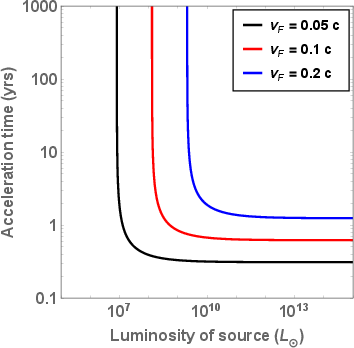
The acceleration time Δt is derived from integrating the non-relativistic version of the equation of motion.
Figure 3: Time required by the light sail (units of years) to achieve the desired final velocity (vF) as a function of the luminosity of the source (units of L⊙) using (\ref{NRelREOM}).
Sail Material Properties and Astrophysical Constraints
The paper emphasizes the importance of sail material properties, particularly absorptance (ε) and areal mass density (Σs). It notes that the derived terminal speeds represent optimistic upper bounds, as achieving low absorptance across the broadband spectral energy distributions (SEDs) of astrophysical sources is challenging. High reflectances in the X-ray and gamma-ray regimes require specific materials and grazing angles, making it difficult to maintain optimal conditions.
Source Environment Constraints
The study analyzes the constraints imposed by the ambient gas and dust in the vicinity of the astrophysical source. It considers the limits on gas density n0 to prevent significant slowdown via gas accumulation:
Ablation caused by dust grain impacts is also examined, leading to constraints on the mass-loss rate (M˙⋆) of the source.
Interstellar Medium Effects
The paper evaluates the effects of the ISM on light sails traversing interstellar distances. It considers the slowdown due to gas accumulation, mass ablation from dust grain collisions, hydrodynamic drag, and sputtering. The maximum travel distance is potentially limited to ≲1 pc, but this can be increased by folding the sail or dispensing with it altogether to increase the effective areal density.
Electric Sails and Charged Particle Momentum
The study also investigates electric sails, which rely on electrostatic forces to deflect charged particles and transfer momentum.
Electric Sail Dynamics
The force per unit length (dFs/dz) for an electric sail is expressible as:
dzdFs≈2Kmpn(v−uw)2rD,
where K is a dimensionless constant, n is the number density, v is the sail velocity, uw is the wind velocity, and rD is the Debye length. The asymptotic analysis indicates that the terminal speed of an electric sail is set by the asymptotic value of the wind speed u∞.
Astrophysical Source Candidates for Electric Sails
The paper lists observed values of u∞ for various astrophysical systems:
Stellar winds: Terminal wind speeds are typically on the order of 10−3c.
Supernovae: Ejecta speeds of ∼0.1c.
AGN outflows: Velocities ≲0.1c for diffuse outflows.
Blazar jets: Lorentz factors of O(10).
Microquasar jets: Lorentz factors of order unity.
Pulsar wind nebulae (PWNe): Bulk Lorentz factors of γ∼104−105 for pulsar winds.
Conclusion
This paper provides a comprehensive conceptual study of using high-energy astrophysical phenomena to propel spacecraft to relativistic speeds. The analysis indicates that speeds on the order of ≳0.1c may be achievable by a number of astrophysical sources, and Lorentz factors much greater than unity might also be feasible in certain environments. Key limitations include the duration of source activity, sail material properties, and the source and interstellar environments. The study suggests that technosignature searches could focus on high-energy astrophysical sources, as they represent promising potential sites for technological species to position their spacecraft.