Electric sails are potentially more effective than light sails near most stars
Published 7 Nov 2019 in physics.space-ph, astro-ph.EP, and astro-ph.SR | (1911.02765v3)
Abstract: Electric sails are propulsion systems that generate momentum via the deflection of stellar wind particles through electric forces. Here, we investigate the relative merits of electric sails and light sails driven by stellar radiation pressure for F-, G-, K- and M-type stellar systems. We show that electric sails originating near M-dwarfs could attain terminal speeds of $\sim 500$ km/s for minimal payload masses. In contrast, light sails are typically rendered ineffective for late-type M-dwarfs because the radiation pressure is not sufficiently high to overcome the gravitational acceleration. Our analysis indicates that electric sails are better propulsion systems for interplanetary travel than light sails in proximity to most stars. We also delineate a method by which repeated encounters with stars might cumulatively boost the speeds of light sails to $\gtrsim 0.1\,c$, thereby making them more suitable for interstellar travel. This strategy can be effectuated by reaching $\sim 105$ stars over the span of $\sim 10$ Myr.
The paper's main contribution is a comparative analysis showing that electric sails outperform light sails near low-mass stars.
Using simulations, the study quantifies electric sail acceleration up to 0.15 m/s² and terminal speeds around 424–500 km/s.
The results suggest electric sails are better suited for short-term interstellar missions, while light sails may reach relativistic speeds via repeated stellar encounters.
Electric Sails for Interstellar Propulsion
This paper explores the potential of electric sails as a propulsion system for interstellar travel, comparing their effectiveness against traditional light sails, particularly in the vicinity of various types of stars. The analysis focuses on F-, G-, K-, and M-type stars, examining how stellar parameters influence the performance of both propulsion methods. The study highlights that electric sails may offer advantages over light sails, especially for travel near low-mass stars, and proposes a method for achieving relativistic speeds using light sails through repeated stellar encounters.
Stellar Wind and Radiation Pressure
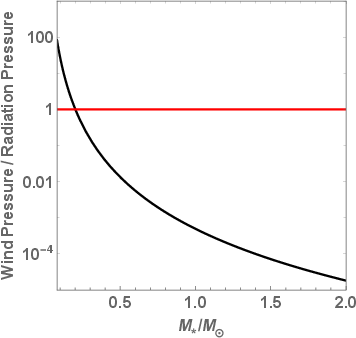
The paper begins by comparing the dynamic pressure exerted by the stellar wind (Pwind) and the stellar radiation pressure (Prad). The ratio of these pressures, δP, is expressed as:
δP=PradPwind≈L⋆M˙⋆v0c
where M˙⋆ is the stellar mass-loss rate, v0 is the stellar wind speed, c is the speed of light, and L⋆ is the stellar luminosity. Using a mass-loss rate obtained via numerical simulations, the ratio is approximated as:
δP∼4.9×10⁻⁴(M⊙M⋆)−4.76
This indicates that for late-type M-dwarfs (M⋆≲0.2M⊙), the stellar wind pressure can exceed the radiation pressure.
Figure 1: The ratio of the stellar wind dynamical pressure and the stellar radiation pressure as a function of the stellar mass M⋆ (in units of M⊙).
Electric Sail Properties and Performance
The paper then discusses the properties of electric sails, which generate momentum by deflecting stellar wind particles using electric forces. The force per unit length (dF/dz) generated by an electric sail is given by:
dzdF=exp[eV0mpv2ln(r0/rw)]−1Kmpnv2r0
where K is a dimensionless constant, mp is the proton mass, n is the number density of the stellar wind, v is the wind velocity, V0 is the potential of the wires, rw is the wire radius, and r0 is a parameter related to the Debye length.
The acceleration experienced by an electric sail (aE) is estimated as:
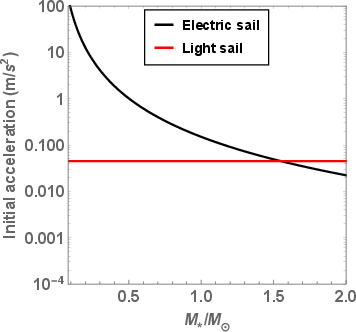
aE∼0.15m/s2(M⊙M⋆)−0.88(1AUr)−1.25
The terminal velocity (v∞,E) achieved by the electric sail is derived from the equation of motion, resulting in:
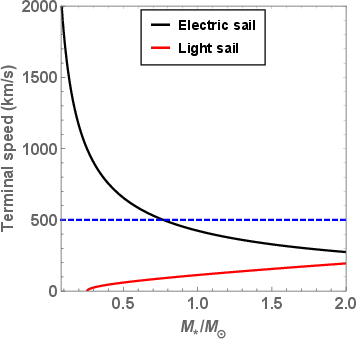
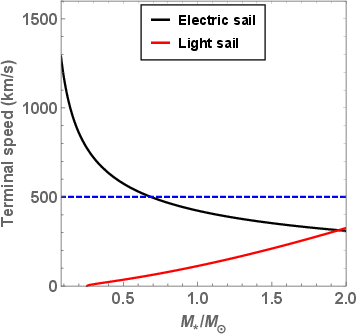
This calculation suggests that electric sails can achieve terminal speeds of approximately 500 km/s near K- and M-dwarfs.
Comparison with Light Sails
The effectiveness of electric sails is compared to that of light sails propelled by stellar radiation. The acceleration experienced by a light sail (aL) is:
The analysis indicates that electric sails are more effective than light sails for most F-, G-, K-, and M-type stars in terms of achieving higher terminal speeds.
Figure 2: The initial acceleration experienced by the two propulsion systems as a function of the stellar mass M⋆ (in units of M⊙).
Figure 3: The terminal speed attained by the two propulsion systems as a function of the stellar mass M⋆ (in units of M⊙) assuming they were launched from the distance d⋆ given by (\ref{EqDist}).
Figure 4: The terminal speed attained by the two propulsion systems as a function of the stellar mass M⋆ (in units of M⊙) assuming they were launched from a fixed distance of 1 AU.
Interstellar Travel Considerations
The paper also addresses the use of electric sails and light sails for interstellar travel. For electric sails, the interstellar medium can be used for deceleration, while light sails can potentially achieve relativistic speeds through repeated encounters with stars. The cumulative terminal velocity (vc) after N kicks from stars is given by:
vc2=∑i=1Nv∞,i2
Assuming similar terminal speeds for each star (v∞,i∼100 km/s), the cumulative speed is:
vc∼Nv∞,i∼0.11c(105N)1/2(100km/sv∞,i)
This suggests that reaching approximately 105 stars could enable light sails to achieve relativistic speeds of ∼0.1c.
Conclusion
In conclusion, this paper presents a comparative analysis of electric sails and light sails for interstellar propulsion, demonstrating that electric sails are potentially more effective for interplanetary travel and short-term interstellar missions, especially near low-mass stars. The study also proposes a method for light sails to achieve relativistic speeds through repeated stellar encounters, offering a pathway for long-distance interstellar travel. Despite the simplifications and assumptions made in the analysis, the paper provides valuable insights into the potential of electric sails and light sails for future space exploration.