Papers
Topics
Authors
Recent
Search
2000 character limit reached

Opinion dynamics on tie-decay networks

Published 30 Sep 2020 in cs.SI, math.DS, nlin.AO, and physics.soc-ph | (2010.00143v3)

Abstract: In social networks, interaction patterns typically change over time. We study opinion dynamics on tie-decay networks in which tie strength increases instantaneously when there is an interaction and decays exponentially between interactions. Specifically, we formulate continuous-time Laplacian dynamics and a discrete-time DeGroot model of opinion dynamics on these tie-decay networks, and we carry out numerical computations for the continuous-time Laplacian dynamics. We examine the speed of convergence by studying the spectral gaps of combinatorial Laplacian matrices of tie-decay networks. First, we compare the spectral gaps of the Laplacian matrices of tie-decay networks that we construct from empirical data with the spectral gaps for corresponding randomized and aggregate networks. We find that the spectral gaps for the empirical networks tend to be smaller than those for the randomized and aggregate networks. Second, we study the spectral gap as a function of the tie-decay rate and time. Intuitively, we expect small tie-decay rates to lead to fast convergence because the influence of each interaction between two nodes lasts longer for smaller decay rates. Moreover, as time progresses and more interactions occur, we expect eventual convergence. However, we demonstrate that the spectral gap need not decrease monotonically with respect to the decay rate or increase monotonically with respect to time. Our results highlight the importance of the interplay between the times that edges strengthen and decay in temporal networks.
Citations (9)

Summary

  • The paper introduces tie-decay networks that dynamically model interaction-induced tie strength increases and exponential decay.
  • The paper employs continuous-time Laplacian and discrete-time DeGroot models to analyze convergence behaviors through spectral gap analysis.
  • The paper contrasts empirical tie-decay networks with randomized models, highlighting non-monotonic spectral gap effects on convergence speed.

Opinion Dynamics on Tie-Decay Networks

Introduction

The paper addresses the dynamic nature of social networks by introducing models for opinion dynamics on tie-decay networks, where the strength of ties increases instantaneously upon interaction and decays exponentially between interactions. This work formulates and analyzes both continuous-time Laplacian dynamics and a discrete-time DeGroot model for these networks, providing insights into convergence behaviors by examining spectral gaps of Laplacian matrices.

Tie-Decay Networks and Dynamics

Tie-decay networks are modeled as temporal graphs where each interaction increases tie strength, subsequently decaying until the next interaction. The continuous-time Laplacian dynamics are expressed as:

$\frac{d\bm{x}}{dt} = -\bm{x}\Tilde{L}(t)^{\top},$

where $\Tilde{L}(t)$ is the time-varying Laplacian. The discrete-time DeGroot model updates opinions via a similar framework fitted for discrete observations.

Randomized and Aggregate Networks

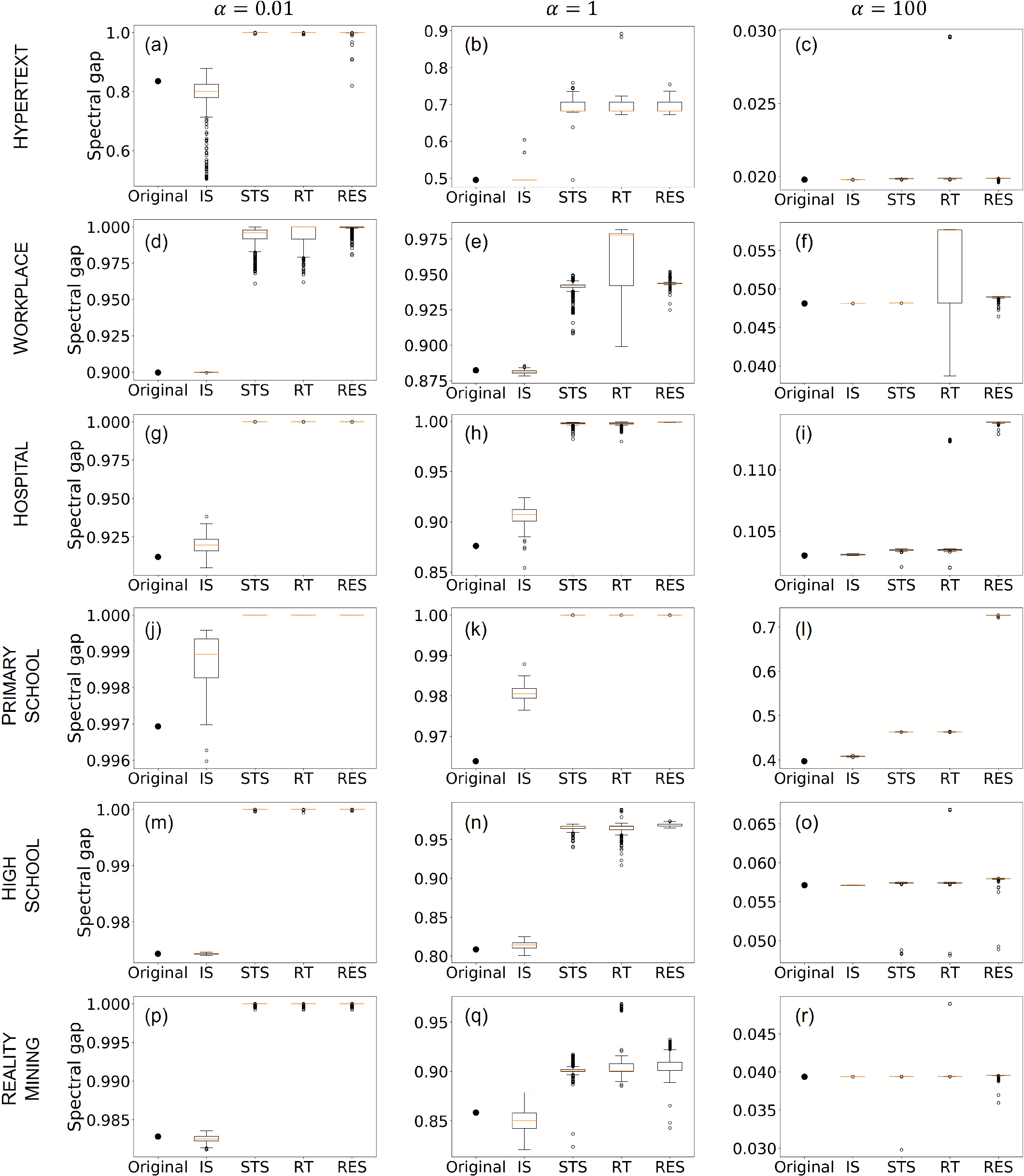
The paper introduces methods to compare empirical tie-decay networks with randomized counterparts and aggregate networks. Randomization techniques include interval shuffling, shuffled timestamps, random times, and edge shuffling. These comparisons yield insights into the importance of temporal patterns in network interactions on convergence behavior. Figure 1

Figure 1: Comparison of spectral gaps for various network randomizations.

Spectral Gap Analysis

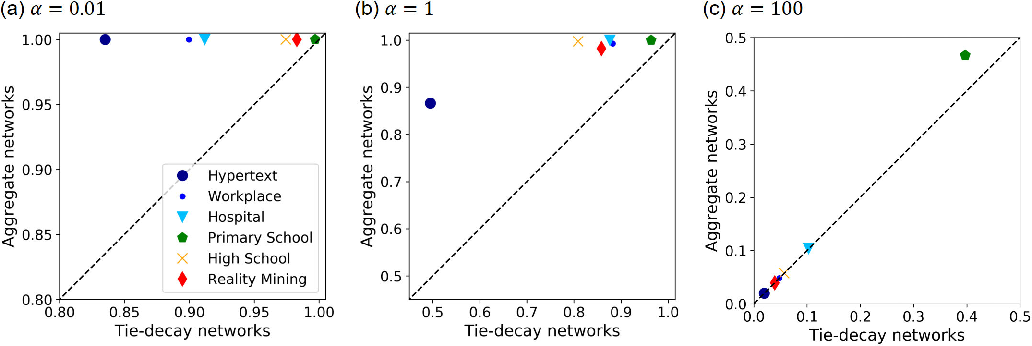
Spectral gaps, defined as the difference between the largest and second-largest magnitude eigenvalues of the matrix governing opinion convergence, serve as a proxy for convergence speed. The paper demonstrates non-monotonic spectral gap behavior with respect to decay rates, challenging intuitive expectations that slower decay always implies faster convergence. Figure 2

Figure 2: Spectral gaps of tie-decay vs. aggregate networks across different decay rates.

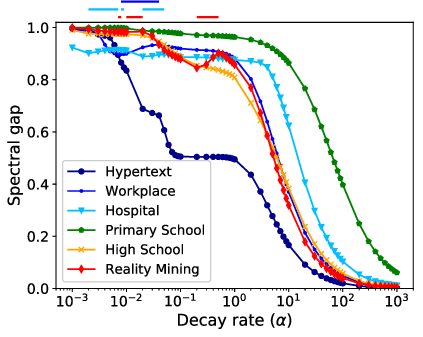
Non-Monotonic Behavior

The non-monotonicity of spectral gaps is explored through time-evolving networks, revealing that the interaction order affects convergence in non-trivial ways. Figure 3

Figure 3: Non-monotonic spectral gap behavior across different datasets.

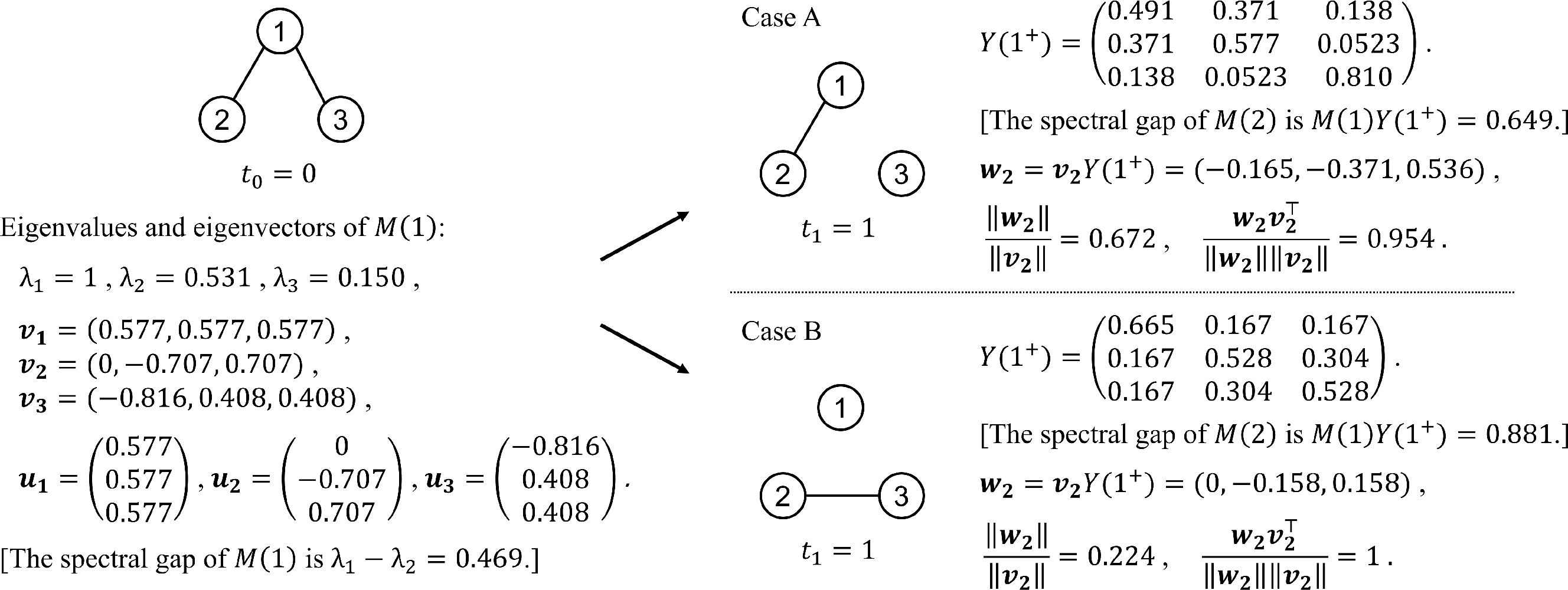
Shrinkage of Fiedler Vectors

The paper examines how interactions affect the Fiedler vector's length, an eigenvector associated with the second-largest eigenvalue of M(t)M(t), asserting that its shrinkage through interactions impacts spectral gaps. Figure 4

Figure 4: Illustration of the impact of interactions on the spectral gap and Fiedler vector length.

Conclusions and Future Directions

The study concludes that tie-decay networks provide a nuanced view of temporal dynamics in networks but introduces complexities in convergence prediction. Potential avenues for further exploration include heterogeneous decay rates, alternative decay functions, and integration with evolving network paradigms such as coevolving networks.

Implications

This work's implications extend to networked systems beyond social media, offering potential application in areas such as epidemic modeling, information diffusion, and network resilience, wherever temporal dynamics critically influence outcomes.

Paper to Video (Beta)

No one has generated a video about this paper yet.

Whiteboard

No one has generated a whiteboard explanation for this paper yet.

Open Problems

We haven't generated a list of open problems mentioned in this paper yet.

Collections

Sign up for free to add this paper to one or more collections.