Papers
Topics
Authors
Recent
Search
2000 character limit reached

Classification of ALS patients based on acoustic analysis of sustained vowel phonations

Published 14 Dec 2020 in cs.SD, cs.CL, cs.LG, and eess.AS | (2012.07347v2)

Abstract: Amyotrophic lateral sclerosis (ALS) is incurable neurological disorder with rapidly progressive course. Common early symptoms of ALS are difficulty in swallowing and speech. However, early acoustic manifestation of speech and voice symptoms is very variable, that making their detection very challenging, both by human specialists and automatic systems. This study presents an approach to voice assessment for automatic system that separates healthy people from patients with ALS. In particular, this work focus on analysing of sustain phonation of vowels /a/ and /i/ to perform automatic classification of ALS patients. A wide range of acoustic features such as MFCC, formants, jitter, shimmer, vibrato, PPE, GNE, HNR, etc. were analysed. We also proposed a new set of acoustic features for characterizing harmonic structure of the vowels. Calculation of these features is based on pitch synchronized voice analysis. A linear discriminant analysis (LDA) was used to classify the phonation produced by patients with ALS and those by healthy individuals. Several algorithms of feature selection were tested to find optimal feature subset for LDA model. The study's experiments show that the most successful LDA model based on 32 features picked out by LASSO feature selection algorithm attains 99.7% accuracy with 99.3% sensitivity and 99.9% specificity. Among the classifiers with a small number of features, we can highlight LDA model with 5 features, which has 89.0% accuracy (87.5% sensitivity and 90.4% specificity).
Citations (37)

Summary

  • The paper demonstrates that acoustic analysis of sustained vowel phonations can accurately differentiate ALS patients from healthy individuals with up to 99.7% classification accuracy.
  • It employs robust methods like LDA combined with LASSO-selected features, including MFCCs, jitter, shimmer, and novel harmonic parameters, to optimize binary classification.
  • The study underscores the potential for non-invasive, smartphone-based screening tools to facilitate early ALS detection and telehealth integration.

Classification of ALS Patients Based on Acoustic Analysis of Sustained Vowel Phonations

Introduction

The paper "Classification of ALS Patients Based on Acoustic Analysis of Sustained Vowel Phonations" proposes an approach to distinguish between healthy individuals and patients with Amyotrophic Lateral Sclerosis (ALS) using sustained vowel phonations. ALS, a neurodegenerative disorder, often presents initial symptoms like speech and swallowing difficulties. This study focuses on analyzing sustained vowel phonation tests (SVP) of vowels /a/ and /i/, which are prevalent in clinical assessments due to their diagnostic simplicity and effectiveness.

Methodology

The study employs a comprehensive acoustic analysis, extracting a wide range of features to optimize the classification performance. Key features such as Mel-Frequency Cepstral Coefficients (MFCCs), perturbation measures (jitter, shimmer), noise measurements (HNR, GNE), and novel harmonic structure parameters are extracted. Linear Discriminant Analysis (LDA) serves as the primary classification method, chosen for its interpretability and effectiveness in handling binary classification problems. The feature selection process leverages algorithms like LASSO, providing an optimal subset of features for the classifier, notably achieving a high classification accuracy with reduced feature dimensions.

Results and Analysis

The experiments demonstrate impressive classification performance, with a LDA model achieving 99.7% accuracy using features selected by the LASSO algorithm, alongside 99.3% sensitivity and 99.9% specificity. The study highlights several significant features, including:

  • MFCCs: They reflect spectral envelope changes, crucial in differentiating ALS from healthy voices.
  • Harmonic Parameters: These are vital in distinguishing harmonic properties in pathological versus healthy voice signals.
  • Phonatory Frequency Range (PFR): Indicates variability in fundamental frequency, relevant for early disease detection. Figure 1

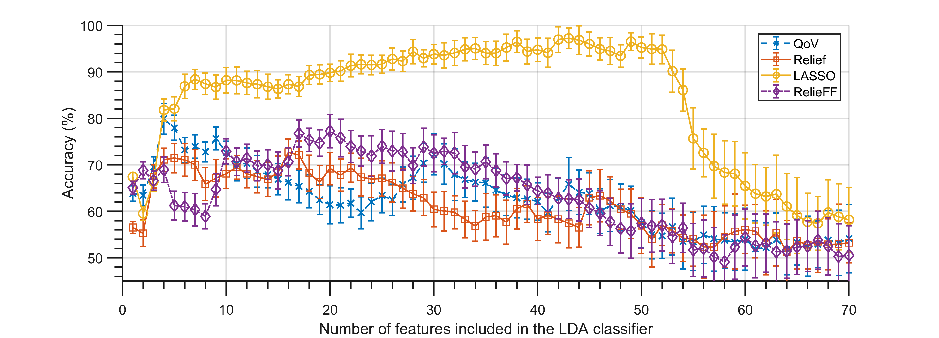
    Figure 1: Classification accuracy with confidence interval (one standard deviation around the quoted mean accuracy). The results obtained using different feature selection algorithms.

The research also explores early ALS detection, achieving up to 93.3% accuracy with a reduced feature set identified through RelieFF-based selection, substantiating the model's robustness for early clinical intervention.

Discussion and Implications

The study emphasizes the effectiveness of combining conventional and novel acoustic features in classifying ALS patients. The robust LDA models, primarily characterized by MFCC and harmonic structures, offer promising results in clinical setups, potentially facilitating remote monitoring and early detection using simple recording devices like smartphones. The findings suggest that certain articulatory and spectral features are significant markers of ALS, paving the way for future developments in non-invasive diagnostic tools.

Conclusion

The research presents a detailed analysis of acoustic features for ALS detection, setting a benchmark in speech-based diagnostic systems. By demonstrating high classification performance with practicable feature subsets, the study contributes significantly to ALS research, offering a foundation for developing accessible, reliable diagnostic aids. Further research may explore integrating these systems into telehealth platforms, expanding accessibility to ALS diagnostics globally.

Paper to Video (Beta)

No one has generated a video about this paper yet.

Whiteboard

No one has generated a whiteboard explanation for this paper yet.

Open Problems

We haven't generated a list of open problems mentioned in this paper yet.

Collections

Sign up for free to add this paper to one or more collections.