Measurement of DC and AC electric fields inside an atomic vapor cell with wall-integrated electrodes
Abstract: We present and characterize an atomic vapor cell with silicon ring electrodes directly embedded between borosilicate glass tubes. The cell is assembled with an anodic bonding method and is filled with Rb vapor. The ring electrodes can be externally connectorized for application of electric fields to the inside of the cell. An atom-based, all-optical, laser-spectroscopic field sensing method is employed to measure electric fields in the cell. Here, the Stark effect of electric-field-sensitive rubidium Rydberg atoms is exploited to measure DC electric fields in the cell of $\sim$5 V/cm, with a relative uncertainty of 10%. Measurement results are compared with DC field calculations, allowing us to quantify electric-field attenuation due to free surface charges inside the cell. We further measure the propagation of microwave fields into the cell, using Autler-Townes splitting of Rydberg levels as a field probe. Results are obtained for a range of microwave powers and polarization angles relative to the cell's ring electrodes. We compare the results with microwave-field calculations. Applications are discussed.
Paper Prompts
Sign up for free to create and run prompts on this paper using GPT-5.
Top Community Prompts
Explain it Like I'm 14
Overview: What is this paper about?
This paper shows how scientists built a special glass cell that holds rubidium atoms (a vapor) and has tiny conducting rings made of silicon built right into its walls. These rings act like “remote-control knobs” for electric fields inside the cell. The team then used light (lasers) and very sensitive atoms (called Rydberg atoms) as tiny field meters to measure both steady (DC) and vibrating (AC/microwave) electric fields inside the cell.
The main questions the researchers asked
- Can we reliably put electrodes (electric field sources) into the walls of a glass vapor cell and keep it vacuum-tight?
- How strong are the DC electric fields we can create inside the cell using these wall-integrated electrodes?
- How well do microwaves get into the cell, and how does their direction (polarization) affect what’s measured?
- Do the measurements match computer simulations, and what do they teach us about how the fields behave inside the cell?
How the experiments worked (in everyday language)
The cell:
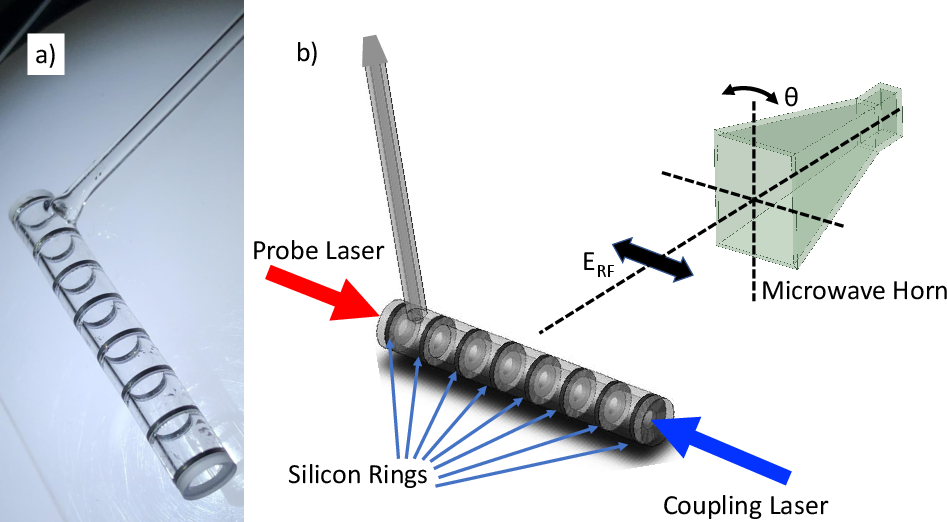
- The team attached multiple silicon ring electrodes between pieces of borosilicate glass using a method called “anodic bonding.” Think of it like carefully welding glass and silicon together using heat and voltage so the seal is tight and clean for vacuum.
- The cell was then filled with rubidium vapor. Eight evenly spaced silicon rings line the cell wall, and each ring can be connected to a voltage or left floating.
The atoms and lasers (the “atomic meter”):
- Rubidium atoms can be excited with two lasers in a setup called “EIT” (Electromagnetically Induced Transparency). With the right laser colors, atoms become partly transparent and produce very narrow signals that are easy to measure precisely.
- The atoms are excited to “Rydberg states,” which means one electron is far from the nucleus—like a loosely held balloon on a string. Because that electron is so far out, Rydberg atoms are extremely sensitive to electric fields.
Two kinds of electric fields:
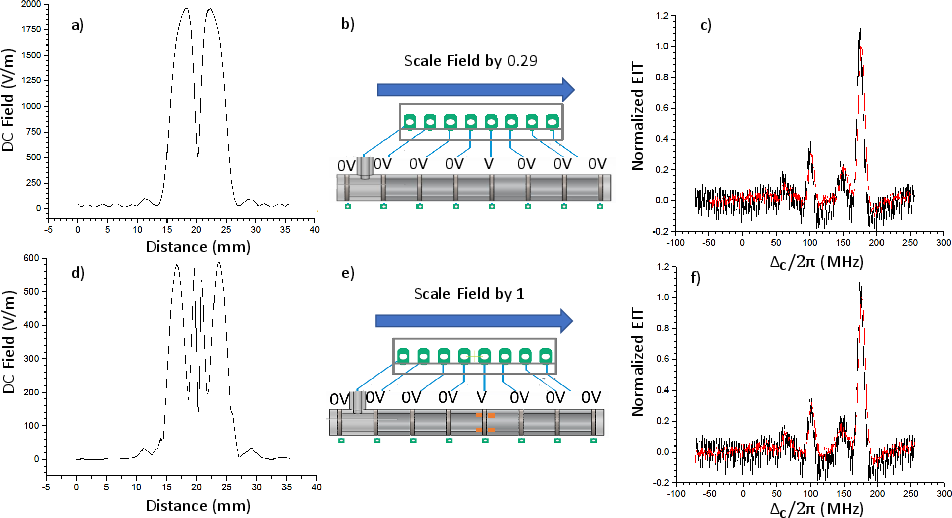
- DC fields (steady fields): The team applied a voltage to one silicon ring to create a DC field. They watched how the Rydberg signal shifted. This shift is called the Stark effect. For DC fields, the shift grows with the square of the field strength (shift ∝ E²).
- AC/microwave fields (vibrating fields): They sent microwaves into the cell using a horn antenna. Microwaves make the Rydberg signal split into two peaks (Autler–Townes splitting). For resonant microwaves, the splitting grows in proportion to the microwave field (splitting ∝ E).
Explaining the technical terms:
- EIT: A laser trick that makes atoms “transparent” at a very specific frequency, giving narrow, easy-to-read signals.
- Rydberg atom: An atom with an electron very far from the nucleus, making it ultra-sensitive to electric fields.
- Stark effect: Electric fields change the energy of atomic levels, shifting the laser signal.
- Autler–Townes splitting: Strong microwaves “pull apart” one atomic signal into two, and the distance between them tells you the field strength.
- Polarization angle (θ): The direction the microwave’s electric field points. Turning the horn changes this direction relative to the silicon rings.
What they found and why it matters
DC fields inside the cell
- By applying a voltage to one ring, they measured a DC electric field of about 5.4 V/cm near that ring (with about 10% uncertainty).
- The measured DC field was significantly smaller (about one-third) than simple calculations predicted. Why? Likely because charges build up on the inner glass surface, partially “shielding” (reducing) the field.
- When they added this effect to their model—like imagining grounded metal sheaths near the voltage ring—the simulated results matched the measurements much better.
Why this is important:
- It shows you can control DC fields inside a glass vapor cell using wall-integrated electrodes, but you must account for surface charge effects to predict the actual field.
Microwaves inside the cell
- They measured how microwaves of different powers and directions (polarizations) transmit into the cell by looking at the Autler–Townes splitting.
- Maximum transmission (best case) happened when the microwave field was aligned to pass between the rings; in that case, the field inside the cell was about 60% of what you’d have with no cell in the way.
- Minimum transmission (worst case) happened when the field was aligned parallel to the rings; the field was still about 25% of the no-cell case.
- The silicon rings act like a “partial polarizer” for microwaves: they favor some directions more than others.
- Computer simulations (HFSS) agreed well with these trends and numbers, confirming the experimental results.
Why this is important:
- It proves microwaves can get into the cell efficiently enough for sensing and control, and the rings can shape the microwave field’s direction. This is useful for devices that need controlled microwave fields (like certain quantum sensors or particle traps).
What this could lead to (implications)
- Better atom-based sensors: Rydberg-atom techniques already measure radio and microwave fields very precisely. Built-in electrodes widen the control options, like tuning signals or adding helper fields for advanced sensing.
- Miniature traps and devices in glass cells: The controlled DC fields and microwaves could help build tiny versions of ion/electron traps (Paul, Penning, and cusp traps) inside sealed glass cells, enabling compact systems for studying charged particles and plasmas.
- Improved quantum technologies: Accurate in-vacuum field control is important for sensitive atomic clocks and other quantum devices, potentially allowing cleaner environments with well-defined electromagnetic conditions.
- Integration with electronics: Because the electrodes are part of the cell wall, these cells can be mounted onto circuit boards, opening paths to portable, robust, and scalable quantum measurement systems.
In short, this work shows how to embed reliable, controllable electrodes inside a glass vapor cell and use atoms themselves as precise meters to measure and shape DC and microwave fields. It’s a step toward compact, high-performance quantum sensors and miniature traps that could one day be part of everyday technology.
Collections
Sign up for free to add this paper to one or more collections.